
July 7, 2026
The Race to the Ocean Floor: Why Autonomous Robotics Are Redefining Critical Mineral Supply
The global scramble for critical minerals demand is reshaping where and how the world looks for resources. Terrestrial deposits of nickel, cobalt, manganese, and copper face mounting pressure from geopolitical concentration, lengthy permitting cycles, and intensifying environmental opposition. Against this backdrop, the deep ocean floor has emerged as a frontier that commands serious institutional attention, not as a distant aspiration, but as an active commercial and technological battleground.
Understanding the Deep Sea Minerals Impossible Metals partnership requires situating it within this broader structural shift. The collaboration is not simply a corporate agreement between two companies. It is a reflection of how the critical minerals industry is reorganising itself around technology-first, environmentally credible approaches to resource development, particularly as downstream manufacturers in defence, energy storage, and advanced manufacturing demand traceable and responsibly sourced inputs.
When big ASX news breaks, our subscribers know first
Understanding the MOU: Framework, Scope, and What It Does Not Guarantee
The agreement formalised between Deep Sea Minerals Corporation, a Canadian seabed exploration company, and Impossible Metals Inc., a US-based marine robotics developer, is structured as a non-binding Memorandum of Understanding. This classification carries specific implications that are important to understand before interpreting the partnership's commercial significance.
A non-binding MOU establishes a shared framework for evaluation and cooperation. It does not create obligations to proceed with test mining, commercial production, or definitive supply arrangements. Any transition toward binding commercial commitments would require separately negotiated definitive agreements. Investors and observers should weight the announcement accordingly.
That said, the scope of cooperation outlined within this framework is substantive:
| Cooperation Pillar | Operational Focus |
|---|---|
| Technology Deployment | Field evaluation of Impossible Metals' robotic systems in Deep Sea Minerals' prospective licence zones |
| Test Mining | Controlled nodule collection trials conducted under applicable regulatory oversight |
| Environmental Monitoring | Seabed baseline surveys and ongoing impact assessments |
| Pilot Production Planning | Pre-commercial logistics and operational design |
| Commercial Harvesting Evaluation | Feasibility analysis for large-scale nodule recovery |
| Downstream Supply Chain | Potential integration into critical minerals processing networks |
One critical dependency underpins all of the above: technology deployment and any subsequent activities are contingent on Deep Sea Minerals being awarded exploration licences by the relevant regulatory authorities. No confirmed deployment timeline exists as of July 2026.
Polymetallic Nodules: The Mineral Chemistry That Makes the Ocean Floor Strategically Significant
Polymetallic nodules are among the least understood and most consequential mineral formations in contemporary resource economics. These roughly potato-shaped concretions form over millions of years on the deep ocean floor, accumulating layer by layer around a nucleating fragment, often a shark tooth or shell fragment, through the slow precipitation of dissolved metals from seawater and sediment pore fluids.
What makes them commercially compelling is their metal content. A typical nodule from a high-grade zone within the Clarion-Clipperton Zone (CCZ) in the Pacific Ocean can contain:
- Manganese: approximately 28 to 34 percent by weight, used in steel production and battery cathode chemistries
- Nickel: approximately 1.2 to 1.4 percent, a critical input for nickel-manganese-cobalt (NMC) battery cells
- Cobalt: approximately 0.1 to 0.2 percent, a high-value mineral facing serious terrestrial supply concentration risks
- Copper: approximately 1.0 to 1.3 percent, foundational across electrification infrastructure
Crucially, nodules in the CCZ also contain trace but commercially interesting concentrations of rare earth elements and tellurium, the latter being a semiconductor material with very limited terrestrial availability. This multi-metal co-occurrence makes nodule deposits uniquely attractive compared to single-commodity terrestrial mines, where separate deposits must be developed and processed independently.
Geological Note: Unlike terrestrial ore deposits, polymetallic nodules are a surface resource. They rest directly on the sediment surface at depths typically ranging from 4,000 to 6,000 metres, meaning extraction does not require underground excavation or open-pit blasting. This fundamentally changes the environmental disturbance calculus compared to land-based mining.
Impossible Metals holds a Bahrain-sponsored exploration contract application within the CCZ under the International Seabed Authority (ISA) framework, placing it in one of the most mineral-rich nodule-bearing regions identified to date.
The Eureka Collection System: How Selective Robotic Harvesting Works
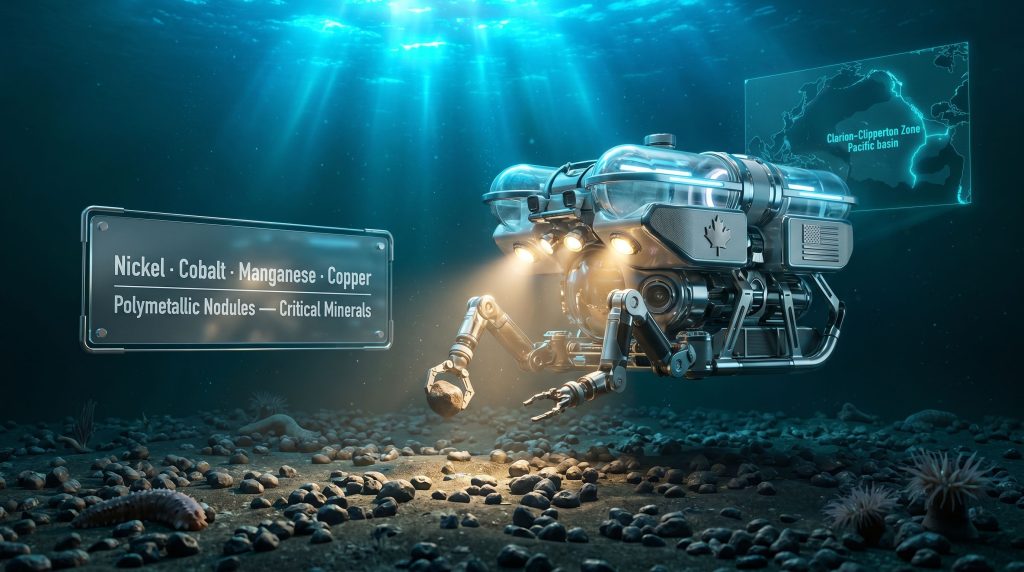
The technological differentiation that defines the Deep Sea Minerals Impossible Metals partnership centres on the Eureka Collection System. This autonomous underwater platform represents a fundamental architectural departure from conventional seabed collection methods, which have historically relied on hydraulic dredging or continuous line bucket systems, both of which generate large sediment plumes and cause widespread benthic habitat disruption.
The Eureka system operates on three integrated technology pillars:
- Buoyancy control systems that enable precise depth management and seabed positioning without requiring anchoring infrastructure or surface-connected risers
- Computer vision and machine intelligence that identifies and targets individual polymetallic nodules while distinguishing and avoiding marine organisms, sessile fauna, and biologically sensitive substrate
- Robotic arm arrays that execute selective nodule retrieval, minimising direct contact with surrounding sediment layers and the benthic community living within them
The riserless operational design is particularly significant from both a regulatory and commercial standpoint. Conventional hydraulic collection systems require continuous pipe infrastructure connecting the seabed to a surface vessel, creating mechanical complexity, weather dependency, and a large physical footprint. The Eureka system's self-contained architecture removes these requirements entirely.
Low-Disturbance vs. Legacy Collection: A Technical Comparison
| Method | Sediment Disturbance | Biological Impact | Selectivity | Infrastructure |
|---|---|---|---|---|
| Hydraulic Dredging | Very High | High | Negligible | Extensive riser arrays |
| Continuous Line Bucket | Moderate to High | Moderate to High | Very Low | Long cable systems |
| Eureka Autonomous Platform | Low (targeted) | Low (selective) | High | Riserless, self-contained |
This comparison matters beyond environmental optics. Several national governments and conservation bodies have called for moratoriums on deep-sea mining pending further environmental study. Low-disturbance technologies with verifiable impact data are increasingly a prerequisite for regulatory advancement, not merely a preference. Furthermore, the deep-sea mining controversy surrounding legacy collection methods has made selective robotic approaches all the more commercially compelling.
Building a Supply Chain From the Seabed Up: The Impossible Metals Ecosystem
The Deep Sea Minerals Impossible Metals partnership sits within a broader multi-partner architecture that Impossible Metals is assembling to build an integrated domestic US critical minerals supply chain. Understanding the full picture reveals a more ambitious strategic thesis than any single MOU would suggest.
Impossible Metals has established MOU-level relationships across several complementary sectors:
- Aqua Metals: An MOU designed to integrate nodule harvesting output with Aqua Metals' proprietary AquaRefining electrochemical platform, targeting a low-carbon, US-based pathway for battery metals refining
- ReElement Technologies: An MOU establishing a rare earth and critical mineral refining corridor that would process deep-sea nodule feedstock at processing infrastructure anchored in Indiana
- Deep Sea Minerals Corporation: The licence-area partnership that provides the prospective geographic foundation for field evaluation and test mining activities
Taken together, this architecture spans harvesting, processing, and refining across multiple technology platforms, all oriented toward reducing US dependence on Chinese-dominated terrestrial mining and processing infrastructure. The Canadian base of Deep Sea Minerals adds a Five Eyes-aligned international partner to what is otherwise a US-centric supply chain strategy.
Strategic Framing: The convergence of allied-nation exploration rights, autonomous collection technology, and domestic refining capacity is the structural combination that governments and downstream manufacturers in the defence and clean energy sectors have consistently identified as a priority. The Impossible Metals ecosystem is being designed to address all three simultaneously, though each MOU remains non-binding and no commercial production timelines have been confirmed.
Regulatory Terrain: The ISA Framework and the Licensing Dependency
Every operational activity contemplated under the Deep Sea Minerals Impossible Metals partnership is contingent on regulatory authorisation. This is not a minor caveat. The international regulatory environment for deep-sea mineral extraction remains genuinely unsettled, and understanding its structure is essential for evaluating the realistic timeline of any commercial activity.
The International Seabed Authority governs mineral exploitation in international waters under the UN Convention on the Law of the Sea (UNCLOS). The ISA has issued exploration contracts to multiple operators but continues to negotiate the Mining Code that would govern commercial extraction. Consequently, until the Mining Code is finalised and adopted, commercial-scale extraction in international waters lacks a definitive legal framework. For a deeper understanding of where the sector stands, the deep-sea mining regulations landscape in 2025 provides essential context.
For activities within national Exclusive Economic Zones (EEZs), separate national permitting regimes apply. These typically involve:
- Environmental impact assessments conducted over extended baseline periods
- Stakeholder consultation processes that may include fishing industries, indigenous groups, and conservation bodies
- Government-to-government agreements where foreign technology deployment is involved
- Ongoing environmental monitoring requirements as a condition of licence maintenance
Environmental monitoring is explicitly embedded within the MOU's scope of cooperation, which signals that both parties recognise environmental data collection as a commercial and regulatory necessity rather than a secondary concern.
The selective collection approach underpinning the Eureka system is directly responsive to the environmental critiques that have stalled or blocked competing deep-sea mining proposals. Verifiable, low-disturbance extraction data is increasingly what separates projects that advance through regulatory processes from those that do not.
The next major ASX story will hit our subscribers first
Industry Dynamics: Where Deep-Sea Mining Stands in 2026
The sector is undergoing a meaningful transition in 2026. The purely exploratory phase, characterised by mapping surveys and resource estimation, is giving way to technology validation. Multiple operators are now pursuing test mining programmes specifically designed to generate the environmental and operational data that regulators require before considering commercial licences.
Several dynamics are converging to shape the investment and development landscape:
- Geopolitical pressure on terrestrial supply: China controls a dominant share of cobalt and rare earth processing capacity. Western-aligned operators face structural incentives to develop alternative supply chains regardless of commodity price cycles.
- Technology maturation: Advances in underwater autonomous systems, machine vision, and deep-sea communication are making selective robotic collection feasible at pre-commercial scale for the first time in the sector's history.
- Environmental scrutiny as a commercial variable: Moratorium campaigns by conservation groups and precautionary policy positions from some governments have raised the bar for environmental performance. Operators with demonstrably low-disturbance technologies hold a meaningful regulatory advantage.
- Downstream demand signalling: Battery manufacturers, critical minerals for defence, and clean energy infrastructure developers are beginning to specify sourcing requirements that favour traceable, responsibly extracted critical minerals, creating potential premium pricing dynamics for verified low-impact supply.
Frequently Asked Questions
Is the Deep Sea Minerals and Impossible Metals agreement a binding contract?
No. The agreement is a non-binding MOU. Neither party is legally obligated to proceed with test mining, commercial production, or any definitive supply arrangement. Binding commitments would require separate formally negotiated agreements.
What minerals are found in polymetallic nodules?
Polymetallic nodules from high-grade zones typically contain commercially significant concentrations of manganese, nickel, cobalt, and copper, alongside trace amounts of rare earth elements and tellurium. All four primary metals are classified as critical minerals for battery, defence, and clean energy applications.
What makes the Eureka system different from conventional collection methods?
The Eureka Collection System uses buoyancy control, computer vision, and robotic arm arrays to selectively retrieve individual nodules from the seabed without disturbing surrounding sediment or marine organisms. It operates without the riser infrastructure required by conventional hydraulic dredging systems, significantly reducing its physical footprint and potential environmental impact.
When will technology deployment begin under this agreement?
All operational activities are contingent on Deep Sea Minerals securing exploration licences from applicable regulatory authorities. No confirmed deployment timeline has been announced as of July 2026.
What other partnerships has Impossible Metals established?
Impossible Metals holds MOU-level partnerships with Aqua Metals for electrochemical battery metals refining and ReElement Technologies for rare earth and critical mineral processing, in addition to the Deep Sea Minerals collaboration. Bahrain sponsors Impossible Metals' exploration contract application within the Clarion-Clipperton Zone under the ISA framework.
This article contains forward-looking statements and analysis based on publicly available information as of July 2026. The partnerships described are non-binding MOUs and do not represent confirmed commercial arrangements, production timelines, or financial commitments. Readers should conduct independent due diligence before making any investment decisions related to companies or sectors discussed herein.
Want to Stay Ahead of the Next Major Mineral Discovery?
Discovery Alert's proprietary Discovery IQ model scans ASX announcements in real time, transforming complex mineral data across more than 30 commodities into clear, actionable insights — so investors can act on significant discoveries before the broader market catches on. Explore historic examples of major mineral discoveries and their returns, then start your 14-day free trial at Discovery Alert to secure your market-leading edge.