August 2, 2026
The Indirect Exposure Problem: How EU Steel Quotas Are Reshaping China's Global Export Architecture
When trade barriers tighten around the world's largest commodity market, the immediate headlines focus on direct bilateral flows. Yet the more consequential story almost always lies beneath the surface, embedded in the web of intermediate processors, third-country re-rollers, and supply chain intermediaries that quietly translate upstream surpluses into downstream market access. The EU's revised steel safeguard framework, which took effect on July 1, 2026, is a textbook example of this dynamic. Understanding the true impact of EU steel quotas and China exports requires moving past the bilateral optics and interrogating the structural architecture that connects them.
When big ASX news breaks, our subscribers know first
The Architecture of the EU's Revised Safeguard Regime
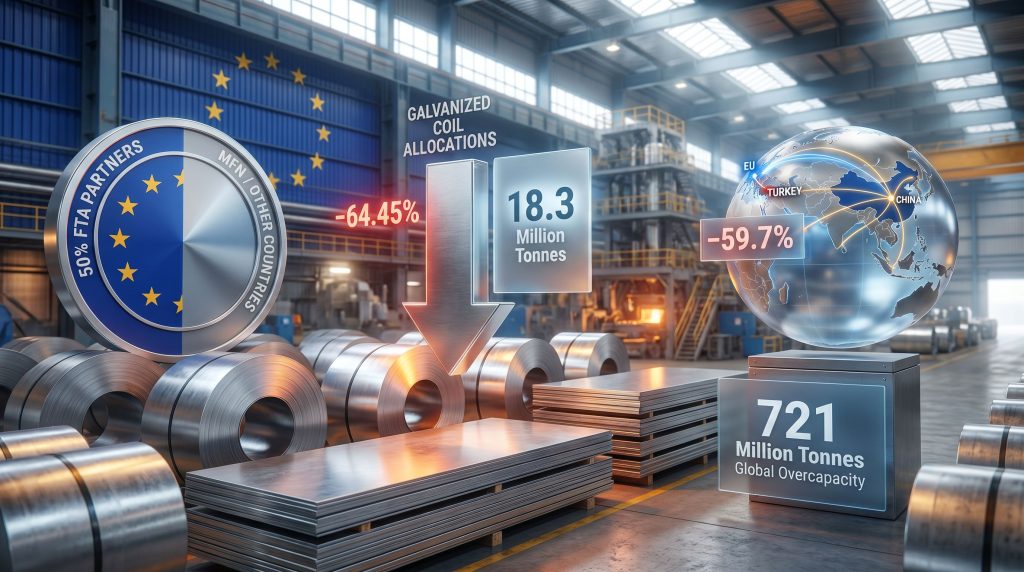
The EU's restructured import framework represents one of the most significant contractions in European steel market access in the safeguard regime's history. At its core, the new rules compress the total tariff-free import quota to 18.3 million tonnes annually across 26 covered product categories, a reduction of approximately 47% from prior levels.
The penalty for exceeding that threshold has also been sharpened considerably. Out-of-quota tariffs have been doubled from 25% to 50%, fundamentally altering the economics of borderline import decisions. A shipment that previously faced a manageable cost overage now confronts a prohibitive tariff cliff.
The structural redesign goes further than volume management. The quota architecture has been split into two distinct access pools:
- A Most Favored Nation (MFN) pool open to all trading partners on a non-discriminatory basis
- A preferential lane reserved exclusively for Free Trade Agreement (FTA) partner nations, including Turkey, South Korea, India, the United Kingdom, and Brazil
Critically, 50% of the total quota has been ring-fenced for FTA partners. This is not a minor procedural adjustment. It is a structural reorientation of EU import policy that permanently disadvantages any steel-exporting nation without a formal trade agreement with Brussels. Furthermore, the global crude steel outlook suggests these structural shifts will have lasting consequences well beyond 2026.
The EU's stated industrial policy goal underpinning this overhaul is to lift domestic steel capacity utilisation from 67% to 80%. With global steel overcapacity estimated at 721 million tonnes, the EU's role as an absorption mechanism for surplus global production has historically been substantial. Reducing that absorption capacity does not simply redirect trade flows; it compresses the entire pressure-release architecture that excess producers have relied upon.
China's Direct Exposure: Narrower Than the Headlines Suggest
For all the attention paid to EU steel quotas and China exports, the direct bilateral trade channel is considerably thinner than most market commentary implies. China accounted for roughly 9.9% of EU steel imports in 2025, and its direct flat steel exports to the EU represent only 3% to 5% of China's total flat steel export volume, translating to approximately 2 million tonnes per year.
According to analysis published by Fastmarkets, this narrow direct footprint is the product of years of accumulated anti-dumping and countervailing duties that have already compressed Chinese access to European markets long before the current safeguard revision. The new quota framework therefore has limited additional direct damage to inflict on a channel that was already structurally constrained.
The product-level picture, however, is more nuanced:
| Product Category | Prior Allocation | New Allocation | Change |
|---|---|---|---|
| Hot-Rolled Coil (Cat. 1A) | Country-specific | Residual "other countries" pool only | Effectively eliminated |
| Hot-Dipped Galvanized Coil (Cat. 4B) | ~514,804 tonnes | ~182,997 tonnes | -64.45% |
| Rebar (Cat. 13) | Country-specific | ~20,200 tonnes | Marginal retention |
| Tin Mill Products | Country-specific | Retained | Minor strategic relevance |
The galvanized coil reduction is particularly sharp. A 64.45% year-on-year cut in China's hot-dipped galvanized coil allocation signals a deliberate product-level escalation in trade defence, targeting a category where Chinese production capacity and pricing competitiveness have historically been most disruptive to European mills.
For hot-rolled coil, the structural demotion is even more revealing. China has been confined to the residual MFN bucket alongside all unlisted suppliers, which carries a combined ceiling of just 22,256 tonnes per year. For a nation exporting more than 130 million tonnes of steel annually, this is not a quota reduction; it is effectively a closure.
EU-based market participants have noted that the residual "other countries" structure is widely interpreted as a de facto targeting mechanism, constructed to achieve country-specific outcomes without explicitly naming any single supplier. The China steel market faces mounting structural pressures on multiple fronts as a consequence.
The Indirect Channel: Where the Real Disruption Lives
Fastmarkets senior steel analyst Paolo Frediani has observed that while the direct volume impact on China is modest in context, the indirect consequences of the new safeguard regime carry far greater systemic weight. The EU imported more than 36 million tonnes of finished steel in the year prior to the new rules taking effect, of which 24 million tonnes were flat products. A significant proportion of that volume originated in countries that are themselves substantial importers of Chinese steel and semi-finished material.
China's export strategy has increasingly operated through a network of third-country processing hubs. The model works as follows:
- Chinese mills export semi-finished steel, primarily slabs and billets, to intermediate processors in Turkey, Southeast Asia, and the Middle East.
- Those processors re-roll or further manufacture the material into finished products.
- The finished goods are then exported onward into the EU and other high-value markets.
This architecture has allowed Chinese-origin steel to access markets that carry China-specific duties, by travelling through intermediate jurisdictions that carry no such restrictions. The EU's new safeguard framework directly undermines this model by cutting the quota access of the very countries serving as China's processing intermediaries. Indeed, these tariff-driven supply chain shifts are fundamentally altering the commercial logic that underpinned years of indirect trade routing.
Turkey as the Bellwether: Quantifying Third-Country Spillover
No single data point better illustrates the indirect exposure problem than Turkey's hot-rolled coil allocation. Turkey's HRC quota was reduced by 59.7% year-on-year, falling from approximately 1.6 million tonnes to 642,295 tonnes. Turkey is simultaneously one of the world's largest importers of Chinese semi-finished steel for re-rolling operations and one of the EU's most significant finished steel suppliers.
The causal chain this creates is straightforward but consequential. If Turkish mills can no longer place finished HRC into the EU at previous volumes, their appetite for Chinese slabs and billets contracts in direct proportion. The demand vacuum created upstream in China's export supply chain is not captured in any bilateral EU-China trade statistic, yet its commercial impact on Chinese exporters may ultimately prove more significant than the direct quota cuts.
Frediani's analysis frames this dynamic clearly: the new quotas will make it more difficult for China to export elsewhere, not just to Europe directly. The EU's reduced capacity to absorb global overcapacity, much of which originates in China, tightens the pressure across the entire downstream network simultaneously.
The cascading displacement effects extend across multiple dimensions:
- Greater competitive pressure among Chinese exporters in Southeast Asian and Middle Eastern markets as displaced EU-bound volumes seek alternative destinations
- Downward price pressure on Chinese steel across non-EU export destinations, compressing mill margins
- Accelerating domestic debates within China around capacity rationalisation and structural reform of its steel sector
- Increased friction in bilateral trade relationships between China and its processing intermediaries, as those partners face tighter EU market access
The Melt-and-Pour Rule: Traceability Infrastructure With Long-Term Teeth
Alongside the quota restructuring, a separate provision has attracted significant attention from traders and market analysts: the melt-and-pour declaration requirement. Effective from October 2026, importers into the EU must declare the country in which their steel was originally melted and poured, regardless of where subsequent processing occurred.
It is important to be precise about what this rule currently does and does not do:
| Mechanism | Current Status | Enforcement Power | Future Potential |
|---|---|---|---|
| Melt-and-Pour Declaration | Active from Oct 2026 | Declaration only | High — data collection phase |
| Anti-Dumping Duties (China-specific) | Long-established | Full tariff enforcement | Ongoing |
| Country-Specific Quota Allocations | Active from July 1, 2026 | Volume caps with tariff penalties | Expandable |
| FTA Preferential Quota | Active from July 1, 2026 | Access restriction for non-FTA nations | Structurally permanent |
The European Commission has not yet attached any volume restrictions or tariff penalties to melt-origin data. For the immediate term, the requirement functions as a transparency and traceability obligation only.
However, market participants operating in China-linked transshipment trade are treating the rule with considerable caution. The consensus view among traders is that even without formal enforcement, the traceability infrastructure now being constructed gives the EU the technical capability to activate country-of-melt restrictions at a future date with minimal additional regulatory groundwork.
Buyers in Turkey and Southeast Asian markets may begin pre-emptively reducing their exposure to Chinese-origin material to avoid future compliance complications, creating a behavioural chilling effect that precedes any formal restriction. New EU tariffs on steel and rare earths signal that Brussels is willing to escalate its trade defence posture across multiple commodity categories simultaneously.
The melt-and-pour rule is less a barrier today and more a foundation for one tomorrow. Its value to European policymakers lies not in what it restricts now, but in what it enables later.
The next major ASX story will hit our subscribers first
EU vs. US Steel Trade Defence: Two Models, One Target
The EU's approach to steel trade protection sits within a broader global architecture of steel trade defence mechanisms. A structural comparison with the US Section 232 framework illuminates the distinctive features of the EU's tariff-rate quota model:
| Dimension | EU Safeguard Regime (2026) | US Section 232 Tariffs |
|---|---|---|
| Mechanism | Tariff-Rate Quota (TRQ) system | Flat tariff on all imports |
| China-specific targeting | Indirect (via quota structure) | Direct (country-specific rates) |
| Market access preserved | Yes, within quota thresholds | Limited, tariff applies to all volumes |
| FTA partner treatment | Preferential quota access | Negotiated exemptions case-by-case |
| Out-of-quota penalty | 50% tariff | N/A (blanket tariff model) |
| Policy framing | Open market with volume limits | National security protection |
The EU model preserves a notional openness while structurally constraining access through volume architecture. The US model applies blunt tariff instruments with fewer distinctions between partner categories. Both frameworks converge on the same outcome: systematically reducing the market share available to Chinese-origin steel, whether directly or through processing intermediaries. The broader impact of tariffs on iron ore and steel trade flows further illustrates how intertwined these policy mechanisms have become across commodity markets.
Three Forces That Will Define EU-China Steel Trade Through 2028
Regulatory Escalation Risk
The melt-and-pour declaration framework creates a ready-built enforcement infrastructure that the European Commission can activate without introducing new primary legislation. Industry analysts broadly anticipate that enforcement decisions, potentially attaching volume restrictions or tariff consequences to melt-origin declarations, are likely within 12 to 24 months of the data collection phase commencing.
If activated, this mechanism would materially close the third-country re-rolling route that has sustained a significant portion of indirect Chinese steel flows into Europe. Reuters reporting on the EU's new steel import quotas confirms that protecting domestic industry from overcapacity is a central and durable motivation behind the structural overhaul.
Geopolitical Realignment of Supply Chains
The FTA preferential quota pool introduces a structural long-term incentive for steel-exporting nations to deepen trade relationships with Brussels. Nations holding existing FTA agreements, including India, South Korea, Brazil, and Turkey, hold competitive advantages that non-FTA suppliers cannot replicate through pricing alone.
China, which currently holds no FTA with the European Union, faces permanent exclusion from the preferential pool absent a fundamental shift in its trade relationship with the bloc. The China steel outlook points to a structural disadvantage that pricing adjustments alone cannot overcome. EU industrial policy goals targeting a lift in domestic capacity utilisation from 67% to 80% represent a durable political commitment that is unlikely to be unwound regardless of cyclical market conditions.
Global Overcapacity as the Underlying Accelerant
No bilateral trade measure can resolve a 721 million tonne global overcapacity problem. As more markets construct barriers, including ASEAN economies responding to displaced Chinese volumes, India tightening its own safeguard frameworks, and the US maintaining Section 232 protections, the cumulative pressure on Chinese export channels intensifies.
The EU's safeguard tightening is one node in a global trade defence architecture that is tightening simultaneously across multiple vectors. Three displacement scenarios are plausible over the near to medium term:
- Scenario A: Chinese exporters redirect EU-blocked volumes into Vietnam, Indonesia, Thailand, and other regional markets, depressing regional prices and potentially triggering secondary safeguard responses from ASEAN economies.
- Scenario B: Reduced external demand channels force inventory accumulation at Chinese mills, accelerating margin compression and creating pressure for capacity consolidation among smaller, less-efficient producers.
- Scenario C: Chinese exporters develop new third-country processing relationships in North Africa or Central Asia, exploiting the window before EU melt-and-pour enforcement infrastructure matures.
Frequently Asked Questions: EU Steel Quotas and China Exports
What is the total EU steel import quota under the 2026 safeguard regime?
The revised framework sets a total tariff-free import threshold of 18.3 million tonnes across 26 covered product categories. Volumes above this threshold face a 50% out-of-quota tariff, doubled from the previous 25% rate.
Why is China's direct exposure to the EU quota cuts considered limited?
China's direct flat steel exports to the EU represent only 3% to 5% of its total flat steel export volume, approximately 2 million tonnes per year, due to years of pre-existing anti-dumping and countervailing duties. The new safeguard regime therefore has limited additional direct damage to inflict on an already constrained channel.
Does China qualify for the EU's preferential FTA quota pool?
No. China does not hold a Free Trade Agreement with the European Union, excluding it entirely from the 50% of total quota reserved for FTA partner nations.
What does the melt-and-pour rule require?
From October 2026, importers into the EU must declare the country where their steel was originally melted and poured. It currently functions as a transparency measure only, with no volume restrictions attached at this stage.
Why does Turkey's quota cut matter for Chinese steel exporters?
Turkey is a major importer of Chinese semi-finished steel for re-rolling. A 59.7% reduction in Turkey's EU hot-rolled coil quota directly reduces Turkish demand for Chinese upstream material, creating a significant indirect impact on China's total export volumes that does not appear in bilateral EU-China trade statistics.
This article is intended for informational purposes only and does not constitute financial or investment advice. Commodity markets involve significant risks, and all forecasts, scenarios, and projections referenced herein are subject to material uncertainty. Readers should conduct independent analysis before making any commercial or investment decisions. For live steel price data and ongoing market intelligence, Fastmarkets provides dedicated steel price coverage relevant to EU-China trade dynamics.
Want to Track the ASX Miners Best Positioned as Global Steel Trade Shifts Reshape Commodity Markets?
As EU safeguard quotas compress Chinese steel export channels and redirect commodity flows across global supply chains, the upstream pressure on iron ore, metallurgical coal, and mineral exploration creates both volatility and opportunity for ASX-listed resource companies. Discovery Alert's proprietary Discovery IQ model delivers real-time alerts on significant ASX mineral discoveries the moment they hit the market — explore historic discoveries and their returns to understand the scale of opportunity, then begin your 14-day free trial to stay ahead of the next major find.