
August 2, 2026
The Pricing Architecture Behind Global Secondary Aluminium Markets
Few industrial commodities reveal as much about structural economic forces as the price of recycled aluminium feedstock. Unlike finished metal products, scrap pricing sits at the intersection of energy economics, trade policy, environmental regulation, and financial market mechanics. For used beverage can (UBC) scrap specifically, these forces have converged over the past several years to create a pricing environment of unusual complexity and intensity. Understanding why aluminium UBC scrap price volatility has become a defining feature of the global secondary metals market requires unpacking several interlocking systems that most industry participants only partially understand.
When big ASX news breaks, our subscribers know first
What Is Aluminium UBC Scrap and Why Does Its Pricing Matter?
Used beverage can scrap represents one of the most chemically consistent and logistically accessible forms of post-consumer aluminium available to secondary smelters. Because beverage cans are manufactured from tightly specified alloy grades, primarily the 3000 and 5000 series alloys, UBC material offers a predictability of composition that many other scrap categories cannot match. This consistency is part of what makes it so strategically valuable.
The broader significance of UBC pricing extends well beyond can-makers and recyclers. As the global aluminium industry accelerates its transition away from energy-intensive primary smelting toward circular feedstock models, UBC scrap has become a bellwether for the health of the entire secondary aluminium supply chain. When UBC prices move sharply, they signal shifts in feedstock availability, energy cost arbitrage, downstream demand, and increasingly, carbon-linked procurement strategies.
Recycling aluminium from UBC scrap requires roughly 5% of the energy consumed in producing primary aluminium from bauxite, a differential that has made secondary production economically compelling during periods of elevated energy costs. This energy asymmetry is not a marginal advantage; it is a structural one that reshapes competitive dynamics between primary smelters and secondary mills whenever power prices spike.
How LME Benchmarks Shape the Aluminium UBC Scrap Price
The pricing infrastructure governing UBC scrap markets has grown considerably more sophisticated over the past decade. Two LME instruments now anchor the global price discovery process for aluminium, and understanding their differences is essential to interpreting aluminium UBC scrap price volatility accurately.
| Feature | LME P1020 Primary Aluminium | LME Aluminium UBC Scrap (Argus) |
|---|---|---|
| Settlement Type | Physical | Cash |
| Reference Index | LME Warehouse Warrant | Argus Mill-Grade Delivered Index |
| Primary Use | Hedge smelter output / ingot supply | Hedge secondary feedstock flows |
| Pricing Currency | USD per tonne | USD per tonne |
| Key User | Primary producers, traders | Recyclers, secondary mills |
The LME Aluminium UBC Scrap contract and the LME Primary Aluminium (P1020) contract together form the two instruments at the heart of global price discovery. The P1020 contract, physically settled and linked to warehouse warranting, functions as the global baseline for intrinsic metal value. The LME Aluminium UBC Scrap US contract, cash-settled against Argus Media's mill-grade delivered index, serves as the operational benchmark for secondary feedstock participants.
Price discovery unfolds in layers. The Official Price set during the second Ring session anchors physical contract settlement, while the Closing Price generated through LMEselect electronic trading reflects broader sentiment across time zones. For secondary market participants, neither figure alone is sufficient. What matters most is the basis between these instruments: the spread between primary aluminium and scrap prices after accounting for collection costs, logistics, and processing overhead.
The introduction of a cash-settled, Argus-referenced scrap contract onto the LME platform fundamentally changed how buyers and sellers manage feedstock price risk. For the first time, recyclers could access a standardised hedging instrument calibrated directly to their input costs rather than relying on imperfect proxies linked to primary metal.
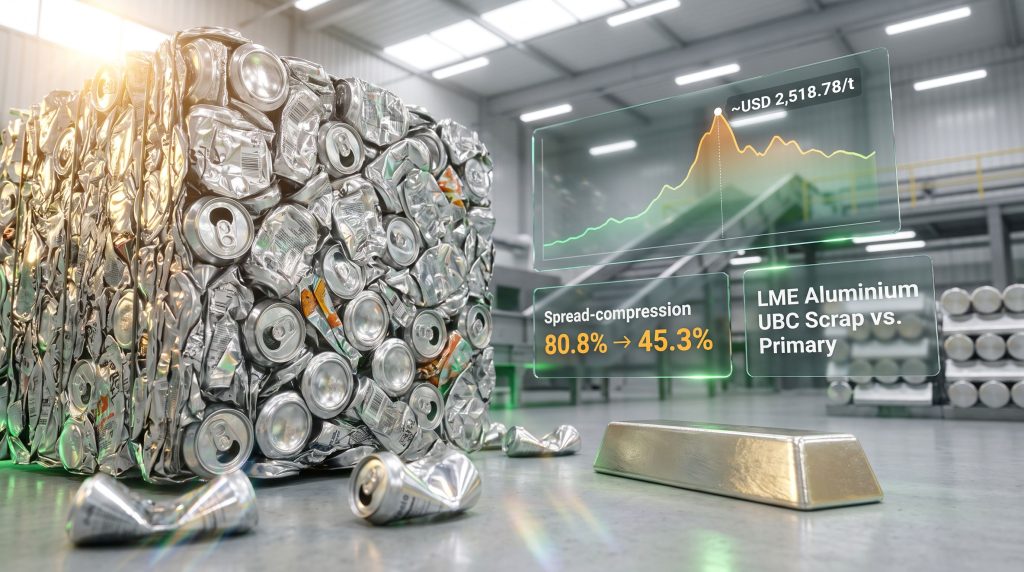
As of April 2026, UBC scrap was benchmarked at approximately USD 2,518.78 per tonne on a second-month settlement basis, while LME primary aluminium was trading materially higher, frequently exceeding USD 3,500 per tonne during supply disruption periods. The spread between these two price points has emerged as one of the most closely watched indicators of secondary market stress.
Basis Risk: The Hidden Variable in UBC Scrap Pricing
Basis risk in scrap markets is not a theoretical concept. It is the lived reality of every secondary mill procurement team trying to lock in feedstock margins while primary aluminium prices gyrate. When the basis between UBC and primary aluminium narrows, it can indicate either genuine feedstock scarcity or the emergence of a green premium being priced into low-carbon recycled content.
When the basis widens, it typically reflects either easing scrap supply or weakening downstream demand for finished aluminium products. This spread has demonstrated extreme intra-year movement in recent cycles. Buying spreads as a percentage of the Midwest transaction price shifted from approximately 80.8% in January to as low as 45.3% in November during recent market cycles, a compression of more than 35 percentage points within a single year.
That magnitude of movement within a twelve-month window illustrates why aluminium UBC scrap price volatility has become a primary risk management concern for secondary producers. Furthermore, the aluminum and alumina markets have added complexity to how participants interpret these spread dynamics on a global scale.
The Five Core Drivers of Aluminium UBC Scrap Price Volatility
Driver 1: Energy Arbitrage Between Primary and Secondary Production
Primary aluminium smelting ranks among the most electricity-intensive industrial processes on the planet, consuming approximately 13 to 15 megawatt-hours per tonne of metal produced. Secondary recycling operates at a fraction of that energy load. When power prices spike, the economic gap between smelting and recycling widens, intensifying competition among secondary mills to secure UBC feedstock. That intensified competition pushes scrap prices higher relative to primary metal, narrowing the spread.
Energy cost divergence has been identified as the single most dominant force behind UBC price swings over the 2021 through 2026 period. The European energy crisis amplified this dynamic dramatically, with regional power price differentials creating localised scrap demand surges that temporarily decoupled regional UBC markets from global benchmarks.
Driver 2: LME and Midwest Benchmark Movements
UBC buying values consistently track primary aluminium price benchmarks, but not in a perfectly linear fashion. U.S. market data has shown instances where UBC prices declined even as the Midwest premium rose, with buying spreads holding in the range of 68 to 69% of the Midwest transaction price. This partial decoupling reflects the fact that secondary markets respond not just to metal value but also to their own supply-demand dynamics.
These dynamics can diverge from primary market trends during periods of seasonal tightness or logistical disruption. In addition, the broader aluminium tariffs impact on benchmark pricing has introduced further complexity into how regional Midwest premiums interact with scrap buying spreads.
Driver 3: Supply Cycles and Seasonal Scrap Generation
UBC scrap availability follows predictable seasonal rhythms tied to beverage consumption patterns. Peak consumption periods in warmer months temporarily increase scrap generation but with a lag, as collection, sorting, and transport infrastructure must absorb the volume before it reaches mills. During Q1, when post-holiday consumption declines, scrap tightness typically intensifies, compressing buying spreads and lifting outright prices.
By contrast, periods of improved scrap generation soften prices as mills gain negotiating leverage over collectors and aggregators.
Driver 4: Trade Policy, Tariffs, and Cross-Border Material Flows
Export controls, import tariffs, and bilateral trade restrictions redirect scrap aluminium flows between regions, creating localised price dislocations that can persist for months. The aluminum and steel tariffs introduced in recent years have, for instance, reshaped cross-border material flows in ways that created persistent regional price divergences. Tariff asymmetries between major producing and consuming nations have introduced a new layer of complexity to what was once a relatively transparent spot market.
The financialisation of scrap through LME-linked contracts has improved price transparency but simultaneously introduced arbitrage-driven volatility as traders exploit regional price differences.
Driver 5: Downstream Demand Weakness or Strength
Mill buying appetite for UBC scrap is ultimately a function of finished product demand. When automotive, packaging, or construction demand weakens, mills reduce their scrap intake, widening buying spreads and softening prices. Conversely, periods of strong downstream demand pull scrap prices upward as mills compete aggressively for available feedstock.
| Volatility Driver | Market Effect | Spread Direction |
|---|---|---|
| Energy price spikes | Increases recycling cost advantage | Narrows |
| Primary aluminium price surge | Lifts UBC outright values | Narrows |
| Seasonal scrap tightness | Reduces feedstock availability | Narrows |
| Improved scrap generation | Increases supply, softens prices | Widens |
| Tariff or trade policy shifts | Redirects material flows regionally | Variable |
| Weak downstream demand | Reduces mill buying appetite | Widens |
The Green Premium: A New Structural Floor for UBC Scrap Prices
Perhaps the most consequential structural development in UBC scrap pricing over recent years has been the emergence of what market participants increasingly describe as the green premium. This represents the additional value attributed to low-carbon recycled aluminium content relative to conventionally produced primary metal.
As corporate sustainability commitments have hardened from voluntary pledges into binding procurement requirements, multinational manufacturers in the automotive, packaging, and consumer goods sectors have begun competing directly for guaranteed access to certified recycled aluminium. This competition for low-carbon feedstock is introducing a structural price floor beneath UBC values that did not exist in previous market cycles.
The mechanism is self-reinforcing. Carbon border adjustment mechanisms in Europe and emerging equivalent policies in other jurisdictions impose cost penalties on carbon-intensive aluminium imports, making domestically recycled UBC content comparatively more valuable. Long-term offtake agreements for recycled feedstock, once rare outside the can-to-can supply chain, are now proliferating across industrial sectors, gradually shifting UBC pricing toward a hybrid of contractual commitments and benchmark-referenced pricing.
This structural shift matters enormously for market participants who continue to price UBC scrap purely as a discount to primary metal. The green premium is beginning to redefine the relationship between these two price points, and those who fail to account for it risk systematic undervaluation of recycled feedstock positions.
Regional Market Dynamics and Geographic Price Divergence
UBC scrap pricing is not uniform globally. Regional energy costs, regulatory environments, infrastructure capacity, and trade flows create meaningful geographic variation in how the global benchmark translates to local transaction prices.
| Region | Key Pricing Influence | Primary Volatility Risk |
|---|---|---|
| North America | Midwest premium, domestic mill demand | Trade tariff shifts, energy costs |
| Europe | Energy prices, CBAM policy | Carbon pricing, import competition |
| Asia-Pacific | Export flow controls, domestic demand | Policy changes, currency exposure |
In North America, the relationship between the Midwest premium and UBC buying spreads is particularly close, as domestic mills reference transaction price rather than LME settlement when negotiating scrap purchases. In Europe, the energy shock that began in 2021 disproportionately elevated the value of secondary production, though exposure to the Carbon Border Adjustment Mechanism has added a new regulatory dimension. Across Asia-Pacific, export control policies from major scrap-generating nations and domestic demand levels from Chinese and Southeast Asian mills introduce currency and policy risk layers not present in Western markets.
However, understanding these regional dynamics also requires awareness of how the Alcoa market downgrade and similar corporate-level developments can signal broader shifts in regional aluminium supply conditions that ultimately feed through to scrap pricing.
The next major ASX story will hit our subscribers first
Managing UBC Scrap Price Risk: A Practical Framework
For procurement teams, recyclers, and secondary mills navigating aluminium UBC scrap price volatility, a structured risk management approach is essential. The following six-step framework provides a foundation for assessing and responding to price exposure.
-
Establish your benchmark reference by identifying whether your pricing is linked to the LME P1020 contract, the Midwest transaction price, or the Argus mill-grade delivered index, as each carries different basis dynamics.
-
Calculate your basis risk by measuring the current spread between your contracted purchase price and the relevant benchmark to understand how much of your margin is subject to benchmark-driven erosion.
-
Monitor spread direction as a leading indicator of market tightness, recognising that a narrowing UBC-to-primary spread typically precedes outright price increases for secondary feedstock.
-
Assess your seasonal positioning within the can-consumption and scrap-generation cycle, as Q1 tightness and mid-year loosening follow reasonably predictable patterns that allow for forward procurement planning.
-
Evaluate LME hedging instruments to determine whether cash-settled UBC scrap contracts can provide effective offset against physical price exposure in your specific geographic and contractual context.
-
Review your trade policy exposure continuously, as tariff changes and export control announcements can redirect material flows within weeks, creating regional price dislocations that require rapid procurement response.
Frequently Asked Questions on UBC Scrap Price Volatility
What causes aluminium UBC scrap prices to rise suddenly?
Sudden price increases typically result from a combination of tight scrap availability, rising primary aluminium benchmarks, energy price spikes that intensify competition for secondary feedstock, or policy changes that restrict cross-border scrap flows. Seasonal tightness in Q1 is a recurring trigger. The aluminium industry leaders most exposed to these dynamics are typically those with significant secondary processing capacity reliant on spot market procurement.
How is UBC scrap price different from primary aluminium price?
Primary aluminium reflects the cost of producing new metal from bauxite through energy-intensive electrolysis. UBC scrap is priced as a discount to primary, reflecting the cost savings of recycling minus collection, logistics, and processing expenses. The size of this discount is the spread, and it fluctuates based on supply-demand dynamics specific to the secondary market. For a detailed breakdown of how traders calculate these values, aluminium scrap pricing methodologies published by specialist pricing agencies provide a useful reference.
Why do buying spreads fluctuate so dramatically within a single year?
Seasonal consumption patterns, shifts in energy economics, changes in downstream mill demand, and trade policy developments all interact to compress or widen spreads at different points in the calendar. The 35-percentage-point swing documented in recent market data illustrates how multiple forces can align or diverge within a single year to produce outsized spread movement.
Is UBC scrap pricing becoming more or less volatile over time?
The evidence points toward structurally higher volatility as a baseline condition. The financialisation of scrap through LME-linked instruments has improved transparency but introduced arbitrage-driven price movements. Simultaneously, the emergence of green premium dynamics and corporate low-carbon procurement mandates has added a new variable that interacts unpredictably with traditional spot-market forces.
Key Market Intelligence Summary
| Metric or Concept | Key Insight |
|---|---|
| UBC Benchmark (April 2026) | Approximately USD 2,518.78 per tonne (second-month settlement) |
| LME Primary Aluminium (disruption periods) | Frequently exceeded USD 3,500 per tonne |
| Intra-year buying spread range | Approximately 80.8% (January) to 45.3% (November) |
| U.S. Midwest buying spread | Approximately 68 to 69% of Midwest transaction price |
| Primary volatility driver (2021 to 2026) | Energy cost divergence between primary and secondary production |
| Structural market shift | Transition from localised scrap pricing to LME-linked global benchmarking |
| Emerging price floor factor | Green premium from carbon policy and corporate low-carbon sourcing mandates |
Disclaimer: This article contains forward-looking analysis, market observations, and data references that reflect conditions as of April 2026. Commodity price forecasts and spread projections involve inherent uncertainty. Readers should conduct independent research before making procurement or investment decisions based on secondary aluminium market data. Readers seeking additional context on global aluminium market dynamics may find industry coverage at AL Circle a useful reference for ongoing developments in the recycled aluminium sector.
Want To Stay Ahead of Major ASX Mineral Discoveries Before the Broader Market Does?
Discovery Alert's proprietary Discovery IQ model delivers real-time alerts on significant ASX mineral discoveries, transforming complex commodity data across more than 30 sectors into clear, actionable insights for both short-term traders and long-term investors. Explore how historic discoveries have generated substantial returns and begin your 14-day free trial today to secure a genuine market-leading advantage.