August 1, 2026
The World's Most Dangerous Energy Chokepoint Is Now Under Active Threat
Every few decades, the global energy system is forced to confront a structural vulnerability it has long preferred to ignore. The current crisis unfolding across the Persian Gulf, Red Sea, and Eastern Mediterranean is not simply a regional conflict — it is a stress test of the architecture that underpins global oil supply. When a single narrow passage of water can determine whether hospitals in Tokyo, factories in Frankfurt, or fuel pumps in Chicago remain operational, the world has built its energy system on an extraordinarily fragile foundation.
That passage is the Strait of Hormuz. And as tankers near Oman come under fire while Iran threatens to choke off shipping routes across multiple maritime corridors simultaneously, the fragility of that foundation is becoming impossible to ignore. Furthermore, the current crude oil prices reflect how rapidly markets are responding to these developments.
When big ASX news breaks, our subscribers know first
Why No Other Waterway Carries This Much Risk
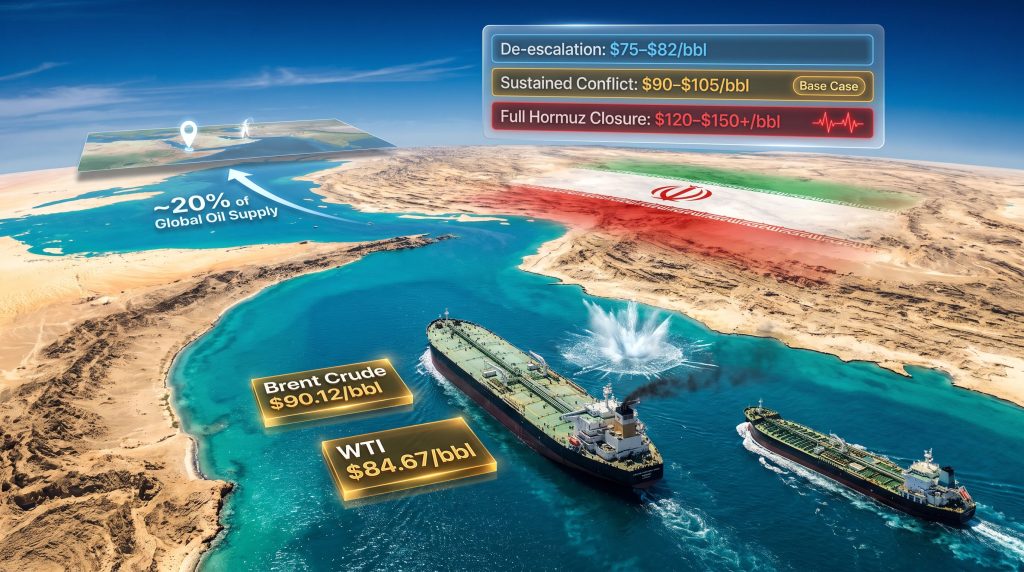
The Strait of Hormuz sits between the Iranian coastline to the north and the UAE and Oman to the south. At its narrowest navigable point, the passage spans roughly 21 nautical miles, yet through this corridor flows approximately one-fifth of the world's entire oil supply. That figure encompasses crude exports from Saudi Arabia, Iraq, Kuwait, the UAE, and Iran itself, along with a substantial share of global liquefied natural gas shipments originating from Qatar.
What makes Hormuz uniquely dangerous compared to other maritime chokepoints is the absence of any viable large-scale alternative. The world's other critical waterways, while strategically significant, each have at least partial bypass options:
| Chokepoint | Daily Oil Flow (Pre-Conflict Est.) | Viable Bypass Route? | Risk Level (2026) |
|---|---|---|---|
| Strait of Hormuz | ~20% of global supply | No | Critical |
| Bab el-Mandeb | ~10% of global supply | Limited (Suez alternative) | High |
| Suez Canal | ~12% of global trade | Cape of Good Hope | Elevated |
| Strait of Malacca | ~25% of global trade | Limited | Moderate |
Saudi Arabia does maintain the East-West Pipeline, which can transport some crude overland to Red Sea terminals, bypassing Hormuz entirely. However, its capacity is insufficient to absorb the full volume of Persian Gulf exports. In any realistic closure scenario, there is no logistical substitute capable of replacing what Hormuz moves every single day.
How the Conflict Reached This Point: A Timeline of Escalation
Understanding the current maritime crisis requires tracing the conflict's architecture from its origins rather than treating each incident as an isolated event. The escalation has followed a discernible pattern of action and counter-action, consistent with the broader oil market disruption analysts have been tracking throughout 2026:
- February 28, 2026: Active hostilities between U.S. and Iranian forces formally begin.
- June 17, 2026: A memorandum of understanding establishes a temporary ceasefire framework between the two sides.
- July 13, 2026: The United States reimposed a naval blockade, preventing Iranian vessels from entering or departing Iranian ports.
- Late July 2026: U.S. CENTCOM completed what it described as a heavy wave of strikes targeting dozens of Islamic Revolutionary Guard Corps infrastructure positions across Iran.
- July 30, 2026: A drone strike damages two ships at Egypt's Damietta Mediterranean port — the first attack on Egyptian soil since hostilities began.
- August 1, 2026: Two commercial tankers report separate incidents in waters approximately 11 nautical miles northeast of Oman.
"The geographic spread of these incidents — from the Strait of Hormuz to the Eastern Mediterranean coast of Egypt — reflects a deliberate expansion of the conflict's operational theatre, not a series of opportunistic strikes."
What Actually Happened to the Tankers Near Oman
Two Incidents, Two Distinct Threat Profiles
On August 1, 2026, the United Kingdom Maritime Trade Operations Centre (UKMTO), the Royal Navy-backed organisation that functions as the primary maritime safety monitor for the region, confirmed two separate incidents in waters northeast of Oman.
The first vessel sustained a direct hit from an unidentified projectile that caused structural damage to its engine room. As a result, the tanker was rendered not under command (NUC) — a formal maritime classification indicating the vessel could no longer manoeuvre as required under international collision regulations. The regional coast guard was notified, and no casualties or environmental contamination were confirmed.
The second vessel, operating in close proximity to the first, reported observing a large water displacement event followed by an explosion nearby. UKMTO confirmed this report separately.
What NUC Status Actually Means for Shipping Traffic
The NUC classification carries consequences that extend well beyond the immediate vessel. In high-traffic transit corridors like the Gulf of Oman, a ship unable to manoeuvre becomes a passive collision hazard for all surrounding traffic. The cascading implications include:
- Immediate salvage liability exposure for the vessel's owner and operator
- Mandatory rerouting of proximate traffic, creating congestion in already narrow sea lanes
- Automatic triggering of war risk premium reviews by maritime insurance underwriters, typically executed within hours of confirmed incidents
- Potential contamination risk if cargo integrity is compromised during any subsequent salvage operation
Critical distinction: While UKMTO confirmed no casualties or environmental damage, the more consequential impact is the corrosive effect on commercial shipping confidence across the entire region. Physical damage to one vessel sends a pricing signal to every operator with assets in the Gulf.
Iran's Multi-Chokepoint Denial Strategy
Decoding the Official Warning
Mohammad Bagher Zolghadr, serving as Secretary of Iran's Supreme National Security Council, issued a formal statement through Iran's WANA news agency asserting that continued U.S. naval blockade operations would result in Iran intensifying its control over the Strait of Hormuz while simultaneously moving to close other critical maritime passages.
This is not standard diplomatic posturing. The statement outlines what security analysts would recognise as a multi-vector maritime denial strategy — a doctrine that seeks to impose costs across multiple geographic points rather than concentrating force at a single location. The strategic logic is straightforward: if Iran can credibly threaten both Hormuz and Bab el-Mandeb simultaneously, the cost of maintaining the U.S. naval blockade becomes exponentially higher. Indeed, OPEC market influence over supply decisions adds yet another layer of complexity to an already volatile situation.
| Waterway | Strategic Function | Iran's Leverage Mechanism |
|---|---|---|
| Strait of Hormuz | Persian Gulf oil and LNG export gateway | Direct IRGC naval capability |
| Bab el-Mandeb | Red Sea access to Suez Canal | Iran-backed Houthi proxy forces in Yemen |
The Houthi Factor: Yemen as a Second Maritime Front
Houthi forces operating from Yemen have maintained an active campaign against commercial shipping in the Red Sea throughout 2026. According to ABC News, the drone strike against Egypt's Damietta port on July 30 represents a significant geographic escalation — Egypt had until that point been considered outside the immediate conflict envelope.
If Bab el-Mandeb becomes operationally denied, shipping operators face three unpalatable choices:
- Reroute around the Cape of Good Hope, adding approximately 10 to 14 days of transit time and significantly higher fuel costs per voyage
- Absorb escalating war risk insurance premiums and maintain existing routes under heightened threat exposure
- Suspend regional operations entirely until the security environment stabilises
The third option, if exercised at scale, would create a de facto supply shock independent of any physical blockade — driven entirely by commercial risk aversion rather than physical denial of access.
How Energy Markets Are Pricing the Risk
Current Price Benchmarks and What They Signal
As of Friday, August 1, 2026:
- West Texas Intermediate (WTI) futures closed at $84.67 per barrel, gaining more than 1% on the session
- Brent Crude, the international benchmark, settled at $90.12 per barrel, also up more than 1%
- Despite the daily gains, both benchmarks recorded weekly losses exceeding 5%, reflecting earlier optimism around diplomatic de-escalation that subsequently proved premature
The weekly decline followed by a daily recovery illustrates a pattern familiar to commodity traders operating in conflict environments: brief rallies driven by acute incident news, sitting within a broader price compression caused by diplomatic uncertainty. Furthermore, the crude oil price trends leading into this period had already signalled elevated volatility well before the tanker incidents occurred. Markets struggle to price conflicts where the outcome distribution is genuinely binary.
Three Forward Scenarios for Oil Prices
| Scenario | Trigger Condition | Estimated Brent Range | Market Assessment |
|---|---|---|---|
| De-escalation | Diplomatic breakthrough; ceasefire restored | $75 to $82/bbl | Low probability as of Aug 1, 2026 |
| Sustained Conflict | Continued strikes; no diplomatic progress | $90 to $105/bbl | Base case |
| Full Chokepoint Denial | Iran executes multi-strait blockade | $120 to $150+/bbl | Tail risk; non-trivial |
The current Brent settlement near $90 indicates markets are treating sustained conflict as the working base case. However, this pricing does not adequately capture the tail scenario. A simultaneous operational denial of both Hormuz and Bab el-Mandeb would affect roughly 30% of globally traded oil with no short-term logistical resolution available at any price. The relationship between oil prices and trade war dynamics has further complicated how analysts are modelling these forward scenarios.
The next major ASX story will hit our subscribers first
The U.S. Military and Diplomatic Position
Strike Planning and Conditional Authorisation
Reporting published on August 1, 2026 by multiple major U.S. news organisations — including The Wall Street Journal, The Associated Press, and Axios — converged on a consistent picture of U.S. military planning. According to those reports, President Trump directed military planners to prepare a fresh strike package against Iran, with execution potentially possible within days. Iranian energy infrastructure was identified as a potential target category in planning discussions.
Crucially, strike authorisation was described as conditional — diplomatic progress could pause or cancel the operation. Trump stated publicly at a Camp David cabinet meeting, as reported by the Associated Press, that continued military pressure on Iran was his intended course of action, adding that the intent was to reach a point where Iranian leadership concluded the costs were unsustainable.
Why the June Ceasefire Failed
The memorandum of understanding signed on June 17 established a ceasefire but resolved none of the structural disagreements driving the conflict. Two issues in particular proved intractable:
- Iran's nuclear program — verification mechanisms, enrichment limits, and the scope of any inspections regime remain points of fundamental disagreement
- Strait of Hormuz sovereignty — Iran's assertion of authority over maritime traffic through the passage conflicts directly with the U.S. doctrine of freedom of navigation, which holds that international straits cannot be subject to unilateral access control
Without resolution on either point, the ceasefire functioned as a cooling-off period rather than a pathway to settlement. Its collapse was structurally probable from the outset.
The Broader Escalation Architecture
Indicators That the Conflict Is Widening
Several developments in late July and early August 2026 point to a conflict that is expanding both geographically and in terms of the actors involved:
- Kuwait's air defence forces reported engaging hostile Iranian drone attacks, confirming that the conflict has extended into GCC airspace beyond the maritime domain
- Egypt's Damietta port strike on July 30 marked the first attack on Egyptian territory, demonstrating that no regional actor can assume insulation from escalation spillover
- Houthi maritime operations in the Red Sea corridor continued throughout this period, operating as a coordinated second front
Key Variables Determining the Next 30 Days
- Whether U.S. strike authorisation is executed or paused pending diplomatic movement
- Whether Iran formally activates Houthi forces to contest Bab el-Mandeb access at scale
- Whether GCC states including Saudi Arabia, the UAE, and Kuwait formally align with U.S. naval operations or maintain strategic ambiguity
- Whether commercial shipping operators begin large-scale route avoidance, creating a supply disruption driven by market behaviour rather than physical blockade
Current Status: Key Metrics at a Glance
| Metric | Status as of August 1, 2026 |
|---|---|
| Brent Crude Price | $90.12/bbl (+1% daily; -5% weekly) |
| WTI Futures | $84.67/bbl (+1% daily) |
| Tanker Incidents Near Oman | 2 confirmed (1 struck, 1 proximate explosion) |
| U.S. Naval Blockade | Active (imposed July 13, 2026) |
| June 17 Ceasefire | Effectively collapsed |
| Bab el-Mandeb Threat Level | Elevated (Houthi activity + Egypt strike) |
| Kuwait Air Defence | Engaged against Iranian drone attacks |
FAQ: The Iran Shipping Crisis Explained
What happened to the tankers near Oman on August 1, 2026?
One commercial tanker was struck by an unidentified projectile approximately 11 nautical miles northeast of Oman, disabling its engine room and leaving it unable to manoeuvre. A second nearby vessel reported witnessing a large explosion in close proximity. The UKMTO confirmed both incidents, with no reported casualties or environmental damage.
Why is the Strait of Hormuz so strategically important?
Approximately one-fifth of the world's oil supply transits through the Strait of Hormuz. No large-scale alternative route exists for Persian Gulf producers, making it the single most consequential maritime chokepoint for global energy security.
What is Iran threatening to do to global shipping routes?
Senior Iranian officials warned that continued U.S. naval blockade operations will result in Iran intensifying control over the Strait of Hormuz and potentially closing other critical maritime passages, including the Bab el-Mandeb strait at the southern entrance to the Red Sea.
What is the UKMTO and why does its reporting matter?
The United Kingdom Maritime Trade Operations Centre is a Royal Navy-backed organisation that monitors and reports maritime security incidents across the Indian Ocean, Persian Gulf, and Red Sea regions. Its incident confirmations function as authoritative early-warning signals for commercial shipping operators, port authorities, and marine insurance underwriters globally.
What oil price level signals that markets are pricing a worst-case scenario?
A Brent Crude price sustained above $120 per barrel would signal that markets are beginning to price the tail risk of simultaneous operational denial of both the Strait of Hormuz and the Bab el-Mandeb. The current settlement near $90 reflects the sustained conflict base case rather than full chokepoint closure.
Disclaimer: All oil price scenarios, market probability assessments, and forward trajectory estimates presented in this article are analytical frameworks based on publicly available information as of August 1, 2026. They do not constitute financial advice. Commodity markets are subject to rapid and unpredictable change, particularly during active geopolitical conflicts. Readers should conduct independent research and consult qualified financial professionals before making investment decisions.
Want to Stay Ahead of the Next Major Resource Discovery Before the Market Moves?
While geopolitical shocks like the Hormuz crisis reshape global commodity markets, Discovery Alert's proprietary Discovery IQ model scans ASX announcements in real time — delivering instant alerts on significant mineral discoveries across more than 30 commodities, so subscribers can act on actionable opportunities ahead of the broader market. Explore historic examples of major discovery returns on Discovery Alert's discoveries page and begin a 14-day free trial to secure a market-leading edge.