August 1, 2026
Nigeria's Fuel Pricing Paradox: When Local Refining Beats the Global Market
Across most emerging economies, the assumption holds that domestically refined petroleum products carry an inherent cost advantage over imported alternatives, given the elimination of long-haul freight, international trading margins, and foreign currency conversion losses. Nigeria, however, has spent decades disproving this assumption, operating a dysfunctional state refining sector that made fuel importation not just necessary but economically rational. That calculus is now shifting, but not in a straight line.
The arrival of large-scale domestic refining capacity has introduced a new variable into Nigeria's downstream petroleum market, one that interacts unpredictably with global crude benchmarks, naira volatility, and the structural economics of ocean freight. The question of whether Dangote refinery petrol is cheaper than imported fuel in Nigeria resists a definitive answer, because the competitive position between local and imported supply has reversed multiple times within a single calendar year, driven by macroeconomic forces rather than anything inherent to the refinery's operational efficiency.
Understanding this dynamic requires unpacking how fuel prices are actually constructed, why the advantage keeps flipping, and what it means for everyone from petroleum marketers to Nigerian motorists at the pump.
When big ASX news breaks, our subscribers know first
The Mathematics Behind Import Parity Pricing
When petroleum marketers import Premium Motor Spirit into Nigeria, the price they pay is not simply the international spot price of refined petrol. It is a layered calculation assembled from multiple cost components, each of which responds to different market forces. Furthermore, crude oil price dynamics play a central role in shaping how these components interact at any given moment:
- Crude oil benchmark pricing, typically anchored to Brent crude
- Refining margins at the overseas processing facility
- Ocean freight, insurance, and demurrage costs for tanker deliveries
- Port handling and terminal charges at Nigerian receiving facilities
- Regulatory levies and import duties applied at customs clearance
- Foreign exchange conversion costs at the prevailing naira-to-dollar rate on settlement day
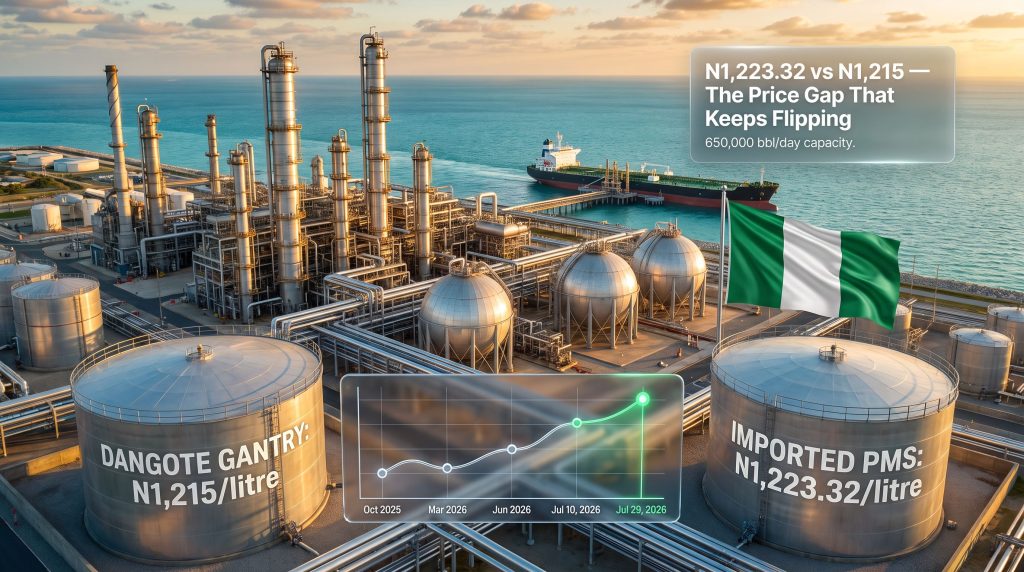
According to data published by the Major Energies Marketers Association of Nigeria (MEMAN) in its most recent Energy Bulletin, Brent crude averaged approximately $90 per barrel during the late July 2026 review period. Simultaneously, the naira traded at an average of N1,367.03 per US dollar. The combined effect of elevated crude prices and a weakened naira pushed the spot landed cost of imported petrol to N1,223.32 per litre as of July 29, 2026.
Against that figure, the Dangote Petroleum Refinery's gantry price — the price petroleum marketers pay to load fuel directly at the Lekki facility for onward distribution — stood at N1,215 per litre, inclusive of regulatory duties. The coastal PMS price was recorded separately at N1,195 per litre.
On those specific dates, locally refined petrol was cheaper than imported fuel by approximately N8 per litre at the gantry level.
A Price Gap That Never Stays Still
What makes Nigeria's fuel pricing environment genuinely complex is that this advantage is not structural or permanent. MEMAN data across 2025 and 2026 reveals a pattern of repeated reversals that expose how sensitive the competitive balance is to relatively modest shifts in crude prices or the naira exchange rate. These oil price movements have consequently reshaped the economics of Nigeria's downstream market in ways that few analysts anticipated.
| Period | Imported PMS Landed Cost | Dangote Gantry Price | Price Advantage |
|---|---|---|---|
| October 2025 | ~N829.77/litre | ~N877/litre | Imports cheaper by ~N47 |
| February 27, 2025 | Not specified | N825/litre (ex-depot) | Dangote competitive |
| March 24, 2026 | ~N1,139.24/litre | ~N1,275/litre | Imports cheaper by ~N136 |
| June 24, 2026 | ~N983.92/litre | ~N1,125/litre | Imports cheaper by ~N141 |
| July 10, 2026 | ~N1,095.15/litre | ~N1,075/litre | Dangote cheaper by ~N20 |
| July 29, 2026 | N1,223.32/litre | N1,215/litre | Dangote cheaper by ~N8 |
Source: MEMAN Energy Bulletin data across multiple reporting periods, 2025-2026.
The table reveals something important that a single data point cannot: the competitive position has flipped at least four times within nine months. As recently as June 2026, imported petrol was arriving in Nigeria at roughly N141 per litre below what Dangote was charging at the gantry. By mid-July, that relationship had inverted entirely.
The speed of these reversals, sometimes within weeks, illustrates that Nigeria's downstream market is now a genuinely dual-source system where neither supplier holds a permanent cost floor. For petroleum marketers, this creates a procurement environment more akin to commodity trading than traditional fuel distribution.
Why the Naira Is the Hidden Variable in the Price Equation
Much of the commentary on Nigeria's fuel pricing focuses on crude oil prices as the primary driver of import costs. While crude benchmarks matter significantly, the naira exchange rate is arguably the more volatile and less predictable input — and therefore the factor most capable of causing rapid price reversals. In addition, broader trade war impacts on global currency markets have compounded this naira volatility in ways that feed directly into Nigeria's import cost calculations.
Here is why this matters structurally: when a Nigerian importer purchases a refined petrol cargo, payment is settled in US dollars. If the naira weakens between the time the cargo is contracted and when it is delivered and off-loaded, the effective naira cost of that cargo increases even if the dollar-denominated price of the fuel itself has not changed.
This creates a self-reinforcing feedback loop that is underappreciated in public discourse:
- Continued importation requires USD purchases, adding pressure to naira demand.
- Increased USD demand weakens the naira relative to the dollar.
- A weaker naira raises the naira-denominated cost of the next import cargo.
- Higher import costs make locally refined fuel more competitive, but only temporarily.
- If crude prices then fall, import parity drops back below local refinery pricing, and the cycle restarts.
Nigeria's Independent Petroleum Marketers Association of Nigeria (IPMAN), through its National Publicity Secretary Chinedu Ukadike as reported by The Punch, has argued that this cycle imposes a systemic cost on Nigeria's foreign exchange reserves that is not captured in any single import parity comparison. According to IPMAN's position, persisting with fuel imports during periods when local supply is cheaper represents a net economic loss to Nigeria even when the nominal per-litre price difference appears small.
The Dangote Refinery's Pricing Architecture
The Dangote Petroleum Refinery operates from its facility in Lekki, Lagos, with a nameplate processing capacity of 650,000 barrels per day, positioning it among the largest single-train refineries anywhere in the world. Its pricing structure distinguishes between two delivery points:
- Coastal PMS Price: N1,195 per litre, applicable to coastal delivery arrangements
- Gantry Price: N1,215 per litre, inclusive of regulatory duties, representing the cost at which marketers load fuel for inland distribution
The distinction is commercially significant. Marketers sourcing fuel for inland Nigerian markets, where the bulk of consumption occurs, face the gantry price plus their own downstream logistics costs. This means the effective per-litre cost of Dangote-sourced fuel rises progressively as distance from Lagos increases, partially eroding the price advantage the refinery holds over imports in coastal regions.
In February 2025, the refinery implemented a reduction that brought its ex-depot price down to N825 per litre, with partner retail stations selling within an approximate range of N860 to N895 per litre depending on location. That pricing move demonstrated the refinery's capacity to adjust competitively, though subsequent months saw prices rise again in response to feedstock cost dynamics.
Import Cost Pressures Extend Across All Refined Products
The pricing pressure visible in petrol is not isolated. MEMAN data from the late July 2026 reporting period shows that the cost surge in imported refined products is broad-based, affecting diesel and aviation fuel with comparable or greater severity. These supply chain impacts on global freight and logistics have consequently added further upward pressure to Nigeria's import cost environment:
| Fuel Type | Spot Landed Cost (Imported) | 30-Day Average (Imported) | Deviation Above Average |
|---|---|---|---|
| Diesel (AGO) | N1,739.96/litre | N1,427.00/litre | +21.9% |
| Aviation Turbine Fuel (ATF) | N1,616.43/litre | N1,421.10/litre | +13.7% |
| Petrol (PMS) | N1,223.32/litre | Not specified | Above Dangote gantry |
Imported diesel landing at nearly 22% above its 30-day average within a single reporting cycle is a figure that carries substantial consequences for Nigerian transport logistics, manufacturing, and power generation sectors, all of which rely heavily on diesel. Aviation fuel at 13.7% above its rolling average has direct implications for airline operating costs and, consequently, domestic airfare levels.
These deviations suggest the late July 2026 pricing environment represented a stress event rather than a new equilibrium, driven by the convergence of elevated crude prices and currency pressure rather than a structural shift in global refining economics.
The next major ASX story will hit our subscribers first
IPMAN's Push to End Fuel Imports: The Policy Argument Unpacked
IPMAN's renewed calls for an import ban rest on two analytically distinct arguments that are sometimes conflated in public debate:
Argument 1: Domestic Supply Adequacy
IPMAN contends that Nigeria's operational refining infrastructure, anchored by the Dangote facility, can now meet national petroleum demand without supplementary import volumes. If accurate, this would mean import licences are being granted for supply that is genuinely redundant.
Argument 2: The Foreign Exchange Drain
Even in periods when imported petrol lands cheaper on a per-litre basis, IPMAN argues the macroeconomic cost of the USD outflows required to fund those imports outweighs the short-term consumer price benefit. This is a more sophisticated argument and more difficult to evaluate without visibility into Nigeria's total import volumes and the marginal impact of those volumes on the naira.
Newly issued import licences, according to IPMAN's publicly stated position as reported by Tribune Online, have not produced lower pump prices for consumers. In periods where imported cargoes priced above locally refined supply, the justification for maintaining an open import regime is weakened considerably by the evidence of the MEMAN pricing data itself.
What Conditions Could Reverse the Advantage Again?
Given the historical volatility, petroleum marketers and downstream operators need frameworks for anticipating when import parity pricing will once again fall below Dangote's gantry price. The data points to four primary scenarios. Furthermore, commodity market volatility means these scenarios can unfold simultaneously or in rapid sequence, compressing the window for strategic sourcing decisions:
- Brent crude retreats toward the $75-$80 per barrel range, reducing the raw material cost embedded in import parity calculations and potentially pushing landed costs below current Dangote pricing.
- The naira appreciates meaningfully against the US dollar, reducing the naira-denominated cost of USD-settled import transactions.
- Dangote raises its gantry price in response to higher domestic feedstock costs or operational adjustments, as occurred in the lead-up to the March 2026 period when its N1,275/litre price was N136 above import parity.
- Global shipping costs decline materially, reducing the freight and insurance components of the import parity calculation.
Any one of these conditions, or a combination, could restore a meaningful import cost advantage within weeks, as the June 2026 data demonstrates.
What This Means for Nigerian Fuel Consumers
For motorists and businesses, the wholesale price dynamics described above do not translate directly or immediately into pump price changes. Several friction points sit between refinery economics and retail fuel costs:
- Retailer margin requirements must be covered regardless of where the fuel originates
- Inland transportation costs from Lekki to retail stations across Nigeria's geography add progressively to the effective cost
- Inventory timing means stations may be selling fuel purchased at higher wholesale prices even after the refinery or import price has fallen
- Regional pricing variation is significant, with coastal proximity to the Dangote facility producing meaningfully different retail economics compared to northern or inland markets
The net result is that Nigerian consumers experience fuel price changes with a lag, and the direction of that lag depends on whether marketers are adjusting upward (quickly) or downward (more slowly) — a pattern consistent with asymmetric price transmission observed in petroleum retail markets globally.
FAQ: Understanding the Dangote vs. Imported Fuel Price Debate
Is Dangote refinery petrol currently cheaper than imported petrol in Nigeria?
As of July 29, 2026, MEMAN data shows the Dangote refinery petrol cheaper than imported fuel in Nigeria, with the gantry price of N1,215/litre sitting marginally below the imported petrol landed cost of N1,223.32/litre. The gap is approximately N8/litre, a narrow margin that has reversed multiple times across 2025-2026.
How often does the competitive position change?
Based on available MEMAN data, the price advantage has shifted at least four to five times between October 2025 and July 2026, sometimes within a matter of weeks.
What is the Dangote refinery's production capacity?
The Dangote Petroleum Refinery at Lekki, Lagos, has a nameplate processing capacity of 650,000 barrels per day.
Why does IPMAN want Nigeria to stop importing fuel?
IPMAN argues both that domestic refining capacity is sufficient to meet national demand and that continued importation consumes scarce foreign exchange reserves, weakening the naira and ultimately raising the cost of future imports.
Did Dangote cut petrol prices in early 2025?
Yes. Effective February 27, 2025, the refinery reduced its ex-depot price to N825 per litre, with affiliated retail stations pricing between approximately N860 and N895 per litre depending on location.
Key Takeaways on Nigeria's Evolving Fuel Price Dynamics
- Whether Dangote refinery petrol is cheaper than imported fuel in Nigeria is not a fixed condition and has reversed at least four times between October 2025 and July 2026
- The primary drivers of price reversals are Brent crude price movements and naira-to-dollar exchange rate shifts, not changes in refinery efficiency or operational performance
- As of late July 2026, Dangote holds a marginal N8/litre advantage at the gantry level, a gap narrow enough to reverse with modest changes in either crude prices or currency markets
- Diesel and aviation fuel imported costs are running significantly above their 30-day averages, at 21.9% and 13.7% respectively, indicating systemic import cost pressure beyond petrol alone
- IPMAN's case for restricting imports rests on foreign exchange conservation arguments as much as on immediate per-litre price competitiveness claims
- Downstream market participants require dynamic, scenario-based sourcing strategies rather than fixed assumptions about which supply source is cheaper
Disclaimer: This article presents analysis based on publicly available MEMAN Energy Bulletin data and industry reporting as of the dates cited. Fuel prices and exchange rates are highly volatile. Nothing in this article constitutes financial or investment advice. Readers should consult relevant industry data sources and professional advisors before making procurement or investment decisions based on petroleum market dynamics.
Want to Track the Commodity Market Shifts Driving Nigeria's Fuel Price Volatility?
The crude oil price movements and currency dynamics reshaping Nigeria's downstream petroleum market are part of broader commodity trends that Discovery Alert monitors in real time — powered by its proprietary Discovery IQ model, which instantly translates complex market data into actionable insights for ASX-listed resource opportunities. Explore historic examples of how major commodity discoveries have generated substantial returns, and begin your 14-day free trial today to ensure you are positioned ahead of the next significant market shift.