
July 24, 2026
Why Conventional Aluminium Grades Are Reaching Their Engineering Limits
The history of industrial materials is punctuated by moments when incremental refinement gives way to fundamental reinvention. Aluminium is living through one of those moments right now. For most of the twentieth century, the selection logic was straightforward: match the alloy designation to the application category and move on. ADC12 for die casting. 1350 for electrical conductors. 6061 for structural extrusions. 7075 for aerospace frames. The system worked because applications were tolerant, margins were forgiving, and performance envelopes were modest.
None of those conditions hold today.
The simultaneous arrival of electric vehicle giga-casting, AI data centre power density demands, and the European Union's Carbon Border Adjustment Mechanism has shattered the old selection logic. The deep-tech aluminium alloy matrix is what emerges from that rupture: a new class of engineered aluminium systems where atomic-level chemistry, reinforcement phase design, and carbon accounting are co-optimised from the outset. Understanding what this means in practice, and why the transition is now commercially unavoidable, is the central challenge for every downstream operator, procurement officer, and materials engineer working in the aluminium value chain today.
When big ASX news breaks, our subscribers know first
Defining the Deep-Tech Aluminium Alloy Matrix
What Separates Engineered Matrix Systems from Standard Alloy Grades
A conventional alloy designation communicates a chemical composition window and a broad performance envelope. A deep-tech aluminium alloy matrix goes several layers deeper. It is an engineered aluminium system in which composition, reinforcement phase geometry, and processing route are deliberately co-designed at the micro or nano scale to achieve performance targets that standard alloys structurally cannot reach.
This definition encompasses two distinct but related platforms:
- Microalloyed monolithic alloys, where trace element additions at the 0.02 to 0.5 wt% level precipitate coherent nanoparticle phases that fundamentally alter grain boundary behaviour, dislocation dynamics, and thermal stability.
- Aluminium metal matrix composites (AMMCs), where a physically distinct reinforcement phase, typically a ceramic such as silicon carbide, aluminium oxide, or boron carbide, is dispersed within the aluminium matrix to deliver stiffness, hardness, or thermal conductivity beyond any monolithic limit.
The alloy platforms most actively engineered within this framework include AA6061, AA7075, AA5083, A356, AlSi7Mg0.3, and AlSi12, each serving as the base matrix for progressively more sophisticated interventions.
The Three Industrial Forces Driving Alloy Obsolescence
Legacy alloys are not failing randomly. They are failing at precisely the points where three industrial forces are converging with maximum intensity:
- EV giga-casting scale: Single-shot aluminium underbody castings that replace hundreds of stamped components expose the brittle intermetallic phases in traditional high-pressure die casting alloys. Standard ADC12, which requires elevated iron content to prevent die soldering, produces needle-like Fe-bearing intermetallics that tear catastrophically during post-casting T6 heat treatment.
- AI data centre power density: Next-generation GPU server racks consuming up to 100 kW per rack are pushing well beyond the structural floor-load tolerances of conventional copper cable systems. The weight of copper infrastructure required to deliver this power density is physically incompatible with raised-floor data centre construction.
- Carbon Border Adjustment Mechanism (CBAM): Under CBAM, the embodied carbon intensity of imported aluminium is treated as a legally enforceable physical property, not an optional sustainability disclosure. High-carbon primary metal sourced from coal-intensive production grids faces border certificate costs that can eliminate processing margins entirely.
Global aluminium casting usage is projected to reach 24.2 million tonnes in 2026, representing both the scale of the market opportunity and the urgency of the alloy transition already underway across the industry.
Engineering the Matrix at the Atomic Level
Microalloying Strategies: Zirconium, Boron, and Scandium
The most commercially significant microalloying interventions centre on three elements: zirconium, boron, and scandium. Each operates through a distinct nano-scale mechanism, and each addresses a specific failure mode in conventional alloys. Furthermore, understanding how these elements interact at the atomic level is essential to appreciating why the deep-tech aluminium alloy matrix represents such a decisive departure from standard grade selection.
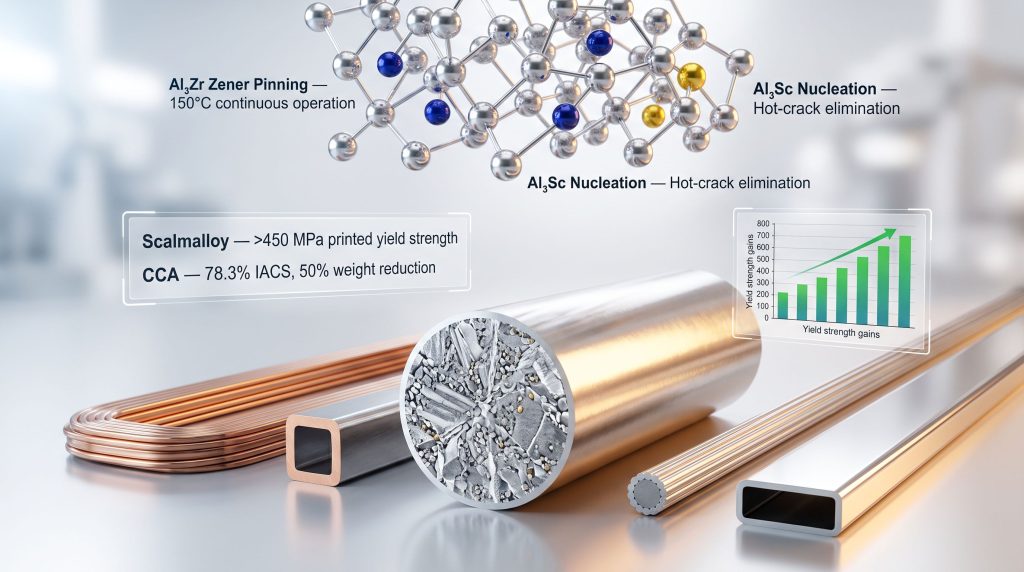
Zirconium doping (0.02 to 0.05 wt%) produces dense, coherent Al₃Zr nanoparticles during solidification. Because these particles share a near-perfect atomic lattice match with the surrounding aluminium matrix, they act as microscopic anchors for grain boundaries through a mechanism known as Zener pinning. The practical result is that grain boundaries cannot migrate, recrystallisation is suppressed, and the alloy retains its tensile strength under continuous thermal loading at temperatures up to 150°C. This is the foundation of Thermal Resistant Aluminium Alloy (TAL) conductors used in high-voltage transmission infrastructure.
Boron co-addition operates through a complementary mechanism: it selectively precipitates conductivity-destroying transition metal impurities, particularly titanium and vanadium, out of the electrical matrix. These elements, present as trace contaminants in most primary aluminium, act as electron scattering centres. Removing them from solid solution via boron-induced precipitation can meaningfully lift the IACS conductivity rating of the finished conductor.
Scandium microalloying (0.1 to 0.5 wt%) is the most powerful single-element intervention currently known in commercial aluminium metallurgy. During solidification and subsequent ageing, scandium precipitates billions of coherent Al₃Sc nanoparticles that simultaneously suppress recrystallisation, eliminate the hot-cracking susceptibility that has historically made 7000-series alloys unweldable, and provide a potent secondary strengthening mechanism capable of pushing yield strengths beyond 400 MPa. The combination of Sc and Zr, most notably in the Scalmalloy (Al-Mg-Sc-Zr) platform, extends this effect into additive manufacturing, where the rapid cooling rates of selective laser melting spontaneously nucleate such high densities of Al₃Sc that printed components routinely exceed 450 MPa yield strength.
Nano-Reinforcement: The AMMC Performance Map
When monolithic microalloying reaches its limits, the next step is introducing a physically distinct reinforcement phase into the aluminium matrix. The table below maps the primary reinforcement materials, their matrix platforms, and the performance gains they deliver:
| Reinforcement Type | Matrix Platform | Primary Performance Gain |
|---|---|---|
| Silicon Carbide (SiC) | AA6061, AA7075 | Stiffness, wear resistance |
| Aluminium Oxide (Al₂O₃) | AA5083, A356 | Hardness, thermal stability |
| Boron Carbide (B₄C) | AA7075 | Extreme hardness, neutron absorption |
| Carbon Nanotubes (CNTs) | AA6061 | Tensile strength, electrical conductivity |
| Graphene | AA7075, AA6061 | Strength-to-weight, thermal conductivity |
| Titanium Carbonitride (TiCN) | Secondary scrap alloys | Dislocation barrier, fatigue resistance |
| Nanodiamond | Aerospace-grade matrices | Wear resistance, thermal management |
A critical but underappreciated distinction exists between micro-reinforced and nano-reinforced composites: nano-scale particle dispersion preserves ductility far more effectively than micron-scale reinforcement, because smaller particles impose fewer stress concentration sites. This distinction matters enormously when processing post-consumer scrap, where tramp iron impurities already introduce embrittlement risk. Well-dispersed ceramic nanoparticles can physically override the degradation caused by iron intermetallics, enabling high-performance composites from low-grade feedstock.
Impurity-Tolerant Alloy Design: The RidgeAlloy Breakthrough
One of the least widely understood developments in the deep-tech aluminium alloy matrix space is the RidgeAlloy system, engineered by Oak Ridge National Laboratory under the U.S. Department of Energy. The foundational engineering challenge it addresses is deceptively simple: how do you process 100% post-consumer scrap without diluting it with expensive virgin primary metal?
Post-consumer scrap typically carries iron concentrations that standard alloy specifications cannot accommodate without catastrophic embrittlement. Iron in conventional aluminium solidification pathways precipitates as sharp, needle-like beta-AlFeSi intermetallic phases that act as stress concentrators, dramatically reducing ductility and fatigue life.
RidgeAlloy sidesteps this problem through a fundamentally different compositional strategy. Using high-throughput computational metallurgy, researchers developed an Al-Mg-Si-Fe-Mn composition capable of absorbing up to 1.5 wt% iron and 1.5 wt% silicon simultaneously without ductility collapse. The mechanism is solidification pathway engineering: the Mn:Fe ratio is calibrated to redirect iron precipitation away from needle morphologies toward rounded, benign intermetallic phases that impose minimal stress concentration.
The performance outcome is remarkable: elongation rates of 7 to 13%, which is sufficient for demanding structural automotive applications, achieved from a feedstock consisting entirely of heavily contaminated post-consumer scrap. The energy intensity reduction compared to primary ingot-based production is estimated at up to 95%, making RidgeAlloy not only a metallurgical breakthrough but a carbon accounting one as well.
Advanced Processing Routes That Define the Deep-Tech Stack
Semi-Solid Metal Rheocasting and CoolCast Integration
The metallurgical benefits of advanced alloy chemistry can only be realised if the casting process itself does not reintroduce defects. This is where Semi-Solid Metal (SSM) Rheocasting becomes critical.
Traditional high-pressure die casting injects liquid aluminium at velocities exceeding 50 m/s. At these velocities, turbulent flow inevitably entrains ambient air and folds surface oxide films into the solidifying casting, producing destructive oxide bifilms and porosity that no post-casting treatment can fully remediate.
Rheocasting controls the melt cooling rate prior to injection to achieve a partially solidified slurry state characterised by a globular, non-dendritic microstructure. When mechanical pressure is applied, this slurry temporarily drops in viscosity and flows as a laminar front, pushing air out of the die cavity rather than entraining it. The result is near-zero porosity, which unlocks two capabilities that are simply unavailable from conventional HPDC parts:
- Aggressive post-casting T6 heat treatment without blister formation
- Structural welding without porosity-induced joint weakness
For thermal management integration, the CoolCast ZLeak Tube technology addresses a historically intractable problem: how to cast hollow cooling channels into structural HPDC components without the tubes collapsing under injection pressures reaching 1,200 bar. The solution is a two-layer sacrificial filler insert placed inside the tube before casting, consisting of a water-soluble outer layer and a coarse-grained, pressure-resistant inner core. After solidification, high-pressure water flushes the filler, leaving seamlessly bonded, leakage-free cooling channels within the monolithic component.
ShAPE Technology: Scrap-Direct Extrusion
Conventional extrusion requires energy-intensive billet preheating and homogenisation steps that make contaminated post-consumer scrap feedstock metallurgically impractical. Pacific Northwest National Laboratory's Shear Assisted Processing and Extrusion (ShAPE) technology eliminates both steps.
ShAPE uses a rotating head paired with a hydraulic press. As unheated scrap feedstock is forced against the rotating head, extreme localised shear generates internal frictional heat sufficient to soften the metal without conventional preheat. At the nano scale, this extreme plastic deformation mechanically fragments iron intermetallics from macro-scale embrittling structures into harmless nanoscale particles, effectively performing in-process impurity remediation.
The reported energy reduction is up to 90% lower than conventional extrusion, and the technology enables 100% post-consumer scrap feedstock without any primary metal dilution. For downstream extruders facing both carbon tariff pressure and raw material cost volatility, ShAPE represents a structural competitive advantage rather than an incremental process improvement.
Solid-State Processing Routes for AMMCs
Liquid-phase composite manufacturing routes such as stir casting and squeeze casting can introduce porosity and reinforcement particle clustering that undermines the theoretical performance gains of AMMC systems. Solid-state alternatives, however, preserve microstructural integrity more reliably:
- Powder metallurgy: Achieves uniform reinforcement distribution and fine grain retention through cold compaction and sintering
- Spark plasma sintering (SPS): Enables rapid densification at lower temperatures, preserving nano-reinforcement particle integrity that longer sintering cycles would damage
- Friction stir processing (FSP): Creates surface-layer composite structures in wear-critical applications without full billet processing
- High-pressure torsion (HPT): Produces ultra-fine grain structures at the theoretical strength ceiling for aluminium systems
In addition, metal matrix composite materials engineering continues to expand the viable application base for solid-state AMMC production routes across both aerospace and automotive sectors.
Application Domains: Where Deep-Tech Matrix Alloys Are Winning Contracts
EV Manufacturing: Giga-Castings and Motor Hairpin Windings
Two separate EV applications are driving alloy upgrades on completely different metallurgical fronts.
For structural giga-castings, the requirement is an impurity-tolerant, heat-treatable alloy delivering elongation rates above 7% from post-consumer scrap feedstock. RidgeAlloy-type compositions are the primary candidate class for this application.
For motor hairpin windings, the solution is Copper-Clad Aluminium (CCA): a 1370 aluminium core co-extruded within a copper cladding volume maintained at exactly 42%. The process parameters are tightly constrained: direct co-extrusion at 150°C using a 40° semi-die angle with a sealed-cup billet design. This configuration prevents premature aluminium outflow and limits the brittle Al-Cu intermetallic layer to 1.45 µm after partial annealing, which is the threshold below which the bimetallic wire can survive the violent rectangular forming required for 3x2mm hairpin geometry. The performance outcome is a 50% winding weight reduction with 78.3% IACS electrical conductivity, achieved through the skin effect concentrating current in the outer copper periphery.
Power Grid Infrastructure: Zr-Doped TAL Conductors
Standard 1350 electrical-grade aluminium fails in high-voltage transmission and offshore wind grid applications through creep: the permanent deformation of metal under sustained mechanical and thermal stress that progressively loosens connection joints and creates resistive oxide layers capable of initiating electrical fires.
Zr-doped TAL conductors solve this at the nano scale through Al₃Zr Zener pinning, enabling continuous operation at 150°C without creep or tensile strength degradation. With global grid upgrade investment running into the trillions of dollars, the market opportunity for thermally resistant aluminium conductors is structurally large and long-duration. Furthermore, the bauxite production outlook remains a critical upstream variable for primary metal supply into these conductor applications.
AI Data Centres: 6xxx Series Busbar Systems
The power density challenge posed by next-generation AI server racks consuming up to 100 kW per unit cannot be solved by scaling conventional copper cable installations. The weight of copper required to deliver this ampacity exceeds the structural load limits of raised data centre floors.
Overhead busbar track systems extruded from 6xxx series aluminium alloys resolve this constraint. These alloys are engineered to balance Mg₂Si precipitation strengthening with maximum electrical conductivity, and aluminium busbar systems are approximately 50% lighter than copper systems of equivalent ampacity. This weight advantage enables denser, multi-storey AI facility construction and meaningfully reduces structural engineering costs per kilowatt of installed capacity.
Aerospace and Defence: Scandium-Enabled Welded Structures
The aerospace sector has operated under a 50-year metallurgical constraint: 7000-series alloys, which represent the highest-strength commercial aluminium platform, cannot be reliably welded. The heat-affected zone hot-cracking mechanism destroys the engineered microstructure around any weld, forcing aircraft manufacturers to rely on millions of heavy, expensive rivets for structural assembly.
Scandium microalloying eliminates this constraint. The coherent Al₃Sc nanoparticle network provides sufficient thermodynamic stability to suppress hot cracking in the heat-affected zone, enabling seamless fuselage welding and rivet elimination. In the 5000-series marine and armour space, Sc-doped AA5083 achieves yield strengths above 400 MPa while retaining full marine corrosion immunity and superplastic forming capability, a combination that no conventional alloy in this family can approach.
How CBAM Rewrites the Economics of Aluminium Procurement
Carbon Intensity as a Legally Enforceable Material Property
The London Metal Exchange cash price and standard regional premiums no longer capture the true landed cost of imported aluminium for European buyers. CBAM introduces a third cost dimension: the carbon certificate liability, calculated from the grid emission factor of the country where the metal was produced and the confirmed initial certificate rate of €75.36 per tonne of CO₂ equivalent.
The carbon arithmetic is punishing for coal-intensive production regions. The grid emission factor applied to industrial production in high-carbon electricity markets approaches 1.0 tCO₂e per MWh, approximately 2.7 times the European Union grid average. This multiplier compounds through every processing stage, and pricing agencies such as Fastmarkets are already embedding CBAM costs directly into billet premiums, making the liability visible in spot market transactions.
The aluminium tariffs impact on downstream procurement strategies is consequently becoming inseparable from carbon cost modelling, as import certificate liabilities increasingly dominate total landed cost calculations for operators sourcing from coal-intensive regions.
Quantifying the Carbon Cost Gap
The financial divergence between low-carbon and high-carbon aluminium sourcing is illustrated by the following scenario for a 1,000-tonne extrusion shipment:
| Cost Variable | Low-Carbon Source | High-Carbon Source |
|---|---|---|
| CBAM Certificate Rate | €75.36/tCO₂e | €75.36/tCO₂e |
| Grid Emission Factor | ~0.37 tCO₂e/MWh (EU avg.) | ~1.0 tCO₂e/MWh (coal-intensive) |
| Estimated CBAM Liability | Minimal | Potentially exceeds €1.35M per shipment |
| Processing Margin Impact | Negligible | Elimination risk |
Secondary aluminium produced from post-consumer scrap carries a structurally lower upstream carbon burden than primary metal smelted from bauxite, creating a compounding procurement advantage for operators who can qualify impurity-tolerant alloy systems for their specifications.
This dynamic creates a powerful alignment between the RidgeAlloy and ShAPE approaches on one side, and CBAM compliance on the other. Systems designed to process post-consumer scrap without primary metal dilution simultaneously reduce carbon liability and raw material cost. For instance, the major aluminium mining companies that are investing in low-carbon aluminium operations are demonstrably better positioned to supply CBAM-compliant metal into European procurement channels.
Strategic Procurement Responses for Downstream Operators
Operators navigating this environment have three primary strategic levers:
- Transition alloy specifications from primary-metal-dependent grades to impurity-tolerant, scrap-compatible matrix systems that qualify for lower CBAM certificate burdens
- Integrate embodied carbon tracking into alloy qualification frameworks alongside traditional mechanical and chemical specifications, treating carbon intensity as a procurement-stage filter rather than a post-purchase disclosure
- Prioritise processing route investments in ShAPE-type or solid-state technologies that enable direct scrap conversion, compressing both the carbon cost and the raw material cost simultaneously
In addition, the aluminium decarbonisation strategy being pursued across major smelting operations signals a structural shift in primary metal supply that downstream operators should incorporate into long-term sourcing frameworks.
The next major ASX story will hit our subscribers first
Performance Benchmarks: The Deep-Tech Aluminium Alloy Matrix at a Glance
| Alloy or System | Primary Application | Key Mechanism | Performance Highlight |
|---|---|---|---|
| RidgeAlloy (Al-Mg-Si-Fe-Mn) | Structural HPDC from scrap | Impurity-tolerant solidification path | 7 to 13% elongation from 100% post-consumer scrap |
| Zr-doped TAL | HV transmission conductors | Al₃Zr Zener pinning | Continuous operation at 150°C, no creep |
| CCA (1370 Al core, 42% Cu clad) | EV motor hairpin windings | Skin-effect conductivity concentration | 78.3% IACS, 50% weight reduction |
| 6xxx Series Busbars | AI data centre power tracks | Mg₂Si precipitation strengthening | 50% lighter than equivalent copper systems |
| Sc-microalloyed AA5083 | Marine and armour structures | Al₃Sc precipitation strengthening | Above 400 MPa yield strength, full corrosion immunity |
| Scalmalloy (Al-Mg-Sc-Zr) | Aerospace additive manufacturing | Rapid Al₃Sc nucleation in SLM | Above 450 MPa printed yield strength |
| SiC-reinforced AA6061 AMMC | Automotive structural components | Dislocation barrier mechanism | Enhanced stiffness-to-weight ratio |
| TiCN-reinforced secondary alloy | Extrusion from low-grade scrap | Nano-particle dislocation pinning | High fatigue resistance from low-cost feedstock |
Frequently Asked Questions
What is the difference between an aluminium alloy and an aluminium metal matrix composite?
A monolithic aluminium alloy consists of a single-phase aluminium base with alloying elements either in solid solution or precipitated as intermetallic phases. An AMMC incorporates a physically distinct reinforcement phase, such as ceramic particles, fibres, or carbon nanotubes, dispersed within that matrix. The distinction has direct implications for recyclability, processing route selection, and end-of-life material recovery economics.
Which system is best for high-temperature continuous operation?
Zirconium-doped TAL systems are the established solution for electrical conductor applications requiring continuous operation at 150°C. Al₂O₃ and SiC-reinforced AMMCs are preferred for structural components under sustained thermal cycling. Scandium-microalloyed systems are selected where weldability at elevated temperatures is a concurrent requirement.
How does scandium compare to zirconium as a microalloying addition?
Scandium and zirconium are frequently used in combination precisely because they operate through complementary mechanisms. Scandium precipitates Al₃Sc particles that suppress hot cracking and deliver the primary strengthening effect. Zirconium precipitates Al₃Zr particles that resist coarsening at higher temperatures, providing thermal stability that pure scandium additions cannot maintain over extended service life. The Scalmalloy platform leverages both effects simultaneously.
What processing route produces the highest-integrity aluminium matrix composite?
Spark plasma sintering and powder metallurgy routes generally deliver the most uniform reinforcement distribution and finest retained grain structures. Friction stir processing is the preferred route for surface-layer composite applications where only the wear surface requires modification. ShAPE technology leads for converting contaminated post-consumer scrap directly into structural profiles without primary metal addition.
How should procurement officers factor CBAM into alloy sourcing decisions?
CBAM certificate costs should be modelled as a variable component of total landed cost at the point of alloy specification, not absorbed as a post-purchase accounting adjustment. For any shipment sourced from a coal-intensive production region, the certificate liability on a 1,000-tonne consignment can exceed €1.35 million, a figure that eliminates standard processing margins entirely. Specifications that qualify secondary aluminium or low-carbon primary metal sources carry a structural cost advantage that compounds with every tonne procured.
The Strategic Divide Between Commodity Operators and Deep-Tech Producers
The aluminium industry is undergoing a bifurcation that has no clear precedent in its post-war history. On one side are operators continuing to treat aluminium as a commodity input, selected primarily on LME price and regional premium. On the other are producers and procurement teams who have integrated atomic-level chemistry, process route engineering, and carbon accounting into a unified decision framework.
The commercial consequences of remaining on the wrong side of this divide are accelerating. Carbon tariffs imposed under CBAM are not a future risk to be managed: the initial certificate price of €75.36 per tonne of CO₂ equivalent is already confirmed and being embedded into billet premiums by pricing agencies. Mechanical failure modes in legacy alloys are not hypothetical: they are occurring in active production programmes for EV structural castings and grid conductor installations.
The operators who will capture disproportionate margin share over the next decade are those who can demonstrate mastery across the full deep-tech aluminium alloy matrix stack, from impurity-tolerant RidgeAlloy chemistry and scandium microalloying precision, through ShAPE-enabled scrap conversion and rheocasting defect elimination, to carbon-transparent sourcing that converts CBAM from a liability into a competitive moat. The timeline for building these capabilities is compressing rapidly, driven by OEM qualification cycles, grid upgrade procurement windows, and the irreversible economics of carbon border regulation.
Disclaimer: This article contains forward-looking statements, market projections, and technical scenario analyses intended for informational and educational purposes only. Figures relating to CBAM certificate pricing, grid emission factors, and shipment cost scenarios are illustrative and subject to change based on regulatory developments. Readers should conduct independent due diligence before making procurement, investment, or business strategy decisions based on the information contained herein.
Want to Capitalise on the Next Major Materials or Mining Discovery Before the Market Moves?
Discovery Alert's proprietary Discovery IQ model delivers real-time alerts the moment significant ASX mineral discoveries are announced, transforming complex data across more than 30 commodities into clear, actionable insights for both short-term traders and long-term investors. Explore how historic discoveries have generated extraordinary returns and begin your 14-day free trial today to position yourself ahead of the broader market.