June 29, 2026
The global energy landscape stands at a critical inflection point where conventional wisdom about resource extraction economics requires fundamental reassessment. While onshore unconventional production has dominated North American energy strategy for over a decade, structural limitations are emerging that signal a profound shift in capital allocation priorities. This transformation creates unprecedented opportunities for deepwater offshore resurgence as operators seek sustainable, long-cycle assets capable of bridging the gap between declining shale productivity and rising energy demand.
Economic Paradigm Shifts Driving Ultra-Deep Water Development
The economics of deepwater offshore projects have undergone a remarkable transformation since the 2014-2016 downturn. Project breakeven costs have compressed dramatically through technological innovation, standardised development approaches, and enhanced operational efficiency. Furthermore, modern deepwater developments now compete favourably with short-cycle onshore assets, fundamentally altering investment decision frameworks across major energy companies.
Key Economic Drivers:
• Standardised floating production storage and offloading (FPSO) designs reducing capital intensity
• Enhanced drilling automation advances reducing operational timelines
• Improved reservoir characterisation minimising geological risk
• Performance-based contracting models optimising cost structures
The shift represents more than incremental improvement. Industry leaders recognise that deepwater projects offer predictable, long-term cash flows that provide portfolio stability during volatile market conditions. Unlike unconventional assets requiring continuous drilling to maintain production, deepwater developments generate sustained output over decades once operational.
Portfolio Rebalancing Toward Long-Cycle Assets
Major energy companies are fundamentally reassessing their asset portfolios as US oil production decline approaches plateau levels. Current U.S. unconventional output represents approximately 7-9 million barrels per day, but this production base faces inherent limitations that constrain future growth potential.
Industry analysis suggests this output level may have reached its sustainable ceiling, creating demand gaps that deepwater development must address. In addition, the trade war oil market impact has highlighted the importance of diverse supply sources, making deepwater projects increasingly strategic.
The strategic implications extend beyond simple production replacement. Long-cycle deepwater assets provide operational predictability and reduced capital volatility compared to continuous drilling programmes required for unconventional maintenance. Consequently, this fundamental difference in investment profiles makes deepwater offshore resurgence increasingly attractive for companies seeking sustainable returns and reduced operational complexity.
When big ASX news breaks, our subscribers know first
Technological Innovation Reshaping Deepwater Economics
The deepwater offshore resurgence reflects breakthrough advances in drilling technology, automation systems, and operational methodologies. These innovations have transformed project economics while expanding the technical envelope for commercially viable developments in previously inaccessible areas.
Automation Revolution in Well Construction
Modern deepwater operations increasingly rely on automated systems designed to reduce drilling duration rather than traditional dayrate optimisation. This fundamental shift in operational philosophy reflects recognition that time reduction delivers superior economic value compared to marginal cost savings on daily rates.
Industry operators report that automation technologies now focus primarily on eliminating non-productive time during drilling operations. Advanced systems monitor real-time drilling parameters, automatically adjust operational parameters, and predict potential issues before they impact project timelines. The result is measurably shorter drilling campaigns with reduced exposure to weather delays and operational complications.
Critical Automation Components:
• Real-time drilling optimisation systems
• Automated pipe handling and connection systems
• Predictive maintenance algorithms for critical equipment
• Integrated well planning and execution platforms
Performance-Based Contracting Model Adoption
The industry has increasingly adopted performance-based contracting structures that align contractor incentives with operator objectives. These arrangements fundamentally alter risk allocation and economic optimisation compared to traditional time-based contracts.
Under performance-based models, drilling contractors assume greater responsibility for operational efficiency while sharing in the economic benefits of successful execution. However, operators report mixed results with these arrangements, noting that successful implementation requires careful contract design and clear performance metrics.
Implementation Considerations:
• Detailed performance metrics definition
• Risk allocation balance between operators and contractors
• Administrative complexity management
• Incentive alignment for long-term relationships
Regional Hotspots Leading Deepwater Renaissance
Geographic concentration of deepwater activity reflects both resource potential and favourable investment conditions. Several basins have emerged as primary focal points for capital deployment, each offering distinct advantages in terms of geology, infrastructure, and regulatory environment.
Established Production Centres
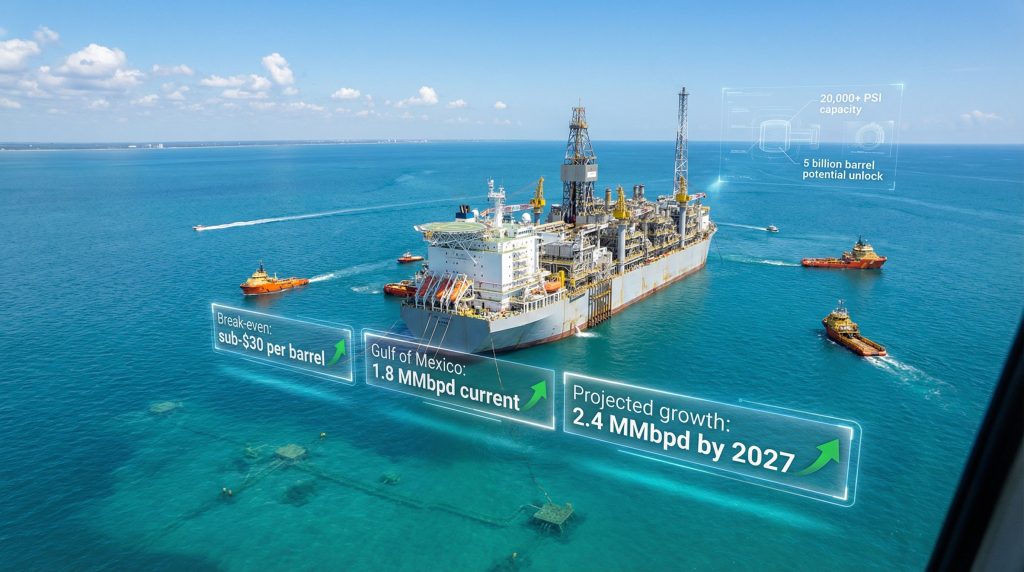
The Gulf of Mexico remains the most mature deepwater province, benefiting from extensive infrastructure, established regulatory frameworks, and proximity to major refining centres. Current production levels provide a foundation for incremental development while new discoveries extend the productive life of existing infrastructure.
Furthermore, industry analysis suggests that Gulf production will play an increasingly critical role as onshore unconventional output stabilises. The existing infrastructure base provides significant competitive advantages for new developments, reducing capital requirements and accelerating project timelines compared to frontier basins.
Emerging High-Potential Basins
Global Deepwater Development Priorities:
| Region | Primary Advantages | Development Stage |
|---|---|---|
| West Africa | Significant resource base, established infrastructure | Mature development |
| Brazil | Proven geology, local content capabilities | Advanced development |
| Guyana-Suriname | World-class discoveries, favourable fiscal terms | Early development |
| Indonesia | Proximity to Asian markets, government support | Emerging opportunity |
| India | Large domestic market, policy support | Evaluation phase |
The North Sea presents a unique case where policy considerations have significantly impacted development activity. Current fiscal regimes, particularly profit levy structures, have created uncertainty that constrains investment despite favourable geology and existing infrastructure. For instance, policy modifications could rapidly transform the investment attractiveness of this mature basin.
Market Dynamics Influencing Investment Decisions
Capital allocation decisions in deepwater development reflect complex interactions between rig availability, market fundamentals, and operator-specific strategic priorities. Understanding these dynamics provides insight into likely development patterns and investment opportunities, particularly considering oil price rally dynamics that influence profitability thresholds.
Equipment Availability and Utilisation
Rig availability varies significantly across operators and project types. Smaller, more agile operators report relatively easy access to drilling capacity for shorter-duration programmes, while larger operators typically secure rigs through longer-term contracts that provide greater schedule certainty.
The current market structure allows nimble operators to capitalise on opportunities through rapid equipment deployment. This operational flexibility represents a competitive advantage for companies capable of quick decision-making and project execution, particularly in volatile market conditions.
Investment Scale Considerations
Different operator categories approach deepwater investment with varying risk tolerances and capital constraints. Mid-sized operators emphasise agility and rapid pivoting capability, while larger companies focus on systematic, long-term development programmes requiring substantial capital commitments.
Operator Categories and Investment Approaches:
• Large Operators: Long-term contracts, systematic development, major capital commitments
• Mid-Size Companies: Flexible contracting, opportunistic development, measured risk exposure
• Specialised Players: Niche expertise, technical innovation, targeted investments
Competitive Analysis: Deepwater versus Alternative Energy Sources
The deepwater offshore resurgence occurs within a broader context of energy transition and evolving resource competition. Understanding competitive positioning requires analysis of lifecycle economics, operational characteristics, and strategic value propositions.
Comparative Economics Framework
Deepwater projects compete against multiple energy sources across different time horizons and risk profiles. Onshore unconventional production provides the most direct comparison, particularly regarding marginal cost structures and development timelines. Additionally, OPEC production impact continues to influence global supply dynamics and competitive positioning.
Current onshore gas operations report breakeven costs around $2 per MMBtu, establishing a competitive benchmark for deepwater developments. However, this comparison requires consideration of production decline rates, drilling intensity requirements, and long-term sustainability factors that favour deepwater economics.
Operational Methodology Innovations
Successful onshore operators have developed operational strategies that reduce costs through simultaneous development of multiple large-scale, multi-well pads rather than isolated individual wells. This "combo-development" approach reportedly achieves cost reductions of up to 30% compared to traditional sequential development.
Similar principles apply to deepwater development, where clustering multiple wells around central production facilities optimises infrastructure utilisation and reduces per-unit development costs. The economies of scale inherent in deepwater projects often exceed those achievable in onshore environments.
Risk Assessment: Critical Challenges Limiting Growth
Despite favourable economic trends and technological advances, the deepwater offshore resurgence faces significant operational and market risks that could constrain future growth. Identifying and addressing these challenges represents a critical success factor for sustained sector expansion.
Workforce Availability Constraints
Skilled labour shortages represent perhaps the most immediate operational constraint facing deepwater operators. Specific technical roles, particularly hydraulic workover unit operations, present acute challenges in securing qualified personnel.
The workforce challenge varies by operational scope and geographic focus. Companies with established operations report better personnel retention, while the broader industry faces a shrinking available talent pool, particularly for U.S.-based operations compared to international assignments.
Critical Workforce Issues:
• Qualified hydraulic workover unit operators
• Experienced managerial personnel for international operations
• Technical specialists for automated drilling systems
• Skilled maintenance and production optimisation technicians
Regional differences in workforce availability drive operational strategies. International operations increasingly rely on expatriate managerial personnel combined with local technical staff, requiring coordination with government workforce development programmes.
Operational and Technical Constraints
Beyond workforce issues, deepwater operations face ongoing challenges related to equipment availability, technical complexity, and environmental compliance. These factors create operational uncertainties that must be incorporated into project planning and risk assessment.
Primary Technical Risk Categories:
• Equipment reliability in harsh offshore environments
• Weather-related operational delays and interruptions
• Complex reservoir management in ultra-deep formations
• Integration challenges for advanced automation systems
The next major ASX story will hit our subscribers first
Future Trajectory: Technology and Market Evolution
The long-term outlook for deepwater offshore development depends on continued technological advancement and favourable market evolution. Industry leaders express confidence that significant opportunities remain for efficiency improvements and cost reduction across all operational phases.
What Are The Next Production Optimisation Frontiers?
While drilling and completion technologies have achieved substantial efficiency gains, production-side optimisation represents the next major opportunity for technological advancement. Emerging technologies include enhanced plunger lift systems, electrical submersible pump innovations, advanced automation, and artificial intelligence applications across production operations.
Industry consensus indicates that technology advancement will continue despite substantial efficiency gains already achieved. The production phase offers particular promise for breakthrough innovations that could further improve project economics and operational reliability.
Technology Development Priorities:
• Artificial intelligence integration in production optimisation
• Advanced automation systems for remote operations
• Predictive maintenance algorithms for subsea equipment
• Enhanced reservoir management through digital twin technology
Strategic Scenario Framework
Future deepwater development will unfold within multiple possible scenarios driven by energy transition pace, unconventional production trajectories, and global energy demand evolution. Understanding these scenarios enables better investment decision-making and strategic planning.
Scenario Planning Variables:
• Unconventional production plateau timing and duration
• Global energy demand growth patterns and geographic distribution
• Energy transition impact on long-cycle investment attractiveness
• Regulatory environment evolution across key deepwater basins
Industry analysis suggests the deepwater offshore resurgence reflects fundamental shifts in energy economics rather than cyclical market movements, positioning the sector for sustained growth over the coming decade.
Investment Outlook and Strategic Implications
The deepwater offshore resurgence represents more than opportunistic investment in favourable market conditions. Structural changes in global energy supply and demand fundamentals support sustained investment in long-cycle deepwater assets as a strategic necessity for portfolio diversification and production sustainability.
Successful participation in this resurgence requires careful attention to technological capabilities, operational efficiency, and risk management across multiple dimensions. Companies that effectively navigate workforce constraints, embrace automation technologies, and execute performance-based contracting strategies are positioned to capture the most significant value from ongoing market evolution.
Furthermore, the deepwater resurgence in key regions continues to gain momentum as operators recognise the strategic value of these long-term assets in their portfolios.
Strategic Success Factors:
• Technological innovation adoption and integration
• Workforce development and retention strategies
• Performance-based contracting expertise
• Geographic diversification across promising basins
• Risk management frameworks for complex projects
The deepwater offshore resurgence reflects a maturation of both technological capabilities and market understanding that positions the sector for sustained growth. While challenges remain, the fundamental drivers supporting deepwater development appear likely to strengthen rather than diminish over the coming decade.
Disclaimer: This analysis is based on industry trends and publicly available information. Investment decisions should incorporate comprehensive due diligence and professional financial advice. Market conditions, regulatory environments, and technological developments may change rapidly, affecting project economics and investment attractiveness.
Looking for High-Impact Energy Investments?
Discovery Alert's proprietary Discovery IQ model delivers instant notifications on significant ASX mineral and energy discoveries, enabling subscribers to identify actionable opportunities ahead of the broader market. Begin your 14-day free trial today and position yourself to capitalise on the next major discovery whilst the deepwater resurgence continues to unfold.