June 29, 2026
The Infrastructure Gap That Made Floating LNG Vessels Inevitable
Decades of ambitious offshore discovery across sub-Saharan Africa repeatedly collided with the same structural obstacle: the coast. Deepwater fields holding billions of barrels of oil equivalent sat beneath waters that were simply too far from functioning onshore pipeline grids, processing hubs, and export terminals to be monetised through conventional means. The capital required to build that shore-based infrastructure often exceeded the appetite of host governments navigating thin fiscal margins, while project timelines of ten to fifteen years for onshore LNG facilities made the economics even harder to defend.
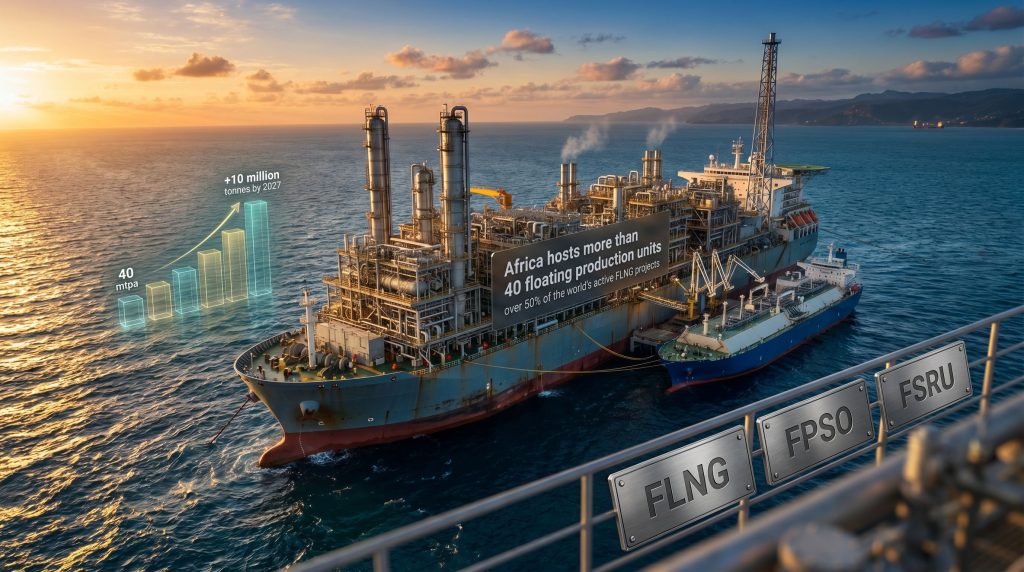
That infrastructure gap, paradoxically, became the continent's greatest accelerant for floating technology adoption. When the shore cannot come to the resource, the processing plant goes to the field instead. Today, Africa hosts more than 40 floating production units, and the continent now accounts for more than half of all active FLNG projects globally. What was once an engineering workaround has become a fully established asset class, commanding serious attention from project finance lenders, equity funds, and sovereign wealth managers alike.
Furthermore, the LNG supply outlook for 2025 and beyond underscores why floating LNG vessels in Africa are attracting unprecedented levels of institutional capital and strategic interest from both public and private sector actors.
When big ASX news breaks, our subscribers know first
Five Vessel Classes, One Integrated Strategy: Understanding the Floating LNG Ecosystem
One of the most persistent sources of confusion in boardroom discussions about African offshore energy is the assumption that all floating vessels serve the same purpose. They do not. Each vessel class occupies a distinct position within the offshore production and monetisation chain, and understanding these distinctions is essential before evaluating any specific project or investment.
Floating LNG vessels are not simply large ships anchored offshore. They are fully integrated production, processing, storage, and export facilities capable of replacing entire onshore LNG plant complexes. This functional distinction is what makes them strategically and financially significant far beyond their physical footprint.
The table below provides a structured comparison of all five vessel types currently operating across Africa's offshore energy economy.
| Vessel Type | Full Name | Primary Function | Onshore Infrastructure Required? | Primary African Use Case |
|---|---|---|---|---|
| FPSO | Floating Production, Storage & Offloading | Extracts, separates, stores, and exports crude oil | No | Angola and Nigeria deepwater oil fields |
| FSO | Floating Storage & Offloading | Stores and transfers crude; no processing | Partial | Supplementary storage at producing fields |
| FLNG | Floating Liquefied Natural Gas | Liquefies offshore gas to -162°C for export | No | Mozambique, Congo, Senegal-Mauritania |
| FSRU | Floating Storage & Regasification Unit | Converts imported LNG back into pipeline-ready gas | Minimal | Egypt import terminals including Ain Sokhna |
| FSU | Floating Storage Unit | Buffer LNG storage offshore; no regasification | No | Paired with FSRUs as complementary storage |
How the FLNG Liquefaction Process Works at Sea
The engineering achievement embedded within a floating LNG vessel is rarely appreciated outside specialist circles. Cooling natural gas to -162 degrees Celsius reduces its volume by approximately 600 times, transforming what would otherwise be an unshippable gaseous resource into a dense, transportable liquid commodity. The challenge is performing this industrial process on a hull that pitches and rolls in open water, requires its own power generation, and must maintain cryogenic integrity across years of continuous operation far from any drydock.
The process itself follows a logical sequence:
- Raw wellhead gas is drawn from subsea wells via flexible risers to the vessel's topsides processing deck.
- Impurities including water, carbon dioxide, hydrogen sulphide, and heavier hydrocarbons are separated and removed.
- The cleaned gas stream passes through a refrigerant-based liquefaction train, progressively chilled through heat exchanger stages until it reaches cryogenic temperature.
- The resulting LNG is stored in purpose-built insulated tanks onboard the vessel.
- LNG is periodically offloaded to shuttle tankers via cryogenic transfer arms or hoses, then shipped to receiving terminals globally.
This condensed supply chain, from wellhead to export-ready cargo, occurs entirely offshore and without a single metre of onshore pipeline. Development timelines for FLNG projects typically run five to eight years from final investment decision to first cargo, compared to ten to fifteen years or longer for equivalent onshore LNG train construction, a compression of roughly 50% that fundamentally transforms project financing logic. Shell's floating LNG overview provides additional technical context on how these cryogenic systems are engineered to function reliably in offshore marine environments.
FPSO vs FLNG: Why the Commodity Distinction Matters
The FPSO dominates Africa's oil-producing basins for the same reason FLNG is reshaping its gas sector: both eliminate the need for fixed coastal infrastructure, but they serve entirely different commodity streams. An FPSO is engineered around crude oil separation, dehydration, and storage, while an FLNG unit is built around gas processing and cryogenic liquefaction.
Fields producing both oil and associated gas increasingly require integrated floating strategies that deploy both vessel types within a single development concept. Angola's Agogo hub, operated by Azule Energy, exemplifies this convergence as FPSO-anchored oil production increasingly occurs alongside associated gas volumes that will require their own monetisation pathway.
Where Floating LNG Vessels Are Operating Across Africa Right Now
The deployment map of floating production units across Africa has expanded considerably over the past four years, driven by a combination of deepwater discovery maturation and accelerating European demand for non-Russian gas supply. The table below captures the current state of play across the continent's key FLNG and FPSO projects.
| Country | Project | Operator | Vessel Type | Status | Capacity |
|---|---|---|---|---|---|
| Mozambique | Coral Sul | Eni | FLNG | Operational since 2022 | 3.4 mtpa |
| Mozambique | Coral Norte | Eni | FLNG | Expected ~2028 | TBC |
| Republic of Congo | Tango FLNG | Eni | FLNG | Operational since late 2023 | Combined ~3 mtpa |
| Republic of Congo | Nguya FLNG | Eni | FLNG | First cargo early 2026, ahead of schedule | ~3 mtpa combined |
| Senegal and Mauritania | Greater Tortue Ahmeyim (Gimi) | BP / Kosmos Energy | FLNG | Operational; targeting 30+ cargoes in 2026 | 2.5 mtpa (scalable to 5 mtpa) |
| Cameroon | Hilli Episeyo | Perenco | FLNG | Operational since 2018 | Established baseline |
| Nigeria | UTM Offshore FLNG | UTM Offshore | FLNG | Financing stage; African Export-Import Bank involvement | TBC |
| Egypt | Ain Sokhna | Various | FSRU | Operational (seasonal import) | Demand-side security |
| Angola | Agogo Hub | Azule Energy | FPSO | Development phase | TBC |
Mozambique: Where Africa's FLNG Commercial Benchmark Was Set
Coral Sul's entry into production in 2022 represented a genuine inflection point for the entire continent's offshore energy narrative. As Africa's first purpose-built FLNG vessel, it demonstrated that deepwater gas fields in politically complex environments could be monetised at scale through floating technology, and the results since commissioning have reinforced that thesis. The vessel has shipped more than 100 LNG cargoes to European buyers, primarily under long-term offtake agreements, establishing a commercial track record that project finance lenders can model with growing confidence.
Coral Norte, the planned sister vessel, is expected to nearly double Mozambique's FLNG export capacity when it comes online around 2028. The significance extends beyond raw production volumes. Each additional cargo shipped strengthens Mozambique's sovereign credit story, builds fiscal revenue that reduces dependence on concessional borrowing, and deepens relationships with European counterparts seeking reliable long-term gas supply.
For a country that has navigated a difficult decade of debt restructuring and security challenges in its northern Cabo Delgado province, the Coral Sul track record represents hard evidence that its offshore resources can generate durable economic returns.
West Africa's Emerging FLNG Corridor
The Greater Tortue Ahmeyim project spanning the maritime border between Senegal and Mauritania is structurally distinctive in several respects. It represents a functioning cross-border energy cooperation model in a region where such arrangements are historically difficult to sustain, and its Gimi FLNG vessel is targeting more than 30 LNG cargoes in 2026 as it ramps toward a design capacity of 2.5 million tonnes per annum, with an expansion pathway to 5 mtpa.
In the Republic of Congo, Eni's two-vessel FLNG strategy has produced results ahead of original schedule. The Nguya FLNG unit shipped its first cargo in early 2026, combining with the already-operational Tango vessel to reach approximately 3 million tonnes per annum of combined throughput. The pace of Nguya's ramp-up signals operational maturity rather than pioneering risk, a distinction that matters significantly when pricing insurance, securing offtake agreements, and negotiating project debt terms. The strategic implications of shifting energy geopolitics further reinforce why European buyers are prioritising long-term African LNG offtake agreements over short-term spot market exposure.
Floating vs Fixed: Why Capital Is Shifting Decisively Toward Floating Units
The economic case for floating LNG vessels over onshore LNG infrastructure is not merely intuitive; it is increasingly quantifiable across multiple performance dimensions.
| Metric | Floating LNG Vessel | Onshore LNG Terminal |
|---|---|---|
| Development Timeline | 5 to 8 years typical | 10 to 15+ years |
| Relative Capital Efficiency | Approximately 50% faster and cheaper | Higher capital intensity throughout |
| Infrastructure Dependency | Minimal to none | Extensive pipelines, ports, and land required |
| Redeployability | Relocatable after field depletion | Fixed asset; stranded risk if reserves deplete |
| Permitting Complexity | Offshore jurisdiction; reduced onshore approvals | Multiple onshore regulatory layers |
| Deepwater Suitability | Optimised for deepwater deployment | Requires costly subsea pipelines without surface facilities |
The redeployability characteristic of floating units fundamentally alters residual asset value modelling for lenders and equity investors. Unlike a fixed onshore plant, a floating vessel retains optionality beyond any single field's productive life. This single attribute can materially improve the risk-adjusted return profile of project debt and extend the capital productivity of equity invested across multiple sequential deployments.
The Capital Surge: What Is Driving Over US$13 Billion in African FLNG Investment
Europe's Gas Pivot and the African Supply Response
The disruption of Russian pipeline gas supply to European markets following 2022 created an urgent and structural demand signal for alternative LNG sources. African FLNG projects, by virtue of geographic proximity relative to competing suppliers in the Pacific Basin, scalable production capacity, and demonstrated commercial viability, positioned themselves as the most credible near-term supply response available to European utilities with long-term procurement mandates.
The shift from opportunistic spot LNG purchases toward structured long-term African offtake agreements reflects a fundamental recalibration of European gas security thinking. The broader impact on global supply chains has only accelerated this repositioning, with European buyers actively reducing exposure to politically volatile supply corridors in favour of more stable long-term African partnerships.
Analyst forecasts now point to more than US$13 billion in African FLNG investment across the near-term project pipeline, with approximately 60% of global FLNG capital expenditure currently directed toward the continent. Asian shipyards, principally in South Korea and China, are constructing the hulls that underpin this investment cycle, while Gulf and Western energy majors co-invest alongside African national oil companies in the upstream field development components of these projects.
Africa's Path to 10 Million Additional Tonnes by 2027
Africa currently exports approximately 40 million tonnes of LNG annually across all production sources. FLNG projects alone are projected to add up to 10 million tonnes to that baseline by 2027, representing a capacity increment of roughly 25% from a single vessel class within a compressed timeframe. The threshold scenario in which Africa emerges as the world's dominant LNG exporting region depends on several convergent variables:
- Continued project execution discipline across Mozambique, Congo, and the Greater Tortue Ahmeyim development
- Nigeria securing final investment decisions and project financing for UTM Offshore FLNG, which would unlock Africa's largest untapped gas reserve base
- Offtake contract coverage maintaining sufficient long-term structure to support project debt service throughout operational life
- Sustained regulatory continuity and fiscal framework stability across producing nations
How Different Capital Perspectives Evaluate Floating LNG Investments
The Lender's Framework: Charter Security and Residual Value
Project finance structures for FLNG vessels depend heavily on the intersection of three variables: the tenor and creditworthiness of long-term charter agreements, the geological confidence underpinning reserve life estimates, and the residual value of the vessel itself once the original field is depleted. Export credit agencies and development finance institutions play a disproportionately important role in early-stage FLNG financing by absorbing sovereign and construction risk tranches that commercial lenders are unwilling to hold alone.
Understanding which institutions are participating in the capital stack of any specific FLNG project is therefore a meaningful indicator of overall risk appetite and perceived creditworthiness.
The Equity Investor's Framework: Reserve Conversion and Production Ramp
For equity participants, the core value proposition of an FLNG project is the speed at which offshore gas discoveries are converted into bankable production cash flows. The production ramp-up curve, the period between first cargo and plateau production, determines when net asset value calculations move from theoretical to realised, and the steepness of that curve is influenced by technical commissioning performance, offtake scheduling, and the reliability of the cryogenic processing train.
Comparing equity return profiles across FPSO-anchored oil projects and FLNG-anchored gas projects in deepwater Africa reveals meaningfully different commodity price exposure, contract structure, and reserve depletion dynamics that should be modelled separately rather than aggregated under a generic offshore Africa risk bucket.
The Host Government's Framework: Early Revenue and Fiscal Architecture
Floating units generate royalty and tax revenue earlier than equivalent onshore developments because their compressed construction timelines bring first cargo forward by years. This earlier revenue generation is not merely a convenience; it can meaningfully alter the fiscal trajectory of small economies where a single offshore project represents a significant share of export earnings.
Mozambique's experience with Coral Sul illustrates how consistent LNG cargo revenues are reshaping sovereign credit ratings and reducing dependence on external budget support. The design of production-sharing contract terms, royalty rates, and local content obligations across producing nations will determine how equitably this offshore wealth is distributed between international investors and host governments over project lifetimes.
The next major ASX story will hit our subscribers first
Key Risks Every Investor Must Evaluate
Floating LNG investments in Africa carry a layered risk profile that cannot be adequately captured by country risk ratings or commodity price assumptions alone.
Operational risk centres on vessel uptime and mechanical reliability in tropical deepwater environments. FLNG units operating continuously in harsh marine conditions are subject to corrosion, topsides equipment degradation, and mooring system fatigue that require proactive maintenance cycles. Production shortfalls during planned or unplanned maintenance windows can trigger offtake contract penalties and disrupt cargo scheduling assumptions built into project financial models.
Commercial risk is anchored in offtake contract coverage. Long-term sale and purchase agreements provide the revenue certainty that underpins project debt service, but spot market volatility creates asymmetric pressure when contracts include price indexation to spot benchmarks rather than fixed price structures. The Greater Tortue Ahmeyim project's 30-cargo target for 2026 functions as a live commercial proof-of-concept for the Gimi vessel's ability to sustain consistent cargo delivery, and its performance will influence how future FLNG offtake negotiations are structured across the West African corridor.
Sovereign and geopolitical risk varies considerably by jurisdiction. The broader geopolitical risk landscape across resource-producing regions underscores why investors must evaluate each African FLNG jurisdiction individually rather than applying a uniform continental risk premium. Production-sharing contract renegotiation risk, expropriation clauses, and the robustness of international arbitration protections embedded in host government agreements are therefore critical due diligence variables across all African FLNG jurisdictions.
Scenario Modelling: Three Trajectories for African LNG to 2030
Scenario 1: Accelerated Execution. All pipeline projects reach final investment decision by 2027. Nigeria's UTM FLNG secures financing through the African Export-Import Bank and international co-lenders. Coral Norte delivers on its 2028 timeline. Africa adds more than 15 million tonnes of annual export capacity, and the continent's share of global LNG supply rises materially. This scenario requires consistent regulatory environments, competitive shipyard delivery slots, and sustained European long-term offtake commitment.
Scenario 2: Base Case Progression. Existing operational projects maintain strong uptime. Coral Norte and Greater Tortue Ahmeyim Phase 2 deliver within current projected timelines. Africa adds approximately 10 million tonnes to its 40 mtpa baseline by 2027 to 2028. This is the most defensible central projection given current project execution trajectories.
Scenario 3: Execution Headwinds. Security disruptions in northern Mozambique, financing delays in Nigeria, or a sustained global LNG price correction slow new investment decisions. Capacity additions fall below 7 million tonnes. Competing supply growth from North American and East African producers partially captures the European demand share that African FLNG projects were positioned to fill. In addition, the green transition demand for alternative energy sources could further complicate the long-term investment case if decarbonisation policy frameworks accelerate faster than current projections assume.
Frequently Asked Questions About Floating LNG Vessels in Africa
What is the difference between an FLNG vessel and an FPSO?
An FPSO processes and stores crude oil, separating it from water and gas at the wellhead before offloading to tankers. An FLNG vessel performs the equivalent function for natural gas, but adds a cryogenic liquefaction process that converts gas into LNG for ocean transport. Both eliminate onshore infrastructure dependency, but they serve entirely different commodity streams.
Which African country has the most floating production units?
Angola leads with 16 FPSO units in operation, followed by Nigeria with 15. Both dominate the oil-focused FPSO segment. In the FLNG category specifically, Mozambique established the continental benchmark with Coral Sul and is positioned to expand significantly with Coral Norte. For further reference, Africa's active FLNG projects are comprehensively mapped across the continent's key producing basins.
Can floating LNG vessels be relocated after a field is depleted?
Yes, and this redeployability is among the most strategically important attributes of floating units from an investor perspective. Once a field's recoverable reserves are exhausted, the vessel can be repositioned to a new development, preserving residual asset value in a way that fixed onshore infrastructure categorically cannot.
Why is Africa attracting the majority of global FLNG capital expenditure right now?
Three factors converge: the continent holds some of the world's largest undeveloped offshore gas reserves, European demand for non-Russian LNG supply has created durable long-term offtake demand, and the commercial viability of FLNG technology has been empirically demonstrated by Coral Sul and the Congo LNG programme. Approximately 60% of global FLNG capital expenditure is now directed toward African projects.
Key Takeaways for Decision-Makers
- Africa hosts more than 40 floating production units and accounts for more than half of the world's active FLNG projects by count
- Floating LNG vessels cut development timelines by approximately 50% compared to onshore LNG facilities, fundamentally compressing the capital commitment-to-revenue timeline
- More than US$13 billion in African FLNG investment is forecast across the near-term pipeline, with roughly 60% of global FLNG capital expenditure concentrated on the continent
- Mozambique's Coral Sul FLNG has shipped more than 100 cargoes since 2022, establishing Africa's commercial FLNG benchmark and demonstrating sustained operational reliability
- Africa exports approximately 40 million tonnes of LNG annually, with FLNG projects alone projected to add up to 10 million tonnes by 2027
- The five vessel classes, FPSO, FSO, FLNG, FSRU, and FSU, serve distinct and complementary functions within an integrated offshore energy monetisation framework and should not be evaluated interchangeably
- Redeployability, charter contract tenor, and sovereign risk profile are the three variables that most directly determine investment viability and residual value across all floating unit classes in African offshore development
This article contains forward-looking projections and scenario modelling based on publicly available data and industry analysis. Actual outcomes may differ materially from projections depending on project execution, commodity price movements, regulatory developments, and geopolitical conditions. Nothing in this article constitutes investment advice.
Want to Know When the Next Major African Energy Discovery Hits the ASX?
Discovery Alert's proprietary Discovery IQ model delivers real-time alerts the moment significant mineral and energy discoveries are announced on the ASX, transforming complex data across more than 30 commodities into clear, actionable insights for both short-term traders and long-term investors. Explore Discovery Alert's discoveries page to understand how historic discoveries have generated substantial returns, and begin your 14-day free trial today to position yourself ahead of the market.