June 29, 2026
When Geopolitical Risk Meets Market Psychology: Understanding the Oil-Equity Relationship
Few forces reshape financial markets as rapidly and unpredictably as armed conflict in the Middle East. When military operations intersect with the world's most critical energy infrastructure, the resulting market movements reveal something fundamental about how investors process uncertainty, price risk, and make split-second decisions with incomplete information. The events that unfolded over the weekend of June 28, 2026, offer a textbook case study in this dynamic — one where stock futures rise with oil prices after U.S. attacks on Iran, crude surged, and the underlying narrative was far more nuanced than any single headline could capture.
When big ASX news breaks, our subscribers know first
The Strait of Hormuz: Why This Waterway Controls Global Energy Pricing
To understand why U.S. military strikes on Iranian targets caused immediate repricing across global energy and equity markets, it is essential to first understand the geography of crude oil supply. The Strait of Hormuz, a narrow passage connecting the Persian Gulf to the Gulf of Oman, is widely regarded as the single most consequential oil transit chokepoint on the planet.
Approximately 20% of the world's total oil supply moves through this waterway daily. The nations most dependent on Hormuz for crude exports include Saudi Arabia, the United Arab Emirates, Kuwait, and Iraq, collectively representing a substantial portion of OPEC+ production capacity. OPEC's market influence over this region means that any credible threat to shipping through this corridor triggers immediate upward pressure on Brent and WTI futures contracts, often well before any physical supply disruption is confirmed.
This is the risk premium mechanism in action. Commodity traders and hedge funds do not wait for tankers to be turned back before bidding crude higher. They price the probability of disruption into futures markets the moment a credible threat materialises. The result is that geopolitical events in the Persian Gulf carry an outsized influence on global energy benchmarks relative to their immediate, measurable supply impact.
How the Risk Premium Gets Built Into Crude Futures
The mechanics of this process are worth understanding clearly:
-
A conflict event or military strike is reported, raising the perceived probability of Hormuz shipping disruption.
-
Speculative traders, primarily commodity-focused hedge funds and institutional desks, begin building long positions in Brent and WTI futures.
-
This buying pressure lifts futures prices independent of any change in physical crude availability.
-
The elevated futures price then flows through to spot markets, energy equities, and consumer fuel pricing.
-
The premium gradually deflates as the conflict situation either escalates into confirmed disruption or de-escalates toward resolution.
This mechanism explains why, as crude oil price trends consistently demonstrate, crude can move 3% or more within hours of a geopolitical event, only to partially reverse within days if no physical supply interruption materialises.
What the Market Data Actually Shows: Separating Two Distinct Scenarios
A critical source of confusion in understanding the phrase stock futures rise with oil prices after U.S. attacks on Iran is that it conflates two fundamentally different market scenarios that played out at different points in the same conflict cycle.
The table below clarifies the two distinct market environments:
| Market Scenario | Crude Oil Direction | Equity Futures Direction | Trigger |
|---|---|---|---|
| Escalation (U.S. strikes on Iran) | Brent +0.8% to $72.57/bbl | S&P 500 futures +0.4%, Dow +0.2%, Nasdaq +0.5% | Geopolitical risk premium, supply disruption fear |
| De-escalation (Tentative peace deal) | Brent -5%+ | Equity futures rally | Risk premium removed, investor confidence restored |
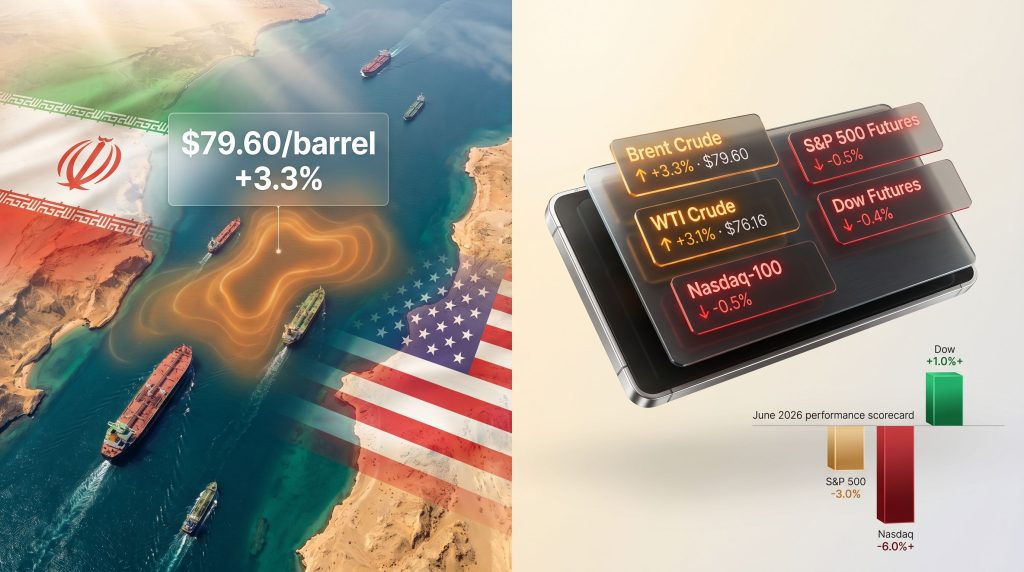
In the escalation scenario following the weekend airstrikes, according to PBS reporting on U.S. strikes, stock futures actually moved higher in early Sunday trading. Dow Jones futures advanced 124 points or 0.2%, S&P 500 futures rising 0.4%, and Nasdaq-100 futures advancing 0.5%. International Brent crude climbed 0.8% to $72.57 per barrel, while West Texas Intermediate advanced 1.1% to $70 per barrel.
This is a subtler and more interesting market response than a simple inverse relationship would predict. Rather than collapsing on geopolitical news, equity futures edged higher. This suggests markets were interpreting the strikes as a contained escalation rather than a trigger for catastrophic regional conflict, and were simultaneously pricing in the possibility of a negotiated resolution.
"When geopolitical events fail to produce the worst-case scenario investors had already feared, markets can paradoxically move higher. If a conflict has been well-telegraphed and partially priced in, the confirmation of a limited strike can actually reduce tail risk compared to the ambiguous uncertainty that preceded it."
The Prior Week's Rotation: Tech Weakness Before the Strikes
The geopolitical escalation did not arrive into a calm, healthy market. In the week preceding the weekend strikes, Wall Street had already experienced a significant internal rotation driven by concerns entirely separate from the Middle East conflict. Furthermore, these market volatility dynamics were already reshaping investor positioning well before the airstrikes.
The S&P 500 fell approximately 2% over the prior week, while the Nasdaq Composite shed approximately 4.6%, a substantial decline driven overwhelmingly by technology sector weakness. The specific damage to individual names was severe:
-
Nvidia declined more than 8%
-
Alphabet fell more than 8%
-
Meta Platforms, Apple, and Amazon each dropped more than 4%
-
SpaceX tumbled approximately 17% in the period following its public market debut
In sharp contrast, the Dow Jones Industrial Average advanced approximately 0.6% for the same week, led by healthcare names. Merck gained 13% and Johnson & Johnson rose 11.5%, illustrating a clear rotation from high-growth technology into more defensive, value-oriented sectors.
AI Fatigue: The Structural Headwind Beneath the Surface
The rotation out of technology was not primarily geopolitical in origin. Ed Yardeni, president of Yardeni Research, identified the core investor concern as growing scepticism about whether the enormous capital expenditure being deployed by major technology companies on artificial intelligence infrastructure would generate proportionate financial returns.
There is also a compounding fear that rapid AI model iteration could quickly render current-generation infrastructure investments obsolete, a process sometimes described as technological creative destruction. This matters for understanding market structure because it means technology stocks entered the weekend geopolitical event in an already-weakened fundamental position.
When a major index sector is under structural selling pressure, external shocks do not need to be the primary driver of drawdowns. They function as an accelerant applied to an existing fire. Consequently, AI fatigue represents a secular headwind that will persist regardless of how the Iran conflict resolves, constraining the Nasdaq's ability to recover as strongly as it might in a purely geopolitical de-escalation scenario.
June 2026 Scorecard: Where Markets Stood at Month-End
As the final trading week of June approached, the performance divergence between major indices was striking:
| Index | June 2026 Performance (to June 27 close) |
|---|---|
| S&P 500 | -3.0% |
| Nasdaq Composite | -6.0%+ |
| Dow Jones Industrial Average | +1.0%+ |
The Dow's positive June performance while both the S&P 500 and Nasdaq declined meaningfully signals a depth of sector rotation that goes beyond typical defensive positioning. Institutional investors appear to be making deliberate, sustained allocation shifts away from technology and growth toward more traditional value sectors — a trend that quarter-end rebalancing flows are likely to reinforce rather than reverse.
Scenario Analysis: Two Market Paths Forward
The conflict between the United States and Iran creates two clearly defined market trajectories, and the difference between them is large enough to warrant serious consideration from investors managing portfolio risk.
Scenario A: Further Escalation or Strait of Hormuz Disruption
-
Brent crude could test levels in the $85 to $90 per barrel range based on historical supply shock precedents from the 1990 Gulf War and the 2003 Iraq invasion
-
Broad equity markets would face additional downward pressure, with technology and consumer discretionary sectors most exposed
-
Safe-haven gold demand would intensify alongside flows into U.S. Treasuries and the U.S. dollar
-
Energy sector equities and defence contractors would emerge as relative outperformers
Scenario B: Ceasefire or Negotiated Resolution
-
Brent crude could fall 5% or more rapidly, as demonstrated by prior tentative peace deal market reactions where the risk premium is abruptly removed
-
Equity futures would likely rally, reversing the geopolitical discount embedded in current pricing
-
Technology and growth stocks could benefit from relief buying, though AI fatigue headwinds would remain as a structural constraint on the magnitude of any recovery
-
The Nasdaq would likely outperform the Dow in a de-escalation scenario given its compressed recent performance
However, as MarketWatch analysis of new Iran attacks notes, markets are currently priced for managed uncertainty — neither full escalation nor full resolution. This positioning creates asymmetric risk in both directions. A decisive move toward either scenario would likely produce market reactions considerably larger than the modest moves observed in early Sunday trading, as forced repositioning by institutional investors amplifies the initial signal.
Furthermore, the broader impact on oil prices from compounding geopolitical and trade pressures suggests that energy markets face layered uncertainty extending well beyond the immediate conflict timeline.
The next major ASX story will hit our subscribers first
SpaceX's Nasdaq-100 Inclusion: Structural Demand Amid Geopolitical Noise
Separate from the geopolitical narrative, a significant structural market event was confirmed on the same weekend. SpaceX was announced as one of the fastest-ever additions to the Nasdaq-100 index, following its recent public market debut.
Under the confirmed timeline, index-tracking funds and ETF sponsors would be required to purchase SpaceX shares after market close on July 6, with official inclusion effective July 7. This creates a mechanical, non-discretionary buying wave driven entirely by passive index replication rather than fundamental investment decisions.
For investors, this represents a structural demand driver that exists independently of both geopolitical conditions and AI sentiment. Passive index inclusion events have historically provided short-term price support for newly added constituents, as trillions of dollars in index-tracking capital must acquire shares at or near the effective date regardless of prevailing market conditions. The addition also reshapes the Nasdaq-100's sector composition, increasing its exposure to the commercial space and aerospace sector.
FAQ: U.S. Strikes on Iran, Oil Prices, and Stock Market Impact
Did stock futures rise or fall after the U.S. attacks on Iran?
In the immediate aftermath of the weekend airstrikes, stock futures actually moved modestly higher. Dow Jones futures rose 124 points or 0.2%, S&P 500 futures gained 0.4%, and Nasdaq-100 futures advanced 0.5%. A separate scenario involving a tentative peace deal produced a different combination of falling oil prices and rising equity futures.
Why did crude oil prices rise after the U.S. strikes on Iran?
The airstrikes heightened the perceived risk of disruption to shipping through the Strait of Hormuz, through which approximately 20% of global oil supply transits. Even without confirmed physical supply disruption, futures markets price in a risk premium when this corridor faces a credible threat.
What is the Strait of Hormuz and why does it matter?
It is a narrow waterway between Iran and Oman connecting the Persian Gulf to global ocean routes. Major Middle Eastern producers including Saudi Arabia, the UAE, Kuwait, and Iraq depend on it for crude exports, making it the world's most critical oil transit chokepoint.
What is AI fatigue and how is it affecting technology stocks?
AI fatigue refers to growing investor scepticism about whether the massive capital expenditure being deployed on artificial intelligence infrastructure by major technology companies will generate sufficient financial returns. Combined with fears that rapid AI model development could render current infrastructure investments obsolete, this concern has been a significant driver of Nasdaq underperformance in June 2026.
What would cause both oil prices and stock futures to rise simultaneously?
This occurs when the geopolitical risk premium is perceived as manageable. Markets interpret a contained military action as reducing tail risk rather than increasing it, with investors simultaneously anticipating higher energy sector profits while believing broader economic disruption remains unlikely — producing the scenario where stock futures rise with oil prices after U.S. attacks on Iran.
This article contains forward-looking scenarios and market analysis that involve forecasts and speculation. Past market behaviour during geopolitical events does not guarantee future outcomes. Readers should conduct their own research and consult qualified financial advisors before making investment decisions.
Want to Stay Ahead of the Next Major Market-Moving Discovery?
While geopolitical events and oil price swings dominate headlines, significant mineral discoveries on the ASX can deliver equally dramatic market movements — and timing is everything. Discovery Alert's proprietary Discovery IQ model delivers real-time alerts the moment significant ASX mineral discoveries are announced, transforming complex data across 30+ commodities into clear, actionable insights — so investors can act before the broader market catches on. Explore Discovery Alert's dedicated discoveries page to see how historic finds have generated extraordinary returns, and begin your 14-day free trial today to secure a genuine market-leading edge.