June 29, 2026
The Hidden Economics of Pumped Hydro: Why Cheaper Isn't Always the Winner
Long-duration energy storage sits at the centre of every serious national grid decarbonisation strategy. As coal-fired baseload generation is progressively retired across Australia, the gap between intermittent renewable supply and reliable dispatchable power grows wider. The Mt Rawdon pumped hydro project shelved by Qld government is a stark illustration of how political and institutional dynamics can override cost-efficiency logic. Pumped hydro remains the most proven technology for filling that gap at scale, accounting for more than 90% of all installed grid-scale energy storage capacity worldwide.
Queensland's decision to shelve the Mt Rawdon pumped hydro project in mid-2026 is a case study in exactly that tension.
When big ASX news breaks, our subscribers know first
What the Mt Rawdon Project Actually Proposed
Situated near Mount Perry, roughly 75 kilometres south-west of Bundaberg in regional Queensland, the Mt Rawdon site is operated by gold mining company Evolution Mining. The core proposal involved repurposing the existing open-cut mine infrastructure into a grid-scale pumped hydro energy storage facility rather than undertaking full site rehabilitation as a traditional mine closure.
The engineering rationale was straightforward. Pumped hydro works by using surplus electricity to pump water from a lower reservoir to an upper one, then releasing it through turbines when demand peaks. What makes the Mt Rawdon site particularly suited to this application is its steep natural topography, which allows water to be cycled between upper and lower reservoirs across a relatively short horizontal distance while generating substantial head pressure.
In pumped hydro engineering, head refers to the vertical height difference between the two reservoirs, and greater head translates directly into greater energy output per unit of water moved.
The project overview headline figures were substantial:
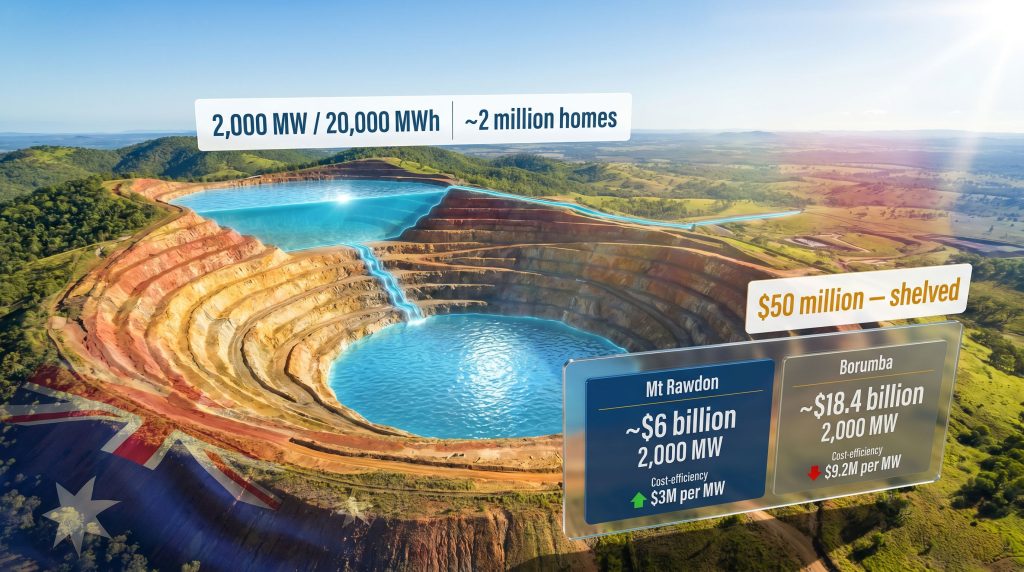
- Proposed generating capacity: 2,000 megawatts (MW)
- Energy storage: 20,000 megawatt-hours (MWh)
- Estimated capital cost: approximately $6 billion
- Projected homes powered: approximately 2 million
- Distance to existing transmission infrastructure: approximately 27 kilometres
Critically, the project would operate within an already-disturbed environmental footprint, leveraging existing access roads, water management infrastructure, and approved land use. This is not a trivial advantage. Greenfield pumped hydro projects routinely face multi-year environmental assessment processes, community consultation requirements, and cultural heritage studies. A mine void conversion compresses much of that timeline by starting from a footprint that regulators have already assessed.
Why Mine-to-Hydro Conversions Are Attracting Global Interest
The concept of repurposing retired or transitioning mine sites for energy storage is gaining traction internationally. Furthermore, mine reclamation innovation is increasingly being recognised as a viable pathway for delivering cost-effective, rapidly deployable storage capacity. Former open-cut mines offer:
- Pre-existing topographic relief that reduces civil earthworks costs
- Established water management and drainage systems
- Access roads and transmission easements already in place
- Disturbed land classifications that simplify environmental approvals
- Reduced greenfield biodiversity impact concerns
Several feasibility studies across Europe and North America have examined analogous conversions, particularly in post-coal regions where governments seek both energy transition outcomes and regional economic continuity. Mt Rawdon represented one of Australia's most advanced examples of this model.
The Budget Decision That Changed Everything
The Mt Rawdon pumped hydro project had accumulated meaningful regulatory and financial momentum heading into 2026. The Queensland government allocated $50 million in its 2025-26 budget toward feasibility work, design studies, and potential project acquisition through CleanCo Queensland, the state-owned clean energy corporation. An Environmental Impact Statement was submitted in May 2024, with a Draft EIS progressing toward public review. In March 2025, the project was included on the Federal Government's Renewable Energy Priority List, a framework designed to accelerate national regulatory approvals.
Then came the Queensland Investment Corporation's verdict.
The QIC was tasked with conducting a comprehensive comparative assessment of four pumped hydro proposals under consideration for state investment: Mt Rawdon, Big-T (north of Toowoomba), Capricornia (near Mackay), and Borumba. Following six months of extensive consultation and analysis, the QIC concluded its assessment and began debriefing proponents. The findings themselves were classified as confidential.
The outcome was unambiguous. Mt Rawdon would not be progressed as a priority project. Evolution Mining's chairman described the company's reaction as one of genuine surprise and disappointment, particularly given the depth of engagement throughout the review process.
The 2025-26 budget instead committed $324.3 million to early works at the Borumba Pumped Hydro Energy Storage project, with total project costs estimated at approximately $18.4 billion.
Borumba vs Mt Rawdon: The Numbers Tell a Complex Story
The contrast between the two projects on a pure cost-efficiency basis is striking.
| Metric | Mt Rawdon | Borumba |
|---|---|---|
| Proposed Capacity | 2,000 MW | 2,000 MW |
| Estimated Total Cost | ~$6 billion | ~$18.4 billion |
| Cost Per MW | ~$3 million/MW | ~$9.2 million/MW |
| Infrastructure Footprint | Existing mine site | Seven new dams required |
| Grid Distance | ~27 km | Not specified |
| FY26 Government Commitment | Shelved | $324.3 million |
| Environmental Footprint | Pre-disturbed | New river system works |
| Current Status | Private capital review | Early works commenced |
Mt Rawdon's implied cost of approximately $3 million per megawatt compares to Borumba's implied cost of approximately $9.2 million per megawatt for equivalent generating capacity. This is a cost differential that energy economists and infrastructure analysts are likely to examine closely as both projects' business cases are scrutinised over time.
The Borumba project involves constructing seven dams across the Mary River system, including an upper reservoir 1.5 times the size of the existing Borumba Dam. It is a substantially more complex civil engineering undertaking on undisturbed river catchment land, with attendant cultural heritage, hydrology, and ecological considerations. In early 2025, the project had already prompted a design rethink following the identification of Indigenous cultural sites within the proposed construction zone.
Why Borumba Won the Political Calculus
Understanding the decision requires acknowledging that infrastructure investment at this scale is never purely a financial optimisation exercise. Borumba was a signature commitment of the former Queensland Labor government's energy transition agenda, carrying substantial political capital and institutional momentum. Government agencies, planning bodies, and community stakeholders had already invested years of preparation in that project.
Abandoning Borumba in favour of a mine conversion, however economically rational, would have represented a significant political reversal. The QIC's role was to assess delivery options, not necessarily to identify the lowest-cost solution in isolation.
The Capricornia pumped hydro project near Mackay, rated at 750 MW, was designated for continued investigation as a secondary priority following the review. Big-T and Mt Rawdon were effectively deferred to private sector consideration.
The Pioneer-Burdekin Cancellation: Crucial Context
Queensland's pumped hydro policy landscape cannot be fully understood without reference to the cancellation of the Pioneer-Burdekin Pumped Hydro Project, a proposed 5 gigawatt facility that was abandoned due to escalating cost projections. That decision signalled a deliberate shift away from mega-scale hydro ambitions toward projects with more clearly defined construction risk profiles and manageable capital requirements.
The paradox is notable. Mt Rawdon, with its comparatively modest $6 billion price tag, limited civil engineering complexity, and established environmental footprint, appeared well-positioned as a direct beneficiary of that policy recalibration. The government's subsequent decision to shelve it in favour of the considerably more expensive Borumba project represents a strategic contradiction that analysts are likely to continue questioning as Queensland's energy transition costs accumulate.
Furthermore, the broader picture of pumped hydro investment trends globally suggests that cost-efficient, rapidly deployable projects are increasingly favoured by both public and private capital allocators — making Queensland's approach all the more noteworthy.
What Happens to the Mine Site Now?
Evolution Mining is currently processing very low-grade ore stockpiles at the Mt Rawdon site, an operation expected to conclude by September 2026. Once that activity ceases, the company faces a decision point with several possible pathways:
- Pursue private capital markets to fund continued development of the pumped hydro concept independently of government ownership
- Assess whether the site retains any residual viability as a conventional gold mining operation
- Progress standard mine rehabilitation and site closure under existing environmental obligations
- Hold development optionality while the broader energy storage investment landscape evolves
The company has confirmed it is actively exploring the private capital pathway. This is not without precedent in Australian infrastructure. Pumped hydro assets have attracted increasing interest from infrastructure funds, superannuation funds, and energy transition-focused private equity, drawn by long-duration contracted revenue streams and the strategic value of dispatchable storage capacity in tightening electricity markets.
What a Private Funding Path Would Actually Require
A privately financed Mt Rawdon project would need to navigate several interconnected challenges before reaching a final investment decision:
- Completion of the Draft EIS and successful public and regulatory review under Queensland's coordinated project framework
- Assembly of an institutional capital consortium capable of underwriting approximately $6 billion in project development costs
- Negotiation of long-term revenue agreements, whether through capacity market mechanisms, offtake contracts, or bilateral arrangements with large energy retailers or the Australian Energy Market Operator (AEMO)
- Resolution of site tenure following the conclusion of gold processing in September 2026
- Potential re-engagement with state or federal government if Queensland's storage pipeline encounters delays at Borumba or Capricornia
The project's existing federal Renewable Energy Priority List status, completed EIS submission, and advanced engineering assessments represent tangible sunk value that a private investor consortium could leverage rather than rebuild from scratch.
The next major ASX story will hit our subscribers first
Implications for Queensland's Energy Transition Credibility
The shelving of the Mt Rawdon pumped hydro project raises questions that extend beyond a single site. At its core, the decision reflects a government strategy of concentrating public risk capital into fewer, larger bets rather than distributing investment across a diversified portfolio of mid-scale storage projects.
This approach carries real execution risk. A single flagship project of Borumba's complexity and cost concentration creates a scenario where delays, cost overruns, or technical setbacks have outsized consequences for the state's overall decarbonisation timeline. By contrast, a portfolio approach including Mt Rawdon would have provided both redundancy and optionality.
In addition, mining sustainability transformation efforts nationally will be watching this outcome closely, as the decision signals ambivalence toward mine rehabilitation as a legitimate energy transition mechanism. Energy transition advocates have noted that the decision also signals mixed messages toward renewable energy in mining contexts, despite growing international evidence that this model can deliver cost-effective, rapidly deployable storage capacity at scale.
However, the mining decarbonisation benefits of projects like Mt Rawdon extend well beyond simple megawatt calculations. Consequently, how that signal is interpreted by other mine operators considering similar conversions across Queensland and nationally will be worth watching closely as the energy transition accelerates.
Disclaimer: This article contains analysis, projections, and cost comparisons based on publicly available information and reported project estimates. These figures are subject to change as projects progress through feasibility, engineering, and regulatory processes. Nothing in this article constitutes financial advice. Readers should conduct independent research before making investment decisions related to any companies or projects mentioned.
Want to Stay Ahead of the Next Major Energy or Mineral Discovery on the ASX?
Discovery Alert's proprietary Discovery IQ model scans ASX announcements in real time, instantly identifying significant mineral discoveries and translating complex data into actionable investment insights — whether you're a short-term trader or a long-term investor positioning for transformative opportunities. Explore historic examples of exceptional discovery returns and begin your 14-day free trial today to secure a market-leading edge.