
June 15, 2026
What Is the Defense Production Act's Role in Modern Energy Security?
The intersection of emergency powers and critical infrastructure governance has become a defining challenge for modern democracies, particularly as energy security trends intensify amid global supply disruptions. These regulatory frameworks, originally designed for wartime mobilisation, now face unprecedented applications in peacetime energy policy decisions involving the Defense Production Act and oil pipeline infrastructure.
Historical Evolution from Wartime Manufacturing to Critical Infrastructure
The Defense Production Act emerged from the Korean War mobilisation efforts in 1950, establishing a legal framework that has evolved far beyond its original wartime manufacturing purpose. Enacted on September 8, 1950, under 50 U.S.C. § 4501 et seq., this legislation granted the President extraordinary authority to prioritise contracts relating to "national defense" during emergencies.
The statutory framework deliberately avoided defining "national defense" with specificity, creating expansive executive interpretation across multiple economic sectors. This ambiguity has proven both a strength and a weakness, allowing presidential administrations to apply the Act to diverse challenges while raising constitutional questions about the scope of federal emergency powers.
Modern applications have stretched well beyond traditional military equipment production. During the COVID-19 pandemic, the Trump administration invoked the Defense Production Act to accelerate production of ventilators, personal protective equipment, and testing supplies. Executive Order 13910, issued on March 23, 2020, demonstrated how contemporary presidents interpret national security to encompass public health emergencies.
Legal Framework for Federal Energy Emergency Powers
Section 101 of the Defense Production Act provides that the President may "require that performance under contracts or orders for such products or services shall take priority over performance under any other contract or order." This creates a hierarchical priority system where DPA-designated projects receive preferential access to materials, labour, and resources over competing commercial interests.
The mechanism operates through several steps:
- Presidential determination of national defence necessity
- Issuance of priority allocation orders to private entities
- Mandatory compliance requirements for affected companies
- Federal enforcement authority over non-compliance cases
Historical energy applications include petroleum allocation during the 1973 Arab oil embargo and subsequent energy crises. However, these precedents focused on supply distribution rather than overriding state environmental regulations, marking a significant doctrinal expansion in contemporary applications.
Comparison with Other Federal Preemption Mechanisms
The Defense Production Act functions as one of several federal preemption mechanisms available under the Supremacy Clause of Article VI of the Constitution. Unlike other preemption doctrines that require explicit Congressional authorisation or field occupation, the DPA grants unilateral executive authority during declared emergencies.
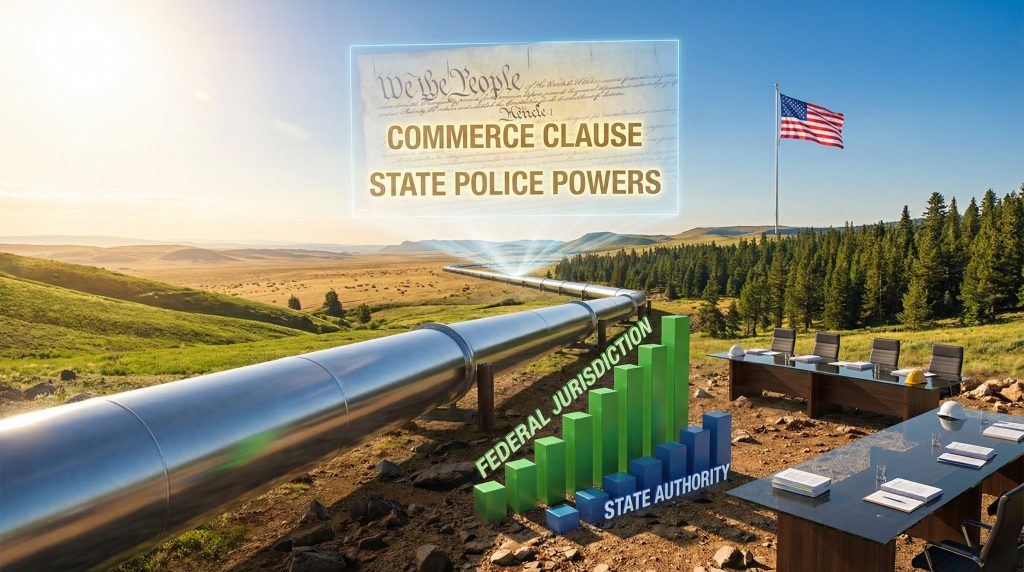
This distinguishes it from traditional Commerce Clause applications, where federal authority over interstate commerce must be balanced against state police powers. The Act's emergency provisions theoretically override this balance, though such applications remain largely untested in federal courts.
| Federal Preemption Type | Legal Basis | Congressional Role | Judicial Review |
|---|---|---|---|
| Express Preemption | Explicit statutory language | Required | Standard constitutional review |
| Field Preemption | Comprehensive federal regulation | Required | Balancing test application |
| Conflict Preemption | Impossibility of dual compliance | Required | Pike balancing standard |
| DPA Emergency Powers | Presidential emergency determination | Post-hoc oversight only | Unclear judicial standard |
When big ASX news breaks, our subscribers know first
Why Are Federal-State Energy Jurisdiction Conflicts Intensifying?
Constitutional Commerce Clause vs. State Police Powers
The current intensification of federal-state energy jurisdiction conflicts stems from fundamental constitutional tensions between federal Commerce Clause authority and state police powers reserved under the Tenth Amendment. This tension has reached a critical juncture as energy infrastructure projects increasingly cross state boundaries while triggering state environmental protection requirements.
California's approach exemplifies this conflict through the California Environmental Quality Act (CEQA), which requires extensive environmental review for major projects regardless of federal involvement. CEQA operates under state police powers for environmental protection and public safety, creating direct confrontation with federal interstate commerce authority.
The Supreme Court's framework in Pike v. Bruce Church, Inc. (1970) established a balancing test for facially neutral state laws that incidentally burden interstate commerce. Under this standard, state environmental regulations must demonstrate that their local benefits clearly outweigh their burden on interstate commerce.
Environmental Federalism in Energy Infrastructure Development
Environmental federalism has created a complex regulatory landscape where state agencies retain significant authority even over federally-regulated energy projects. The Clean Water Act's Section 401 water quality certification requirements exemplify this shared authority, allowing states to condition federal permits through environmental review processes.
Recent litigation in Waterkeeper Alliance v. Department of Energy (2020) established that states retain meaningful environmental review authority over federally-regulated pipelines. This precedent reinforces state capacity to impose environmental conditions that can effectively halt federal energy projects, particularly when considering Venezuela energy policy implications.
The offshore California pipeline situation demonstrates these dynamics. While federal regulators asserted control in December 2025, a state consent decree from 2015 pipeline spill litigation has created conflicting regulatory authority. This consent decree requires specific pressure testing requirements that must be satisfied before pipeline operations can resume.
Interstate vs. Intrastate Pipeline Classification Disputes
Pipeline jurisdictional classification represents a critical battleground between federal and state regulatory authority. The distinction between interstate and intrastate pipeline operations determines whether projects fall under Federal Energy Regulatory Commission (FERC) jurisdiction or state regulatory control.
Interstate pipelines transport energy across state boundaries and fall under federal jurisdiction through FERC regulation under the Natural Gas Act and analogous oil pipeline statutes. Intrastate pipelines operate within state boundaries and remain subject to state regulation, even when transporting energy ultimately destined for out-of-state markets.
The Sable Offshore pipeline controversy illustrates these classification disputes. The pipeline network transports crude oil produced from offshore platforms approximately 35 miles off the California coast. While the oil may ultimately reach interstate markets, the pipeline operations occur within California state jurisdiction, complicating federal preemption claims.
How Does DPA Preemption Authority Actually Work in Practice?
Legal Requirements for Presidential DPA Invocation
Presidential invocation of Defense Production Act authority requires meeting specific statutory criteria, though these requirements remain deliberately broad to preserve executive flexibility during emergencies. The March 3, 2026, Department of Justice legal opinion explicitly states that the statute "authorises the President to regulate private entities in ways that may be inconsistent with state law."
However, this interpretation represents a significant doctrinal expansion not previously tested in environmental consent decree contexts. The opinion does not address whether established state court judgements constitute protected state sovereignty interests that might survive federal preemption challenges.
The legal requirements include:
- Presidential determination that the action relates to "national defence"
- Formal invocation through executive order or presidential directive
- Specific entity designation requiring compliance with federal priorities
- Enforcement mechanism establishment for non-compliance cases
Scope of "National Defence" in Energy Context
The expansive interpretation of "national defence" has evolved significantly since the Act's 1950 enactment. Contemporary applications encompass economic stability, critical supply chain resilience, and infrastructure security concerns that extend far beyond traditional military preparedness.
Current market conditions provide context for potential national defence justifications. WTI crude broke through $90/barrel on March 6, 2026, driven by Middle East supply disruptions and Strait of Hormuz closure concerns, reflecting broader oil price adjustments. Alaska North Slope crude simultaneously hit record highs as Asian demand surged for alternative supply sources.
The Defense Production Act grants the President authority to require that performance under contracts or orders relating to national defence shall take priority over performance under any other contract or order, potentially overriding state regulatory frameworks when energy security concerns are determined to affect national defence interests.
Preemption Standards Under Federal Law
Federal preemption doctrine operates through three primary mechanisms, each presenting different legal standards for Defense Production Act and oil pipeline applications:
Express Preemption requires explicit Congressional language demonstrating clear intent to preempt state law. The DPA contains no such explicit language regarding state environmental laws or consent decrees, creating legal vulnerability for expansive interpretations.
Field Preemption occurs when federal law comprehensively occupies an entire regulatory field. Energy regulation remains a shared federal-state jurisdiction, with states retaining traditional police powers over environmental protection and public safety.
Conflict Preemption applies when compliance with both federal and state requirements becomes impossible, or when state law obstructs federal objectives. This presents the strongest legal theory for DPA applications to energy infrastructure, though it remains untested in consent decree contexts.
What Are the Strategic Implications for Energy Infrastructure Development?
Precedent-Setting Potential for Future Pipeline Projects
A successful Defense Production Act and oil pipeline application to override state environmental consent decrees would establish unprecedented federal authority over energy infrastructure development. This precedent could fundamentally alter the regulatory landscape for future pipeline projects, shifting the balance of power from shared federal-state jurisdiction toward unilateral executive control during declared emergencies.
The implications extend beyond immediate pipeline operations to broader energy infrastructure policy. Projects involving natural gas transmission, renewable energy transmission lines, and critical minerals order processing facilities could potentially invoke similar federal preemption authority during future energy security crises.
Market participants are closely monitoring this development as a potential game-changer for regulatory risk assessment. Infrastructure investors traditionally factor both federal and state regulatory approval into project timelines and financial modelling. DPA preemption authority could significantly accelerate project approval processes whilst creating new legal and political risks.
Impact on State Environmental Review Processes
State environmental review processes, particularly in states with stringent environmental protection frameworks like California, face potential marginalisation if DPA preemption authority expands. The California Environmental Quality Act (CEQA) and similar state environmental statutes could lose effectiveness as regulatory tools if federal emergency powers can routinely override their requirements.
This development creates strategic tensions for environmental compliance across the energy sector. Companies may increasingly seek federal emergency declarations to bypass state environmental review processes, potentially accelerating a shift toward federal centralisation of energy infrastructure decisions.
Environmental justice communities, which often rely on state-level environmental protections, could face reduced regulatory protection if federal preemption becomes a standard tool for energy infrastructure development. This raises questions about community consultation requirements and environmental impact assessment processes under emergency federal authority.
Investor Confidence in Regulatory Certainty
The potential expansion of DPA authority creates both opportunities and risks for energy infrastructure investors. On the positive side, federal preemption could reduce regulatory uncertainty by eliminating state-level veto points that have historically delayed or cancelled major infrastructure projects.
However, the legal uncertainty surrounding DPA applications creates new investment risks. Projects relying on federal preemption face potential prolonged litigation challenges, Congressional oversight investigations, and political backlash that could ultimately prove more costly than traditional regulatory approval processes.
| Investment Risk Factor | Traditional Regulatory Process | DPA Preemption Process | Risk Assessment |
|---|---|---|---|
| Regulatory approval timeline | 2-5 years typical | 6-18 months potential | Reduced timeline risk |
| Legal challenge probability | Moderate (30-40%) | High (70-80%) | Increased litigation risk |
| Political risk exposure | State-level primarily | Federal-level primarily | Shifted but not reduced |
| Community opposition | Local focus | National attention | Amplified visibility risk |
Which Legal Challenges Could Emerge from DPA Energy Applications?
Constitutional Law Considerations
Defense Production Act and oil pipeline applications to energy infrastructure face several constitutional law challenges that could limit their effectiveness or durability. The most fundamental challenge concerns the scope of executive power during peacetime emergencies, particularly when overriding state judicial decisions rather than state legislation.
Separation of powers concerns arise when executive branch DPA authority attempts to override state court consent decrees. These decrees represent judicial branch determinations that have resolved private litigation through negotiated settlements. Federal executive override of state judicial decisions raises constitutional questions about judicial independence and the balance of powers between executive and judicial branches.
Tenth Amendment challenges could argue that federal preemption of state environmental police powers exceeds constitutional limits on federal authority. States retain significant sovereignty over environmental protection and public safety under the Tenth Amendment, and DPA applications must demonstrate that national defence concerns genuinely override these sovereign state interests.
The Due Process Clause presents additional challenges, particularly regarding notice and hearing requirements before federal preemption takes effect. Private parties affected by consent decree modifications may have due process rights to challenge federal override authority in court proceedings.
Environmental Justice and Community Rights
Environmental justice considerations could generate significant legal challenges to DPA energy applications, particularly in communities disproportionately affected by energy infrastructure projects. The 2015 pipeline spill that triggered the current consent decree had significant environmental impacts on coastal communities, and DPA override attempts may face claims of discriminatory environmental enforcement.
Procedural justice requirements under federal environmental law may still apply even during DPA invocations. The National Environmental Policy Act (NEPA) and environmental justice executive orders could require consultation and impact assessment processes that limit the speed advantages of DPA applications.
Community standing to challenge DPA applications presents complex legal questions. Whilst the Act grants broad executive authority, affected communities may retain rights to challenge the factual basis for national defence determinations or to seek judicial review of procedural compliance with federal environmental justice requirements.
Procedural Due Process Requirements
Due process challenges to DPA applications could focus on several procedural requirements that must be satisfied even under emergency federal authority:
Notice requirements to affected parties, including state governments, private companies, and impacted communities, may be constitutionally required before DPA authority takes effect. Emergency powers do not eliminate all procedural safeguards, particularly when overriding existing legal obligations.
Hearing opportunities for affected parties to challenge the factual basis for national defence determinations could be required under due process standards. Courts may require that DPA invocations be based on substantial evidence rather than mere executive assertion.
Judicial review standards for DPA applications remain unclear, creating uncertainty about the level of deference courts will provide to executive national defence determinations. The Youngstown Sheet & Tube Co. v. Sawyer (1952) precedent suggests that executive power is not unlimited even during national emergencies.
How Might This Reshape Federal Energy Policy Going Forward?
Potential Expansion to Other Energy Infrastructure Types
Successful DPA application to oil pipeline operations could establish a template for federal preemption across diverse energy infrastructure categories. Natural gas transmission projects, frequently delayed by state environmental review processes, represent logical next targets for DPA applications during future energy supply disruptions influenced by OPEC oil production impact.
Renewable energy transmission lines crossing multiple state jurisdictions could invoke DPA authority to accelerate grid modernisation projects deemed essential for national energy security. The interstate nature of renewable energy transmission creates strong federal Commerce Clause justification for DPA applications.
Critical mineral processing facilities may also benefit from DPA preemption authority, particularly given growing concerns about supply chain security for materials essential to clean energy infrastructure and national defence applications. Rare earth element processing, battery material refinement, and strategic mineral extraction could all potentially qualify for DPA emergency designation.
The precedent could extend to energy storage infrastructure, including large-scale battery installations and pumped hydro storage projects that face state-level siting and environmental challenges. These facilities are increasingly recognised as critical components of national energy security infrastructure.
State Response Strategies and Counter-Litigation
States are likely to develop sophisticated counter-strategies to limit the effectiveness of federal DPA preemption authority over energy infrastructure. Multi-state litigation coordination could challenge the constitutional basis for DPA applications, particularly focusing on Tenth Amendment sovereignty and procedural due process requirements.
Legislative responses at the state level might include enhanced environmental protection statutes specifically designed to resist federal preemption. States could also develop legal theories arguing that certain state environmental protections are essential governmental functions that cannot be preempted even under emergency federal authority.
Interstate compacts for environmental protection could create regional resistance to federal energy infrastructure preemption. Multi-state agreements might establish shared environmental standards that present stronger legal challenges to federal override attempts than individual state regulations.
California and other environmentally progressive states may develop alternative regulatory frameworks that maintain environmental protection whilst technically complying with federal preemption requirements. These could include enhanced federal consultation requirements, alternative environmental review processes, or conditional compliance mechanisms.
Congressional Oversight and Legislative Modifications
Congressional response to expansive DPA applications will likely determine the long-term viability of using 1950s emergency powers for contemporary energy infrastructure decisions. Oversight hearings could examine whether current DPA applications exceed Congressional intent when the statute was originally enacted.
Legislative modifications to the Defense Production Act could either expand or constrain executive authority over energy infrastructure. Pro-energy development legislators might seek to codify DPA authority over energy projects, whilst environmental protection advocates could push for explicit limitations on environmental preemption.
Funding restrictions through Congressional appropriations could limit the practical effectiveness of DPA energy applications. Congress could restrict funding for federal agencies implementing DPA preemption orders, creating practical constraints on executive authority even when legal authority exists.
The Government Accountability Office may conduct investigations into the economic and environmental costs of DPA energy applications, providing Congressional oversight with empirical data on the effectiveness and consequences of emergency preemption policies.
The next major ASX story will hit our subscribers first
What Does This Mean for Energy Market Participants?
Risk Assessment for Infrastructure Investors
Energy infrastructure investors face fundamentally altered risk assessment frameworks if Defense Production Act preemption becomes a standard tool for project development. Traditional regulatory risk models that factor state-level approval processes into project timelines and financial projections require significant revision.
Legal risk exposure increases significantly for projects relying on DPA preemption authority. Whilst federal preemption might accelerate initial project approval, the likelihood of prolonged litigation challenges creates new categories of legal expenses and timeline uncertainty that could ultimately exceed traditional regulatory costs.
Political risk assessment becomes more complex as DPA applications shift regulatory focus from state to federal political dynamics. Projects face potential Congressional oversight investigations, changes in presidential administration policies, and national political attention that may be more intense than local or state-level opposition.
Market volatility presents both opportunities and challenges. Current crude oil price spikes, with WTI breaking through $90/barrel and Alaska North Slope crude hitting record highs, create political pressure for expedited energy infrastructure development that supports DPA applications. However, this same volatility creates uncertainty about long-term project economics.
Compliance Strategy Implications
Energy companies must develop dual-track compliance strategies that prepare for both traditional state regulatory processes and potential federal DPA preemption scenarios. This requires maintaining capabilities for standard environmental review whilst simultaneously developing rapid-response systems for federal emergency procedures.
Environmental compliance programmes need expansion to address federal emergency standards that may differ significantly from state environmental requirements. Companies may need to maintain parallel documentation systems that satisfy both state environmental review processes and potential federal emergency compliance requirements.
Stakeholder engagement strategies require recalibration to address both local community concerns and national political dynamics. DPA applications generate broader media attention and political scrutiny than traditional regulatory processes, requiring enhanced public relations and government relations capabilities.
Insurance and risk management products may need revision to address the unique risks associated with DPA preemption projects. Traditional regulatory risk insurance may not cover political and legal challenges specific to federal emergency preemption applications.
Long-term Regulatory Trend Analysis
The potential normalisation of Defense Production Act applications to energy infrastructure suggests a broader trend toward federal centralisation of energy policy decisions. This shift could reduce the influence of state-level environmental groups and increase the importance of federal policy advocacy for energy companies.
Regulatory convergence between national security and energy policy creates new institutional dynamics as defence and energy agencies coordinate more closely on infrastructure decisions. The Department of Energy's expanded role in DPA applications could establish it as the primary federal agency for energy infrastructure emergency decisions.
International implications of DPA energy applications could affect global energy investment patterns. Foreign investors in U.S. energy infrastructure may view federal preemption authority as either an attractive streamlining mechanism or a concerning expansion of government control over private investments.
| Regulatory Trend | 2015-2025 Pattern | 2026+ Projection | Market Impact |
|---|---|---|---|
| Federal vs. State Authority | Shared jurisdiction predominant | Federal expansion likely | Reduced state veto power |
| Environmental Review Timeline | 18-36 months typical | 6-12 months potential | Accelerated project development |
| Legal Challenge Frequency | 25-35% of major projects | 60-75% of DPA projects | Increased litigation costs |
| Political Risk Concentration | State/local focus | Federal/national focus | Amplified political exposure |
Balancing Federal Energy Security with State Sovereignty
The Defense Production Act's potential application to energy infrastructure represents a fundamental test of American federalism principles during energy security crises. The legal framework established in 1950 for wartime manufacturing mobilisation now confronts complex contemporary challenges involving environmental protection, community rights, and interstate commerce regulation that the original statute did not contemplate.
Constitutional tensions between federal emergency powers and state environmental sovereignty will likely require judicial resolution that clarifies the boundaries of executive authority during peacetime energy emergencies. These precedents could influence federal-state relations across multiple policy domains beyond energy infrastructure. Furthermore, oil pipeline infrastructure development litigation continues to test constitutional boundaries.
Market implications extend beyond immediate project approval processes to encompass fundamental questions about regulatory predictability, investment risk assessment, and the role of emergency powers in routine infrastructure development decisions. Energy market participants must prepare for a potentially transformed regulatory landscape whilst maintaining compliance capabilities for traditional approval processes.
Democratic governance questions arise from the expansion of emergency executive powers into areas traditionally governed through deliberative regulatory processes involving public participation, environmental review, and state-federal cooperation. The balance between energy security imperatives and democratic oversight of infrastructure decisions remains an evolving challenge for American energy policy.
This analysis is for educational purposes only and does not constitute investment advice. Energy infrastructure investments involve significant risks including regulatory, environmental, and market uncertainties that may result in substantial losses. Readers should consult qualified financial advisors before making investment decisions and conduct independent research on specific projects and regulatory developments.
Ready to Capitalise on Energy Infrastructure Opportunities?
The evolving regulatory landscape around energy infrastructure development creates significant implications for ASX-listed companies involved in oil and gas exploration, pipeline operations, and energy services. Discovery Alert's proprietary Discovery IQ model provides real-time notifications when Australian energy companies announce significant developments that could benefit from shifting regulatory frameworks, ensuring you're positioned ahead of market movements when energy infrastructure opportunities emerge. Begin your 14-day free trial today to stay informed about actionable opportunities in the dynamic energy sector.