
June 6, 2026
The Global Silver Supply Crisis Nobody Is Talking About
The world's primary silver mines are quietly running out of road. Decades of underinvestment in exploration have left the development pipeline dangerously thin at precisely the moment when industrial demand is accelerating. Photovoltaic solar manufacturing, electric vehicle electronics, and next-generation power infrastructure are collectively consuming silver at a rate that existing producing mines are struggling to match. The Silver Institute has documented consecutive annual physical market deficits, yet the number of large-scale, construction-ready primary silver projects globally remains vanishingly small.
This supply-demand asymmetry creates a very specific investment thesis: projects with genuine scale, advanced permitting, and credible economics become extraordinarily scarce assets. Furthermore, silver supply deficits continue to widen, making it essential to understand which undeveloped deposits actually meet that threshold — requiring analysis beyond headline resource numbers and examination of the full constellation of factors that separate a feasible mine from a perpetual development story.
The AbraSilver Diablillos silver-gold project in Argentina has recently accumulated a series of milestones that position it as one of the most analytically interesting assets in the global silver development pipeline. The convergence of a materially expanded resource base, fiscal incentive approval, and primary environmental clearance within a compressed timeframe warrants serious examination from investors, industry analysts, and mining sector observers alike.
When big ASX news breaks, our subscribers know first
Where Diablillos Sits: Geography, Scale, and Logistical Context
The Diablillos project occupies a commanding position on Argentina's Puna plateau, straddling the provinces of Salta and Catamarca at elevations ranging from 4,100 to 4,650 metres above sea level. This high-altitude setting is both a technical challenge and a geological signal: the Puna plateau is one of South America's most prolific precious and base metal mineral belts, hosting a cluster of significant deposits that have attracted sustained exploration capital over several decades.
The project encompasses 11,403 hectares across 15 contiguous mineral concessions, held in their entirety by AbraSilver Resource Corp. (TSX: ABRA; OTCQX: ABBRF) since 2016. The concessions sit approximately 160 km southwest of Salta city and roughly 375 km northwest of Catamarca, with year-round road accessibility providing a logistical advantage that many comparable high-altitude projects in the Andes cannot match.
Operating at this elevation introduces real engineering complexity. Equipment must be derated to account for reduced air density, diesel combustion efficiency drops materially above 4,000 MASL, and workforce acclimatisation requirements affect labour planning and productivity assumptions. However, these are well-understood engineering constraints with documented solutions from comparable operations across Chile, Peru, and Bolivia, rather than novel technical unknowns.
What Does the Diablillos Mineral Resource Actually Look Like?
Measured and Indicated Resource Scale
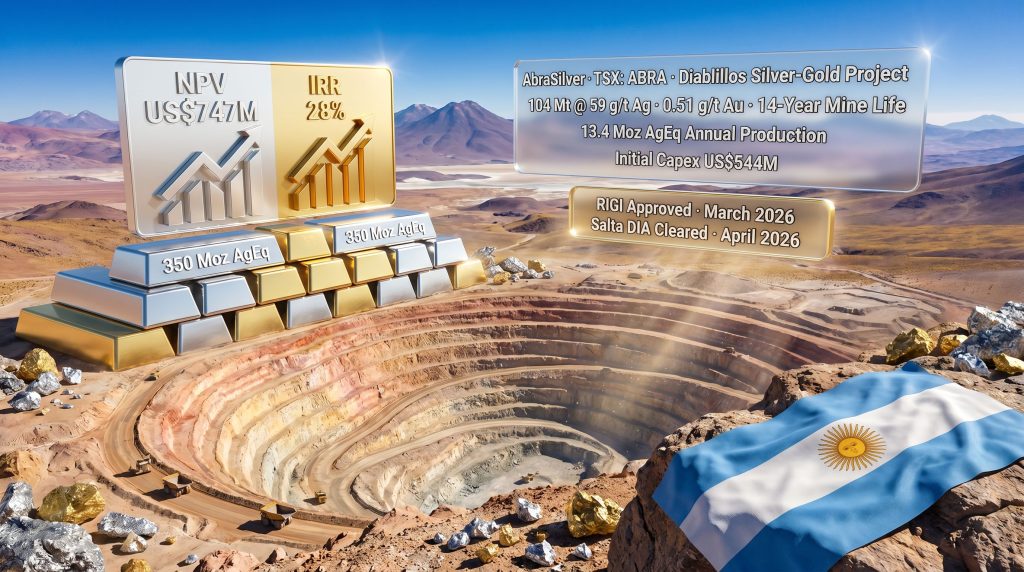
The current Measured and Indicated mineral resource stands at 104 million tonnes grading 59 g/t silver and 0.51 g/t gold, containing approximately 199 million ounces of silver and 1.7 million ounces of gold, aggregating to 350 million ounces of silver-equivalent (AgEq). This represents growth of approximately 27% in AgEq terms compared to the prior estimate, which covered tank leach material only.
| Resource Category | Tonnes | Silver Grade | Gold Grade | Contained Ag | Contained Au | AgEq Total |
|---|---|---|---|---|---|---|
| Measured and Indicated | 104 Mt | 59 g/t Ag | 0.51 g/t Au | 199 Moz | 1.7 Moz | 350 Moz AgEq |
| Prior MRE (tank leach only) | – | – | – | ~159 Moz | ~1.36 Moz | ~276 Moz AgEq |
| Growth vs. Prior Estimate | – | – | – | +25% | +14% | +27% |
The resource update's most strategically significant element is the inclusion of a maiden heap leach resource category. This is not simply an accounting exercise. The addition of lower-grade material that heap leach processing can economically treat at meaningfully lower capital cost per tonne changes the shape of the deposit's economic profile. Lower-grade ore previously excluded from mineable inventory now contributes to life-of-mine planning and provides a foundation for phased development optionality that single-methodology projects cannot replicate.
The Multi-Deposit Architecture
Diablillos is not a single-zone deposit. The resource base is structured across multiple mineralised bodies:
- Oculto deposit: The primary high-grade core driving the bulk of the Measured and Indicated resource
- JAC, Laderas, Fantasma, and Sombra deposits: Satellite zones currently contributing to inferred categories, each representing independent resource growth vectors
- Total drilling programme: Over 157,000 metres accumulated across all phases, providing a robust data foundation for resource confidence classification
- Phase IV (20,000 metres): Now complete and incorporated into the updated resource estimate
- Phase V: Ongoing, targeting resource conversion at satellite zones and new zone identification within the broader project footprint
Geological Insight: The multi-deposit structure at Diablillos creates a resource growth runway that single-body deposits fundamentally cannot replicate. Each satellite zone carries independent potential to extend mine life, support throughput expansion decisions at the DFS stage, or justify future resource upgrades as drilling density increases.
What is less commonly understood about silver deposits at high-altitude epithermal systems in the Puna region is the tendency for mineralisation to occur in structurally controlled corridors that can persist laterally and at depth beyond initial drill intercepts. The Fantasma and Sombra zones, as relatively newer discoveries within the Diablillos footprint, may represent the early-stage identification of broader mineralised trends that Phase V drilling is designed to test.
How Does the December 2024 PFS Define the Project's Economic Profile?
Core Economics at a Glance
The December 2024 prefeasibility study provides the current economic foundation for Diablillos. Key parameters are summarised below:
| Economic Metric | Value |
|---|---|
| Life of Mine | 14 years |
| Average Annual Production | 13.4 Moz AgEq |
| Average Annual Silver Production | 7.6 Moz Ag |
| Average Annual Gold Production | 72,000 oz Au |
| Peak Production (Years 1-5) | 16.4 Moz AgEq |
| Peak Silver (Years 1-5) | 11.7 Moz Ag |
| Mining Method | Open-pit at 9,000 tpd |
| Initial Capital Expenditure | US$544M (incl. contingency) |
| Sustaining Capital Expenditure | US$77M |
| After-Tax NPV | US$747M |
| After-Tax IRR | 28% |
What a 28% IRR Actually Means in Silver Development Context
An after-tax internal rate of return of 28% carries real significance in the precious metals development sector. For context, development-stage silver projects with IRRs consistently above 20% under base-case metal price assumptions are generally considered economically robust by project finance practitioners, with meaningful buffer capacity against both silver price weakness and capital cost escalation.
Many undeveloped silver projects globally produce feasibility-stage IRRs in the 15-18% range at comparable pricing assumptions, which leaves little margin for the capital cost inflation and commodity price volatility that characterise the period between study completion and first production. The 28% figure at Diablillos provides an uncommon degree of economic resilience for a project at this stage of development.
It is worth noting that all IRR and NPV figures are base-case estimates derived from specific metal price assumptions embedded in the PFS. Investors should treat these figures as indicative rather than definitive, and sensitivity analysis across a range of silver and gold price scenarios remains essential for comprehensive evaluation. The definitive feasibility study, targeting completion in H1 2026, will provide updated and more granular economic modelling.
Front-Loaded Production: Why Mine Plan Sequencing Matters
The contrast between peak production of 16.4 Moz AgEq in the first five years and a 14-year average of 13.4 Moz AgEq reflects a deliberately front-loaded mine plan. This is not accidental design. Front-loading precious metal production into a mine's early years serves several strategic purposes that are well understood in project finance:
- Accelerated capital payback: Higher early cash flows reduce the time to recover the initial US$544M investment, compressing the period of maximum financial exposure
- Reduced long-dated commodity price risk: Cash flows concentrated in years one through five are exposed to a shorter horizon of silver price uncertainty compared to projects with flat production profiles
- Improved NPV sensitivity: Earlier cash generation increases the present value of the mine plan at any given discount rate, improving project attractiveness to lenders and equity investors alike
- Project finance alignment: Debt service schedules for project finance facilities typically require peak cash flow generation in the early operational years, making front-loaded mine plans structurally compatible with conventional financing models
Argentina's RIGI Framework and What Approval Actually Means
Understanding the Large Investment Incentive Regime
Argentina's Régimen de Incentivo para Grandes Inversiones (RIGI) is a fiscal framework designed to attract large-scale capital into strategic sectors including mining, energy, and infrastructure. The regime offers a structured package of protections and incentives that directly address the concerns that have historically deterred foreign mining investment in Argentina. In addition, broader Argentina mining developments across the country demonstrate that the investment climate is evolving in favour of major resource projects.
Key RIGI provisions include:
- Fiscal stability guarantees: Protection against future legislative changes to the tax treatment of qualifying investments for the duration of the project's contractual term
- Import duty relief: Reduced or eliminated customs duties on capital equipment, consumables, and operational inputs, directly affecting the capital cost structure of large mine builds
- Foreign exchange flexibility: Relaxed restrictions on the repatriation of capital and profits, addressing what has historically been one of the most significant structural deterrents to mining investment in Argentina
- Early-phase tax incentives: Reduced corporate income tax burden during the initial operational period, improving early cash flow generation
RIGI Approval and Dual-Province Alignment
Argentina's Economy Ministry confirmed Diablillos' RIGI qualification in March 2026. Critically, both Salta and Catamarca provinces formally opted into the RIGI framework, creating alignment across the project's dual-province footprint. This dual opt-in matters because Argentina's federal structure gives provinces meaningful regulatory autonomy, and a divergence between provincial positions could introduce jurisdictional complexity into an otherwise advancing project timeline.
Regulatory Note: RIGI qualification is not a routine administrative process. Projects must demonstrate compliance with minimum investment thresholds and meet environmental and social standards to qualify. The dual-province opt-in and federal qualification together represent a layered de-risking event that materially improves the project's attractiveness to project finance lenders and institutional investors.
How RIGI Changes the Investment Calculation
| Scenario Dimension | Without RIGI | With RIGI |
|---|---|---|
| Foreign Exchange Risk | High; peso volatility affects operational cost base | Materially mitigated through forex flexibility provisions |
| Tax Stability | Exposed to future legislative changes | Contractually protected for investment duration |
| Capital Equipment Costs | Full import duties apply to mine build | Reduced or exempt; direct capex benefit |
| Investor Confidence | Moderate; standard Argentina country risk premium applies | Improved; sovereign fiscal commitment demonstrated |
| Project Finance Accessibility | Constrained by sovereign risk perceptions | Expanded; bankability profile strengthens materially |
One dimension of RIGI that receives insufficient analytical attention is its effect on the debt-to-equity ratio achievable in project financing. Project finance lenders apply country risk adjustments that affect the leverage they are willing to extend. By providing contractual fiscal stability, RIGI can compress the effective country risk premium applied by lenders, potentially enabling higher debt financing ratios that reduce the equity dilution required to fund construction.
Permitting Progress: Environmental Approvals and the Path to Construction
Salta Province DIA Approval, April 2026
The Environmental Impact Declaration, known as the DIA (Declaración de Impacto Ambiental), represents the primary environmental permitting gate for construction authorisation in Salta Province. Its approval by provincial authorities in April 2026 cleared a foundational barrier to advancing the project toward a construction decision.
The DIA process requires comprehensive environmental baseline studies, impact assessment across multiple environmental vectors, community consultation processes, and mitigation planning documentation. The approval reflects successful navigation of this multi-stage process and positions the project for the financing and construction phases that follow.
Community and government engagement were central to the approval outcome. In Argentina's Puna region, where indigenous and local communities have a meaningful voice in resource development decisions, maintaining genuine social licence is as important as regulatory compliance. Projects that treat community engagement as a box-ticking exercise rather than a substantive stakeholder process face significant execution risk at exactly the point when construction momentum is most valuable.
Permitting and Development Timeline
The following sequence outlines the key milestones and anticipated pathway from current status to potential production:
Development Timeline Snapshot
- March 2026: RIGI fiscal incentive approval confirmed
- April 2026: Salta Province DIA environmental approval granted
- H1 2026: Definitive Feasibility Study (DFS) target completion
- 2026: Potential construction decision, subject to DFS and financing
- ~2029-2030: First production (estimated, based on 3-4 year construction timeline)
The DFS completion is the next pivotal value catalyst. It will incorporate Phase IV drilling results, updated capital and operating cost estimates, refined mine planning assumptions, and bankable technical documentation required for formal engagement with project finance lenders and potential streaming or royalty counterparties.
The next major ASX story will hit our subscribers first
Competitive Positioning: Where Diablillos Stands Globally
Argentina's Puna Region in the Broader Mining Context
| Project | Developer | Primary Metal | Development Status |
|---|---|---|---|
| Diablillos | AbraSilver Resource Corp. | Silver-Gold | Advanced PFS / DFS Stage |
| Lindero | Fortuna Silver Mines | Gold | Operating |
| Taca Taca | First Quantum Minerals | Copper-Gold | Feasibility Stage |
The Global Undeveloped Silver Project Hierarchy
At 350 Moz AgEq Measured and Indicated, Diablillos ranks among the largest undeveloped primary silver deposits in the world. However, resource size alone is not the differentiating factor. The combination of attributes that Diablillos now holds simultaneously is what makes the project analytically distinctive:
- A large, multi-deposit resource base with active drilling providing ongoing growth potential
- An advanced PFS with a robust 28% after-tax IRR and US$747M NPV
- RIGI fiscal incentive approval providing contractual protection against the sovereign risk factors that have historically constrained Argentina mining investment
- Primary environmental clearance in Salta Province, with a DFS targeting completion in H1 2026
Very few undeveloped silver projects globally hold all four of these attributes concurrently. Most comparable projects either carry the resource scale without the permitting progress, or hold environmental approvals without the fiscal framework protection, or have limited economic robustness at current metal price assumptions.
Silver Market Structural Dynamics
The macroeconomic backdrop amplifies the significance of large-scale silver development assets. Consequently, the gold-silver supply constraints affecting global markets are becoming increasingly pronounced, and the structural demand growth driven by photovoltaic solar panel manufacturing alone is substantial: each standard solar panel requires approximately 20 grams of silver for electrical contacts and conductors, and global solar installation capacity is expanding rapidly across Asia, Europe, and North America.
The Silver Institute has documented physical market deficits in consecutive recent years, driven by this demand acceleration against a supply backdrop constrained by a decade of limited primary silver mine development investment. New primary silver production capacity takes an average of seven to ten years to move from discovery through to first production, meaning that projects making construction decisions today will be delivering supply into a market that current demand trajectories suggest will remain structurally tight.
Key Risk Factors: What Investors and Analysts Must Monitor
Operational and Technical Risks
- High-altitude construction complexity: The 4,100-4,650 MASL operating environment elevates logistics, labour, and equipment costs beyond sea-level benchmarks, creating capital cost sensitivity that the DFS must explicitly address
- Water availability: Arid conditions in the Puna require robust water management planning, including storage, recycling, and potentially desalination or long-distance transfer infrastructure
- Metallurgical variability: The dual-processing pathway (tank leach and heap leach) introduces complexity around ore blending, recovery assumptions, and scheduling that requires rigorous testwork validation
Jurisdictional and Policy Risks
- Argentina's macroeconomic environment: Despite RIGI protections, Argentina's track record of fiscal policy volatility, currency devaluation, and political transitions remains a material background risk that no contractual framework fully eliminates
- RIGI political durability: Contractual fiscal stability provisions are only as durable as the political and institutional will to honour them across successive governments, which introduces a long-dated risk that is difficult to fully quantify at the time of investment decision
- Social licence continuity: Ongoing community relations in the Puna, including engagement with indigenous communities under Argentina's consultation obligations, require sustained investment and cannot be assumed stable once initial approvals are obtained
Development Execution Risks
- DFS capital cost revision: Initial capex of US$544M (inclusive of contingency) at PFS stage typically faces revision in either direction at DFS; upward pressure from global construction cost inflation remains a sector-wide concern
- Financing timeline uncertainty: Securing a project finance syndicate for a US$544M development in Argentina requires navigating sovereign risk pricing, potentially complex streaming arrangements, and equity market conditions that remain variable
- Silver price sensitivity: The NPV of US$747M and IRR of 28% are base-case projections; investors should independently model scenarios at silver prices 15-30% below PFS assumptions to assess the project's economic floor
Disclaimer: This article is for informational purposes only and does not constitute financial advice. Mineral resource estimates, economic projections, and development timelines involve inherent uncertainty. All NPV, IRR, and production figures referenced are derived from the December 2024 prefeasibility study and are subject to revision in the Definitive Feasibility Study. Investors should conduct independent due diligence before making investment decisions.
Frequently Asked Questions
What is the Diablillos project and who owns it?
Diablillos is a 100%-owned advanced-stage silver-gold exploration and development project held by AbraSilver Resource Corp. (TSX: ABRA; OTCQX: ABBRF), located in Argentina's Puna plateau across Salta and Catamarca provinces, approximately 160 km southwest of Salta city.
How large is the Diablillos mineral resource?
The current Measured and Indicated resource totals 104 million tonnes grading 59 g/t silver and 0.51 g/t gold, containing approximately 199 million ounces of silver and 1.7 million ounces of gold, aggregating to 350 million ounces of silver-equivalent. Furthermore, gold-silver ratio analysis supports the case that this combined silver-gold inventory carries meaningful strategic value at current and projected price ratios.
What does the addition of a heap leach resource mean for the project?
The inclusion of a maiden heap leach resource category expanded the project's Measured and Indicated silver inventory by approximately 25% compared to the prior tank-leach-only estimate. Heap leach processing typically carries lower capital cost per tonne than conventional tank leach milling, adding lower-grade material to the mineable inventory at economically viable processing costs and providing additional development optionality.
What are the key economic metrics from the PFS?
The December 2024 PFS outlines a 14-year mine life, average annual production of 13.4 Moz AgEq, peak production of 16.4 Moz AgEq in the first five years, initial capital expenditure of US$544M, an after-tax NPV of US$747M, and an after-tax IRR of 28%.
What is RIGI and how does it benefit the project?
RIGI is Argentina's Large Investment Incentive Regime, providing qualifying projects with contractual fiscal stability, import duty relief on capital equipment, reduced corporate tax obligations during early operations, and foreign exchange flexibility for capital and profit repatriation. Diablillos received RIGI qualification in March 2026, with both Salta and Catamarca provinces opting into the framework.
What environmental approvals has Diablillos received?
Salta Province granted the Environmental Impact Declaration approval in April 2026, representing the primary environmental permitting gate for construction activities within the province. This milestone enables the project to advance toward formal construction decision-making, subject to DFS completion and project financing.
When could Diablillos potentially enter construction?
AbraSilver is targeting DFS completion in H1 2026. A construction decision is being targeted for 2026, contingent on DFS outcomes, project financing arrangements, and remaining regulatory approvals including in Catamarca Province.
Scenario Analysis: Three Pathways to Production
Base Case: DFS Delivery and 2026 Construction Decision
The base case assumes DFS delivery in H1 2026 incorporating Phase IV drilling results and updated cost modelling. Project finance engagement commences following DFS completion, with a potential syndicate including project finance lenders and a streaming or royalty component to reduce equity dilution. Construction commences in late 2026 or early 2027, targeting first silver and gold production approximately three to four years later.
Upside Scenario: Resource Expansion Improves Project Scale
Phase V drilling identifies additional high-grade continuations at Oculto or advanced satellite zones, with results incorporated into a resource update that either extends mine life beyond 14 years or supports a throughput expansion above 9,000 tpd in the DFS mine plan. A stronger silver price environment accelerates financing negotiations and attracts strategic partnership interest from a major mining company seeking silver production exposure, potentially improving financing terms and accelerating construction timelines.
Downside Scenario: Financing Complexity or Cost Escalation
DFS capital cost modelling returns estimates materially above US$544M, compressing the after-tax IRR below 25% and reducing financing attractiveness. Project finance lenders require more extensive equity participation or streaming arrangements than anticipated, extending the timeline to a construction decision into 2027. Silver price weakness below PFS assumptions during the DFS and financing period reduces NPV headroom and complicates equity market support.
Why Diablillos Represents a Defining Moment for Argentina's Silver Sector
The AbraSilver Diablillos silver-gold project in Argentina is approaching a genuine inflection point. The simultaneous accumulation of a 350 Moz AgEq Measured and Indicated resource, RIGI fiscal approval, and Salta Province environmental clearance within early 2026 creates a project configuration that is uncommon in junior precious metals development globally.
What makes this moment analytically significant extends beyond the individual milestone achievements. The structural silver market context, with consecutive physical deficits and a constrained development pipeline, provides a demand backdrop that is fundamentally supportive of large-scale primary silver projects advancing toward production. Projects that can demonstrate the combination of resource scale, economic robustness, fiscal protection, and environmental credibility are rare in any commodity cycle.
The DFS targeted for H1 2026 will be the critical next test. It will determine whether the PFS economics survive the scrutiny of bankable engineering, whether capital cost assumptions hold under inflationary pressure, and ultimately whether a 2026 construction decision is achievable. For those tracking the global silver supply pipeline, few assets currently offer the convergence of scale, momentum, and analytical substance that the AbraSilver Diablillos silver-gold project in Argentina presents at this stage of its development trajectory.
Want to Track the Next Major Silver Discovery Before the Market Does?
Discovery Alert's proprietary Discovery IQ model scans ASX announcements in real time, instantly alerting subscribers to significant mineral discoveries — including silver and precious metals opportunities — so informed decisions can be made ahead of the broader market. Explore historic discoveries and their extraordinary returns, then begin your 14-day free trial to position yourself at the front of the next major find.