August 6, 2026
The global economy operates within an intricate web of energy dependencies that extend far beyond simple supply and demand calculations. Industrial economies rely on complex fuel distribution networks where disruptions in one geographic region can trigger cascading effects across multiple continents. Understanding these interconnected systems becomes crucial when analyzing how energy price volatility transforms from regional disruptions into broader economic phenomena that reshape investment strategies, consumer behavior, and policy frameworks.
Energy markets function as economic multipliers where price increases in critical industrial fuels create ripple effects throughout manufacturing, transportation, and consumer goods sectors. These transmission mechanisms operate through established economic channels that have evolved over decades of industrial development, creating predictable patterns of cost escalation that economists can model and anticipate.
What Makes Diesel Price Volatility a Macro-Economic Indicator?
The Industrial Fuel That Powers GDP Growth
Diesel fuel serves as the backbone of modern industrial activity, powering everything from heavy manufacturing equipment to long-haul freight transportation networks. Unlike gasoline, which primarily affects consumer mobility, diesel price fluctuations directly impact the cost structure of goods production and distribution systems that form the foundation of economic output.
Economic research indicates that sustained diesel prices above $4.75 per gallon begin triggering measurable GDP drag, while prices exceeding $5.25 historically correlate with recession probability increases above 40%. This relationship exists because diesel consumption correlates closely with industrial production levels, making it an effective leading indicator of economic activity.
When U.S. average diesel prices cross $5 a gallon, as occurred in March 2026 for only the second time in recorded history, the economic implications extend far beyond transportation costs. The previous occurrence in December 2022, during the aftermath of Russia's invasion of Ukraine, demonstrated how geopolitical disruptions translate into domestic economic pressures through energy markets.
Supply Chain Dependencies and Economic Multiplier Effects
The diesel market's role as an economic indicator stems from its position at the intersection of multiple critical sectors. Manufacturing facilities depend on diesel-powered generators for backup power, construction equipment relies on diesel engines, and agricultural operations use diesel for everything from tractors to irrigation systems.
Furthermore, research suggests that every $1 increase in diesel prices typically translates to a 0.3% rise in core goods inflation within 90 days, according to Federal Reserve economic models. This transmission mechanism operates through several channels:
- Direct transportation costs affecting freight and logistics operations
- Manufacturing input costs impacting production economics
- Agricultural expenses influencing food supply chain pricing
- Construction sector margins affecting infrastructure development costs
The Iran conflict's impact on global diesel supplies, affecting between 10% to 20% of total global seaborne diesel supplies through the Strait of Hormuz disruption, demonstrates how regional conflicts can create global economic consequences through energy market linkages. Additionally, this situation highlights the broader trade war oil impact on global supply chains.
Historical Correlation Between Energy Costs and Recession Risk
Energy price shocks have historically preceded major economic downturns, with diesel prices serving as particularly reliable recession predictors. The 1973 oil crisis, 1979 energy shock, and 2008 commodity spike all featured significant diesel price increases that preceded broader economic contractions.
Current market conditions echo these historical patterns, with gasoline prices reaching $3.76 per gallon as of March 2026, the highest levels since October 2023. When combined with diesel crossing the $5 threshold, these price levels create economic headwinds that typically force businesses to reduce expansion plans and consumers to adjust spending patterns.
When big ASX news breaks, our subscribers know first
Why Are U.S. Diesel Markets Under Unprecedented Pressure?
Global Refining Capacity Constraints Beyond Middle East Disruptions
The current diesel supply crisis reflects structural challenges that extend beyond immediate geopolitical disruptions. Global refining capacity has failed to keep pace with demand growth, particularly for diesel fuel, which requires specific crude oil types and refining processes that differ from gasoline production.
Middle Eastern crude oil, particularly suitable for diesel production, has seen reduced flows to Asian refineries due to the ongoing conflict. This disruption forces refineries to seek alternative crude sources that may be less suitable for diesel production, reducing overall yield efficiency and increasing production costs.
The slump in Middle Eastern crude oil flow to Asian refineries has pushed many facilities to cut production, further constraining global diesel availability. This supply chain disruption highlights the concentrated nature of global diesel production capacity and the vulnerability created by geographic clustering of refining infrastructure. Consequently, this situation has contributed to a broader US oil production decline.
Strategic Petroleum Reserve Limitations and Policy Response Gaps
Government intervention through strategic reserve releases has proven insufficient to stabilise prices during the current crisis. A record release of oil reserves by industrialised nations, announced by political leaders, has done little so far to tame surging fuel prices, highlighting the limitations of existing policy tools.
The Strategic Petroleum Reserve system was designed primarily for crude oil storage rather than refined products like diesel, creating a mismatch between available intervention tools and market needs. This structural limitation means that even large-scale releases may have limited impact on diesel-specific supply shortages.
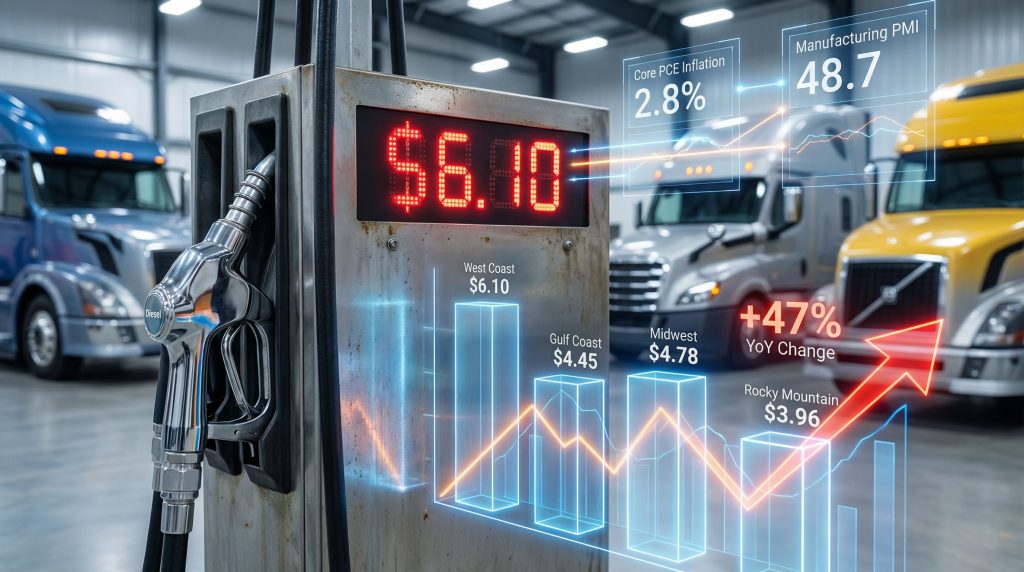
Regional Diesel Price Analysis (March 2026)
| Region | Current Price | Weekly Change | YoY Change | Economic Impact Score |
|---|---|---|---|---|
| West Coast | $6.10 | +$1.11 | +47% | Critical |
| Rocky Mountain | $3.96 | +$0.85 | +32% | Moderate |
| Gulf Coast | $4.45 | +$0.92 | +38% | High |
| Midwest | $4.78 | +$0.89 | +35% | High |
Regional Price Disparities Signal Deeper Infrastructure Vulnerabilities
The variation in regional diesel prices reveals underlying infrastructure constraints that amplify the impact of global supply disruptions. West Coast markets, showing the most severe price increases, demonstrate how geographic isolation from refining centres creates vulnerability during supply shortages.
These regional disparities indicate that transportation and storage infrastructure limitations prevent efficient price arbitrage between regions, allowing local shortages to persist even when supplies might be available elsewhere in the country.
How Do $5+ Diesel Prices Cascade Through Economic Sectors?
Manufacturing Cost Inflation and Competitive Disadvantage
Manufacturing operations face immediate cost pressures when diesel prices exceed critical thresholds. Facilities dependent on diesel-powered generators for backup power, material handling equipment, and transportation of raw materials experience direct margin compression that forces difficult operational decisions.
Companies typically absorb initial cost increases to maintain market share, but sustained high prices eventually require price increases for finished goods. This lag effect means that the full inflationary impact of diesel price increases may not appear in consumer price indices for several months after the initial fuel cost spike.
Energy-intensive manufacturing sectors, including steel production, chemical processing, and heavy equipment manufacturing, face particularly acute challenges when diesel costs surge beyond historical norms. However, this crisis has also accelerated energy transition investments as companies seek alternatives.
Agricultural Input Costs and Food Security Implications
Agricultural operations depend heavily on diesel fuel for field operations, transportation of commodities, and grain drying processes. When U.S. average diesel prices cross $5 a gallon, farming operations face significant cost increases that ultimately translate into higher food prices for consumers.
The timing of diesel price increases relative to planting and harvest seasons can amplify or moderate the economic impact on agricultural productivity. Spring price spikes, coinciding with planting season, create immediate pressure on farmers' input cost calculations and may influence crop selection decisions.
Freight Transportation Margins and Consumer Price Pass-Through
The trucking industry operates on notoriously thin margins, making it particularly vulnerable to diesel price volatility. Independent operators and small fleets often lack the financial resources to absorb extended periods of high fuel costs, leading to service reductions or business failures that can disrupt supply chains.
Every $1 increase in diesel prices typically translates to a 0.3% rise in core goods inflation within 90 days, according to Federal Reserve economic models.
Large retailers and manufacturers with established logistics networks may initially absorb increased transportation costs to maintain customer relationships, but sustained high prices eventually require freight surcharges or price increases for final goods. For instance, U.S. average diesel prices have crossed $5 a gallon, creating significant cost pressures across the supply chain.
What Does Energy Price Shock Theory Predict for 2026?
Demand Destruction Thresholds in Heavy Industry
Economic theory suggests that sustained high energy costs eventually trigger demand destruction as businesses and consumers modify behaviour to reduce energy consumption. For diesel fuel, this threshold appears to occur when prices remain above $5 per gallon for extended periods.
Heavy industry sectors may postpone capital investments, reduce production schedules, or accelerate efficiency improvements when faced with persistently high diesel costs. These behavioural changes can create feedback effects that reduce economic growth even before widespread business failures occur.
The current price environment, with diesel crossing the $5 threshold amid ongoing Middle Eastern conflicts, suggests that demand destruction mechanisms may begin operating within the next several quarters if supply conditions don't improve. In addition, this scenario could contribute to the broader oil price crash analysis experts are monitoring.
Consumer Spending Reallocation and Service Sector Impact
Higher fuel costs force consumers to reallocate spending away from discretionary purchases toward essential transportation and heating needs. This spending reallocation particularly affects service sector businesses that depend on consumer discretionary income.
Restaurants, entertainment venues, and non-essential retail sectors typically experience reduced customer traffic when fuel costs consume larger portions of household budgets. The service sector's vulnerability to energy price shocks creates secondary economic effects that extend beyond direct fuel users.
Federal Reserve Policy Constraints During Energy-Driven Inflation
Energy price inflation creates policy dilemmas for central bank officials who must balance inflation control against economic growth objectives. Traditional monetary policy tools prove less effective against supply-driven inflation compared to demand-driven price increases.
Interest rate increases designed to combat inflation may exacerbate economic slowdowns caused by high energy costs, potentially creating stagflationary conditions where economic growth stagnates while prices continue rising.
Which Economic Scenarios Could Unfold From Sustained High Diesel Costs?
Scenario 1: Supply Chain Regionalisation Acceleration
Extended periods of high diesel costs may accelerate existing trends toward supply chain regionalisation as businesses seek to reduce transportation dependencies. Companies might relocate production facilities closer to end markets or develop regional supplier networks to minimise freight exposure.
This regionalisation trend could reshape global trade patterns, potentially reducing international commerce while strengthening regional economic integration. The economic implications include reduced efficiency from lost economies of scale but increased resilience against future supply disruptions.
Scenario 2: Energy Transition Investment Surge
Sustained high diesel prices could trigger accelerated investment in alternative energy technologies for commercial transportation and industrial applications. Electric commercial vehicles, hydrogen fuel systems, and renewable energy infrastructure might receive increased capital allocation as businesses seek alternatives to volatile fossil fuel markets.
This transition scenario involves significant upfront capital costs but potentially creates new economic growth sectors while reducing long-term energy price volatility exposure.
Scenario 3: Recessionary Demand Adjustment
The most concerning scenario involves economic contraction triggered by persistent high energy costs that reduce business profitability and consumer spending capacity. Historical precedent suggests that sustained U.S. average diesel prices cross $5 a gallon correlate with increased recession probability.
Summary Statistics Table:
| Economic Indicator | Pre-Crisis Baseline | Current Trajectory | 90-Day Forecast |
|---|---|---|---|
| Core PCE Inflation | 2.1% | 2.8% | 3.4% |
| Trucking Sector Margins | 4.2% | 1.8% | 0.3% |
| Manufacturing PMI | 52.1 | 48.7 | 45.2 |
How Are Alternative Energy Markets Responding to Diesel Price Volatility?
Electric Commercial Vehicle Adoption Acceleration
High diesel prices create economic incentives for businesses to accelerate adoption of electric commercial vehicles, particularly for urban delivery and short-haul transportation applications. Fleet operators increasingly view electric vehicles as hedge strategies against fuel price volatility rather than purely environmental initiatives.
The total cost of ownership calculations for electric commercial vehicles become more favourable as diesel prices rise, potentially reaching break-even points earlier than previously projected. This shift could create sustained demand for electric vehicle infrastructure and manufacturing capacity.
Renewable Diesel and Biodiesel Investment Flows
Alternative diesel fuels gain economic competitiveness as conventional diesel prices rise above critical thresholds. Renewable diesel production capacity, biodiesel manufacturing, and feedstock supply chains may receive increased investment as price differentials make these alternatives economically attractive.
The challenge for alternative fuel markets involves scaling production capacity quickly enough to meaningfully impact overall supply balances during acute shortage periods.
Natural Gas Transportation Infrastructure Development
Natural gas powered commercial vehicles represent another alternative that becomes more economically viable as diesel prices increase. Infrastructure development for compressed natural gas (CNG) and liquefied natural gas (LNG) refuelling networks may accelerate in response to sustained high diesel costs. This trend aligns with the broader natural gas price forecast that suggests increased demand.
The next major ASX story will hit our subscribers first
What Policy Tools Could Mitigate Diesel-Driven Economic Risk?
Strategic Reserve Release Effectiveness and Limitations
Current experience demonstrates the limitations of traditional strategic reserve releases in addressing refined product shortages. Crude oil releases require refining capacity and time to convert into diesel fuel, creating delays that limit effectiveness during acute supply disruptions.
Policy makers may need to consider maintaining strategic reserves of refined products rather than crude oil to provide more immediate market intervention capability during future crises.
Refining Capacity Expansion Incentives and Timeline Realities
Long-term solutions to diesel price volatility require expanded and diversified refining capacity, but new refinery construction involves multi-year development timelines and significant capital investment. Policy incentives for refining capacity expansion must account for these temporal constraints.
Environmental regulations and permitting requirements create additional complexity for refinery capacity expansion, potentially requiring regulatory streamlining to address supply security concerns.
Emergency Transportation Fuel Allocation Mechanisms
Some economists suggest developing emergency fuel allocation systems that prioritise essential services during severe supply disruptions. Such mechanisms could include fuel rationing protocols, priority allocation for critical infrastructure, and coordinated distribution systems.
Frequently Asked Questions:
How quickly do diesel price increases affect consumer goods?
Typically within 60-90 days, as transportation costs work through supply chains and inventory cycles
Which industries are most vulnerable to diesel cost shocks?
Trucking, agriculture, construction, and manufacturing sectors with high fuel consumption
Can monetary policy effectively counter energy-driven inflation?
Limited effectiveness, as supply-driven inflation requires supply solutions rather than demand suppression
What historical precedents exist for $5+ diesel prices?
December 2022 during post-Ukraine invasion period; typically associated with major geopolitical disruptions
Investment and Market Implications of Energy Cost Inflation
Sector Rotation Patterns During Energy Price Spikes
Energy price inflation historically triggers predictable investment flows as portfolio managers seek sectors that benefit from or remain insulated from fuel cost increases. Energy companies, particularly those with refining operations, often outperform during diesel price spikes.
Defensive sectors including utilities, consumer staples, and healthcare typically attract investment during energy price shocks as investors seek stability. Conversely, transportation, manufacturing, and consumer discretionary sectors may experience outflows due to margin pressure concerns.
Recent market data shows Saudi stocks outperforming the region as investors rotate into energy-focused markets amid ongoing conflict, demonstrating these rotation patterns in real-time market conditions.
Currency and Bond Market Responses to Fuel Cost Inflation
Energy price inflation creates complex effects in currency and fixed income markets. Countries with significant energy exports may see currency appreciation, while energy importers face currency pressure and potential balance of payments concerns.
Bond markets typically experience volatility during energy price shocks as investors weigh inflation concerns against potential economic slowdown risks. The Federal Reserve's policy response expectations become crucial factors in determining interest rate trajectories.
GCC debt issuances have fallen significantly as the Iran conflict escalated, according to Fitch ratings, illustrating how geopolitical energy disruptions affect capital market activity even in energy-exporting regions.
Commodity Complex Correlations and Portfolio Hedging Strategies
Diesel price volatility creates correlation effects across commodity markets, particularly affecting agricultural commodities, metals, and other energy products. Portfolio managers often adjust commodity allocations to account for these correlation changes during energy price shock periods.
Hedging strategies may include direct diesel futures positions, energy sector equity investments, or alternative energy investments as long-term hedges against fossil fuel price volatility.
Long-Term Structural Changes From Energy Price Volatility
Supply Chain Resilience Investment Priorities
Extended periods of high diesel costs force businesses to reconsider supply chain design principles, potentially prioritising resilience over cost efficiency. This shift may involve nearshoring production, developing alternative supplier networks, and investing in transportation alternatives.
Saudi Arabia, UAE, and Oman have activated alternative logistics corridors amid war disruption, demonstrating how energy supply concerns drive infrastructure investment and trade route diversification efforts.
Energy Security Policy Evolution and Economic Trade-offs
Policymakers may reassess energy security frameworks in light of demonstrated vulnerabilities in diesel supply chains. This evolution could involve strategic reserve policy changes, alternative fuel promotion, or infrastructure investment in energy independence technologies.
Economic trade-offs between energy security investments and other priorities require careful analysis of costs and benefits over extended time horizons.
Industrial Location Decision Factors in High-Cost Energy Environment
Sustained high energy costs may influence industrial location decisions as companies seek regions with more stable or lower energy costs. This geographic reallocation could affect regional economic development patterns and labour market dynamics.
Manufacturing facilities with high energy intensity may relocate to regions with favourable energy cost structures or renewable energy availability, creating winners and losers in regional economic competition. Moreover, diesel prices hitting $4 per gallon represents a critical threshold for many industrial operations.
Investment Considerations and Risk Disclosure:
The analysis presented reflects current market conditions and historical patterns but cannot predict future outcomes with certainty. Energy markets remain subject to geopolitical, weather, and economic variables that can create rapid changes in price trajectories. Investors should consult qualified financial advisors before making investment decisions based on energy market analysis. Past performance of energy price correlation patterns does not guarantee future results.
The intersection of geopolitical conflict and energy market dynamics continues shaping economic outcomes in ways that extend far beyond immediate price effects. Understanding these complex relationships becomes essential for businesses, policymakers, and investors navigating an increasingly interconnected global economy where regional disruptions can trigger widespread economic consequences through energy market transmission mechanisms.
Are You Positioned for the Next Wave of Resource Discovery Opportunities?
Discovery Alert's proprietary Discovery IQ model delivers real-time alerts on significant ASX mineral discoveries, instantly empowering investors to identify actionable opportunities ahead of the broader market during periods of economic uncertainty. Understand why major mineral discoveries can lead to substantial market returns by exploring historic examples of exceptional outcomes, then begin your 14-day free trial today to secure your market-leading advantage.