May 13, 2026
Understanding Digital Twin Technology in Modern Mining
The global mining industry faces mounting pressure to optimise operational efficiency while managing increasingly complex geological challenges. As ore grades decline and mining operations extend to greater depths and more remote locations, traditional approaches to mine management are reaching their operational limits. This convergence of factors has accelerated the adoption of digital twin solutions in mining that fundamentally transform how mining operations are planned, executed, and maintained.
Furthermore, the integration of advanced technological frameworks enables comprehensive monitoring and prediction capabilities that were previously impossible with conventional mining approaches. Mining industry innovation continues to drive these transformative changes across the sector.
When big ASX news breaks, our subscribers know first
Core Components of Digital Twin Architecture in Mining Operations
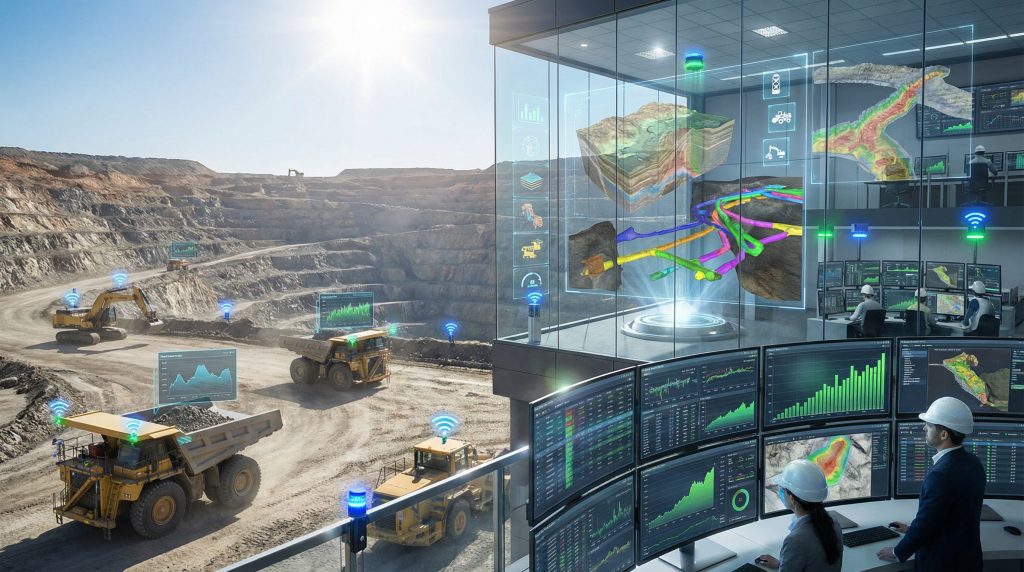
Digital twin solutions in mining create comprehensive virtual replicas of physical mining assets through sophisticated integration of sensor networks, cloud computing platforms, and artificial intelligence algorithms. These systems establish continuous data flows that enable real-time monitoring, predictive analytics, and operational optimisation across the entire mining value chain.
The foundational architecture consists of three interconnected layers that work in harmony to deliver actionable insights. The data acquisition infrastructure forms the base layer, incorporating IoT sensor networks throughout mining operations to capture equipment performance metrics, geological modelling integration systems that continuously update subsurface understanding, environmental monitoring stations that track atmospheric and water conditions, and production flow measurement devices that monitor throughput and quality parameters.
Advanced Data Processing and Analytics Framework
The processing and analytics layer transforms raw operational data into strategic intelligence through machine learning algorithms for pattern recognition that identify subtle indicators of equipment degradation or process inefficiencies. Predictive maintenance models analyse historical performance patterns to forecast component failures with remarkable accuracy, while real-time performance optimisation engines automatically adjust operational parameters to maximise efficiency.
Risk assessment and mitigation systems continuously evaluate operational hazards and recommend preventive measures. This comprehensive approach enables mining operations to shift from reactive management to proactive optimisation, fundamentally changing how decisions are made across all operational levels.
In addition, the integration of data-driven mining operations enhances decision-making capabilities across all operational levels through comprehensive analytics frameworks.
| Data Layer | Primary Function | Key Technologies |
|---|---|---|
| Acquisition | Real-time data collection | IoT sensors, SCADA systems |
| Processing | Pattern analysis | Machine learning, AI algorithms |
| Analytics | Predictive modelling | Statistical analysis, neural networks |
| Integration | Enterprise connectivity | API frameworks, cloud platforms |
Revolutionary Impact on Mine Planning and Design
Traditional mine planning methodologies rely heavily on static geological models established during initial feasibility studies, often requiring extensive revisions as new information becomes available. Digital twin solutions in mining transform this approach by creating dynamic, three-dimensional virtual environments that incorporate real-time drilling data, geospatial information, and continuously updated geological interpretations.
This technological shift enables mining engineers to simulate various extraction scenarios using continuously updated geological data, rather than relying on fixed models that may not accurately represent subsurface conditions. Advanced geological modelling capabilities now integrate real-time drilling information directly into mine plans, updating ore body boundaries and grade distributions as operations progress.
Dynamic Geological Modelling Capabilities
Real-time drilling data integration captures information from active drilling operations, including penetration rates, core recovery, and geological contacts, feeding this information directly into geological models. Geospatial information processing combines surface topography, structural geology, and remote sensing data to create comprehensive three-dimensional representations of mining areas.
Ore grade distribution mapping utilises assay results, geophysical surveys, and geostatistical modelling to predict mineral concentrations throughout the ore body. Structural geology analysis incorporates fault systems, joint orientations, and rock mass characteristics to assess geotechnical stability and optimise extraction sequences.
Moreover, enhanced drilling results interpretation capabilities provide mining companies with more accurate geological understanding throughout the exploration and production phases.
Scenario Planning and Optimisation
Digital twin platforms enable comprehensive testing of different mining approaches without physical implementation risks. Mining companies can now evaluate unlimited design iterations compared to the traditional 3-5 major revisions, conduct real-time risk modelling instead of relying solely on historical data, and integrate sustainability metrics throughout the design process rather than evaluating environmental impact after design completion.
Cost estimation transforms from static calculations to dynamic optimisation processes that adjust in real-time based on changing geological conditions, equipment performance, and market factors. This approach significantly reduces design uncertainty and enables more accurate project economics throughout the mine lifecycle.
How Can Equipment Health Be Monitored Through Predictive Analytics?
Predictive maintenance represents one of the most transformative applications of digital twin solutions in mining, addressing the critical challenge of equipment reliability in harsh operating environments. By creating virtual replicas of critical equipment, mining companies can anticipate failures before they occur, fundamentally changing maintenance strategies from reactive to predictive.
Comprehensive Equipment Monitoring Systems
Real-time equipment monitoring encompasses multiple measurement parameters that provide comprehensive insight into equipment health. Vibration analysis for rotating machinery monitors pumps, motors, compressors, and conveyor systems for abnormal signatures indicating bearing wear, misalignment, or component damage.
Temperature monitoring for thermal systems tracks cooling circuits, engine temperatures, and heat-generating equipment for thermal degradation patterns. Pressure tracking for hydraulic components monitors hydraulic systems for seal degradation, component wear, or fluid contamination that could lead to system failures.
Wear pattern analysis for cutting tools monitors drilling equipment, crusher components, and grinding media for progressive tool wear, enabling optimisation of replacement schedules and operational parameters.
Performance Optimisation Results
Mining companies implementing digital twin-based predictive maintenance systems report significant operational improvements. Industry data indicates average reductions of 25-30% in unplanned downtime and 15-20% decreases in maintenance costs through proactive maintenance scheduling and component replacement.
Industry Benchmark: Advanced predictive maintenance systems enable mining operations to extend equipment lifecycles by 15-25% while maintaining operational reliability standards.
Asset lifecycle optimisation extends beyond immediate maintenance needs to encompass performance benchmarking against manufacturer specifications, upgrade timing optimisation based on operational data analysis, replacement planning using predictive wear models, and resale value maximisation through comprehensive maintenance documentation.
The implementation of AI in mining operations further enhances these predictive capabilities through advanced pattern recognition and automated decision-making processes.
Processing Plant Optimisation and Energy Management
Mining processing plants involve complex, energy-intensive operations requiring continuous optimisation to maintain profitability and environmental compliance. Digital twin solutions in mining enable operators to simulate and optimise these processes in virtual environments before implementing changes, reducing risks and maximising efficiency gains.
Process Simulation and Control
Crushing and grinding optimisation represents a primary application area where digital twins deliver substantial benefits. Feed rate optimisation based on ore characteristics enables processing plants to adjust throughput rates according to ore hardness, moisture content, and mineral composition. Energy consumption minimisation algorithms automatically adjust motor loads, mill speeds, and classifier performance to reduce power consumption while maintaining product quality.
Particle size distribution control ensures consistent product specifications through automated adjustments to grinding parameters. Equipment wear prediction and mitigation systems monitor liner wear, ball mill charge levels, and crusher component degradation to optimise replacement schedules and operational parameters.
Flotation Process Enhancement
Digital twins model flotation cell behaviour under various operating conditions, enabling optimisation of chemical dosage based on ore mineralogy and processing objectives. pH level control strategies automatically adjust lime addition and acid neutralisation to maintain optimal flotation chemistry.
Recovery rate maximisation algorithms analyse bubble dynamics, froth characteristics, and concentrate quality to optimise cell-to-cell performance. Concentrate grade improvement systems monitor product quality and automatically adjust operational parameters to meet specification requirements.
Energy Management and Sustainability
Digital twin implementations deliver quantifiable energy and resource savings across multiple process areas. Grinding circuits achieve 8-12% energy reduction through motor load balancing and optimisation of mill operating parameters. Flotation cells realise 5-8% energy savings through aeration optimisation and improved bubble generation efficiency.
| Process Area | Optimisation Focus | Potential Savings |
|---|---|---|
| Grinding Circuits | Motor load balancing | 8-12% energy reduction |
| Flotation Cells | Aeration optimisation | 5-8% energy savings |
| Thickening Operations | Polymer dosage control | 10-15% chemical reduction |
| Water Management | Recycling optimisation | 20-25% water savings |
Thickening operations achieve 10-15% chemical reduction through polymer dosage control and settling optimisation. Water management systems realise 20-25% water savings through recycling optimisation and closed-circuit processing configurations.
However, the integration with renewable energy mining transformation initiatives creates additional opportunities for sustainable operations and further energy cost reductions.
Safety and Risk Management Enhancement
Digital twin solutions in mining significantly enhance safety protocols by providing comprehensive risk assessment capabilities and emergency response planning tools. These systems enable proactive identification of potential hazards and implementation of preventive measures before incidents occur.
Geotechnical Risk Assessment
Slope stability monitoring and prediction systems continuously analyse ground movement, groundwater conditions, and structural integrity to prevent catastrophic failures. Ground movement detection systems utilise real-time monitoring networks to identify precursory indicators of slope instability or ground subsidence.
Structural integrity analysis monitors underground excavations, surface infrastructure, and equipment foundations for signs of deterioration or overstress. Emergency evacuation planning utilises real-time personnel tracking and escape route optimisation to ensure rapid emergency response capabilities.
What Are the Key Operational Safety Improvements?
Worker location tracking in underground operations provides real-time visibility of personnel locations, enabling rapid emergency response and evacuation procedures. Equipment collision avoidance systems prevent accidents through automated monitoring of mobile equipment interactions and proximity warnings.
Atmospheric monitoring for gas detection continuously measures air quality, oxygen levels, and hazardous gas concentrations throughout mining operations. Emergency response simulation training enables personnel to practice emergency procedures in virtual environments, improving response effectiveness without exposing workers to actual hazards.
Compliance and Regulatory Management
Digital twins facilitate regulatory compliance through automated reporting of environmental metrics, including air quality measurements, water discharge parameters, and waste generation statistics. Real-time monitoring of safety parameters ensures continuous compliance with occupational health and safety regulations.
Documentation systems provide comprehensive audit trails for regulatory inspections and compliance verification. Predictive compliance modelling anticipates future regulatory requirements and enables proactive adaptation of operational procedures.
According to recent digital twin applications in mining, these comprehensive safety systems demonstrate measurable improvements in incident prevention and regulatory compliance across mining operations.
The next major ASX story will hit our subscribers first
Advanced Analytics and Strategic Decision Making
The integration of artificial intelligence and machine learning with digital twin platforms creates powerful analytics capabilities that transform decision-making processes throughout mining operations. These systems provide comprehensive insights that enable data-driven optimisation across all operational levels.
Production Optimisation Analytics
Throughput maximisation algorithms analyse bottlenecks, equipment performance, and process efficiency to identify optimisation opportunities. Quality control prediction models anticipate product quality variations and recommend preventive adjustments to maintain specifications.
Bottleneck identification systems continuously monitor process flow rates and identify constraints that limit overall throughput. Resource allocation optimisation ensures optimal distribution of personnel, equipment, and materials across multiple operational areas.
Financial Performance Modelling
Digital twins provide comprehensive financial analytics that enable strategic planning and operational optimisation. Operating cost analysis incorporates real-time updates of energy costs, consumable usage, and maintenance expenses. Revenue optimisation through production planning maximises valuable mineral recovery while minimising processing costs.
Capital expenditure planning utilises equipment lifecycle data and performance trends to optimise equipment replacement and upgrade timing. Risk-adjusted return calculations for investment decisions incorporate operational uncertainties and market volatility into financial planning models.
Enterprise System Integration
Digital twin platforms integrate with multiple enterprise systems to provide comprehensive operational visibility. ERP system integration enables financial data synchronisation and automated reporting. SCADA network integration provides real-time control capabilities and automated process adjustments.
| Integration Type | Business Benefit | Technical Complexity |
|---|---|---|
| ERP Systems | Financial synchronisation | Medium |
| SCADA Networks | Real-time control | High |
| Geological Software | Enhanced modelling accuracy | Medium |
| Supply Chain Management | Optimised logistics | Low |
Geological software integration enhances modelling accuracy through combined data sources and analysis capabilities. Supply chain management integration optimises logistics planning and inventory management across mining operations.
Furthermore, advanced digital twin technology in decision-making demonstrates how major mining companies leverage these systems for strategic advantage.
Implementation Challenges and Solutions
While digital twin solutions offer substantial benefits, successful implementation requires addressing several technical and organisational challenges. Mining companies must carefully plan implementation strategies to maximise benefits while minimising disruption to ongoing operations.
Technical Infrastructure Requirements
Data quality and integration represent primary technical challenges, particularly regarding legacy system compatibility and data standardisation across different platforms. Network connectivity in remote locations often requires substantial infrastructure investment to support high-bandwidth data transmission requirements.
Cybersecurity considerations become increasingly critical as mining operations become more connected and dependent on digital systems. Comprehensive security frameworks must protect operational technology networks from cyber threats while maintaining system functionality and reliability.
Computational Resources and Infrastructure
Digital twin implementations demand significant computing power to support complex simulations and real-time analytics. High-performance computing systems enable complex geological modelling and process simulations that would be impractical with conventional computing resources.
Cloud infrastructure provides scalable data processing capabilities that can accommodate varying computational demands throughout different operational phases. Edge computing systems enable real-time decision making at remote locations where network connectivity may be limited or unreliable.
Data storage solutions must accommodate vast quantities of historical and real-time operational data while providing rapid access for analytics applications.
Organisational Change Management
Skills development and training programmes must prepare personnel for digital twin platform operation and data interpretation capabilities. Technical expertise requirements span multiple disciplines, including data analytics, system integration, and operational optimisation.
Change management processes must address modifications to operational procedures and decision-making workflows. Cross-functional collaboration becomes essential as digital twin systems integrate previously separate operational domains.
Future Technology Integration and Industry Transformation
Emerging technologies continue to expand the capabilities and applications of digital twin solutions in mining operations. The convergence of artificial intelligence, extended reality, and autonomous systems promises to further transform mining operations over the next decade.
Artificial Intelligence Enhancement
Autonomous decision-making systems will enable fully automated operational adjustments based on real-time conditions and predictive models. Natural language processing capabilities will allow operators to interact with digital twin systems using conversational interfaces rather than complex technical commands.
Computer vision applications will enable automated equipment inspection and maintenance assessment through visual analysis of equipment conditions. Reinforcement learning algorithms will continuously optimise operational parameters through trial-and-error learning processes that improve over time.
Extended Reality Applications
Virtual reality training and simulation systems will provide immersive training experiences that prepare personnel for complex operational scenarios without exposure to actual hazards. Augmented reality maintenance guidance will provide real-time visual instructions and technical information directly in workers' field of view.
Mixed reality collaborative planning will enable distributed teams to interact with three-dimensional mine models and participate in joint planning sessions regardless of geographic location. Remote operation capabilities will enable specialists to provide technical support and operational guidance from distant locations.
Industry Transformation Outlook
Digital twin adoption in mining operations continues to accelerate, driven by increasing pressure for operational efficiency, environmental compliance, and safety improvement. Industry projections suggest that digital twin implementation will become standard practice across major mining operations within the next five years.
Future Projection: The integration of autonomous systems with digital twin platforms will enable fully self-optimising mining operations that continuously adapt to changing geological, environmental, and market conditions.
Sustainability integration will become increasingly important as mining companies face pressure to reduce environmental impact and comply with carbon emission regulations. Water usage optimisation and waste minimisation strategies will be directly integrated into digital twin optimisation algorithms.
Autonomous Operations Development
Digital twins will enable fully autonomous mining operations through integrated control systems that manage unmanned equipment fleets across entire mining operations. Predictive logistics systems will optimise material handling and transportation without human intervention.
Automated quality control throughout the value chain will ensure consistent product quality while minimising manual sampling and testing requirements. Self-optimising processes will continuously adjust operational parameters based on real-time conditions and performance feedback.
Disclaimer: This analysis is based on current industry trends and technological developments. Actual implementation results may vary depending on specific operational conditions, geological factors, and technical infrastructure. Mining companies should conduct comprehensive feasibility studies before implementing digital twin solutions.
The transformation of mining operations through digital twin technology represents a fundamental shift toward data-driven, predictive, and autonomous operational management. As these technologies continue to mature, mining companies that successfully integrate digital twin solutions will gain significant competitive advantages in operational efficiency, safety performance, and environmental compliance.
Could Digital Mining Innovation Unlock Your Next Investment Opportunity?
Discovery Alert's proprietary Discovery IQ model delivers real-time alerts on significant ASX mineral discoveries, instantly empowering subscribers to identify actionable opportunities ahead of the broader market as mining companies embrace transformative technologies like digital twins. Begin your 14-day free trial today at Discovery Alert and secure your market-leading advantage in the rapidly evolving mining sector.