
June 2, 2026
The Silver Supply Gap Nobody Is Talking About
The global silver market has been running a structural supply deficit for several consecutive years, yet the pipeline of large-scale, development-ready projects capable of meaningfully closing that gap remains remarkably thin. Most of the world's significant undeveloped silver deposits face one or more obstacles: jurisdictional complexity, insufficient reserve scale, single-metal economics that make financing difficult, or feasibility studies that remain years away from completion. Against that backdrop, the Discovery Silver Cordero project in Mexico occupies an unusual position. It is not a speculative resource play. It is a fully feasibility-studied, reserve-defined, polymetallic open-pit project sitting in one of the world's most historically productive silver belts, with a company balance sheet that has been fundamentally transformed by Canadian gold cashflow.
Understanding where Cordero stands today requires examining not just the resource numbers, but the interconnected web of regulatory, financial, and infrastructure decisions that will determine whether this asset moves toward construction or remains in a holding pattern. Furthermore, the broader context of silver supply deficits across multiple consecutive years makes projects of this scale increasingly critical to watch.
When big ASX news breaks, our subscribers know first
Why the Chihuahua Silver Belt Produces Projects of This Scale
Mexico's Chihuahua state is not merely a silver-producing region. It is the geological expression of a tectonic and hydrothermal history that concentrated precious and base metals across a vast belt spanning hundreds of kilometres. The region sits within the broader Sierra Madre Occidental, a north-south trending volcanic arc where epithermal and skarn mineralisation systems created some of the largest silver-zinc-lead deposits on the planet.
Cordero, located approximately 35 kilometres north of the city of Parral, sits within a structural setting that allowed for the simultaneous concentration of four economically significant metals: silver, gold, zinc, and lead. This polymetallic character is not incidental. It is the geological feature that makes the project's economics structurally different from a pure silver play and dramatically alters how analysts should model its cost profile.
What distinguishes Cordero at a geological level is the sheer tonnage of mineralisation at recoverable grades, combined with the open-pittable geometry of the orebody. Open-pit deposits require not just mineralisation, but the right spatial distribution of ore relative to waste, combined with near-surface accessibility. Cordero satisfies both criteria at a scale that is genuinely rare in the global silver project inventory, even among the largest silver mines currently in operation worldwide.
Cordero Project Metrics: What the February 2024 Feasibility Study Established
The February 2024 definitive feasibility study remains the definitive technical baseline for the project. Its key outputs are summarised below:
| Metric | Value |
|---|---|
| After-Tax NPV (Base Case) | US$1.2 billion |
| Initial Capital Expenditure | US$606 million |
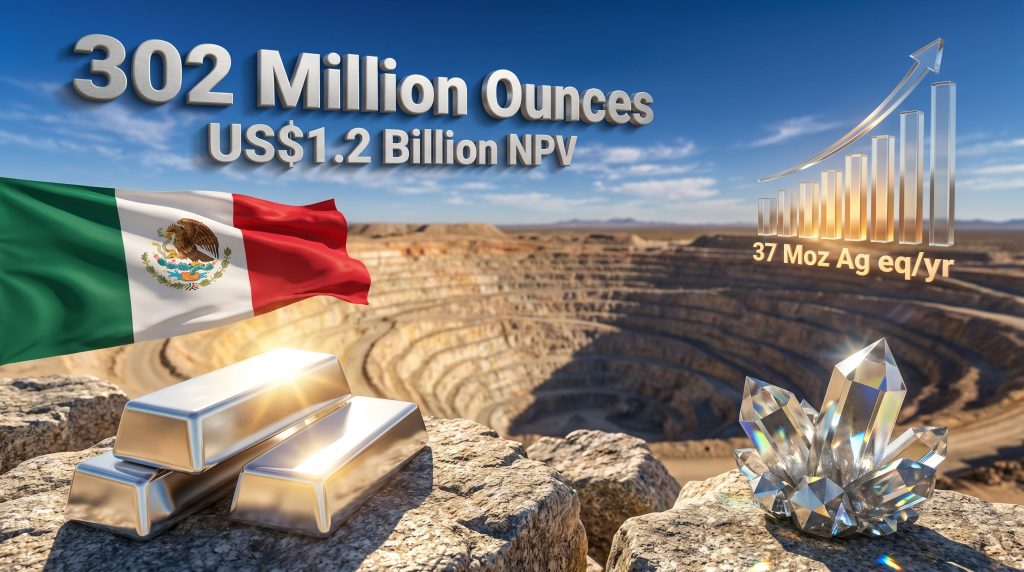
| Average Annual Production (First 12 Years) | 37 million silver-equivalent ounces |
| Total Mine Life | 19 years |
| Silver Reserves | 302 million ounces |
| Gold Reserves | 840,000 ounces |
| Zinc Reserves | 5.2 billion pounds |
| Lead Reserves | 3 billion pounds |
| Mining Method | Open-pit |
| Location | Chihuahua, Mexico (~35 km north of Parral) |
One of the less-discussed aspects of Cordero's economics is how the zinc and lead byproduct credits function within the silver cost model. In mining, all-in sustaining cost (AISC) calculations for silver-focused projects can be materially reduced by crediting revenues from co-produced metals against operating costs. At Cordero's reserve scale, 5.2 billion pounds of zinc and 3 billion pounds of lead represent enormous byproduct credit potential.
Depending on base metal pricing assumptions, these credits could push Cordero's net silver production cost well below the industry average, making the project economically resilient even in a moderately weaker silver price environment. This dynamic reflects silver's dual role as both a monetary asset and an industrial commodity, which increasingly underpins its long-term demand profile.
It is worth noting that feasibility study economics are inherently point-in-time assessments. The February 2024 cost estimates were constructed using the pricing environment and contractor rates prevailing at that time. With construction cost inflation having moved materially in certain categories since then, the updated capex figures expected in 2026 will be critical inputs for any financing mandate.
Three Parallel Workstreams Defining Cordero's 2026 Development Trajectory
Rather than following a single sequential development path, the Discovery Silver Cordero project in Mexico is simultaneously progressing across three distinct but interdependent workstreams. Each carries its own timeline, its own risk profile, and its own set of external dependencies.
Workstream 1: Environmental Permitting and the MIA Approval Process
The Manifestación de Impacto Ambiental (MIA) is Mexico's principal environmental impact assessment instrument for large-scale industrial projects. Administered by Semarnat, Mexico's federal environment ministry, the MIA process for a project of Cordero's scale involves a multi-stage technical review that examines biodiversity impacts, water resource management, community consultation outcomes, and long-term site rehabilitation commitments. Approval is not automatic, and timelines are not guaranteed.
What makes the MIA milestone particularly significant for Cordero is its direct financial linkage. A substantial portion of Discovery Silver's planned US$90 million to US$100 million in 2026 fees and growth capital expenditure is contingent on paying the land-use permit fee that accompanies MIA approval. This means that until Semarnat grants the permit, the largest single capital commitment of the year cannot be deployed.
The deliberate capital discipline evident in Q1 2026, where only US$2.5 million was spent (primarily on salaries and benefits), reflects precisely this sequencing logic. An often overlooked credibility signal in the permitting context is Cordero's PROFEPA Quality Environmental Certification, awarded in 2023. PROFEPA is Mexico's environmental enforcement agency, and its certification programs assess whether companies meet voluntary environmental management standards that exceed minimum regulatory requirements.
Holding this certification ahead of a MIA review demonstrates proactive environmental governance, which can positively influence how regulators assess a project's social and environmental risk profile.
Workstream 2: Energy Infrastructure Selection
The energy source decision for a mine processing roughly 37 million silver-equivalent ounces per year is not a minor operational detail. It is a capital-cost and operational-risk variable that carries multi-decade implications.
The case for on-site natural gas generation:
- Insulates the operation from Chihuahua's grid reliability constraints, which have historically been a concern for industrial users in northern Mexico
- Provides predictable power cost structure through long-term gas supply agreements
- Reduces vulnerability to grid outages that could disrupt processing operations and damage equipment
The case for grid connection:
- Eliminates the upfront capital cost of constructing and maintaining a dedicated generation facility
- Reduces operational complexity and the need for on-site fuel logistics
- May align better with evolving ESG expectations around carbon footprint reporting
The engagement of a third-party power consultant to model both pathways and develop updated capex estimates for the natural gas option signals that this is a genuinely contested decision with meaningful economic consequences either way. A final determination is expected before the end of 2026.
Workstream 3: Capital Cost Updating and Financing Strategy
The third workstream is arguably the most consequential for investors modelling Cordero's path to construction. The February 2024 feasibility study's US$606 million capex estimate was built using 2023-era contractor pricing, equipment costs, and materials escalation assumptions. Global construction cost indices have continued to move since then, particularly for steel, concrete, and specialist mining equipment.
The updated cost estimate will either validate or revise the financing quantum required, and will serve as the foundation for any formal financing mandate. In the context of ongoing silver supply constraints across the broader market, the urgency of advancing projects like Cordero to construction cannot be understated.
Discovery Silver's Financial Position: The Porcupine Effect
The transformation of Discovery Silver's balance sheet following the 2025 acquisition of the Porcupine gold complex in Ontario, Canada, is central to understanding how Cordero's development could be funded. Porcupine is one of Canada's longest-operating gold mining districts, and its acquisition gave Discovery Silver a producing asset generating substantial quarterly cashflow.
| Financial Metric | Q1 2026 | Q4 2025 | Change |
|---|---|---|---|
| Net Earnings | US$81.7 million | US$65.3 million | +25% QoQ |
| EBITDA | US$177.9 million | ~US$126 million | +41% QoQ |
| Cash Position | US$384.9 million | – | – |
| Undrawn Credit Facility | US$250 million | – | – |
| Total Liquidity | US$634.9 million | – | – |
This financial architecture creates a structurally interesting dynamic: a Canadian gold operation is generating the cashflow that reduces dilution risk for a Mexican silver development. The strategic logic is sound. Rather than returning to equity markets to fund Cordero's initial development costs, Discovery Silver can draw on Porcupine-generated cash and its undrawn credit facility to fund permitting fees, technical studies, and early-stage site preparation without issuing shares at a discount.
Scenario Analysis: Three Financing Pathways to US$606 Million
How a project of this scale ultimately gets financed will define its economics for decades. Three credible pathways exist, each with distinct risk-return trade-offs:
Scenario A: Balance Sheet Self-Funding
Conditions required include sustained gold cashflow from Porcupine and continued silver price strength. Risk profile is low dilution but high balance sheet concentration, meaning a significant portion of corporate liquidity becomes committed to a single asset.
Scenario B: Project Debt Combined with a Streaming Arrangement
Streaming agreements, where a financing counterparty provides upfront capital in exchange for the right to purchase a fixed proportion of future metal production at below-market prices, have become a standard tool for large undeveloped mining projects. This pathway requires MIA approval, a finalised energy decision, and published updated cost estimates before any streaming counterparty will commit capital. Risk profile involves moderate dilution of long-term silver revenue but preserves equity upside.
Scenario C: Strategic Partnership or Joint Venture
A major silver producer seeking to replace depleting reserves through acquisition of development-stage assets could find Cordero's scale attractive. Risk involves diluted ownership and operational control, but could accelerate the timeline to construction through a partner's existing contractor relationships and financing access.
The next major ASX story will hit our subscribers first
Mexico's Regulatory Landscape: Structural Tailwinds and Persistent Risks
Mexico's mining permitting environment has undergone notable shifts in recent years. Following a period of effective permit freezes that stalled project development across the sector, a cautious reactivation of the approvals pipeline has unlocked an estimated US$11 billion in previously stalled project activity. This reactivation does not represent formal policy designation for any specific project, but reflects a broader directional shift in how federal agencies are processing pending applications.
However, Metals Focus has noted that Mexico's silver sector continues to face structural headwinds including weaker exploration grades, declining new drilling activity, and ongoing legislative uncertainty. For a project of Cordero's scale, the permitting timeline carries political and policy dimensions that technical execution cannot fully control.
Investors evaluating the Discovery Silver Cordero project in Mexico should treat the MIA approval timeline as a probability distribution, not a fixed date. The technical merits of the project do not guarantee administrative speed, particularly in an environment where broader mining policy remains subject to legislative review.
Water infrastructure negotiations add an additional social licence dimension. Discovery Silver's active engagement with operators of a local water treatment facility regarding planned upgrades signals an understanding that community infrastructure contributions are not peripheral to permitting success. In Mexico's mining regulatory environment, the boundary between environmental permitting and community relations is deliberately permeable.
Cordero's Economic Footprint in Mexico: Beyond the Resource Numbers
| Economic Contribution Category | Estimated Value or Scale |
|---|---|
| Initial Capital Investment in Mexico | More than US$600 million |
| Construction Phase Employment | ~2,500 jobs |
| Operational Phase Employment | 1,000+ jobs over mine life |
| Total Investment Since 2019 Acquisition | More than US$100 million |
A 19-year mine life at this production scale generates regional economic multiplier effects that extend well beyond direct employment. Supply chain demand for local contractors, fuel, consumables, and services creates secondary employment across the Parral region. The water treatment plant commitment, if realised, adds lasting community infrastructure value that persists beyond the mine's operational life. Consequently, Cordero's broader socioeconomic contribution to Chihuahua state represents a compelling element of its social licence case.
The Critical Path to a Construction Decision
For analysts and investors tracking the Discovery Silver Cordero project in Mexico, the sequenced milestone framework below represents the logical dependency chain that must be worked through before a construction decision can be made:
- MIA environmental approval from Semarnat is the non-negotiable regulatory gate that unlocks all subsequent steps
- Land-use permit fee payment follows immediately from approval and represents the largest single 2026 capital commitment
- Energy infrastructure decision must be finalised to enable accurate updated capex modelling
- Updated capital and operating cost estimates must be published before any financing counterparty will commit to a mandate
- Financing structure selection determines whether the project proceeds via balance sheet, debt and streaming, or partnership
- Construction contractor engagement requires 12 to 18 months of lead time for a project of this scale, meaning mobilisation planning must begin well before financial close
How Cordero Compares to Other Major Undeveloped Silver Projects
| Project | Owner | Location | Key Silver Resource | Development Stage |
|---|---|---|---|---|
| Cordero | Discovery Silver | Chihuahua, Mexico | 302 Moz reserves | Feasibility Complete |
| Bowdens | Silver Mines Ltd | New South Wales, Australia | ~300 Moz resource | Permitting |
| Corani | Bear Creek Mining | Puno, Peru | ~340 Moz resource | Permitting |
| Prognoz | Polymetal / Mangazeya | Sakha Republic, Russia | ~560 Moz resource | Development Paused |
Note: Resource and reserve figures are sourced from publicly available company disclosures. Resource and reserve classifications differ materially by project and should not be directly compared without accounting for cut-off grades, confidence categories, and processing assumptions.
What separates Cordero from several of its peers is the combination of a completed feasibility study, a polymetallic reserve base that provides genuine byproduct credit protection, and a parent company with over US$634 million in liquidity ready to be deployed. As confirmed by positive feasibility results, Cordero is firmly established as one of the world's leading development-stage silver projects. Most comparable projects are either in less financially capable hands, face more complex jurisdictional environments, or lack the byproduct revenue diversification that underpins Cordero's cost competitiveness.
Frequently Asked Questions: Discovery Silver Cordero Project in Mexico
What is the Discovery Silver Cordero project?
Cordero is a large-scale open-pit silver development project located in Chihuahua, Mexico, owned by Toronto-based Discovery Silver. It is widely regarded as one of the largest undeveloped silver deposits in the world, with a completed feasibility study and a reserve base spanning four economically significant metals.
Where exactly is Cordero located?
The project is situated approximately 35 kilometres north of the city of Hidalgo del Parral in Chihuahua state, within Mexico's historically productive silver belt.
What are Cordero's proven silver reserves?
The February 2024 feasibility study outlined reserves of 302 million ounces of silver, alongside 840,000 ounces of gold, 5.2 billion pounds of zinc, and 3 billion pounds of lead.
What is the project's estimated net present value?
Using base-case metal prices, the feasibility study calculated an after-tax NPV of US$1.2 billion.
What is the initial capital cost to build Cordero?
The February 2024 feasibility study estimated initial capital expenditure at US$606 million, though this figure is currently being updated to reflect current pricing conditions.
What is the expected annual silver production?
Cordero is projected to produce an average of 37 million silver-equivalent ounces per year during the first 12 years of operation, over a total mine life of 19 years.
When will Cordero receive its environmental permit?
The MIA approval from Semarnat remains the key pending milestone. No confirmed approval date has been announced, and the timeline carries regulatory uncertainty that investors should factor into their assessment.
How much has Discovery Silver invested in Cordero since acquisition?
Since acquiring the project in 2019, Discovery Silver has invested more than US$100 million in Mexico through exploration drilling and technical studies.
What energy source will power the mine?
A final decision between on-site natural gas generation and grid power connection is expected during 2026, with a third-party consultant engaged to evaluate both options.
How does Cordero rank among global undeveloped silver projects?
By reserve scale and feasibility advancement, Cordero is among the most developed large-scale undeveloped silver projects in the Western Hemisphere, distinguished by its polymetallic profile and open-pit design.
This article is intended for informational purposes only and does not constitute financial advice. Statements relating to project timelines, production forecasts, net present values, and capital cost estimates are forward-looking in nature and subject to material risks, uncertainties, and assumptions. Readers should conduct their own independent research and consult qualified financial advisers before making any investment decisions.
Want to Catch the Next Major Silver Discovery Before the Market Does?
Discovery Alert's proprietary Discovery IQ model delivers real-time alerts on significant ASX mineral discoveries, cutting through complex geological and financial data to surface actionable opportunities the moment they are announced — explore the historic returns major discoveries have generated and begin your 14-day free trial to position yourself ahead of the broader market.