June 12, 2026
The Geopolitics of Grid Reliability: Understanding America's Federal Coal Infrastructure Bet
Global energy policy rarely moves in straight lines. The arc of industrial history shows repeated cycles where dominant energy sources face existential threats, only to find unexpected lifelines through geopolitical necessity, technological adaptation, or the blunt force of federal industrial policy. The current moment in American coal infrastructure represents precisely such an inflection point, where DOE coal funding for power plants and export infrastructure has collided with longstanding energy transition narratives to produce one of the most consequential shifts in federal energy investment priorities in over a decade.
The US Department of Energy's announcement of up to $500 million in Defense Production Act funding for coal infrastructure is not simply a subsidy for a struggling industry. It is a statement of strategic intent, one that repositions coal generation and export capacity within the same policy architecture as defence procurement, critical mineral supply chains, and allied energy security commitments. Understanding what this funding actually covers, why it is structured the way it is, and what it means for the trajectory of the US energy system requires moving beyond the surface-level debate about coal versus renewables and engaging with the deeper logic of energy security as an instrument of geopolitical influence.
When big ASX news breaks, our subscribers know first
What the $500 Million in DOE Coal Funding Is Actually Built to Achieve
The total DOE coal funding for power plants and export infrastructure has been divided into two structurally distinct but strategically complementary streams, each targeting a different dimension of the national energy security challenge.
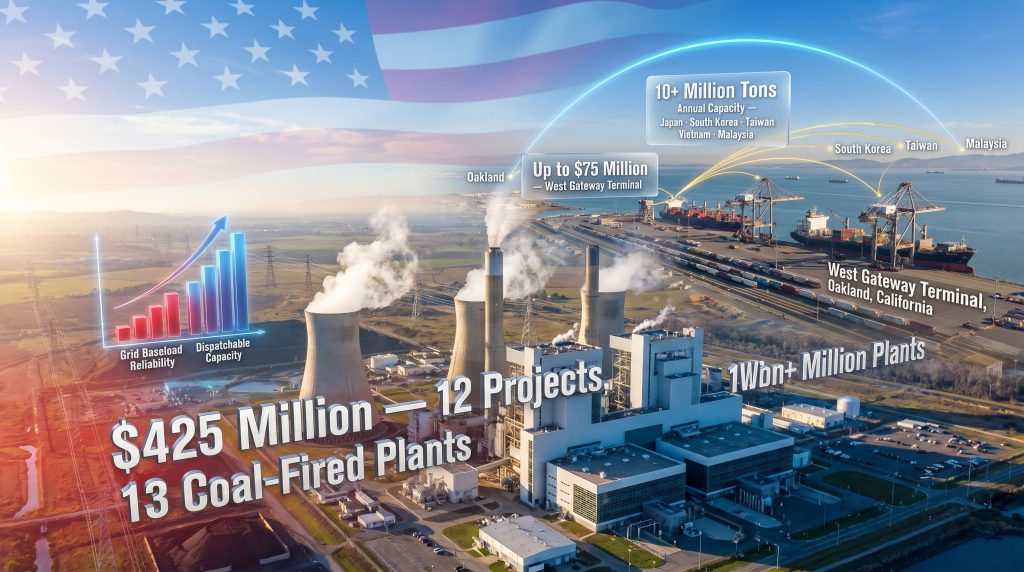
The larger allocation, up to $425 million, has been distributed across 12 projects targeting 13 coal-fired power plants across the United States. These projects span a range of intervention types designed to extend operational life, restore lost generating capacity, and improve the reliability and flexibility of existing coal assets. The smaller but strategically significant allocation of up to $75 million targets the West Gateway Terminal Project in Oakland, California, a proposed rail-served marine bulk export facility designed to move more than 10 million tons of bulk commodities annually toward Indo-Pacific markets.
| Funding Stream | Allocation | Target | Primary Objective |
|---|---|---|---|
| Coal Fleet Strengthening | Up to $425M | 12 projects across 13 plants | Baseload reliability and grid resilience |
| West Gateway Terminal | Up to $75M | Oakland, California | West Coast export capacity expansion |
| Total Package | Up to $500M | Multiple sites nationally | Grid security and Indo-Pacific energy diplomacy |
The dual structure of this package is deliberate. By simultaneously investing in domestic generation capacity and export infrastructure, the administration is treating coal as both an internal grid stabilisation tool and an external foreign policy lever — a combination that elevates the funding's strategic significance well beyond a conventional energy subsidy. Furthermore, these coal revival executive orders reflect a broader policy shift that has been building since early 2025.
Coal Fleet Strengthening: What the Plant-Level Investments Target
The $425 million directed at domestic coal plant preservation encompasses several distinct categories of investment, each addressing a specific operational or reliability challenge:
- Recommissioning shuttered or retirement-scheduled units to restore generating capacity that has been removed from the grid in recent years under economic and regulatory pressure
- Turbine, boiler, and control system retrofits designed to improve heat rates, reduce unplanned outages, and enhance operational flexibility to respond to variable grid operator dispatch signals
- Fuel-switching and co-firing system integration, enabling plants to blend biomass, waste-derived fuels, or other lower-carbon alternatives with traditional coal to reduce emissions intensity while preserving dispatchable capacity
- Wastewater treatment and environmental compliance infrastructure upgrades that allow continued operation within evolving regulatory requirements, addressing longstanding concerns that have accelerated coal plant retirements
- Rural and remote community resilience components, recognising that coal plants in isolated regions often lack viable near-term replacement options given grid interconnection limitations and the economics of renewable deployment in low-density areas
The common thread running through each category is dispatchability. Unlike wind and solar, coal plants can be instructed to generate power on demand, providing what grid operators refer to as firm capacity — the ability to guarantee electricity output regardless of weather conditions or time of day. This characteristic has become increasingly valuable as peak demand events, extreme weather, and the rapid proliferation of energy-intensive artificial intelligence data centres place unprecedented stress on grid infrastructure.
The Defense Production Act: Why the Legal Mechanism Matters
The invocation of Defence Production Act authority for coal infrastructure funding is not a procedural formality. It is a deliberate policy choice with significant legal and political implications that deserve careful analysis. The Defense Production Act role in reshaping federal energy priorities has consequently become one of the most debated aspects of this policy shift.
The Defence Production Act was originally enacted in 1950 to enable the federal government to direct industrial production during the Korean War, prioritising defence-related manufacturing over civilian demand when national security required it. Its subsequent applications have generally remained tethered to genuine national emergency contexts, including pandemic-era medical supply chain interventions and wartime industrial mobilisation.
Applying this authority to coal infrastructure represents a meaningful conceptual expansion, framing domestic coal capacity not as an energy market participant but as a defence-relevant industrial asset requiring federal direction to ensure availability.
This framing carries several practical consequences. It creates legal architecture for federal involvement in privately operated energy infrastructure that would otherwise be difficult to justify under standard procurement or grant authority. It also insulates the funding from certain categories of legal challenge by anchoring it to established national security authority rather than contested energy policy discretion.
Energy Secretary Chris Wright's characterisation of the funding as a national security measure, rather than an energy market intervention, reflects a deliberate rhetorical strategy that places coal infrastructure in the same policy category as defence procurement and critical minerals demand frameworks, according to reporting by Mining Technology.
The West Gateway Terminal: A Strategic Infrastructure Gap Addressed
The $75 million directed toward the West Gateway Terminal in Oakland, California addresses what DOE Under-Secretary Kyle Haustveit has described as a critical infrastructure gap on the US West Coast, according to Mining Technology's coverage of the announcement. The Energy Department's $625 million investment in reinvigorating America's coal sector provides broader context for understanding how this terminal fits within federal energy strategy.
US coal producers have historically faced a significant competitive disadvantage in Asian markets relative to Australian and Indonesian suppliers, primarily because of inadequate West Coast export infrastructure. The absence of sufficient rail-served marine terminal capacity on the Pacific Coast means that even when US coal prices are competitive, the logistical cost of moving product from inland production basins to Asian buyers erodes the commercial advantage.
The West Gateway Terminal is specifically designed to close this gap, with a projected annual throughput capacity exceeding 10 million tons of bulk commodities through a rail-served marine export facility that connects inland production regions directly to oceangoing vessels.
| Terminal Metric | Detail |
|---|---|
| Location | Oakland, California |
| Infrastructure Type | Rail-served marine export facility |
| Projected Annual Capacity | More than 10 million tons of bulk commodities |
| Primary Target Markets | Japan, South Korea, Taiwan, Vietnam, Malaysia |
| Federal Funding Allocated | Up to $75 million |
The Indo-Pacific Energy Dimension
The terminal's target export markets are not selected arbitrarily. Japan, South Korea, Taiwan, Vietnam, and Malaysia each represent strategically significant energy relationships for the United States, and each maintains substantial ongoing reliance on thermal coal for baseload electricity generation despite long-term decarbonisation aspirations.
Japan and South Korea in particular have historically sourced significant portions of their thermal coal imports from Australia, Indonesia, and Russia. Diversifying these supply relationships toward US sources carries obvious strategic value in the current geopolitical environment, where energy supply concentration represents a vulnerability that adversaries can exploit. The US-China trade war impact on global energy markets has, furthermore, accelerated the urgency of establishing alternative supply chains across the Indo-Pacific region.
Taiwan's energy security situation is even more acute, given the island's geographic exposure and limited domestic energy resources. A reliable US supply relationship for coal, channelled through enhanced West Coast export infrastructure, reduces Taiwan's dependence on supply routes that could be disrupted in a regional security crisis.
Vietnam and Malaysia represent rapidly growing coal consumers whose industrialisation trajectories are creating substantial new demand for reliable energy imports. Establishing US supply relationships in these markets now, before they become locked into competing supply chains, carries long-term strategic and commercial value that extends well beyond the immediate economic calculus of any individual export contract.
The West Gateway Terminal transforms a domestic industrial policy decision into an instrument of Indo-Pacific energy diplomacy, using infrastructure investment to project US energy supply reliability as a form of soft power.
The Funding Controversy: When Clean Energy Appropriations Meet Coal Infrastructure
The most politically contested dimension of the DOE coal funding for power plants and export infrastructure involves the origin of the capital being deployed. Reporting indicates that a portion of the funding draws on previously appropriated or unobligated federal funds, including allocations that had been designated for the Office of Clean Energy Demonstrations and carbon capture programmes.
This redirection has generated substantial criticism from energy transition advocates, who argue that funds specifically designated by Congress for clean energy demonstration and carbon reduction purposes are being repurposed for conventional coal operations in a manner that contradicts legislative intent. The legal question of whether executive budget flexibility permits this redirection without additional congressional authorisation remains actively debated. In addition, energy transition pressures continue to mount from multiple directions simultaneously, complicating the policy calculus considerably.
Proponents of the redirection offer several counter-arguments worth examining on their merits:
- The reliability gap argument: Coal retirements have consistently outpaced the deployment of equivalent dispatchable replacement capacity, creating genuine grid vulnerability that federal intervention is justified in addressing
- The supply chain resilience case: Domestic coal production represents a hedge against fuel import dependency that aligns with broader federal energy security objectives regardless of the original designation of the funding
- The allied energy security rationale: US export capacity functions as a strategic counterweight to Chinese energy influence in the Indo-Pacific, justifying national security framing for what might otherwise appear to be a commercial infrastructure investment
- The regional economic dimension: Coal plant preservation in key states carries substantial employment and economic consequences that intersect with broader industrial policy objectives
Critics counter that federally subsidising aging coal assets distorts energy market signals, potentially crowding out investment in the newer dispatchable technologies — including advanced nuclear, long-duration storage, and gas peakers with carbon capture — that would provide equivalent reliability benefits with lower long-term carbon exposure. Consequently, the DOE coal plant modernisation programme has drawn both strong support and fierce opposition from industry and environmental groups alike.
The Structural Categories of Coal Fleet Investment
While the DOE has confirmed 12 projects spanning 13 coal-fired power plants, the specific plant names and final award details remain subject to announcement. However, the strategic investment categories provide a useful framework for understanding how the $425 million will be deployed:
Recommissioning and Restart Projects focus on restoring generating capacity at recently idled plants where the physical infrastructure remains largely intact. These projects offer the fastest pathway to capacity restoration but require coordination with grid operators to ensure recommissioned units can be reliably integrated into regional electricity markets.
Modernisation and Efficiency Upgrades target plants that remain operational but suffer from ageing equipment that reduces reliability and raises operating costs. Digital monitoring systems, predictive maintenance technologies, and advanced control systems represent the core of these investments.
Rural and Remote Energy Resilience Projects address the unique challenge of coal-dependent communities in regions where grid interconnection is limited and alternative energy deployment faces substantial logistical and economic barriers. These projects differ structurally from large-scale grid-connected investments in ways that make direct comparisons difficult.
Fuel Flexibility and Co-Firing Systems represent the most forward-looking category, integrating biomass and waste fuel capabilities that reduce coal intensity while maintaining the dispatchability characteristics that justify the plants' continued operation.
The next major ASX story will hit our subscribers first
Three Scenarios for the Long-Term Trajectory of Federally Supported Coal Assets
The ultimate impact of this funding depends heavily on factors that extend well beyond the DOE's control, including natural gas prices, renewable deployment rates, the pace of battery storage cost reduction, and the policy posture of future administrations. Three distinct scenarios deserve serious consideration:
Scenario One: Policy Continuity and Fleet Stabilisation
Federal funding successfully extends the operational life of targeted coal plants by a decade or more. The West Gateway Terminal becomes operational and captures meaningful market share in Indo-Pacific coal trade. Coal maintains a material share of US baseload generation through the early 2030s, providing the reliability insurance that grid operators require during the renewable energy transition.
Scenario Two: Partial Success Against Market Headwinds
Modernised plants operate with improved efficiency but face persistent margin pressure from structurally low natural gas prices and rapidly declining renewable and storage costs. The export terminal achieves throughput but struggles to compete against lower-cost Australian and Indonesian supply on a purely commercial basis. Federal support delays rather than reverses the long-term structural decline of the US coal fleet.
Scenario Three: Policy Reversal and Stranded Asset Risk
A future administration redirects DOE priorities back toward clean energy, withdrawing support mechanisms and potentially reintroducing carbon pricing frameworks. Federally modernised coal plants face accelerated retirement pressure that strands the capital invested in their rehabilitation. Export infrastructure becomes underutilised as Asian markets accelerate their own domestic clean energy transitions faster than current projections suggest.
Each scenario carries materially different implications for energy investors, utility operators, coal producers, and the communities whose economic vitality depends on continued plant operations.
Key Takeaways: What the DOE's Coal Investment Strategy Reveals
- The $500 million Defence Production Act package represents the most significant federal commitment to coal infrastructure in over a decade, with strategic framing that extends well beyond conventional energy subsidy logic
- The dual structure combining domestic grid reliability investment with export capacity expansion reflects a comprehensive industrial policy approach that treats energy infrastructure as both a domestic security asset and a foreign policy instrument
- The West Gateway Terminal's projected 10-plus million ton annual throughput capacity could meaningfully improve US competitive positioning in Indo-Pacific coal markets where Australian and Indonesian suppliers have historically dominated
- The redirection of funds originally designated for clean energy demonstrations toward coal plant support represents the most legally and politically contested dimension of the policy, with unresolved questions about congressional intent and executive budget authority
- The Indo-Pacific strategic framing of the export infrastructure component elevates this from a domestic energy debate to a foreign policy and national security discussion with implications for US relationships with Japan, South Korea, Taiwan, Vietnam, and Malaysia
- Long-term viability of federally supported coal assets remains contingent on policy continuity, natural gas price trajectories, storage technology cost curves, and the pace of energy transition in target export markets, none of which can be predicted with confidence
Readers seeking additional context on US energy policy and coal infrastructure developments can explore related industry reporting at Mining Technology, which provides ongoing coverage of developments in the mining and energy sectors.
This article contains forward-looking assessments regarding energy policy trajectories, infrastructure outcomes, and market dynamics. These represent analytical scenarios rather than confirmed forecasts. Readers should conduct independent research before making investment or business decisions based on energy policy developments.
Want to Identify the Next Major ASX Mineral Discovery Before the Market Moves?
Discovery Alert's proprietary Discovery IQ model delivers real-time alerts on significant ASX mineral discoveries, transforming complex resource data into actionable investment insights for both short-term traders and long-term investors. Explore Discovery Alert's dedicated discoveries page to understand how historic mineral discoveries have generated substantial returns, and begin your 14-day free trial today to position yourself ahead of the broader market.