August 24, 2026
The Fuel Chain Problem That Advanced Reactors Cannot Solve Alone
Every generation of nuclear technology confronts the same upstream constraint: the availability of the right fuel, in the right form, at the right cost. For the current generation of advanced reactor developers, that constraint has never been more acute. High-assay low-enriched uranium, known in the industry as HALEU, is enriched to between 5% and 20% U-235, a level required by most non-light-water reactor designs but essentially unavailable at commercial scale from domestic sources. Without a parallel fuel infrastructure build-out, advanced reactors face a structural deployment ceiling regardless of how quickly they achieve regulatory approval or private financing.
This is not a technology problem. It is a supply chain problem decades in the making, and it is precisely why the DOE consortium growing nuclear fuel cycle initiative represents the most consequential federal attempt to restructure American energy inputs since the post-Cold War drawdown of enrichment capacity.
When big ASX news breaks, our subscribers know first
How Foreign Dependency Became a Strategic Liability
For most of the post-Cold War period, the logic of nuclear fuel procurement followed the same economic calculus as any other industrial commodity: buy from the cheapest available supplier, hedge with long-term contracts, and accept that domestic production infrastructure would atrophy. The consequences of that logic have accumulated quietly for three decades.
By the early 2020s, the United States was importing the majority of its enriched uranium from foreign sources, including suppliers in Russia and its allied states. The ban on Russian uranium accelerated the urgency of finding domestic alternatives, but the infrastructure required to replace that supply simply did not exist at meaningful scale. The gap between what U.S. reactors consume and what domestic facilities can produce spans virtually every stage of the fuel cycle:
- Mining and milling: Domestic output covers only a fraction of annual reactor requirements
- Conversion (UO₃ to UF₆): Near-zero domestic commercial capacity, with the Honeywell Metropolis Works facility representing the only legacy option
- Enrichment: Partial and expanding, but still reliant on foreign-enriched material for much of the fleet
- HALEU production: Commercially nascent, with only demonstration-scale output available
- Fuel fabrication: Established for conventional light-water reactor fuel but severely limited for advanced fuel types
- Spent fuel recycling: Effectively dormant at commercial scale for decades
The Defense Production Act was selected as the legal framework for the federal response because it permits the government to convene private competitors under voluntary coordination agreements without triggering antitrust concerns. Section 708 of the DPA specifically authorises such arrangements when national security interests are at stake, making it a legally precise instrument for an economically sensitive industrial problem.
The DOE Nuclear Fuel Cycle Consortium: Architecture and Scale
The DOE Office of Nuclear Energy structured the DPA Nuclear Fuel Cycle Consortium as a voluntary agreement mechanism under Executive Order 14302, which mandated a coordinated federal approach to restoring domestic nuclear fuel production. The consortium convenes companies across every segment of the fuel cycle under a framework that enables data sharing, coordinated investment planning, and joint problem-solving without requiring participants to surrender competitive positioning.
The scale of participation signals something important about private sector confidence in the sector's trajectory. More than 90 company representatives have engaged with the consortium, spanning miners, converters, enrichers, fuel fabricators, recycling technology developers, and crucially, reactor operators themselves. The inclusion of end-users — utilities that operate the nation's existing and planned reactors — is not incidental. It creates a demand-side anchor that gives upstream investors and developers a clearer signal of where offtake agreements and long-term contracts are likely to materialise.
Furthermore, understanding uranium market dynamics helps contextualise why this level of private sector engagement is so significant at this particular moment in the energy transition.
What the "3 by 33" Campaign Actually Requires
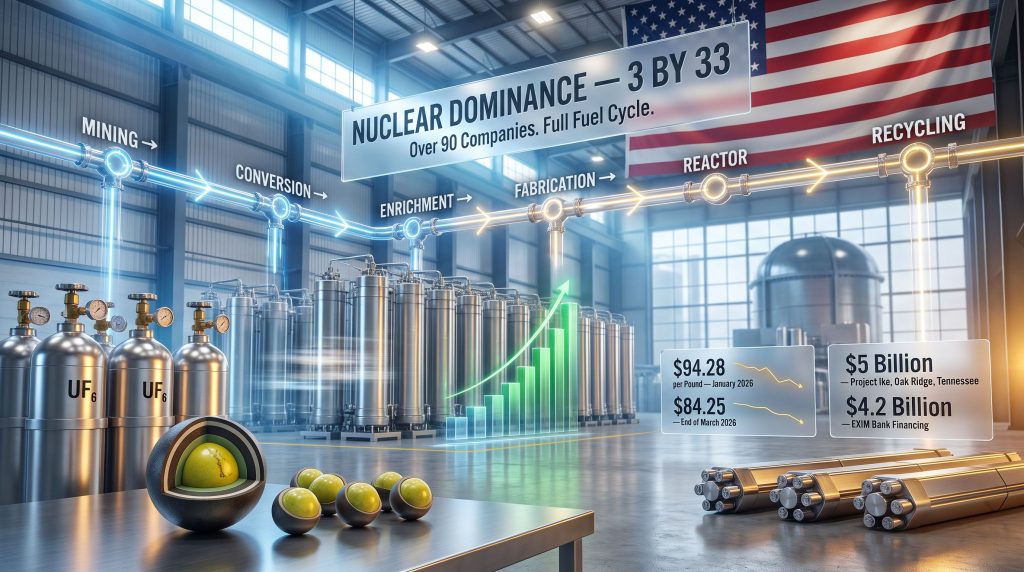
Launched in April 2026, the Nuclear Dominance: 3 by 33 campaign organises the consortium's objectives into three concurrent streams, each targeting completion by 2033:
- Building a cost-competitive domestic fuel supply chain that can serve existing light-water reactors and next-generation advanced designs without dependence on foreign-enriched material
- Accelerating advanced reactor deployment alongside the development of a closed fuel cycle that recaptures value from spent nuclear fuel rather than treating it as waste
- Expanding coordination across workforce development, private capital formation, technology innovation, and cross-sector collaboration to ensure the first two objectives are institutionally supported
The campaign applies a 60-day sprint governance model to track execution, with milestones established at the April 2026 launch. This approach imports a project management discipline more commonly associated with technology development into the domain of industrial policy, acknowledging that annual reporting cycles are too slow for the pace of build-out required.
"What makes the sprint model significant: Traditional federal industrial policy operates on budget cycles measured in years. The 60-day sprint framework introduces accountability checkpoints that force consortium members to demonstrate progress against specific milestones, making it harder for participation to remain aspirational rather than operational."
Stage-by-Stage: Where the Fuel Cycle Gaps Are Most Severe
Understanding the DOE consortium growing nuclear fuel cycle effort requires mapping where the genuine bottlenecks exist across each production stage.
| Fuel Cycle Stage | Current U.S. Status | Primary Vulnerability |
|---|---|---|
| Mining and Milling | Limited and restarting | Import dependence for most requirements |
| Conversion (UO₃ to UF₆) | Near-zero commercial capacity | Only one legacy facility, no new entrants until recently |
| Enrichment (LEU) | Partial, expanding | Foreign enrichers dominate available supply |
| HALEU Production | Demonstration scale only | Insufficient for planned advanced reactor fleet |
| Deconversion | Underdeveloped | Creates downstream processing bottlenecks |
| Fuel Fabrication | Established for LWR fuel | Very limited HALEU-capable facilities |
| Spent Fuel Recycling | No commercial-scale operation | Decades of accumulated used fuel with no recovery pathway |
The conversion stage deserves particular attention. Converting uranium oxide into uranium hexafluoride (UF₆) is a chemically intensive intermediate step that is not optional: enrichment centrifuges require UF₆ as feedstock. Without domestic conversion capacity, expanding enrichment infrastructure provides only partial supply chain security.
FluxPoint Energy's announcement of plans to develop the first new U.S. uranium conversion facility in more than 70 years directly addresses this gap, and its emergence at CERAWeek 2026 in Houston reflects the degree to which energy infrastructure investors are now seriously engaging with the nuclear fuel supply chain.
Private Capital Responds: The Enrichment Build-Out
How Are Major Players Positioning Themselves?
The scale of private investment now targeting enrichment capacity is genuinely unprecedented in the post-Cold War era. Three distinct strategic approaches are visible:
Centrus Energy at Piketon, Ohio has brought Fluor Corporation on as its engineering, procurement, and construction contractor for the expansion of the American Centrifuge Plant. Fluor's role spans engineering and design, supply chain procurement, construction management, and commissioning support, representing a full-service EPC engagement rather than a partial advisory arrangement.
Orano's Project Ike at Oak Ridge, Tennessee represents a $5 billion centrifuge enrichment facility investment. Orano has already signed a memorandum of understanding with North America's Building Trades Unions to establish the cooperative labour framework for construction, a move that simultaneously addresses workforce availability and signals that the project has moved beyond feasibility into active development planning.
General Matter, an American enrichment start-up, is pursuing an export-oriented strategy, securing up to $4.2 billion in potential debt financing from the Export-Import Bank of the United States to supply enriched uranium to Japan and South Korea. This international dimension is significant: it demonstrates that allied nations are actively seeking to diversify away from the same foreign suppliers that U.S. utilities are trying to move away from, creating a mutually reinforcing demand dynamic.
The next major ASX story will hit our subscribers first
Advanced Fuel Fabrication: TRISO and the HALEU Frontier
TRISO fuel, which encases uranium particles in multiple protective ceramic and carbon layers, represents the fuel form required by high-temperature gas reactors and some other advanced designs. Its manufacture is technically distinct from conventional fuel pellet fabrication, and its use with HALEU adds an additional regulatory and materials handling complexity.
In February 2026, the Nuclear Regulatory Commission granted X-energy subsidiary TRISO-X a special nuclear material licence for HALEU fuel fabrication. The licence covers two planned commercial facilities, TX-1 and TX-2, for an initial 40-year period, making them the first new nuclear fuel fabrication plants licensed by the NRC in more than half a century.
This licensing milestone matters not just for X-energy's commercial plans but as a proof point that the NRC can process advanced fuel fabrication applications within a timeframe relevant to industry planning.
Separately, Standard Nuclear announced plans to commence TRISO production at two additional new facilities in 2026, further expanding the nascent production base. Underpinning these commercial efforts, Oak Ridge National Laboratory's researchers are using the Spallation Neutron Source's Spallation Neutrons and Pressure Diffractometer to conduct neutron scattering measurements on HALEU-bearing TRISO particles. This technique reveals internal chemistry and structural changes within fuel particles under irradiation conditions that are difficult to detect through conventional methods, providing the fundamental materials data needed to validate HALEU-fuelled high-temperature gas reactor performance over operational lifetimes.
Spent Fuel Recycling: From Policy Aspiration to Federal Procurement
Perhaps the most consequential shift within the consortium framework is the treatment of spent nuclear fuel recycling as an active federal procurement priority rather than a long-term research objective. The DOE issued two Requests for Applications in April 2026 inviting private industry to propose approaches to kickstarting commercial-scale reprocessing and recycling in the United States.
A closed fuel cycle is not simply a recycling programme. It represents a fundamental reconfiguration of how nuclear material is managed across the energy system. Spent light-water reactor fuel still contains a substantial proportion of fissile and fertile material, including residual uranium-235, plutonium isotopes, and minor actinides.
A closed cycle recovers these materials as feedstock for advanced reactors rather than committing them to permanent geological storage, reducing both the long-term radioactive burden and the primary resource demand placed on mining and enrichment.
Two technology pathways are now advancing toward validation:
-
Project Omega secured an ARPA-E contract to validate its molten salt electrochemical recycling platform in collaboration with Idaho National Laboratory. The platform is designed to process used nuclear fuel, recover valuable isotopes, and reduce the long-term waste management challenge. Molten salt electrochemistry allows separation of actinides and fission products through electrochemical potential differences in a molten salt medium, a process that operates at relatively moderate temperatures compared to traditional aqueous reprocessing.
-
H Canyon at the Savannah River Site in South Carolina has been reactivated for uranium recovery and isotope separation from used nuclear fuel. H Canyon is a federal facility with existing hot cell infrastructure capable of handling highly radioactive materials, giving it a near-term operational capability that no private facility currently matches. The isotope recovery dimension adds economic value beyond waste reduction, as certain isotopes recovered from spent fuel have medical, industrial, and defence applications that command significant market premiums.
Idaho National Laboratory anchors the research framework for both pathways, providing irradiation testing, fuel characterisation, and process validation capabilities that are not available at commercial facilities.
Upstream Security: Mining Activity and Uranium Price Dynamics
What Is Driving Domestic Mining Activity?
The consortium's fuel chain ambitions require a secure and expanding upstream uranium supply. Three developments in early 2026 illustrate the direction of domestic and allied-nation mining activity:
Uranium Energy Corp. commenced in-situ recovery production at its Burke Hollow operation in southern Texas after receiving approval from the Texas Commission on Environmental Quality. Uranium produced at Burke Hollow is processed at the Hobson Central Processing Plant, which serves as the hub for five satellite ISR projects across the Texas Uranium Belt. This hub-and-spoke processing model is a capital-efficient approach to ISR mining that allows multiple satellite wellfields to share centralised processing infrastructure.
Indeed, the expansion of U.S. uranium ISR production represents one of the most tangible near-term contributions to the domestic supply chain that the consortium is working to strengthen.
Eagle Nuclear Energy announced a 27,000-foot investigative drilling programme at its Aurora Uranium Project along the Oregon-Nevada border, commencing in July 2026. Investigative drilling at this scale is aimed at establishing the geometry and grade continuity of uranium mineralisation, providing the dataset needed for a resource estimate under standard reporting frameworks.
Denison Mines received full regulatory clearance from the Canadian Nuclear Safety Commission for its Wheeler River project in Saskatchewan's Athabasca Basin, the region that hosts some of the world's highest-grade uranium deposits. Wheeler River represents Canada's first ISR uranium mining operation, a method that involves dissolving uranium in place and pumping the solution to surface rather than excavating rock, significantly reducing the environmental footprint of extraction.
On pricing, the uranium spot market traded at $94.28 per pound at the end of January 2026, a two-year high, before easing to $86.95 by end of February and $84.25 by the end of March. This two-month retreat should not be read as a structural reversal. The uranium supply-demand volatility in spot pricing is well understood by long-term participants; most fuel chain infrastructure decisions are evaluated against contracted volumes at negotiated prices rather than weekly movements. The more important signal is that spot prices remain substantially above the sub-$30 levels that made domestic production uneconomic for most of the prior decade.
Alternative Feedstocks: Thorium and Fuel Salts
Beyond conventional uranium-based fuel cycles, two alternative feedstock strategies are gaining traction within the broader fuel security framework.
Canadian Nuclear Laboratories has signed an agreement with Chicago-based Clean Core Thorium Energy to manufacture demonstration irradiation bundles of the ANEEL fuel, which combines thorium with HALEU for use in pressurised heavy water reactors, including Canada's CANDU fleet. The thorium-HALEU combination exploits thorium's high neutron capture cross-section to breed fissile uranium-233 in-reactor, potentially extending fuel cycle economics and reducing the enrichment demand per unit of energy produced.
Building a domestic fuel salt supply chain introduces a distinct set of infrastructure requirements. Molten salt reactor developers require uranium or thorium feedstocks converted into salt form, specifically fluoride salts with uranium in a +3 or +4 valence state. A pathway exists through the enrichment process: UF₆, produced as part of conventional enrichment, can be chemically reduced to uranium fluoride salts with the appropriate valence. However, the handling requirements for molten salt chemistry are stringent. Oxygen and moisture contamination are particularly damaging to molten salt systems, requiring specialised containment and handling infrastructure that does not currently exist at industrial scale in the United States.
Three Scenarios for 2033: What Success and Failure Look Like
The consortium's 2033 target horizon is ambitious but not arbitrary. It aligns with the earliest credible commercial operation dates for advanced reactor designs now in licensing or late-stage development. Three scenarios frame the range of plausible outcomes:
Scenario A: Full Execution. Enrichment capacity at Piketon and Oak Ridge reaches commercial scale, FluxPoint's conversion facility enters operation, TRISO-X's TX-1 begins fuel fabrication, and at least one spent fuel recycling pilot achieves continuous operation. Domestic fuel costs achieve parity with foreign suppliers. This scenario requires no major regulatory delays, consistent capital availability, and successful workforce recruitment across multiple highly specialised technical disciplines.
Scenario B: Partial Progress. Enrichment and fabrication capacity expands meaningfully, reducing but not eliminating foreign supply dependence. Conversion remains a bottleneck. Recycling remains at the pilot scale. Advanced reactors begin deploying but face HALEU supply constraints that limit deployment pace below planned rates.
Scenario C: Structural Delay. Regulatory processing times extend project timelines by two to three years across multiple segments simultaneously. Capital markets reprice nuclear risk in response to cost overruns at early projects. Workforce constraints, particularly for specialised nuclear materials handlers and centrifuge technicians, slow commissioning across new facilities.
"Investor note: The historical precedent for large-scale nuclear infrastructure projects in the United States includes significant cost overruns and schedule delays. Scenario B is arguably the baseline, not the optimistic case. Positions sized for Scenario A outcomes carry meaningful execution risk even in a supportive policy environment. This is not financial advice; investors should conduct their own due diligence."
The Enablers the Consortium Cannot Afford to Underestimate
Three enabling conditions determine which scenario materialises, and all three are currently in transition rather than secured.
Workforce is the constraint most frequently underestimated by capital markets. Operating centrifuge cascades, handling HALEU, managing molten salt chemistry, and staffing hot cells for reprocessing all require training pathways that take years to build. Orano's MOU with North America's Building Trades Unions for Project Ike establishes a model for construction workforce agreements, but the operational workforce challenge is distinct and requires engagement with universities, community colleges, and national laboratory training programmes at a scale not yet visible.
Financing structures are evolving to match the project scale involved. EXIM Bank's $4.2 billion financing commitment to General Matter's export-enrichment strategy demonstrates that federal credit facilities can be deployed at a scale commensurate with the infrastructure requirements. DOE's loan programmes and DPA funding mechanisms provide additional capital access, but the projects involved are large enough that private debt and equity markets must also participate at meaningful scale.
Cross-sector coordination through the voluntary agreement model has real structural limitations. Unlike the directed industrial investment seen in some competitor nations, the DPA consortium cannot compel investment decisions or guarantee offtake. Its value lies in reducing coordination failures, improving information flow between fuel cycle segments, and creating a forum where the chicken-and-egg problem of fuel availability versus reactor deployment can be addressed collectively rather than by each company independently.
Furthermore, the global uranium reserves picture adds another layer of complexity to long-term planning, as the geographic concentration of high-grade deposits outside U.S. borders shapes the strategic calculus for every consortium participant.
Frequently Asked Questions: DOE Consortium and the Nuclear Fuel Cycle
What Is the DOE Nuclear Fuel Cycle Consortium?
It is a voluntary coordination mechanism established by the DOE Office of Nuclear Energy under the Defense Production Act, convening more than 90 companies across all segments of the nuclear fuel cycle to address domestic supply chain gaps.
What Does the "3 by 33" Campaign Aim to Achieve?
Three concurrent objectives by 2033: a cost-competitive domestic fuel supply chain, accelerated advanced reactor deployment alongside a closed fuel cycle, and expanded coordination across workforce, finance, and innovation.
What Is HALEU and Why Is It Critical to Advanced Reactors?
HALEU is uranium enriched to between 5% and 20% U-235. Most advanced non-light-water reactor designs require it as fuel, but commercial-scale domestic production is essentially non-existent as of 2026.
What Is the Difference Between Nuclear Fuel Recycling and Reprocessing?
Reprocessing typically refers to chemical separation of fissile and fertile materials from spent fuel. Recycling is a broader term encompassing reprocessing plus the fabrication of recovered materials into new fuel. A closed fuel cycle integrates both within a continuous materials flow system.
How Does Uranium Spot Price Volatility Affect Domestic Fuel Chain Investment?
Most fuel chain infrastructure decisions are evaluated against long-term contract pricing rather than spot prices. The spot market provides a sentiment signal, but producers and investors building facilities with 30-to-40-year operational lives base their economics on contracted volumes at negotiated prices, making short-term spot movements less determinative than they appear.
Key Structural Shifts the Consortium Signals
The DOE consortium growing nuclear fuel cycle initiative reflects a recalibration of assumptions that have governed U.S. nuclear policy for thirty years. Several shifts are now measurable rather than speculative:
- Over 90 companies are actively engaged across mining, enrichment, fabrication, and recycling segments
- Multi-billion dollar enrichment investments at Piketon and Oak Ridge have moved from announcement to EPC contract stage
- The NRC has licensed HALEU fuel fabrication for TRISO-X's first two commercial facilities for an initial 40-year term
- Spent fuel recycling has transitioned from a research programme to an active federal procurement process with two open RFAs
- Uranium spot prices, while retreating from the $94.28 per pound January 2026 high, remain structurally elevated relative to the sub-$30 levels of the prior decade
- A first new U.S. uranium conversion facility in more than 70 years is now in planning through FluxPoint Energy
Consequently, the degree to which voluntary industrial coordination can substitute for directed investment, and whether the 60-day sprint model can maintain momentum across a multi-year build-out, remain the central open questions. The American Nuclear Society provides ongoing coverage of how the DOE consortium growing nuclear fuel cycle effort is evolving across each of these segments. What is no longer in question is that the structural transformation of the U.S. nuclear fuel cycle has begun.
Readers seeking additional coverage of U.S. nuclear fuel supply chain developments and advanced reactor policy can explore reporting published by the American Nuclear Society's Nuclear Newswire at ans.org/news.
Want to Track the Next Major Uranium Discovery Before the Market Does?
Discovery Alert's proprietary Discovery IQ model delivers real-time alerts the moment significant uranium and nuclear commodity discoveries are announced on the ASX, translating complex mineral data into actionable insights for investors at every level — explore historic discovery returns on Discovery Alert's discoveries page to understand the scale of opportunity, and begin your 14-day free trial at discoveryalert.com.au to position yourself ahead of the next major find in this rapidly restructuring sector.