
July 28, 2026
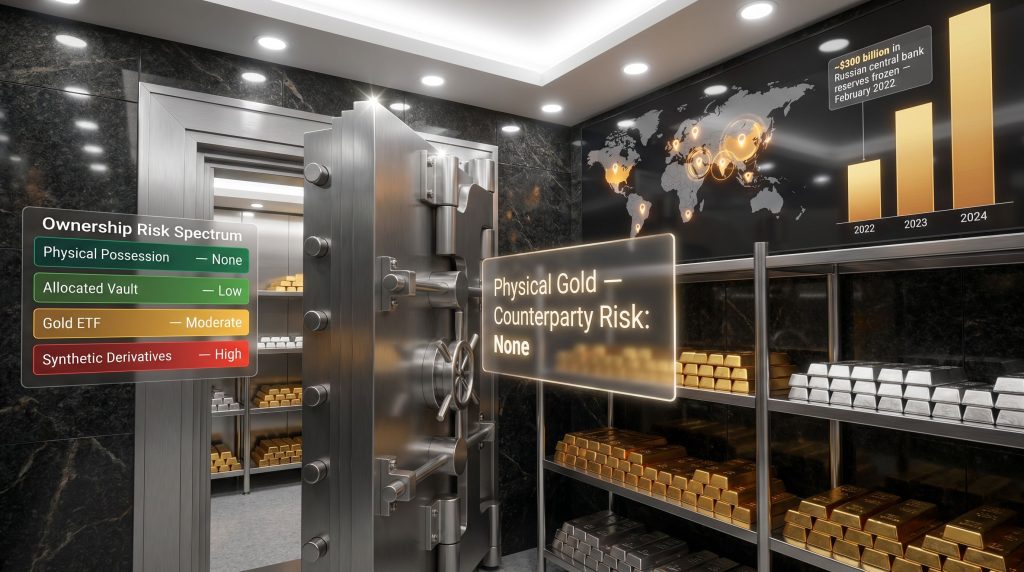
The Hidden Dimension of Risk That Most Portfolios Ignore
Most investors approach portfolio construction as an exercise in asset diversification. They allocate across equities, bonds, real estate, and commodities, believing that spread equals safety. This logic is sound as far as it goes. But it addresses only one axis of risk, and arguably not the most dangerous one during systemic stress events.
There is a second axis that receives far less attention: institutional dependency. How many intermediaries stand between you and your wealth? How many of those intermediaries could fail, freeze, restrict, or lose access to your assets under conditions of financial stress? This is the domain of counterparty risk, and it is where the question of does physical gold have counterparty risk becomes genuinely complex.
The answer is not a simple yes or no. It depends entirely on the form of ownership, not the metal itself. Understanding this distinction is one of the most practically important things a serious investor can grasp.
When big ASX news breaks, our subscribers know first
Why Counterparty Risk Is Systematically Underestimated
Standard retail investor frameworks tend to concentrate on market risk, liquidity risk, inflation risk, and concentration risk. Counterparty risk sits in an uncomfortable category: it is invisible during stable conditions and only becomes visible at precisely the moment when mitigation options have narrowed.
This is a predictable feature of how human cognition processes threat. The availability heuristic leads investors to weight risks that have recently materialised more heavily than those that haven't. When banks function smoothly, when deposits are accessible, and when wire transfers clear in seconds, the idea that financial infrastructure could fail feels abstract. The risk is real, but it produces no signal.
The Bank for International Settlements defines counterparty risk as the probability that one party in a financial arrangement fails to honour their contractual obligation. Critically, this definition applies to agreements and claims, not to physical assets held outright. This distinction carries enormous practical significance for how investors should categorise their holdings. (Source: Bank for International Settlements, Counterparty Credit Risk: Framework and Definitions)
Key insight: Counterparty risk is embedded in the structure of a financial instrument, not its label. A gold certificate and a gold bar are both called "gold exposure." Their risk profiles are fundamentally different.
What a Bank Deposit Actually Is (And Why It Matters)
Most people believe they are storing money when they deposit funds at a bank. Legally and functionally, they are doing something quite different. A bank deposit is an unsecured loan to the institution. The bank records that balance as a liability on its balance sheet. The depositor becomes an unsecured creditor, not the owner of segregated property.
The Federal Deposit Insurance Corporation covers up to $250,000 per depositor per institution in the event of individual bank failure. This is meaningful protection against isolated institutional collapse. However, it carries two significant limitations that are rarely discussed:
- FDIC coverage addresses individual institution failure, not simultaneous systemic stress across multiple major banks at once
- The $250,000 ceiling is a fixed nominal dollar amount that does not adjust for inflation or purchasing power erosion over time
Physical gold in direct possession carries none of these dependencies. It is not a claim against any institution. It does not sit on any bank's balance sheet. No institution can freeze it, dilute it, or default on it, because there is no obligation outstanding. Furthermore, gold as a safe haven has historically demonstrated this independence during periods of institutional stress. (Source: Federal Deposit Insurance Corporation, Understanding Deposit Insurance)
Does Physical Gold Have Counterparty Risk? The Definitive Answer
The direct answer to this question is that physical gold held in personal possession carries zero counterparty risk. It is outright property, not a financial claim. Nobody owes it to you and there is no intermediary whose solvency or behaviour determines whether you can access it.
However, the moment gold is held by a third party, whether a custodian, vault operator, financial institution, or fund structure, a degree of institutional dependency is introduced. The nature and magnitude of that dependency varies significantly depending on how the arrangement is structured.
The ownership structure is the entire story. The metal itself is constant. The risk profile is determined by who holds it and under what legal framework.
The Full Counterparty Risk Spectrum Across Gold Ownership Structures
The following table maps every major form of gold ownership against its counterparty risk profile and key risk factors:
| Ownership Form | Counterparty Risk Level | Key Risk Factors | Who Bears Default Risk |
|---|---|---|---|
| Physical gold, personal possession | None | Theft, storage, liquidity | No counterparty exists |
| Allocated vault storage (third-party) | Low | Custodian failure, access restrictions | Vault operator |
| Unallocated storage | Moderate | Pooled claims, creditor hierarchy | Institution holding pool |
| Physically backed gold ETFs | Moderate | Custodian chain, subcustodian risk | ETF issuer and custodians |
| Synthetic gold and derivatives | High | Counterparty default, margin calls | Issuing institution |
| Bank-held gold certificates | High | Bank solvency, access restrictions | Issuing bank |
Personal Possession: Zero Counterparty Risk With Important Trade-offs
Gold coins or bars held at home involve no intermediary whatsoever. No institution can restrict, freeze, or default on the asset. The risk profile shifts entirely to non-counterparty categories: physical security, theft exposure, fire and flood damage, and insurance adequacy.
This last point is frequently overlooked. Standard homeowners' insurance policies typically cap bullion coverage at approximately $200 to $250 per claim, which is negligible for any meaningful position. Investors holding significant quantities at home should investigate specialist bullion insurance policies that provide full replacement value coverage. (Source: Insurance Information Institute, What Is Covered by Standard Homeowners Insurance?)
Home storage eliminates counterparty risk entirely but transfers that risk to the owner's own security infrastructure. The two are not the same risk category, but both require deliberate management. For a broader view of counterparty risks in precious metals, understanding these distinctions is essential before committing to any storage structure.
Allocated vs. Unallocated Storage: A Distinction With Legal Consequences
This is among the most important and least understood distinctions in precious metals ownership:
- Allocated storage assigns specific physical metal to a named owner, registered by serial number, weight, and purity. The metal does not appear on the custodian's balance sheet as an asset they can lend, pledge, or use as collateral. In an insolvency scenario, allocated metal is legally segregated from the custodian's estate and returned to the owner.
- Unallocated storage gives the investor a claim against a pool of metal held by the institution. Functionally, this resembles a bank deposit in its risk structure. If the institution fails, the unallocated account holder ranks as an unsecured creditor, not as the owner of specific identified property.
The legal distinction between these two structures in an insolvency proceeding is not marginal. It is the difference between recovering your metal and joining a creditor queue.
Gold ETFs and the Custody Chain Problem
Physically backed gold ETFs hold metal through a chain of custodians and subcustodians. Each link in that chain introduces incremental counterparty exposure. The investor's legal claim is to units in a trust structure, not to specific identified bars of metal.
Operational risk, legal jurisdiction risk, and subcustodian default risk all exist within the structure and are not always transparently disclosed. Synthetic gold ETFs, which use derivatives rather than physical metal, carry the highest counterparty risk of any gold exposure vehicle. They are gold in name only and introduce all the complexity of derivative counterparty relationships. Investors considering physical vs ETF gold should weigh these structural differences carefully before allocating capital.
What Sovereign Behaviour Reveals About Institutional Risk
The theoretical case for physical gold's counterparty risk advantage was stress-tested at sovereign scale in February 2022, when Western governments froze approximately $300 billion in Russian central bank foreign currency reserves held within Western financial institutions.
These assets were legally held, properly documented, and denominated in reserve currencies. They were rendered inaccessible within days. The event demonstrated a category of risk that most reserve managers had never previously modelled: political counterparty risk that operates independently of any credit or solvency consideration.
The 2022 reserve freeze established a new benchmark for institutional risk assessment. Assets that appear legally sound and financially secure can be frozen by foreign government action if they reside within that government's financial system. The jurisdiction of custody is not an administrative detail. It is a material risk variable.
According to World Gold Council demand data, central bank gold demand reached multi-decade highs in 2022, 2023, and 2024. The buying was concentrated among non-Western institutions, including central banks across China, India, and the Middle East, systematically reducing dollar-denominated reserve exposure. These were not tactical allocation shifts. They represented permanent structural reassessments of reserve asset composition. (Source: World Gold Council, Gold Demand Trends, annual series)
The Parallel Between Sovereign and Individual Risk Logic
| Risk Category | Reserve Currency Holdings | Physical Gold |
|---|---|---|
| Credit and default risk | Dependent on issuer solvency | None |
| Inflation and purchasing power | Erodes with monetary expansion | Historically preserved |
| Political and sanctions risk | Subject to foreign government action | Not applicable to domestically held metal |
| Access restrictions | Can be frozen or restricted | Not applicable to personally held metal |
| Trading hours | Limited to banking infrastructure | Trades continuously, globally |
The individual investor faces a structurally analogous decision at a smaller scale. Assets held within the financial system carry systemic dependency. Physical metal held outside it does not. Central bank behaviour since 2022 validates this logic at an institutional level.
The next major ASX story will hit our subscribers first
Gold and Silver: Different Risk Profiles, Different Market Mechanics
Gold and silver are not interchangeable instruments. They share some characteristics but operate on fundamentally different demand structures.
Gold functions primarily as a monetary anchor. Its price behaviour is dominated by real yield dynamics, central bank demand, and currency debasement trends. It moves with comparatively lower volatility and serves as the appropriate instrument when long-term purchasing power preservation is the primary objective.
Silver operates on dual demand drivers: monetary demand that correlates with gold, and industrial demand tied to solar energy, electric vehicles, artificial intelligence infrastructure, and electronics. During monetary stress events, silver tends to amplify gold's directional move, but with greater volatility in both directions. During periods where industrial demand softens while monetary demand surges, silver often outperforms substantially.
The performance divergence over the recent cycle illustrates this dynamic. Gold has approximately doubled from its early 2024 lows, driven by central bank accumulation, real yield compression, and debasement trade positioning. Silver has gained more than 130% over the same period, outperforming during the monetary demand surge phase. (Source: World Gold Council, Gold Demand Trends)
The gold-silver ratio is one signal experienced investors use to assess relative value between the two metals. It functions most effectively when interpreted alongside real yield trends and central bank flow data, not as a standalone allocation trigger. Short-term price corrections are a normal feature of long-term precious metals bull markets and do not negate the structural demand drivers underlying both assets.
A Practical Framework for Assessing Your Current Counterparty Exposure
Most investors have never formally mapped the institutional dependency embedded in their existing precious metals holdings. The following framework provides a structured starting point:
- Audit your existing gold exposure and identify whether each holding is in personal possession, allocated storage, unallocated storage, an ETF structure, or mining equities
- Map the counterparty chain for each holding, identifying how many institutions stand between you and the metal
- Assess jurisdiction risk by determining where the metal is physically located and under whose legal framework it sits
- Evaluate insurance coverage by confirming whether your current storage arrangement carries full market replacement value coverage or a fixed dollar cap
- Determine liquidity requirements to identify which portion of your holdings needs to be immediately accessible without institutional intermediation
- Allocate across the risk spectrum recognising that not all gold needs to sit at the same point on the counterparty risk continuum
In addition, monitoring record gold ETF inflows can provide useful context about broader investor sentiment and structural demand trends when conducting this kind of portfolio review. Furthermore, the S&P Global guide on physical versus synthetic gold exposure offers detailed technical analysis that complements this framework for investors seeking deeper due diligence.
Home Storage vs. Professional Vault Storage: A Structured Comparison
| Consideration | Home Storage | Professional Allocated Vault |
|---|---|---|
| Counterparty risk | Zero | Low, custodian dependency |
| Physical security | Owner-managed | Institutional grade, UL 608 Class 3 rated |
| Insurance coverage | Typically $200 to $250 cap via homeowners policy | Full market replacement value |
| Independent auditing | None | Third-party verification |
| Liquidity and delivery | Immediate, no intermediary | Delivery on request |
| Jurisdiction options | Domestic only | Offshore locations available, including Singapore and Hong Kong |
| Best suited for | Emergency access, direct independence | Accumulation, insured storage, institutional-grade security |
Why a Dual-Structure Approach Is Often the Most Rational Position
Neither home storage nor professional vault storage addresses every risk dimension in isolation. A layered ownership structure combines the strengths of both:
- Home-held metal provides direct, unmediated access with no institutional dependency
- Professionally vaulted allocated metal provides insured, audited accumulation with institutional-grade physical security
The allocation between the two depends on individual liquidity requirements, personal security infrastructure, insurance considerations, and jurisdiction preferences. The underlying principle is sound regardless of scale: no single point of failure should be capable of compromising the entire position.
Vault Security Standards: What UL 608 Class 3 Actually Means
UL 608 Class 3 represents the highest burglary-resistance classification issued by Underwriters Laboratories for vault doors and modular panels. Institutional vault operators certified to this standard typically layer additional controls on top of the structural requirement, including continuous 24-hour surveillance, armed security personnel, dual-control access protocols, and independent third-party auditing that matches physical inventory against ownership records. (Source: Underwriters Laboratories, UL 608: Standard for Burglary Resistant Vault Doors and Modular Panels)
Frequently Asked Questions
Does physical gold have counterparty risk?
Physical gold held directly in personal possession carries no counterparty risk. The metal is property, not a claim. No institution can default on it because no institution owes it. Gold held by a third-party custodian introduces limited institutional dependency, but properly structured allocated storage minimises this by keeping the metal legally segregated from the custodian's balance sheet.
How is a bank deposit different from owning physical gold?
A bank deposit is a legally unsecured loan to a financial institution. The institution records the balance as a liability it owes you and can restrict access during stress events. Physical gold in personal possession is outright property with no such dependency. FDIC insurance covers deposits up to $250,000 per institution, a fixed nominal ceiling that does not protect against purchasing power erosion and does not extend to simultaneous systemic stress across multiple institutions.
What is the difference between allocated and unallocated gold storage?
Allocated storage registers specific physical metal to a named owner by serial number, weight, and purity. It is not pooled, not lent out, and does not appear on the custodian's balance sheet. In an insolvency, it is legally segregated and returned to the owner. Unallocated storage gives the investor a proportional claim against a pool of metal, placing them as an unsecured creditor if the institution fails.
Is a gold ETF the same as owning physical gold?
No. A physically backed gold ETF holds metal through a chain of custodians and subcustodians, and the investor's legal claim is to trust units, not specific identified bars. Each link in the custody chain introduces incremental counterparty exposure. Synthetic gold ETFs, which use derivatives rather than physical metal, carry the highest counterparty risk of any gold exposure vehicle.
Can a foreign government freeze domestically held physical gold?
No. The defining feature of the 2022 reserve freeze was that assets rendered inaccessible were held within the freezing governments' own financial systems. Domestically held physical gold cannot be frozen by a foreign government. Domestic confiscation risk is a separate legal and historical question governed by each jurisdiction's specific legal framework and is a distinct category from counterparty risk.
Key Takeaways
- Whether does physical gold have counterparty risk is a function of ownership structure, not the metal itself. Direct possession carries zero counterparty risk. Paper gold instruments carry the most.
- Bank deposits are unsecured loans to financial institutions, carrying credit risk, access risk, and purchasing power risk that physical metal does not.
- The 2022 freeze of approximately $300 billion in Russian central bank reserves validated at sovereign scale that assets held within any financial system are subject to that system's vulnerabilities, including political ones.
- Central bank gold purchases reached multi-decade highs in 2022, 2023, and 2024, led by non-Western buyers. This reflects a structural, not tactical, reassessment of reserve asset risk following the 2022 freeze event.
- Gold has approximately doubled from early 2024 lows. Silver has gained more than 130% over the same period. Short-term corrections do not alter the underlying structural demand drivers.
- A dual-structure ownership approach, combining home-held metal with professionally vaulted allocated storage, is often the most rational architecture because each form addresses risks the other cannot.
- The goal of counterparty risk management in precious metals is not to eliminate all risk. It is to ensure that no single point of institutional failure can compromise the entire position.
Disclaimer: This article is for informational and educational purposes only and does not constitute financial or investment advice. Precious metals prices are volatile and past performance is not indicative of future results. Always consult a qualified financial adviser before making investment decisions.
Want to Identify the Next Major Mineral Discovery Before the Broader Market Does?
While physical gold and silver remain cornerstone assets for counterparty risk management, Discovery Alert's proprietary Discovery IQ model delivers real-time alerts on significant ASX mineral discoveries — instantly translating complex geological data into actionable investment insights for both short-term traders and long-term investors. Explore historic discoveries and their exceptional market returns, then begin your 14-day free trial to position yourself ahead of the market.