July 28, 2026
The Silent Force Reshaping Gold's Supply and Demand Equation
The gold market has spent decades being analysed through a relatively stable set of lenses: central bank reserves, exchange-traded fund flows, jewelry fabrication, and industrial consumption. These four pillars underpin virtually every demand model published by major research institutions. Yet a structurally new category of buyer has been quietly accumulating physical metal at volumes that rival sovereign nations, without appearing in a single official demand report. Understanding this buyer requires first understanding the instrument it is building its reserves around: the gold-backed stablecoin and Tether gold buying.
When big ASX news breaks, our subscribers know first
What Is a Gold-Backed Stablecoin? The Mechanics Explained
The Basic Architecture: One Token, One Ounce
A gold-backed stablecoin is a blockchain-based digital token whose value is pegged directly to physical gold held in custody. The standard design is straightforward: one token represents one fine troy ounce of allocated gold, stored in a third-party vault on behalf of token holders.
The word "allocated" carries significant technical weight here. Unlike unallocated gold accounts, where metal is pooled and the holder has a creditor claim against the custodian, allocated gold is legally segregated and titled to a specific owner. It cannot be lent, leased, or rehypothecated. The issuer's sole obligation is to maintain the one-to-one ratio: issue a token, purchase and vault the gold; redeem a token, release the corresponding metal.
This binary structure is what makes the instrument categorically different from most gold exposure products available in financial markets today.
Gold-Backed Stablecoin vs. Gold ETF: A Structural Comparison
Many investors assume gold-backed stablecoins and gold ETFs are functionally equivalent. They are not. The differences in custody structure, redemption mechanics, and reserve management have material implications for how each instrument interacts with the physical market. For a broader comparison of physical gold vs ETFs, the distinctions become even more pronounced when stablecoin mechanics are introduced.
| Feature | Gold-Backed Stablecoin (XAUt) | Gold ETF |
|---|---|---|
| Backing structure | Fully allocated physical gold | May include unallocated or partially allocated gold |
| Metal lending | Not permitted | Permitted in some fund structures |
| Settlement | On-chain, near-instant | T+1 or T+2 via exchange |
| Custody location | Swiss vaults (XAUt) | Varies by fund |
| Redemption | Token redeemed for physical ounce (eligible holders) | Shares redeemed for cash (retail); physical (authorised participants only) |
| Reserve transparency | Regular third-party attestation reports | Prospectus and NAV disclosure |
| Primary market | Emerging economies, crypto-native users | Institutional and retail investors |
The critical distinction for the physical gold market is this: every gold ETF share created does not necessarily require a new ounce of physical metal to move into an allocated vault. A gold-backed stablecoin does. There is no hedging window and no discretionary buffer. Adoption directly equals physical demand.
How Tether's Gold Buying Works: XAUt and the Reserve Obligation
XAUt: Tether's Gold Product and Its Custody Framework
Tether's XAUt token operates on the fully-allocated model. Each token in circulation is backed by one fine troy ounce of gold stored in Swiss vaults, with reserve attestations published regularly by independent third parties. You can review XAUt's full FAQ and structure for further technical detail on their custody and redemption processes. XAUt is a distinct product from Tether's US dollar stablecoin, USDT, and the two instruments maintain entirely separate reserve pools.
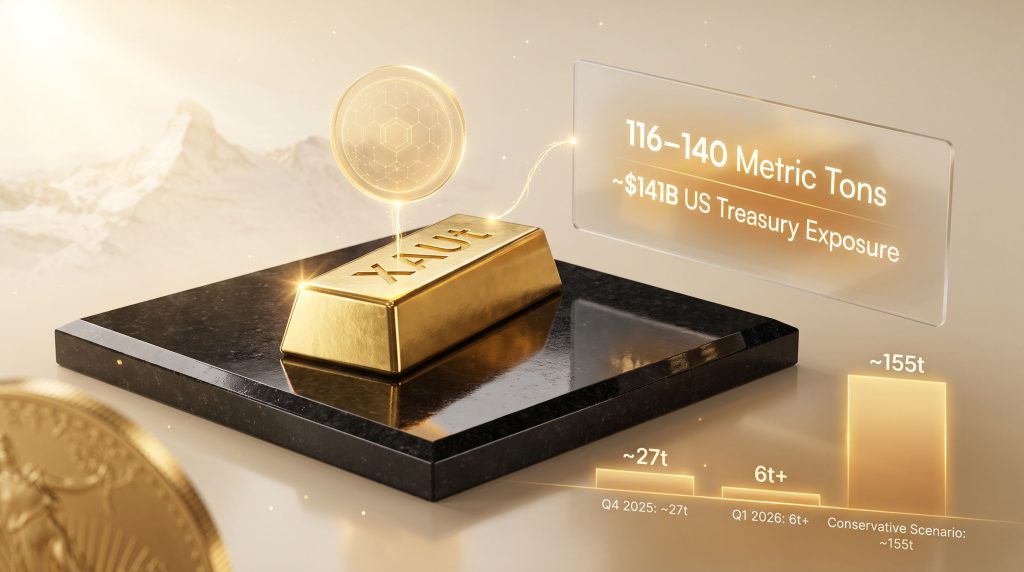
What makes Tether's role in the gold market remarkable is the scale of the organisation sitting behind the product. As of Q1 2026, Tether's attestation reports placed the company among the 17th or 18th largest holders of US Treasury securities globally, with approximately $141 billion in exposure (Tether, Q1 2026 Attestation Report). This is not a position held by a sovereign wealth fund or a central bank. It is a private company, and the same capital infrastructure that built a $141 billion Treasury position is now being systematically directed into physical gold.
Adrian Day, Chairman and CEO of Adrian Day Asset Management, has noted that Tether's gold accumulation since Q2 2025 has surpassed the purchases of any single central bank over the same period, describing the development as a story that remains far less understood than its scale warrants. (GoldSilver, July 2026)
Tether's Gold Acquisition Timeline
| Period | Reported Activity |
|---|---|
| Pre-Q2 2025 | Gold held primarily as broader corporate reserve collateral alongside USDT reserves |
| Q4 2025 | Approximately 27 metric tons of additional gold acquired |
| Q1 2026 | More than 6 metric tons acquired within a single quarter |
| February 2026 | $150 million strategic stake taken in Gold.com to expand XAUt distribution and tokenised gold infrastructure |
| Q1 2026 estimated total holdings | 116 to 140 metric tons (range reflects differing methodologies across sources) |
Sources: Reuters reporting, Tether attestation disclosures, Jefferies research
For context, many G20 central banks hold fewer than 100 metric tons in total gold reserves. A private company sitting at 116 to 140 metric tons, with a mandate that requires it to buy more as adoption grows, represents a categorically new type of market participant.
Why Tether's Gold Buying Is Price-Insensitive by Design
The Structural Mechanism Behind Non-Discretionary Purchasing
Most participants in the gold market exercise at least some degree of price sensitivity. Retail buyers respond to momentum. Fund managers monitor technical levels and real yield correlations. Even central banks demonstrate a degree of opportunism in their accumulation timing. A fully-backed gold-backed stablecoin and Tether gold buying operation cannot work this way.
The moment a gold stablecoin token is sold to a user, the corresponding physical ounce must already exist in the vault. There is no option to wait for a technical setup, a moving average signal, or a macro catalyst. As Adrian Day of Adrian Day Asset Management has explained, if an issuer sells ten million gold stablecoin tokens, ten million ounces of physical gold must be held in reserve, with no timing discretion whatsoever. (GoldSilver, July 2026)
This is what distinguishes stablecoin-driven gold demand from almost every other demand category:
- ETF flows are highly correlated with price momentum and investor sentiment cycles
- Central bank purchases involve strategic timing, even when driven by reserve diversification mandates
- Jewelry demand contracts sharply when gold prices rise
- Stablecoin reserve accumulation is mechanically indifferent to price. It is a function of token issuance volume, which is driven by adoption, not gold's spot price trajectory
Furthermore, Tether has been reported to be accumulating physical gold ahead of widespread XAUt adoption, building vault reserves in anticipation of future token issuance. If adoption scales, the purchasing obligation scales automatically and proportionally with it.
Tether executives have referenced the growth trajectory of USDT over its first five years as a benchmark scenario for XAUt's potential. This is a projection framing, not a confirmed commitment, but it illustrates the order-of-magnitude thinking behind the reserve pre-accumulation strategy.
Who Uses a Gold-Backed Stablecoin? The Real Demand Geography
Emerging Markets: Where Gold Stablecoins Find Their Deepest Resonance
The primary adoption base for gold-backed stablecoins is not concentrated in developed Western markets. Dollar stablecoins, particularly USDT, found their deepest penetration in economies experiencing severe currency depreciation, capital controls, and restricted access to stable financial instruments. Countries including Venezuela, Nigeria, Argentina, and Turkey represent the heartland of dollar stablecoin adoption. (World Gold Council, Gold Demand Trends)
A gold stablecoin addresses the same structural need, with one additional property: it insulates the holder from long-run US dollar debasement risk as well as local currency risk. Residents in these markets already have a deeply embedded cultural familiarity with gold as a safe haven tool for generational wealth preservation. A digital gold instrument removes the logistical barriers to that preference, enabling fractional ownership, instant transferability, and custody without physical storage costs.
The choice facing savers in currency-stressed economies is not abstract:
| Option | Protects Against Local Currency Risk | Protects Against USD Debasement | Historical Purchasing Power Track Record |
|---|---|---|---|
| Dollar stablecoin (e.g., USDT) | Yes | No | No |
| Bitcoin | Partially (high volatility) | Partial | No |
| Gold-backed stablecoin (e.g., XAUt) | Yes | Yes | Centuries of evidence |
Adrian Day has articulated this clearly: even if only a fraction of the global population currently using dollar stablecoins for currency protection opts instead for a gold-backed equivalent, the physical demand implications are substantial, given that this population base significantly exceeds the entire existing retail gold investment market. (GoldSilver, July 2026)
The Domestic Use Case: Gold as a Transaction Medium
A secondary demand source exists in developed economies, particularly among investors who want to denominate savings and everyday transactions in gold rather than fiat currency. A gold-backed stablecoin makes this operationally practical in a way that physical bullion storage cannot. Gold-denominated payments, transfers, and savings become possible without requiring a fiat conversion at each point of use. This use case is currently smaller than the emerging market opportunity but represents a structurally distinct and potentially durable new demand channel.
The Analytical Blind Spot in Standard Gold Demand Models
What Official Frameworks Are Missing
The World Gold Council's Gold Demand Trends framework tracks four primary demand categories: central bank purchases, ETF inflows, jewelry fabrication, and industrial use. These categories capture virtually all of the demand analysis that informs mainstream gold price forecasting models.
None of them include a line item for stablecoin reserve accumulation.
Central bank gold demand is reported through the IMF's International Financial Statistics and tracked by the World Gold Council quarterly. Private company accumulation, even at volumes comparable to major sovereign buyers, does not appear in these frameworks. The result is a systematic undercounting of physical demand that produces incomplete forward price models.
At 116 to 140 metric tons, Tether's estimated gold holdings are comparable to the annual purchases of many of the most active central bank buyers. This is not a marginal rounding error in global demand accounting. It is a structurally significant variable being omitted entirely.
The next major ASX story will hit our subscribers first
XAUt vs. PAXG: How the Two Leading Gold Stablecoins Compare
A Feature-by-Feature Breakdown
Two products dominate the gold-backed stablecoin space: Tether's XAUt and Paxos' PAXG. Both operate on the fully-allocated model, but they differ substantially in regulatory jurisdiction, custodial geography, and the institutional scale of their issuers. For a comprehensive overview of XAUt's real-time price data and market metrics, CoinMarketCap provides regularly updated figures across exchanges.
| Feature | Tether XAUt | Paxos PAXG |
|---|---|---|
| Backing ratio | 1 token : 1 troy oz | 1 token : 1 troy oz |
| Custody location | Swiss vaults | Brinks vaults (United States) |
| Issuer type | Private (Tether) | Regulated trust company (Paxos) |
| Regulatory framework | Offshore / multi-jurisdictional | NYDFS-regulated |
| Reserve attestation | Regular third-party attestations | Regular third-party attestations |
| Fractional ownership | Yes | Yes |
| Issuer's broader institutional scale | ~$141B Treasury exposure; 116-140t gold | Smaller institutional scale |
Tether's competitive advantage in this space is primarily a distribution one. USDT already has deep penetration in the emerging markets where gold stablecoin adoption is expected to be highest. XAUt can leverage existing user infrastructure, onboarding rails, and trust relationships that Paxos does not yet possess in those geographies.
Frequently Asked Questions: Gold-Backed Stablecoins
What Makes a Gold-Backed Stablecoin Different From Simply Buying Gold?
Physical gold requires storage, insurance, and logistical arrangements that compound in cost and friction over time, particularly for small savers. A gold-backed stablecoin is divisible into fractions of an ounce, transferable on-chain within minutes, and accessible without a brokerage account or vault arrangement. The underlying physical metal still exists in allocated form. The token is a more portable and liquid claim on it.
Is a Gold-Backed Stablecoin Safe?
Safety depends on three distinct factors:
- The integrity and independence of the custody arrangement
- The reliability and frequency of reserve attestation
- The operational and legal continuity of the issuing organisation
Fully allocated custody in regulated vaults with regular independent attestation is a higher structural safety standard than unallocated gold products. Counterparty risk does not disappear, but it shifts from price risk to issuer and custodian risk. Investors should assess both dimensions independently before committing capital.
Can a Gold-Backed Stablecoin Lose Value?
In gold terms, no, provided the one-to-one backing is maintained. Each token represents one troy ounce regardless of market conditions. In fiat currency terms, yes. If the dollar gold price falls, the dollar value of the token falls proportionally. The instrument is a gold proxy, not a capital-guaranteed product.
Why Would an Issuer Accumulate Gold Before Tokens Are Widely Adopted?
Pre-accumulation serves two purposes. First, it positions the issuer to fulfil redemption obligations instantly as adoption scales, without creating a lag between token issuance and physical settlement. Second, it reflects a broader balance sheet strategy. Tether has indicated publicly that gold plays a role in its corporate reserves beyond XAUt backing alone. Building reserves ahead of demand growth is operationally prudent for an organisation anticipating rapid token issuance acceleration.
What the Gold Price Outlook Looks Like When This Variable Is Included
Scenario Modelling: What Scaled XAUt Adoption Would Imply
Tether's own framing around XAUt's potential trajectory, referenced against USDT's growth over its first five years, is a projection, not a commitment. However, the gold price forecast implications that flow from scenario modelling at scale are nonetheless instructive for analysts building forward demand models.
| Adoption Scenario | Implied Token Issuance | Required Physical Gold | Demand Impact |
|---|---|---|---|
| Conservative (5% of USDT's current scale) | ~5 million tokens | ~155 metric tons | Comparable to a top-5 central bank buyer |
| Moderate (20% of USDT's current scale) | ~20 million tokens | ~622 metric tons | Exceeds annual mine supply from several major producing nations |
| Aggressive (USDT-equivalent scale over 5 years) | Proportional to USDT growth | Multi-thousand metric ton accumulation | Structurally transformative for the physical market balance |
Note: These are illustrative scenario projections only, not forecasts. Actual outcomes depend on regulatory developments, competitive dynamics, and broader macro conditions.
The New Signal Worth Monitoring
Traditional gold market analysis watches ETF flow reversals, central bank purchase acceleration, real yield compression, and currency dynamics as leading indicators. Consequently, the broader gold market outlook must now incorporate a new variable alongside these established signals: XAUt token issuance velocity and Tether's quarterly gold reserve disclosures.
Tether's attestation reports, published on a regular basis, provide a forward-looking physical demand signal that no conventional gold market data source currently captures. For investors and analysts building gold price models through 2026 and beyond, monitoring this data stream is no longer optional. It is essential for any claim to analytical completeness.
Investors and analysts building forward gold demand models without a stablecoin reserve line item are working from a structurally incomplete picture of the physical market. At 116 to 140 metric tons of holdings and growing, the omission is not minor.
Disclaimer: This article is intended for informational and educational purposes only and does not constitute financial or investment advice. Past performance is not indicative of future results. Forecasts and scenario projections are illustrative only and do not represent guaranteed outcomes. Always consult a qualified financial adviser before making investment decisions.
Want to Track the Next Major Discovery Reshaping a Commodity Market?
Discovery Alert's proprietary Discovery IQ model delivers real-time alerts on significant ASX mineral discoveries, instantly cutting through complex data to surface actionable opportunities — the same way structural shifts in gold demand are reshaping how informed investors position themselves. Explore how historic discoveries have generated extraordinary returns on Discovery Alert's discoveries page, and begin your 14-day free trial today to ensure you're never behind the market when the next major announcement lands.