
July 28, 2026
The Slow Erosion of a Financial Orthodoxy
For most of the post-Bretton Woods era, one assumption has underpinned global finance almost without challenge: U.S. Treasury securities are the world's safest, most liquid, and most universally accepted store of value. Central banks, sovereign wealth funds, and commercial institutions have structured entire reserve frameworks around this premise. That assumption is now being stress-tested in ways that would have seemed implausible even a decade ago.
The question is not simply whether gold prices are rising. The more consequential question is whether the global monetary architecture is undergoing a structural reorientation — one in which gold replacing U.S. Treasuries as global collateral represents a reclaiming of gold's historic function as the world's neutral reserve anchor. Recent data from the European Central Bank suggests the shift has already crossed a measurable threshold.
When big ASX news breaks, our subscribers know first
What the ECB's 2026 Reserve Data Actually Shows
Gold's Share of Global Official Reserves: A Historic Milestone
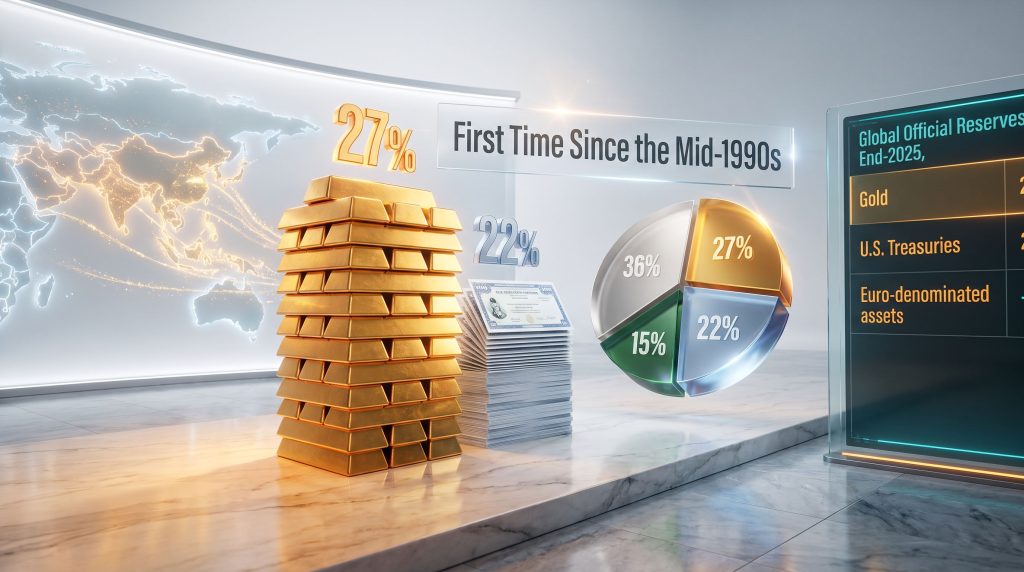
According to ECB reporting released in June 2026, gold now accounts for 27% of global official reserves as measured by market value at end-2025. U.S. Treasuries, by contrast, have declined to 22% of official reserve holdings, while euro-denominated assets represent approximately 15%. This marks the first time since the mid-1990s that gold's portfolio weight in central bank reserves has exceeded that of U.S. government debt.
| Reserve Asset | Share of Global Official Reserves (End-2025) |
|---|---|
| Gold | 27% |
| U.S. Treasuries | 22% |
| Euro-denominated assets | 15% |
| Other assets | 36% |
This is not a marginal shift. It represents a fundamental reordering of reserve preferences that reflects multiple converging forces, none of which are likely to reverse quickly. Furthermore, as central bank gold reserves continue to climb, the structural weight of this transition becomes increasingly difficult to dismiss.
How the Gap Closed So Rapidly
The speed of this transition can be explained by three compounding dynamics operating simultaneously:
-
Active central bank accumulation of physical gold, which accelerated sharply after 2022 and has continued at an elevated pace through 2025.
-
Gold's price appreciation mechanically increasing its portfolio weight even without proportional increases in volume holdings.
-
Active reduction of Treasury holdings by non-Western central banks, compressing the U.S. share from both ends of the equation.
Each force reinforces the others. Rising gold prices attract further institutional interest, while declining Treasury demand reduces the denominator. The result is a share reversal that looks sudden in data terms but reflects years of deliberate policy decisions.
Why Central Banks Are Diversifying Away From Treasuries
Sanctions Risk and the Weaponization of Dollar Infrastructure
The single most consequential catalyst in the current reserve diversification cycle was the 2022 decision by Western governments to freeze Russian sovereign assets held within dollar-denominated financial infrastructure. For central banks in Asia, the Middle East, and across the Global South, this event functioned as an existential warning: assets held in a foreign currency, within a foreign financial system, are ultimately subject to the political decisions of that system's operators.
Physical gold held domestically operates entirely outside this risk framework. It carries no counterparty, no issuer, no jurisdiction, and no network that can be switched off. This quality, which economists describe as zero counterparty risk, has become the defining characteristic that differentiates gold from every other reserve instrument in a world of rising geopolitical fragmentation. Consequently, central bank gold demand has reached levels not seen in decades, reflecting a broad-based institutional reassessment of reserve risk.
The Fiscal Credibility Problem
Beyond sanctions risk, questions about U.S. fiscal sustainability have grown increasingly difficult to dismiss. G7 sovereign debt levels have reached points where conventional repayment, without either default or currency debasement, is arithmetically implausible for many nations. The U.S. federal deficit trajectory has attracted renewed scrutiny from international creditors who once treated Treasury purchases as essentially risk-free.
Matthew Piepenburg, Partner at Von Greyerz, has argued extensively that nominal Treasury yields, while elevated in absolute terms, do not represent genuinely positive real yields once measured against honest inflation metrics rather than the officially reported figures. His position, shared by a number of institutional macro analysts, is that official consumer price indices systematically understate actual purchasing power erosion, making the apparent yield advantage of Treasuries largely illusory for investors seeking real wealth preservation.
"When real yields are measured against shadow inflation metrics rather than official CPI figures, the conventional case that rising nominal rates are bearish for gold breaks down entirely. Investors who accepted the official narrative were, in this framing, systematically mispricing gold's opportunity cost."
This matters because the dominant institutional argument against gold has always been that it generates no yield. If that yield comparison is being made against a benchmark that understates inflation, the entire analytical framework collapses.
Dollar Dependency vs. Dollar Dominance: A Critical Distinction
It is important to be precise here. The dollar remains the dominant currency for global trade invoicing, derivatives settlement, and interbank finance. This is not under serious near-term threat. What is eroding is something different: dollar dependency, meaning the absence of credible alternatives for nations seeking to manage reserve risk.
Central banks are not executing a wholesale exit from the dollar system. They are building optionality — adding gold, renminbi-denominated instruments, and other non-dollar assets to reduce the concentration risk that comes from holding reserves exclusively in a single nation's liabilities. Indeed, understanding gold in the monetary system more broadly helps clarify why this diversification is structural rather than cyclical.
Can Gold Actually Replace Treasuries as Global Collateral?
The Functional Architecture of Treasury-Based Collateral
To answer whether gold is replacing U.S. Treasuries as global collateral requires understanding what that collateral role actually entails. U.S. Treasuries do not simply sit in reserve portfolios. They actively underpin the global financial system's plumbing in several critical ways:
-
The global repo market, estimated to process over $10 trillion in daily volume, is overwhelmingly collateralised by government securities, with U.S. Treasuries as the dominant instrument.
-
Derivatives margining across major clearing houses relies on Treasuries as the default high-quality liquid asset.
-
Trade finance and letters of credit in international commerce frequently reference Treasury-denominated collateral frameworks.
This infrastructure took decades to build and reflects three pillars that Treasuries uniquely provide: deep intraday liquidity, yield generation, and universal counterparty acceptance.
Where Gold Already Functions as Collateral
Gold's collateral role is more established than many investors realise, though it remains limited to specific institutional contexts:
-
The Bank for International Settlements accepts gold as collateral in certain bilateral facilities, lending institutional legitimacy to its collateral function.
-
Historical precedent exists for emergency gold-backed sovereign borrowing, including India's 1991 gold swap with the Bank of England during a balance-of-payments crisis.
-
A growing number of commercial banks and clearing houses now accept gold-backed instruments as margin collateral under defined frameworks.
-
Gold's role in commodity trade finance and structured lending is expanding, particularly across Asian financial centres.
Where Gold Falls Short of Universal Collateral Status
Despite this growing institutional acceptance, gold faces structural limitations that prevent it from functioning as a systemic replacement for Treasuries in financial market infrastructure:
| Limitation | Explanation |
|---|---|
| No yield generation | Repo and securities lending markets depend on carry economics that gold cannot provide |
| Settlement friction | Physical delivery, custody verification, and assay requirements add operational complexity |
| Liquidity depth | Gold markets lack the intraday turnover capacity of the Treasury market |
| Standardisation gaps | Divergence between paper gold and allocated physical gold creates valuation ambiguity |
"The most accurate characterisation is that gold is increasingly accepted as collateral in bilateral and institutional contexts, while remaining structurally unable to replace Treasuries as the universal instrument underpinning global financial market plumbing in its current form."
China's Alternative Settlement Architecture: A Structural Game-Changer
The June-July 2026 Announcement and Its Implications
Among the most consequential developments in the current gold market cycle is China's announcement, made in conjunction with Hong Kong, of a new gold clearing and settlement system designed to price gold based on physical supply and demand rather than the paper derivatives markets that currently dominate price discovery.
This initiative is a direct challenge to the pricing frameworks underpinning the LBMA and COMEX markets. Critics, including a number of institutional precious metals analysts, have long argued that the enormous volume of paper gold contracts traded on COMEX — where delivery obligations are overwhelmingly settled in cash rather than metal — allows institutional participants to exert downward pressure on spot prices that would not be sustainable in a purely physical market.
The so-called Silver Friday episode in late January 2026 became a focal point for this debate. Algorithmically-driven price movements in thin trading conditions produced sharp, rapid price dislocations that bore little relationship to physical supply and demand dynamics. Piepenburg has identified this event as one of three forces — alongside sovereign liquidity sales and ETF algorithmic selling — that explain the significant price correction gold experienced after its earlier record-breaking highs.
What a Physically-Anchored Pricing System Would Change
If China's new settlement infrastructure achieves meaningful adoption, the consequences for gold price discovery would be significant:
-
A physically-anchored benchmark would reduce the capacity of paper market participants to influence spot prices through futures positioning.
-
Non-Western nations could settle bilateral trade obligations using gold priced through a non-dollar, non-COMEX benchmark, creating a genuine alternative to SWIFT-linked dollar settlement.
-
The gold price would more accurately reflect actual physical scarcity and demand, potentially driving prices structurally higher over time.
The implementation timeline remains uncertain, and the system's eventual scale of adoption will determine its actual market impact. However, the announcement itself signals a deliberate effort to build monetary infrastructure that operates independently of Western financial architecture.
The Real Yield Illusion and Its Impact on Gold Positioning
Why Official Inflation Data May Be Misleading Investors
The conventional analytical framework holds that gold performs poorly when real yields are positive, because yield-bearing assets offer an alternative that gold, as a non-yielding asset, cannot match. This framework has led many institutional and retail investors to reduce gold exposure as nominal Treasury yields have risen.
The flaw in this reasoning, as Piepenburg and a number of independent economists have argued, is that it relies on officially reported inflation metrics that may significantly understate actual purchasing power erosion. Methodological changes to consumer price indices over recent decades, including adjustments for substitution effects and hedonics, have produced inflation measurements that diverge materially from experienced cost-of-living increases for many households and institutions.
If true inflation runs meaningfully above reported CPI, then the real yield calculation inverts. Nominal yields that appear positive against official inflation may in fact represent negative real returns against actual purchasing power erosion. In that environment, gold's zero nominal yield becomes comparatively attractive. According to reporting by the Financial Post, gold has already overtaken U.S. government bonds as the top foreign reserve asset — a milestone that underscores the practical consequences of this analytical shift.
The Debt Monetisation Trajectory
The long-duration case for gold, which operates independently of short-term rate cycles, rests on the arithmetic of sovereign debt. When debt levels reach points where conventional repayment is no longer plausible, the two available resolution mechanisms are default or debasement. Historically, debasement through inflation and currency expansion has been the politically preferred path.
Gold, as a fixed-supply asset with no counterpart liability and no issuer, is structurally positioned to preserve value through a sustained debasement cycle. Patient investors who understand this thesis are, in Piepenburg's framing, positioned for wealth preservation over a multi-year horizon rather than seeking short-term price speculation.
Scenario Analysis: In a scenario where major central banks resume large-scale asset purchases to manage rising debt servicing costs, the debasement case for gold would strengthen materially, and the reserve diversification trend already underway would likely accelerate further.
The next major ASX story will hit our subscribers first
Silver's Position in the Evolving Monetary Landscape
Silver occupies a more complex position than gold in the current environment. Its dual role as both a monetary metal and an industrial commodity creates price dynamics that are more volatile and harder to predict. Silver underperformed gold significantly through the correction period, in part because industrial demand uncertainty weighed on its commodity dimension while its monetary characteristics attracted less institutional attention than gold.
The gold-silver ratio analysis for this period shows the ratio reached historically elevated levels, suggesting that silver was deeply undervalued relative to gold on a long-term historical basis. When gold's monetary credentials strengthen and investment demand expands, silver has historically followed with amplified price movements, though with considerably greater short-term volatility. Piepenburg acknowledged silver's recent underperformance while maintaining that its longer-term progression is tied to the same structural forces driving gold.
Frequently Asked Questions: Gold vs. U.S. Treasuries as Global Collateral
Has Gold Officially Replaced U.S. Treasuries as the World's Top Reserve Asset?
By market value in official central bank portfolios, gold surpassed U.S. Treasuries at end-2025 for the first time since the mid-1990s, holding 27% vs. 22% of global official reserves respectively. However, Treasuries retain their dominant role in financial market collateral infrastructure, repo markets, and trade finance settlement.
Why Are Central Banks Buying So Much Gold?
The primary drivers are sanctions risk following the freezing of Russian sovereign assets in 2022, concerns about U.S. fiscal sustainability and dollar-system counterparty risk, and gold's unique status as a politically neutral asset with no issuer and no liability. Furthermore, research from UNSW Business School highlights how the gold price surge itself is partly a consequence of this sustained institutional buying.
Can Gold Replace Treasuries in Repo Markets?
Not at current scale. Repo markets require deep intraday liquidity, yield generation, and standardised electronic settlement infrastructure that gold does not currently provide. Gold can function as collateral in specific bilateral and institutional contexts, but lacks the systemic infrastructure to replace Treasuries in global financial market plumbing.
What Is China's New Gold Settlement System?
Announced in June-July 2026, China in partnership with Hong Kong is developing a gold clearing and settlement system designed to establish pricing based on physical supply and demand rather than paper derivatives. If implemented at scale, it would create an alternative gold pricing benchmark outside the COMEX and LBMA frameworks, with significant implications for gold price discovery globally.
What Would Accelerate Gold's Role as Global Collateral?
Key catalysts include broader adoption of China's physical gold settlement system, further erosion of confidence in U.S. fiscal management, additional geopolitical sanctions episodes that reinforce counterparty risk concerns, and the development of standardised gold-backed collateral instruments by multilateral institutions such as the BIS.
Summarising the Evidence: What Has Changed and What Hasn't
| Dimension | Current Status |
|---|---|
| Gold's share of official reserves | 27%, highest since mid-1990s, exceeding Treasuries |
| Treasuries as repo and derivatives collateral | Still dominant, no functional replacement exists |
| Central bank gold buying trend | Accelerating, structural rather than cyclical |
| China's alternative settlement system | Announced, implementation timeline uncertain |
| Gold as bilateral collateral | Growing institutional acceptance in specific contexts |
| Full replacement of Treasuries by gold | Not occurring, forward-looking scenario only |
The evidence supports a specific and carefully bounded conclusion. The question of whether gold replacing U.S. Treasuries as global collateral conflates two distinct phenomena: gold's growing share of reserve portfolios by market value, which is measurable and confirmed, and gold's capacity to replace Treasuries as the functional collateral instrument underpinning global financial market infrastructure, which has not occurred and faces significant structural barriers.
What is unambiguously underway is a structural reassessment of the risks embedded in holding dollar-denominated assets as the primary reserve instrument. That reassessment — driven by sanctions risk, fiscal trajectory concerns, and the development of alternative settlement infrastructure — represents a genuine sea change in the global monetary landscape, even if its ultimate destination remains contested.
Gold is not replacing U.S. Treasuries. It is reclaiming the role it held for centuries before the dollar system was constructed: the world's neutral, no-liability, politically agnostic monetary anchor of last resort.
This article contains forward-looking analysis and scenario projections. Nothing in this article constitutes financial or investment advice. Readers should conduct their own due diligence and consult qualified financial advisers before making any investment decisions. References to price trajectories, debt dynamics, and monetary system evolution represent analytical perspectives and not guarantees of future outcomes.
Want to Position Yourself Ahead of the Next Major Mineral Discovery?
As central banks globally reassess reserve strategies and shift towards hard assets, the case for exposure to real resources has never been more compelling — Discovery Alert's proprietary Discovery IQ model delivers real-time alerts on significant ASX mineral discoveries, turning complex data across 30-plus commodities into actionable insights for investors at every level. Explore how historic mineral discoveries have generated substantial returns and begin your 14-day free trial today to secure a genuine market-leading edge.