
June 9, 2026
The Architecture of Financial Power: How Dollar Control Shapes Modern Conflict
The idea that economic instruments can be more decisive than military ones is not new. Empires have long understood that controlling trade routes, credit systems, and monetary standards can weaken adversaries without firing a single shot. What has changed in the modern era is the precision, scale, and increasingly public nature of these tools. The U.S. dollar's structural role in global finance gives Washington a degree of financial leverage that has no historical parallel, and nowhere has this leverage been more visibly deployed than in the lead-up to and during the Iran conflict.
Understanding dollar weaponization in the Iran conflict requires moving beyond headlines and examining the underlying mechanics of how monetary systems create geopolitical power. Furthermore, it raises the question of why that power, once acknowledged openly, signals something fundamentally different about the current era of U.S. foreign policy.
When big ASX news breaks, our subscribers know first
Why the Dollar's Reserve Status Creates Asymmetric Financial Power
The U.S. dollar did not achieve global reserve currency status through a top-down mandate. It grew organically through the Eurodollar market, a sprawling network of dollar-denominated credit and deposits held outside the United States, which expanded throughout the second half of the twentieth century because institutions worldwide found it useful, not because the U.S. compelled adoption.
This organic origin is precisely what makes dollar weaponization so effective. Because the dollar underpins global trade, debt contracts, commodity pricing, and interbank clearing, any nation cut off from dollar access faces cascading consequences that extend far beyond simple trade restrictions. The U.S. Treasury does not need to physically block ships or close borders — it only needs to restrict dollar clearing access, and the effects ripple through every layer of a target economy.
Three structural features give the dollar this asymmetric power:
- The vast majority of global commodity contracts, including oil, are priced and settled in dollars, forcing all nations to maintain dollar reserves regardless of their political alignment
- The SWIFT interbank messaging system and correspondent banking networks create chokepoints through which dollar access can be selectively withdrawn
- Foreign entities holding dollar-denominated debt must continuously source dollars to service that debt, creating a perpetual demand that cannot be easily substituted
How the U.S. Treasury Engineered a Dollar Shortage Inside Iran
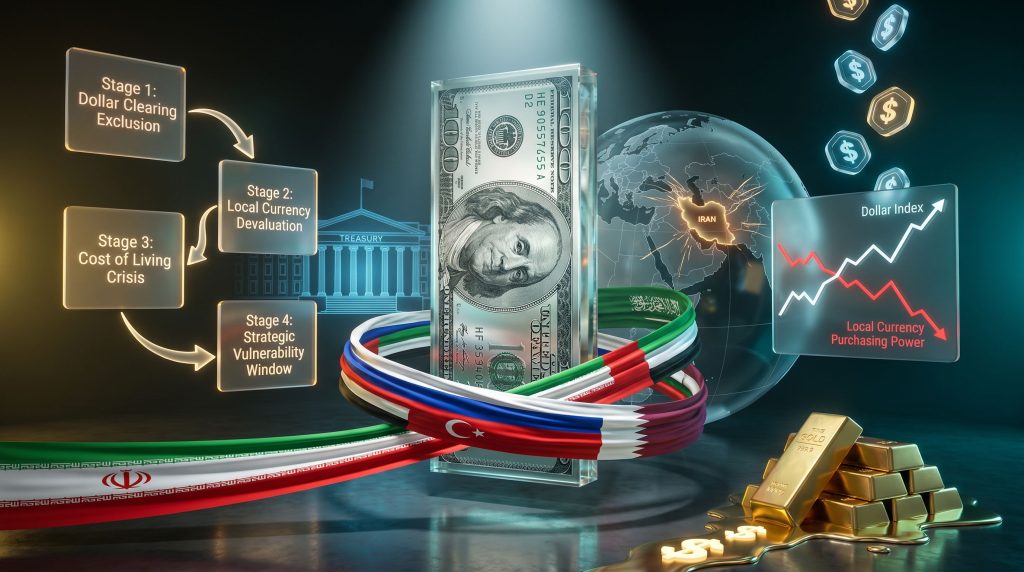
The mechanics of the financial pressure applied to Iran follow a transmission sequence that is more predictable than most observers recognise. By restricting Iran's access to dollar clearing, prohibiting correspondent banking relationships, and sanctioning financial intermediaries, the U.S. Treasury effectively created an artificial dollar shortage inside the Iranian economy.
The transmission chain operated as follows:
| Stage | Policy Action | Economic Effect | Social Consequence |
|---|---|---|---|
| 1 | Dollar clearing exclusion and sanctions | Dollar shortage in Iranian economy | Import costs rise sharply |
| 2 | Central bank forced to expand local currency supply | Iranian rial devaluation accelerates | Purchasing power collapses |
| 3 | Inflation accelerates across consumer goods | Severe cost-of-living crisis | Public unrest intensifies |
| 4 | Internal regime pressure builds | Reduced geopolitical capacity | Strategic vulnerability window opens |
Scott Bessant, the U.S. Treasury Secretary, publicly stated that dollar pressure was deliberately used against Iran as part of a broader strategic playbook, acknowledging that the Treasury had engineered a liquidity squeeze to weaken the Iranian government from within. This public acknowledgment is historically significant. While the United States has applied similar financial pressure to Russia, Venezuela, North Korea, and Cuba over many decades, the explicit and unapologetic public declaration of the strategy by a sitting Treasury Secretary represents a departure from the post-World War II "rules-based order" framing.
The toolkit extended beyond conventional sanctions. U.S. authorities seized cryptocurrency wallets that Iranian entities were operating, and sanctioned Chinese independent oil refineries — commonly referred to as teapot refineries — that were purchasing Iranian crude in ways designed to circumvent the primary sanctions architecture. These actions demonstrate that dollar weaponization now operates across both traditional financial rails and emerging digital infrastructure. The consequences of weaponising the dollar in this manner extend well beyond the immediate target nation, creating broader systemic uncertainty.
The public confirmation by a senior U.S. Treasury official that dollar coercion was deliberately deployed against Iran marks a fundamental shift in how Washington frames its financial statecraft. The America-first doctrine replaces the greater-good narrative with an openly transactional posture: if it does not serve U.S. interests, it will not be done, regardless of multilateral consensus.
The current Treasury Secretary's background is also relevant context. Prior to his government role, Bessant was a global macro hedge fund manager with direct operational experience in currency market dynamics, including participation in the events surrounding the breaking of the Bank of England's currency peg in 1992. This is not a diplomat applying sanctions as a diplomatic gesture — it is a practitioner of sovereign currency mechanics who understands precisely how to engineer the outcomes described.
The Dollar Band Framework: Understanding Systemic Limits
Dollar weaponization does not operate in a vacuum. The broader framework for understanding dollar dynamics involves what can be described as a band — a conceptual range within which the U.S. Dollar Index must operate for the global economy to function in an orderly manner. Understanding gold and bond dynamics alongside this framework provides important additional context for investors.
The Dollar Band refers to the operating range within which the U.S. Dollar Index maintains global financial stability. A current working approximation places this band between roughly 85 and 105 on the dollar index, though the precise boundaries are not fixed and should not be treated as exact thresholds.
Breaking through either boundary produces distinct but equally damaging consequences:
When the dollar breaks below the lower band:
- Excess dollar credit creation floods global markets through expanded QE and swap line extensions
- Foreign currencies strengthen, making export sectors uncompetitive
- New dollar-denominated debt becomes temporarily easier to service
- Credit contraction follows as export revenues decline, triggering a dollar slingshot back higher
- The cycle amplifies debt stress in emerging markets precisely as their economic conditions are already deteriorating
When the dollar breaks through the upper band:
- Dollar scarcity makes existing debt servicing increasingly expensive across all dollar-denominated obligations
- Loan defaults accelerate, contracting the underlying money supply
- De-dollarization emerges not from ideological preference but from practical necessity, as entities simply cannot source sufficient dollars
- Historical precedents include the Global Financial Crisis of 2008, the March 2020 COVID liquidity shock, and the 2022 dollar surge
The greatest systemic risk is not dollar weakness. It is an uncontrolled dollar surge that overwhelms the global debt architecture. Dollar weakness, by contrast, is largely self-correcting through the debt repayment cycle.
The United States holds more influence over the dollar's trajectory than any other actor, but not unlimited control. Consequently, the risk is not deliberate weakening by design — it is that dollar strength escapes containment and triggers systemic unravelling that no single institution can reverse alone.
Gold's Counterintuitive Behaviour During Active Conflict Periods
A persistent misconception among investors is that geopolitical crises automatically drive gold higher and the dollar lower. However, the evidence from the Iran conflict period, and from prior crisis episodes, challenges this assumption fundamentally. The geopolitical gold drivers at play during these periods are often more nuanced than headline narratives suggest.
During acute crisis periods, gold is frequently sold by sovereign holders to raise dollar liquidity for debt servicing and import financing. Turkey, Russia, and Gulf Cooperation Council states all sold gold during the Iran conflict escalation period precisely because they needed dollars, not because they were abandoning gold as an asset class.
| Crisis Period | Initial Dollar Move | Gold Behaviour | Explanation |
|---|---|---|---|
| September 2008 (GFC onset) | Dollar fell approximately 5% over two weeks | Sold to raise liquidity | Capital repatriation from U.S. assets |
| March 2020 (COVID shock) | Dollar initially fell | Sold alongside equities | Same repatriation dynamic |
| April 2025 (trade shock) | Dollar initially fell | Volatile, then stabilised | Short-duration crisis; no full liquidity event |
| Post-crisis phase (GFC 2009) | Dollar slingshot higher | Recovered after initial sell-off | Global liquidity crunch drove dollar demand |
The counterintuitive initial dollar behaviour in crisis periods also deserves attention. In the early stages of a financial shock, the dollar often falls rather than rises. This occurs because foreign institutions and governments that have invested their excess savings in U.S. dollar assets for years are forced to liquidate those assets to repatriate capital and address domestic funding needs.
In September 2008, the dollar fell approximately five percent over a two-week period at the very onset of the Global Financial Crisis before slingshoting dramatically higher as the liquidity crisis deepened globally. The same dynamic repeated in March 2020. The April 2025 trade shock followed the initial pattern but did not develop into a full global liquidity event, which is why the subsequent dollar slingshot did not materialise to the same degree.
Gold's role in these dynamics is best understood as a liquidity bridge rather than a direct dollar competitor. The reason to hold gold in a crisis is not that it rises during acute stress, but rather that its lack of counterparty risk and high liquidity allow it to be converted into the dollars that the system actually demands. Furthermore, gold in the monetary system serves a longer-term strategic function that extends well beyond short-term crisis responses.
De-Dollarization: Structural Response or Overstated Threat?
The repeated use of dollar coercion does create long-term incentives for targeted nations and their trading partners to develop alternative settlement infrastructure. The EU-Iran trade mechanism known as INSTEX, BRICS payment system discussions, and bilateral trade agreements denominated in non-dollar currencies all represent structural responses to the demonstrated risk of dollar exclusion. In addition, the global monetary shift driven by China's growing influence adds another dimension to this evolving landscape.
However, several factors limit the speed and depth of any de-dollarization trend:
- No existing alternative settlement system currently replicates the liquidity depth, institutional infrastructure, or global acceptance of the dollar system
- The BRICS+ payment mechanisms remain limited primarily to commodity trade among member states rather than achieving broad transactional coverage
- Dollar-denominated debt obligations worldwide ensure continued structural demand for dollars regardless of political preferences
- De-dollarization driven by dollar strength is a distress response, not a managed transition
De-dollarization is better understood as partial diversification at the margins than as systemic replacement. The distinction matters for investors and policymakers who may be tempted to overweight the speed of this transition.
The paradox of dollar weaponization is that it strengthens the dollar's position in the short and medium term by demonstrating its coercive utility, while simultaneously eroding the trust and goodwill that sustained the post-World War II rules-based framework over decades.
The next major ASX story will hit our subscribers first
Stablecoins as the New Frontier of Dollar Hegemony
One of the less widely understood dimensions of dollar entrenchment is the role that dollar-pegged stablecoins are beginning to play in extending monetary reach beyond the formal banking system. A market volatility reset in the broader financial system could, furthermore, accelerate this trend considerably.
When citizens in high-inflation or financially repressed economies adopt dollar-denominated stablecoins to protect their savings from local currency debasement, they effectively transfer monetary sovereignty from their domestic central bank toward the U.S. Federal Reserve system. This dynamic closely parallels the organic expansion of the Eurodollar market during the latter decades of the twentieth century, where dollar adoption occurred because it served the interests of participants, not because Washington mandated it.
The regulatory challenge for local governments is significant. Preventing a citizen with an internet connection from purchasing a stablecoin on a mobile device is considerably more difficult than controlling flows through a regulated domestic banking system. This creates an asymmetry that favours dollar extension over local currency retention.
The frequent policy discussion framing stablecoin regulation primarily as a debt financing mechanism for U.S. Treasuries may obscure what is arguably the more significant strategic dimension. According to Investopedia's analysis of dollar weaponisation, stablecoin adoption is a grassroots extension of dollar hegemony that bypasses the institutional barriers typically associated with formal dollarisation — reinforcing the dollar's structural position from the bottom up rather than the top down.
Dollar Dominance: Scenario-Based Assessment
| Scenario | Timeframe | Key Drivers | Probability Assessment |
|---|---|---|---|
| Extended Dollar Dominance | 10-30 years | Stablecoin adoption, no viable alternative liquidity depth, managed dollar band | Moderate-High |
| Accelerated Partial De-Dollarization | 5-15 years | Sanctions overuse, BRICS+ critical mass in commodity trade | Moderate |
| Systemic Dollar Crisis | Indeterminate | Uncontrolled upper band break, cascading defaults | Low probability, high impact |
The purchasing power paradox is an important concept for investors navigating this environment. The dollar can simultaneously be strong against foreign currency pairs while losing purchasing power against real assets and goods — these are not contradictory conditions. Fiat currency systems are structurally designed to erode purchasing power over time, and the dollar is no exception.
This means investors can hold both positions simultaneously: that the dollar will likely remain dominant as a global settlement and reserve currency for longer than consensus forecasts suggest, and that real assets including gold, commodities, and productive infrastructure will appreciate in dollar terms over the same horizon precisely because purchasing power erosion is a feature of fiat design, not a malfunction.
All exponential debt systems eventually reach structural limits. The key uncertainty is not whether these limits exist, but whether the timeline is measured in years or decades. Preparing for volatility without timing the crisis is the practical implication for long-term investors.
Frequently Asked Questions: Dollar Weaponization and the Iran Conflict
What does dollar weaponization mean in practice?
Dollar weaponization refers to the deliberate use of U.S. control over dollar clearing, payment infrastructure, and credit access as a coercive geopolitical tool. By restricting a target nation's ability to access dollar liquidity, the U.S. can weaken that nation's currency, accelerate inflation, and create internal political pressure without direct military engagement.
Has the U.S. used dollar coercion before the Iran case?
Yes. Financial exclusion tools have been applied against Russia, Venezuela, North Korea, Cuba, and others over many decades. The Iran case is notable primarily because senior U.S. officials publicly and explicitly acknowledged the deliberate use of this strategy, which represents a departure from the previous practice of framing such actions in humanitarian or multilateral terms.
Why did gold fall during parts of the Iran conflict escalation?
During acute crisis periods, sovereign holders including central banks and sovereign wealth funds sell gold to raise dollar liquidity for debt servicing and import financing. Gold's value in a crisis is its liquidity and the ability to convert it into the dollars that the system demands, not its directional price performance.
What is the Dollar Band framework?
The Dollar Band is a conceptual range for the U.S. Dollar Index within which global financial conditions remain manageable. Breaking below the band triggers excess credit creation and eventual dollar slingshot dynamics. Breaking above it causes debt stress, defaults, and forced de-dollarization as entities cannot access sufficient dollars.
How do stablecoins reinforce dollar hegemony?
Dollar-pegged stablecoins extend the U.S. monetary system's reach into economies where formal dollar access is limited. When citizens adopt stablecoins over local currencies to protect purchasing power, monetary sovereignty effectively shifts toward the Federal Reserve system, reinforcing dollar dominance at the grassroots level in a manner analogous to the historic expansion of the Eurodollar market.
Is dollar dominance likely to persist?
A credible case exists for dollar dominance extending for ten to thirty years given stablecoin adoption trends, the absence of viable alternative liquidity infrastructure, and the structural debt dynamics that generate recurring dollar demand. The key risk is not deliberate dollar weakening but an uncontrolled dollar surge through the upper band that exceeds the capacity of monetary authorities to manage.
This article contains forward-looking analysis, macroeconomic frameworks, and scenario projections that are inherently speculative in nature. Nothing contained herein constitutes financial or investment advice. Readers should conduct their own research and consult qualified financial professionals before making any investment decisions.
Want to Identify the Next Major ASX Mineral Discovery Before the Broader Market?
Discovery Alert's proprietary Discovery IQ model delivers real-time alerts on significant ASX mineral discoveries, transforming complex mineral data into clear, actionable insights for both short-term traders and long-term investors seeking an immediate market edge. Explore historic examples of major mineral discoveries and their exceptional returns, then begin your 14-day free trial at Discovery Alert to position yourself ahead of the market.