July 20, 2026
Africa's Most Valuable Mining Corridor Has an Electricity Problem That Ore Grades Cannot Solve
Across the global commodities landscape, investor attention naturally gravitates toward ore grades, reserve estimates, and production targets. Yet in the Central African Copperbelt, the variable that most constrains output has nothing to do with what lies beneath the ground. It is what fails to flow through the grid above it. Electricity, not geology, has become the defining ceiling on one of the world's most mineral-rich regions, and the gap between available power and operational demand is now wide enough to reshape how governments, private developers, and institutional lenders approach infrastructure financing across the continent.
This reality is driving one of the most structurally significant energy infrastructure decisions in the Copperbelt's recent history: a USD $270 million, 200-kilometre, 330 kV high-voltage transmission corridor connecting Zambia's copper-producing northwest to the heart of the Democratic Republic of Congo's copper and cobalt industry. Understanding why the DR Congo Zambia power line matters, and what it reveals about the region's longer-term trajectory, requires stepping back from the project itself and examining the deeper economics of power-constrained mining.
When big ASX news breaks, our subscribers know first
The Invisible Ceiling: Why Power Shortage Compounds Across the Entire Value Chain
The Central African Copperbelt sits atop one of the planet's most concentrated accumulations of copper and cobalt mineralisation. The DRC alone accounts for roughly 70% of global cobalt supply and is consistently among the top two or three copper-producing nations worldwide. Furthermore, Zambia, its southern neighbour, holds some of the highest-grade copper deposits outside of Chile's Atacama region.
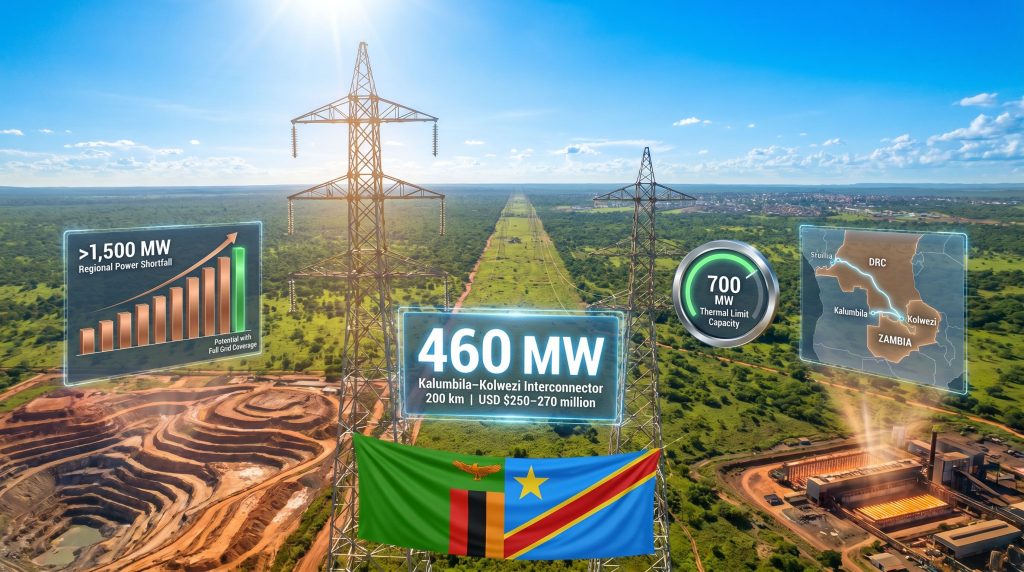
Yet output from this corridor consistently underperforms its geological potential, and the primary bottleneck is electricity. The estimated regional power shortfall across the cobalt mining industry heartland is reported to exceed 1,500 MW, a structural deficit that has persisted across multiple investment cycles and government administrations. To contextualise that figure: a single modern copper smelter consuming approximately 250 to 300 MW of continuous baseload power represents a meaningful fraction of that deficit on its own.
The consequences of this shortfall are felt at every layer of the mining value chain:
- Mine-site operations rely on diesel generators for backup power, with diesel generation typically costing three to five times more per kilowatt-hour than grid supply, directly compressing operating margins
- Beneficiation bottlenecks persist because energy-intensive smelting and refining operations require guaranteed, uninterruptible power that diesel systems cannot reliably or economically provide at scale
- Project financing challenges increase when lenders cannot model stable, long-term energy costs, elevating perceived operational risk across the region
- Stranded asset creation occurs when mining operators invest capital in interim diesel infrastructure that becomes economically unviable once grid power eventually arrives
The situation in Zambia adds a further dimension of fragility. The country's electricity system has historically depended overwhelmingly on hydropower, which leaves it acutely exposed to rainfall variability. Extended drought cycles across Southern Africa between 2019 and 2023 forced Zambia's national utility, ZESCO, to implement demand rationing and pursue emergency power imports from South Africa, placing strain on the Southern African Power Pool's regional balancing capacity.
| Metric | Current State | Potential with Grid Expansion |
|---|---|---|
| Estimated regional power shortfall | Exceeds 1,500 MW | Substantially reduced with KKIP + solar additions |
| Power needed to double DRC mine output (per Finance Ministry studies) | ~1,000 MW additional | Achievable through phased grid and renewables buildout |
| Diesel cost premium vs. grid tariff | Est. 3-5x grid cost | Eliminated with reliable grid supply |
| Kamoa-Kakula smelter annual processing capacity | 500,000 tonnes Cu | Fully constrained by current supply reliability |
The structural logic here is self-reinforcing in a problematic direction: insufficient grid power forces diesel dependency, which inflates costs, which compresses margins, which reduces capital available for grid investment, which perpetuates insufficient grid power. Breaking that cycle requires external capital, bilateral political commitment, and a project structure capable of attracting institutional financing at frontier market risk premiums.
The Kalumbila-Kolwezi Interconnector: A 200-Kilometre Answer to a Regional Problem
The Kalumbila-Kolwezi Interconnector Project, or KKIP, is the most consequential energy infrastructure initiative currently advancing across the Central African mining corridor. Its basic parameters are defined by practicality rather than ambition: a 200-kilometre, 330 kV high-voltage transmission line connecting Kalumbila in Zambia's North-Western Province to Kolwezi in the DRC's Lualaba Province. The African Development Bank's project documentation provides further technical detail on the interconnection's engineering specifications.
Project Parameters at a Glance
| Parameter | Specification |
|---|---|
| Total project cost | USD $270 million |
| Transmission voltage | 330 kV |
| Line length | 200 km (approx. 124 miles) |
| Initial power capacity | 460 MW |
| Design ceiling capacity | 550 MW |
| Thermal limit capacity | Up to 700 MW |
| Developer | Enterprise Power DRC (EPDRC) and Enterprise Power Zambia Ltd. |
| Financing structure | Approx. 70% institutional debt, 30% equity |
| Zambia regulatory approval | Granted 2025 |
| Construction start date | Not yet confirmed (as of May 2026) |
The geographic anchors of this corridor are not arbitrary. Kalumbila sits within one of Zambia's most active copper exploration and production corridors in the North-Western Province. Kolwezi, on the DRC side, is effectively the operational epicentre of global cobalt and copper supply, hosting Ivanhoe Mines' Kamoa-Kakula complex, Glencore's Katanga operations, and a cluster of junior and mid-tier producers.
What distinguishes the KKIP from previous regional energy proposals is its development model. Enterprise Power DRC is a private power trading company, not a state utility, and the financing structure reflects this: approximately 70% of the project cost is expected to be sourced through development finance institution debt, with the remaining 30% from equity contributors, including a planned stake from the DRC government's Finance Ministry.
Zambia's energy regulator approved the KKIP in 2025, providing the regulatory certainty necessary to advance financing and detailed engineering. However, as of May 2026, no confirmed construction start date has been announced, and the project remains in pre-construction stages on the DRC side.
What the 330 kV Voltage Class Means in Practice
The selection of 330 kV as the transmission voltage is technically significant and deserves explanation for readers unfamiliar with power engineering. High-voltage transmission lines carry electricity at elevated voltages to minimise energy losses over long distances. At 330 kV, the KKIP sits within the sub-transmission to high-voltage transmission classification used across Southern and Central Africa, compatible with the voltage standards used by both ZESCO (Zambia) and SNEL (DRC's national utility).
Critically, the thermal limit of 700 MW indicates the physical ceiling at which the conductors and equipment can operate safely. The gap between initial capacity (460 MW) and thermal limit (700 MW) creates meaningful expansion headroom without requiring full infrastructure replacement, a design feature that gives the project long-term optionality as demand grows.
Sovereign Skin in the Game: The DRC's Equity Stake and What It Signals
The DRC Finance Ministry's decision to take an equity position in the KKIP is not a routine infrastructure investment. It represents a deliberate policy signal, embedded within a broader pivot in the country's economic strategy. Indeed, the Congo-US minerals security partnership context adds further geopolitical weight to this infrastructure commitment.
In April 2026, the DRC successfully raised a USD $1.25 billion debut Eurobond, marking the country's first access to international sovereign debt capital markets. This was a landmark transaction: it demonstrated sufficient institutional investor confidence in DRC creditworthiness to place sovereign paper at scale, establishing a reference yield for future borrowing and signalling a new era of capital market engagement for what has historically been one of the world's most challenging frontier sovereign credit profiles.
Finance Minister Doudou Fwamba publicly articulated the government's position following the Eurobond issuance, stating that studies indicate approximately 1 gigawatt of additional electricity capacity could effectively double current mine production volumes across the DRC. He framed energy infrastructure investment not as a logistical necessity but as a precondition for the country's broader industrial transformation: a deliberate shift from exporting lightly processed mineral concentrates toward retaining value-added refining and manufacturing capacity domestically.
This framing is economically coherent. The value differential between copper concentrate (typically 20-30% copper content) and refined copper cathode or copper anodes (99%+ purity) is substantial. A country that processes ore into refined metal retains:
- Greater revenue per tonne at point of export or domestic consumption
- Employment multipliers from skilled industrial labour in processing plants
- Tax revenue capture from higher-value processing activities
- Technology transfer through operation of sophisticated smelting and refining facilities
Without reliable grid electricity, none of these outcomes are economically viable at scale. The DRC government's equity stake in the KKIP is therefore best understood as a direct investment in its own industrialisation strategy, not simply a passive infrastructure subsidy.
How the Eurobond Changes the Infrastructure Financing Landscape
The sequencing of the Eurobond issuance and the KKIP equity announcement is not coincidental. Access to international capital markets at sovereign level expands the range of instruments available for infrastructure financing. It also establishes a credit signal that can improve the terms available to development finance institution lenders on sub-sovereign projects within the country.
For the KKIP specifically, the DRC government's equity participation serves a dual function: it aligns sovereign incentives with project delivery, and it signals to institutional debt providers that the project has political durability. Whether this translates into improved financing terms or faster financial close remains to be confirmed, but the structural logic is sound.
When Mines Become Factories: The Smelting Multiplier and Its Power Implications
One of the less appreciated dynamics driving electricity demand across the DRC mining sector is the physics of in-country processing. Mining, at its most basic, is a mechanical operation: ore is extracted, crushed, and concentrated. The power demands are substantial but relatively consistent and predictable. Smelting and refining are categorically different: they are electrochemical and thermochemical processes that operate at extreme temperatures and require uninterrupted, high-quality electrical supply.
Copper smelting, at industry-standard energy intensities, typically requires approximately 4,000 to 5,500 kilowatt-hours of electricity per tonne of copper produced, depending on process design, ore grade, and facility efficiency. Applying this to Kamoa-Kakula's recently commissioned anode smelter, which carries an annual processing throughput of 500,000 tonnes of copper, produces a continuous baseload demand estimate of roughly 228 to 314 MW from the smelter alone, assuming full-capacity operation across the entire year.
This is the smelting multiplier effect in quantitative terms: a single in-country processing facility can add the equivalent power demand of a medium-sized city to an operation already operating under constrained grid supply.
The CrossBoundary Solar Investment: Parallel Architecture, Not Competition
The response of private energy developers to this demand signal is instructive. CrossBoundary Energy, a specialised developer focusing on clean energy for African industrial and commercial customers, has identified the Central African Copperbelt as the strategic core of its Africa operations. The company is developing a USD $250 million solar-and-storage project specifically serving Kamoa-Kakula's operations, with phased capacity delivery targeting full output by the third quarter of 2025.
Frank Alloghe, CrossBoundary Energy's mining and industrial lead in Africa, has characterised the Copperbelt as central to the company's continental strategy. The scale of the solar-and-storage commitment — $250 million for a single mining complex — reflects both the magnitude of the unmet demand and the commercial viability of renewable energy solutions in mining at this scale.
What this reveals is that grid transmission infrastructure (the KKIP) and distributed renewable generation (CrossBoundary's solar project) are not competing approaches. They are complementary layers within a hybrid energy architecture:
- High-voltage grid transmission provides bulk power delivery and grid balancing capacity across large distances
- On-site solar generation provides daytime energy cost reduction and partial demand offset
- Battery storage systems bridge solar intermittency gaps and provide grid stabilisation ancillary services
- Diesel backup transitions from primary generation to emergency reserve only
Mining operators increasingly prefer this multi-layer model because it eliminates single-point-of-failure risk in energy supply, provides cost predictability through long-term power purchase agreements, and positions operations favourably relative to emerging carbon accounting requirements in key export markets.
Private Capital in a Frontier Market: The Risk Architecture of the KKIP
The KKIP's financing structure deserves careful examination, because it represents a template with potential implications beyond this single project. The approximately 70% institutional debt, 30% equity split, with development finance institution participation on the debt side, reflects a risk allocation model specifically designed for infrastructure projects in high-risk sovereign environments.
Development finance institutions (DFIs), such as the African Development Bank, the International Finance Corporation, and bilateral DFI entities, provide debt on terms that commercial banks typically cannot match in frontier markets: longer tenors, patient capital structures, and tolerance for construction-period risk profiles that would disqualify many frontier market infrastructure projects from conventional bank financing.
This structure matters for a critical reason: it de-risks the project sufficiently to attract equity capital from private developers and sovereigns alike, while ensuring that the technical and governance standards required by DFI lenders are applied to the project's engineering, environmental, and social management frameworks.
Unresolved Risks That Demand Investor Attention
Despite the project's conceptual merits and regulatory progress in Zambia, several material uncertainties remain unresolved as of May 2026:
- Financial close has not been confirmed: DFI debt commitments must be formally executed before construction begins; frontier market projects at this stage regularly face 12 to 36-month delays between regulatory approval and financial close
- DRC-side regulatory clearance: While Zambia's energy regulator approved the project in 2025, the DRC's regulatory approval status as of May 2026 is not yet formally confirmed in public announcements
- Grid interconnection standards: Linking ZESCO (Zambia) and SNEL (DRC) grids requires alignment of frequency management protocols, voltage regulation systems, and protection relay coordination across two national utilities with different technical standards and governance structures
- Political and sovereign risk: The DRC's institutional environment introduces contract enforcement uncertainty, the risk of policy reversals on equity participation terms, and potential complications arising from changes in government composition or priorities
- Environmental and community approvals: A 200-kilometre transmission corridor crossing international boundaries requires environmental impact assessments, land acquisition processes, and community consultation protocols in both countries, processes that routinely extend project timelines
Disclaimer: This article discusses infrastructure projects and mining sector developments for informational purposes only. Nothing contained here constitutes financial or investment advice. Investors should conduct their own due diligence and seek professional advice before making any investment decisions. Forward-looking statements and projections involve risks and uncertainties, and actual outcomes may differ materially from those discussed.
The next major ASX story will hit our subscribers first
The Regional Grid Vision: Where the KKIP Sits in a Larger Architecture
The Southern African Power Pool (SAPP) has long maintained a vision of coordinated cross-border electricity trading across its member states, allowing countries with surplus generating capacity to export to deficit markets, and enabling emergency supply arrangements during planned maintenance or demand spikes.
The KKIP advances this vision in a structurally important way: it adds a commercially structured, privately developed bilateral corridor to a regional grid architecture that has historically been dominated by state utility interconnections and bilateral government agreements. The private development model creates a precedent for commercially negotiated power trading arrangements between national markets, which could accelerate grid integration more broadly if the KKIP demonstrates viable returns for equity investors. The World Economic Forum's analysis of cross-border infrastructure similarly highlights how such projects can unlock critical mineral supply chains at a regional scale.
| Parameter | KKIP | Typical Regional Benchmark |
|---|---|---|
| Line length | 200 km | 150-400 km |
| Voltage class | 330 kV | 220-400 kV |
| Initial capacity | 460 MW | 200-600 MW |
| Maximum expandable capacity | 550-700 MW | Project-specific |
| Capital cost | USD $270 million | USD $200-400 million |
| Developer model | Private company with sovereign co-equity | Typically state utility-led |
The distinctive feature of the KKIP within this regional context is the developer model. Enterprise Power DRC is a private power trading company, not a government entity, and this carries both advantages and complications. Private developers can move faster than state utilities on project structuring and financing negotiations, but they lack the sovereign backing that simplifies cross-border regulatory negotiations and may face greater difficulty securing long-term power purchase agreement counterparties capable of absorbing 460 MW of new supply.
What the Diesel Trap Reveals About Capital Allocation Under Energy Stress
One of the least-discussed dynamics in the Copperbelt's energy equation is what economists sometimes call the investment irreversibility problem in interim energy infrastructure. When reliable grid power is unavailable, mine operators face a binary choice: accept operational constraints, or invest in diesel generation capacity. Most operators choose the latter.
The problem is that diesel generation assets are not neutral placeholders. They consume capital that could otherwise fund productive mine development, lock in high-cost operating expense structures that persist as long as the equipment is in service, and create organisational dependencies that slow the transition to grid power when it eventually arrives. In regions where grid development has been repeatedly delayed, operators sometimes maintain diesel capacity as insurance even after grid connection, paying for redundancy rather than reliability.
This pattern has a compounding effect at the regional level. Widespread diesel dependency normalises high energy costs as a structural feature of Copperbelt operations, which inflates the production costs used in feasibility studies, which in turn raises the commodity price hurdles required to justify new mine development. The cumulative effect is a suppression of the region's investable project pipeline that extends well beyond any individual mine's balance sheet.
The KKIP, if delivered, does not just add 460 MW to the regional grid. It begins to dismantle the economic logic of diesel dependency across an entire mining corridor, progressively lowering the cost floor for operations throughout the Kolwezi and Kalumbila catchment areas. Consequently, this has significant implications for the broader role of critical minerals in the energy transition, where reliable power underpins every stage of the supply chain.
FAQ: The DR Congo Zambia Power Line and What It Means for Mining's Energy Future
What is the Kalumbila-Kolwezi Interconnector Project?
The KKIP is a 200-kilometre, 330 kV high-voltage electricity transmission corridor linking Zambia's copper-mining hub at Kalumbila to Kolwezi in the DRC, carrying an initial capacity of 460 MW expandable to a thermal limit of 700 MW, developed at a total cost of USD $270 million by Enterprise Power DRC and its Zambian subsidiary.
Why is the DRC Taking an Equity Stake in a Private Power Project?
The DRC Finance Ministry's equity participation reflects its industrialisation strategy: securing domestic energy infrastructure to enable in-country mineral processing and manufacturing, moving beyond the export of lightly processed ore toward higher-value refined metal products.
How Significant is the Region's Power Shortfall?
Studies cited by the DRC Finance Ministry indicate that 1 GW of additional electricity could double current mine production output in the DRC. The broader Copperbelt shortfall is estimated to exceed 1,500 MW, representing a structural constraint that a single 460 MW interconnector will only partially address. Furthermore, the DRC cobalt export suspension has underscored just how tightly energy and mineral output dynamics are interlinked across the region.
Who is Developing the DR Congo Zambia Power Line?
Enterprise Power DRC and its subsidiary Enterprise Power Zambia Ltd. are the project developers, using a financing structure of approximately 70% development finance institution debt and 30% equity, with the DRC government planning to take an equity position.
What is CrossBoundary Energy's Role?
CrossBoundary Energy is developing a USD $250 million solar-and-storage project at Kamoa-Kakula, targeting full capacity delivery by Q3 2025, providing distributed renewable generation that complements the grid transmission capacity offered by the KKIP.
When Will Construction Begin?
As of May 2026, no confirmed construction start date has been announced for the KKIP, despite Zambia's energy regulator approving the project in 2025.
Energy Infrastructure as the Unlocking Variable for Africa's Critical Minerals Decade
Global demand trajectories for copper and cobalt are accelerating in ways that ore deposit quality alone cannot satisfy. Electric vehicle battery manufacturing, utility-scale energy storage deployment, and grid electrification programmes across Asia, Europe, and North America are collectively driving copper demand projections that the current Copperbelt output level is structurally insufficient to meet, even with existing mine capacity fully utilised.
The KKIP, if it advances from regulatory approval through financial close and into construction, represents a meaningful step toward unlocking production capacity that global energy transition supply chains urgently require. Yet it is important to maintain analytical proportion: a 460 MW initial capacity interconnector addresses a fraction of the estimated 1,500 MW regional shortfall. The KKIP is better understood as the first commercially structured element of a much larger infrastructure investment cycle than as a complete solution in itself.
What it does establish, more importantly, is a replicable financing template: sovereign equity combined with private developer execution, anchored by development finance institution debt, across a bilateral cross-border structure. If the KKIP demonstrates viable returns and delivers on its technical specifications, it creates a proof-of-concept that could accelerate additional private capital deployment into Central African energy infrastructure at a scale the region has not previously experienced.
For mining operators across the Copperbelt, energy security is transitioning from a background operational concern to a primary competitive differentiator. Operators that secure long-term power supply agreements through either grid connection or on-site renewables will carry a structural cost and production reliability advantage over diesel-dependent peers, an advantage that compounds over time as processing mandates intensify and energy-intensive beneficiation becomes the operational norm rather than the exception.
The ore is in the ground. The capital is increasingly available. The DR Congo Zambia power line that links Kalumbila to Kolwezi may well determine how much of that potential the next decade actually delivers.
Further analysis of African Copperbelt energy infrastructure and mining sector developments is available through African Mining Market, which provides ongoing coverage of energy and mining dynamics across the continent.
Want to Know Which ASX Miners Could Benefit From the Next Major Discovery?
Discovery Alert's proprietary Discovery IQ model scans ASX announcements in real time, instantly identifying significant mineral discoveries across copper, cobalt, and more than 30 other commodities — transforming complex data into clear, actionable opportunities for investors at every level. Explore how historic mineral discoveries have generated substantial returns and begin your 14-day free trial today to position yourself ahead of the market.