June 26, 2026
The Hidden Bottleneck Holding Back Africa's Copper Belt
Africa's copper belt sits atop some of the most extraordinary mineral wealth on earth. The DR Congo Zambia power link stake has become central to debates about the corridor's future, as the DRC and Zambia together account for a substantial share of global copper production and hold an even greater proportion of the world's cobalt reserves. Yet the factor most visibly constraining output in this corridor is not geological scarcity, geopolitical instability, or a lack of mining investment. It is electricity.
Understanding this energy deficit requires stepping back from individual project announcements and looking at the structural mechanics of how power systems interact with industrial ambition at scale. The DRC's national electricity shortfall is estimated at more than 5,000 MW, a figure that dwarfs the generation capacity of many mid-sized African nations in its entirety. Within the country's mining-intensive southern provinces, the unmet demand component alone is estimated at approximately 900 MW. That is not a rounding error. It is a fundamental production bottleneck.
When big ASX news breaks, our subscribers know first
Why Electricity, Not Ore Grade, Is the Binding Constraint
Mining investors and analysts have historically focused on deposit quality, resource tonnage, and geological risk when assessing project economics. Increasingly, however, energy access is emerging as the variable that determines whether even world-class deposits can be developed competitively. This challenge is further compounded by the ongoing copper supply crunch that is reshaping investment priorities across the sector.
The challenge is further compounded across the DRC-Zambia corridor by climate exposure. Zambia generates roughly 70% of its electricity from hydropower, a dependence that creates systemic vulnerability to drought cycles. The Kariba Dam, a cornerstone of the regional grid, has experienced historically low reservoir levels during dry seasons in recent years, directly reducing available generation capacity at precisely the moments when industrial demand remains constant.
When Zambia's generation output declines, the knock-on effects ripple across the interconnected Southern African Power Pool system, reducing the supply buffer available to mines on both sides of the border. Furthermore, the global copper supply forecast suggests that demand pressures will only intensify, making grid reliability an increasingly urgent priority.
The operational consequence for mining companies is a forced reliance on diesel-powered backup generation. While effective as a short-term contingency, diesel electricity carries a substantial cost premium over grid supply. For operations running continuous processing circuits, that premium compounds over time, directly eroding project-level margins and making expansion decisions harder to justify. The energy cost burden effectively functions as an invisible tax on the entire copper belt's production economics.
Energy insecurity in the DRC-Zambia copper belt is not a temporary disruption. It is a structural bottleneck that directly constrains the region's capacity to scale copper and cobalt output at a time of rising global critical mineral demand.
The Kalumbila-Kolwezi Interconnector: Project Specifications and Strategic Architecture
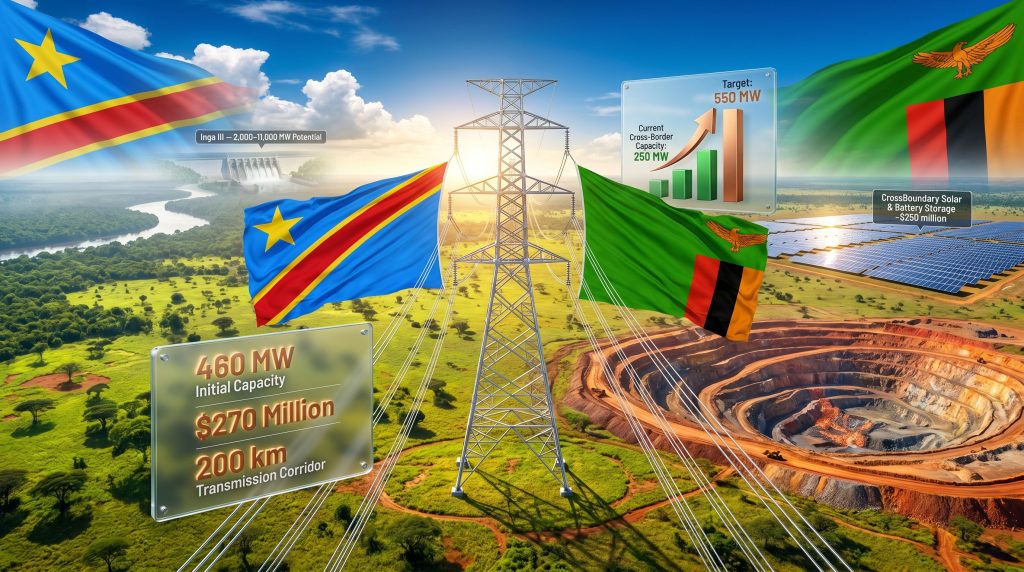
Against this backdrop, the Kalumbila-Kolwezi Interconnector Project represents one of the most consequential pieces of near-term energy infrastructure in Central Africa. The project involves the construction of a 200-kilometre high-voltage transmission corridor linking Kalumbila in north-western Zambia to Kolwezi, the geographic and industrial core of the DRC's copper belt.
The line is engineered to deliver an initial rated capacity of 460 MW, with an expansion pathway built into the design that would allow throughput to reach 550 MW. The project is valued at approximately $270 million and is being developed by Enterprise Power DRC, a private power trading company, alongside its Zambian subsidiary. Zambia's Energy Regulation Board has granted regulatory approval, though a formal construction commencement date remains unconfirmed as of the time of reporting. (Business Insider Africa, May 2026)
What Makes This Project Structurally Distinctive
The KKIP is classified as the first privately financed high-voltage cross-border transmission project in Sub-Saharan Africa. That distinction matters beyond the headline, because it represents a structural departure from the model that has historically governed energy infrastructure development across the continent, where state utilities and sovereign balance sheets have been the default funding vehicles.
The financing architecture deployed here combines three capital streams:
- Private equity from African Infrastructure Investment Managers (AIIM)
- Development finance from the International Finance Corporation (IFC), acting as lead debt arranger
- Potential sovereign co-investment from the DRC government
This blended structure is significant not just for the KKIP itself, but for what it signals about the replicability of private-led cross-border energy finance across the continent. For infrastructure specialists and development finance institutions, it offers a template worth studying.
| Project Parameter | Detail |
|---|---|
| Transmission Route | Kalumbila (Zambia) to Kolwezi (DRC) |
| Line Length | 200 kilometres |
| Initial Rated Capacity | 460 MW |
| Maximum Expandable Capacity | 550 MW |
| Estimated Project Value | $270 million |
| Lead Developer | Enterprise Power DRC |
| Lead Debt Arranger | International Finance Corporation (IFC) |
| Private Equity Backer | African Infrastructure Investment Managers (AIIM) |
| Regulatory Approval | Zambia Energy Regulation Board |
The DRC's Equity Stake: Sovereign Strategy, Not Just Symbolism
The detail that has attracted significant attention is the DRC government's active pursuit of an equity stake in the KKIP. For Kinshasa, this is not a passive expression of national interest. It reflects a deliberate pivot in how the government positions itself relative to infrastructure that is critical to its revenue base.
Sovereign equity participation converts the DRC from a passive energy consumer into an active co-owner with governance rights, a share of long-term revenue, and a direct seat at the table in cross-border pricing and grid access negotiations. That combination of financial and political leverage is precisely what the Finance Ministry appears to be seeking.
The analytical framing articulated by Finance Minister Doudou Fwamba is striking in its directness. Ministry research modelling suggests that adding 1 GW of new generation capacity to the system could effectively double current mining output. If that relationship holds even partially, the return profile on energy infrastructure investment is not merely meaningful — it is transformational relative to almost any other capital allocation the government could make. (Business Insider Africa, May 2026)
Industrial Policy and the Electricity Demand Multiplier
The equity pursuit also connects to a broader and less-discussed policy dynamic. The DRC government has implemented mandates requiring mining companies to process ore domestically rather than exporting raw minerals. This is a common sovereignty-based resource policy, however its implementation carries a significant and often underappreciated consequence: processing is dramatically more electricity-intensive than extraction.
A mine that ships ore concentrate requires a fraction of the power needed by one running a smelter or refinery on-site. As more operators comply with domestic processing requirements, the aggregate electricity demand profile of the copper belt rises sharply, independent of any increase in mining volumes. The grid is being asked to absorb an industrial upgrade cycle while already operating well below the demand it needs to serve.
This dynamic makes the DRC's equity stake in the KKIP a form of industrial policy investment, not just infrastructure finance. The government is effectively co-funding the enabling infrastructure for the processing mandate it has already imposed. In addition, critical minerals energy security concerns are adding further urgency to these decisions at both national and international levels.
The timing of the equity pursuit also aligns with the government's recent $1.25 billion debut eurobond issuance, which signalled a strategic pivot toward market-based capital mobilisation for infrastructure. Sovereign co-investment in the KKIP can consequently be read as an effort to demonstrate fiscal credibility and commitment to attracting further multilateral and private capital into the energy sector. (Business Insider Africa, May 2026)
Kamoa-Kakula: The Canary in the Copper Belt
No single operation illustrates the electricity crisis more concretely than the Kamoa-Kakula copper complex in Lualaba Province. Recognised as one of the world's largest and highest-grade copper deposits, Kamoa-Kakula represents a generational asset. Yet even this flagship project is not immune to grid constraints.
Project management at Kamoa-Kakula has characterised the electricity shortfall affecting operations as massive, with the site compelled to supplement grid supply with costly diesel generation in order to sustain throughput. The cost and logistical burden of maintaining diesel-powered backup at this scale is substantial. (Business Insider Africa, May 2026)
The Smelter Calculus: New Demand on a Strained Grid
The electricity challenge at Kamoa-Kakula is not static. Ivanhoe Mines has commissioned a copper anode smelter at the site, designed to process up to 500,000 tonnes of copper annually. This development materially increases the site's electricity consumption profile. A smelter of this scale operating continuously requires significantly more power than extraction and concentration circuits alone, creating a step-change in on-site demand that the regional grid is poorly positioned to absorb.
In response, private energy providers are moving to fill the gap. CrossBoundary Energy is developing a solar and battery storage facility valued at approximately $250 million specifically to support Kamoa-Kakula operations, with phased delivery targeting full operational capacity in the near term. (Business Insider Africa, May 2026)
This private energy response is instructive. It reflects a broader pattern where mining operators and their energy partners are effectively building parallel energy infrastructure because the national grid cannot be relied upon as a primary supply source.
The convergence of new smelting capacity, government-mandated local processing requirements, and chronic grid underperformance is creating an electricity demand surge that neither the national grid nor any single private energy solution can fully absorb in isolation.
Key Cost and Operational Pressures on DRC Mining Operations
- Diesel generation carries a significant cost premium over grid electricity, compressing mine-level margins across the copper belt
- Processing-intensive operations, including smelters and refineries, face disproportionately higher electricity demand than extraction-only operations
- Private energy infrastructure investment is increasingly being treated as a project-level capital cost rather than a grid-provided utility
- The energy cost burden is not evenly distributed, with larger, more processing-intensive sites absorbing a greater share of the operational impact
The Copperbelt Energy Corporation and the Private Sector's Grid Ambitions
The KKIP is not operating in isolation. The Copperbelt Energy Corporation (CEC) is simultaneously executing a $500 million investment programme targeting solar energy expansion and transmission infrastructure upgrades, with a target timeline running to 2026. A central objective of CEC's programme is increasing cross-border transmission capacity between Zambia and the DRC from the current 250 MW to 550 MW, a target that directly mirrors the KKIP's upper capacity range. (Business Insider Africa, May 2026)
The alignment between these two initiatives is not coincidental. It reflects a convergence of incentives: the private sector views cross-border energy trading between the DRC and Zambia as a commercially viable and growing market. That commercial logic, rather than development mandate alone, is what makes the CEC investment notable. When private capital chases energy trading opportunities independently of project-specific development finance, it signals genuine market depth.
Zambia's Energy Regulation Board has added further momentum by approving two additional solar and battery storage projects alongside the KKIP, reflecting a deliberate policy shift away from single-source hydropower dependence. The strategic objective is reducing exposure to the climate-driven variability that affects the Kariba Dam system and has periodically constrained Zambia's generation output during drought cycles. (Business Insider Africa, May 2026)
| Energy Initiative | Estimated Value | Capacity Impact |
|---|---|---|
| Kalumbila-Kolwezi Interconnector (KKIP) | $270 million | 460-550 MW cross-border |
| CrossBoundary Energy Solar and Storage (Kamoa-Kakula) | ~$250 million | Site-specific, phased delivery |
| CEC Solar and Transmission Upgrade Programme | $500 million | Cross-border capacity to 550 MW |
| Inga III Hydropower Project (long-term) | Up to $1 billion (World Bank programme) | 2,000-11,000 MW potential |
The next major ASX story will hit our subscribers first
Inga III: The Long Game and Why It Cannot Substitute for Near-Term Solutions
Any serious analysis of the DRC's energy future eventually arrives at Inga III. Located on the Congo River, the Inga system represents the most significant concentration of untapped hydropower potential on the African continent. The DRC holds Africa's largest undeveloped hydropower reserves, and the Congo River's flow characteristics make it one of the most energy-dense river systems on the planet.
Inga III is backed by a World Bank programme valued at up to $1 billion and carries a generation potential ranging from 2 GW to 11 GW depending on the development scenario. At its upper bound, the project would not merely resolve the DRC's domestic deficit — it would position the country as a net regional electricity exporter, fundamentally altering the energy trade dynamics across the Southern African Power Pool. (Business Insider Africa, May 2026)
Why Inga III Is a Long-Horizon Dependency
The project has faced repeated and significant delays. The factors driving those delays include the sheer complexity of financing civil works at this scale, governance challenges within DRC institutions, and the difficulty of structuring commercially viable power purchase agreements for generation volumes that exceed domestic absorption capacity. None of these obstacles are trivial, and none have been resolved on previous timelines.
The practical implication is that the copper belt cannot afford to wait for Inga III. The electricity demand surge driven by new smelting facilities, domestic processing mandates, and rising mining volumes is occurring now, not in a decade. This is the structural rationale for intermediate solutions like the KKIP, the CEC programme, and the CrossBoundary Energy solar project. These are not substitutes for Inga III's transformational potential — they operate on entirely different time horizons and serve different strategic functions.
The KKIP addresses the immediate operational crisis facing the copper belt today. Inga III represents the transformational infrastructure required for the DRC to fulfil its long-term role as a regional energy anchor. These are complementary solutions, not competing ones.
Regional Integration and the Broader Significance of the DR Congo Zambia Power Link Stake
The DR Congo Zambia power link stake pursuit sits within a much larger context of regional energy integration across Sub-Saharan Africa. The Southern African Power Pool provides the institutional framework through which cross-border electricity trading between these two countries would be governed and settled. The KKIP's structure and financing model represent a meaningful evolution within that framework.
For global copper and cobalt supply chains, grid reliability in the DRC-Zambia corridor is not an abstract infrastructure story. It is a material supply chain risk factor with direct implications for manufacturers of electric vehicle batteries, renewable energy technologies, and the broader electronics sector. The DRC cobalt export risks associated with infrastructure shortfalls are increasingly visible to procurement teams and investors in downstream industries. Furthermore, the Congolese cobalt rivalry between major global powers adds a further geopolitical dimension to the region's resource governance challenges.
The blended finance model anchoring the KKIP — combining IFC-led development finance, AIIM private equity, and potential DRC sovereign co-investment — may prove to be the project's most enduring contribution. If it performs as structured, it establishes a credible, replicable blueprint for mobilising private capital into energy infrastructure across other resource-rich but grid-constrained African economies. That precedent, if it holds, could unlock financing conversations for cross-border energy projects that have historically stalled at the development finance dependency stage.
The bilateral energy interdependence created by the DR Congo Zambia power link stake also carries geopolitical dimensions worth noting. Physical energy infrastructure creates durable economic incentives for sustained diplomatic cooperation between Kinshasa and Lusaka. Infrastructure is harder to unpick than trade agreements, and the revenue streams it generates create constituencies on both sides with an interest in its continued operation.
Disclaimer: This article contains forward-looking assessments related to infrastructure timelines, energy capacity projections, and economic outcomes. These involve inherent uncertainty and should not be construed as investment advice. Readers should conduct independent research and consult qualified advisors before making any investment or commercial decisions based on information contained herein.
Want to Track the ASX Mining Opportunities Emerging From the Critical Minerals Revolution?
The energy infrastructure buildout unlocking Africa's copper and cobalt belt is reshaping global critical mineral supply chains — and the investment opportunities it creates extend well beyond the DRC-Zambia corridor. Discovery Alert's proprietary Discovery IQ model delivers real-time alerts on significant ASX mineral discoveries, instantly turning complex data across more than 30 commodities into actionable insights, while its dedicated discoveries page illustrates the kind of historic returns that major mineral discoveries have generated — begin your 14-day free trial today to position yourself ahead of the market.