
August 7, 2026
The Mechanics Behind Concentrate Export Restrictions and Why They Matter
Global commodity markets operate on a subtle but critical distinction that most casual observers overlook: the difference between raw ore, concentrate, and refined metal. Each stage of processing represents a quantum leap in value. A tonne of copper ore might contain just 1-2% copper by weight. Smelting and flotation produces a concentrate typically assaying 25-35% copper. Further refining yields cathode copper at 99.99% purity, the form in which the metal commands full market pricing and enters manufacturing supply chains directly.
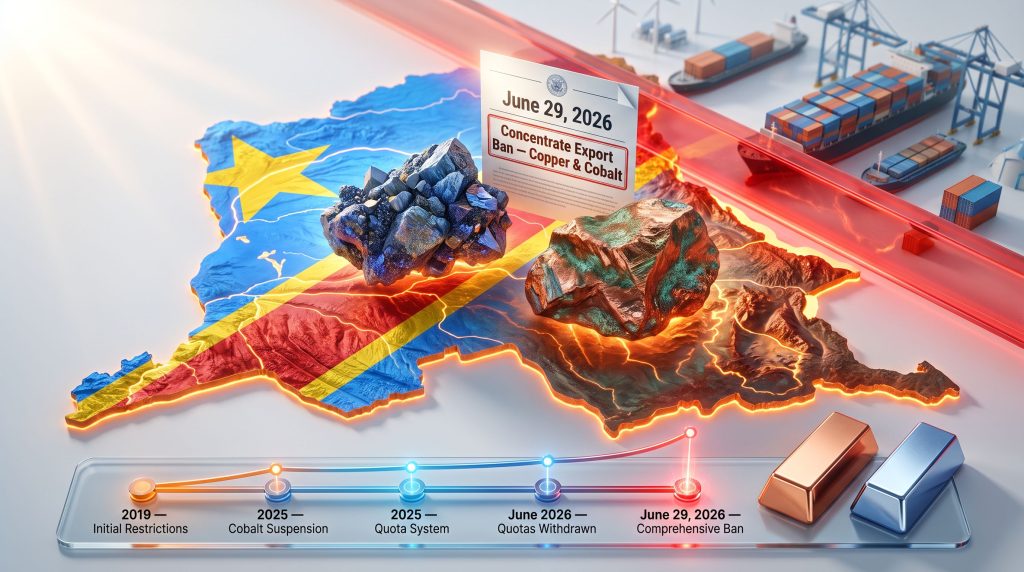
The DRC export ban on copper and cobalt concentrates, enacted on June 29, 2026, is simultaneously more targeted and more strategically significant than a blanket export restriction would be. By focusing specifically on the intermediate concentrate stage, the Democratic Republic of the Congo has drawn a precise line in the sand: raw extraction and preliminary processing can continue, but the higher-value transformation must increasingly happen on Congolese soil.
Understanding why this matters requires examining not just the policy itself, but the decades-long trajectory of resource nationalism that made it inevitable.
When big ASX news breaks, our subscribers know first
Defining the Policy: Concentrates, Refined Metals, and Ministerial Discretion
Copper and cobalt concentrates are produced at or near mine sites using physical and chemical separation processes, primarily froth flotation, which separates valuable minerals from waste rock. The resulting product is a powder or slurry with dramatically elevated metal content, but it still requires smelting and hydrometallurgical refining before it can be used in electronics, electric vehicle batteries, or industrial applications.
The June 29, 2026 government order prohibits export of this intermediate product. Critically, fully refined copper and cobalt metal exports remain unaffected, meaning integrated operations with domestic smelting capacity face minimal disruption. The policy is surgical, not sweeping.
Two additional mechanisms define the practical operation of the ban:
- The mines minister retains discretionary authority to grant one-year waivers for operations that can demonstrate strategic justification, introducing a case-by-case exemption pathway that creates regulatory flexibility but also uncertainty for long-term planning.
- A new by-product tax regime was introduced simultaneously, with a three-month transition window giving existing operations time to adjust accounting and compliance frameworks.
The waiver mechanism deserves particular scrutiny. In practice, ministerial discretion of this kind can function as both a safety valve and a negotiating instrument. Operations seeking waivers must engage directly with the Congolese government, creating leverage for the state to extract commitments around domestic processing investment, employment, or infrastructure development in exchange for temporary relief.
A Progressive Escalation: The DRC's Regulatory Timeline
The June 2026 concentrate ban did not emerge in isolation. It represents the latest and most comprehensive step in a multi-year escalation of export controls that began in earnest around 2019. Furthermore, the DRC cobalt export ban history clearly illustrates how each policy phase informed the next.
| Year | Policy Action | Targeted Commodity |
|---|---|---|
| 2019 | Initial concentrate export restrictions introduced | Copper, Cobalt |
| Early 2025 | Full cobalt export suspension imposed | Cobalt |
| Mid-2025 | Quota-based system replaces suspension | Cobalt |
| June 2026 | Unused cobalt export quotas withdrawn | Cobalt |
| June 29, 2026 | Comprehensive concentrate export ban enacted | Copper and Cobalt |
The 2025 cobalt suspension is frequently mischaracterised as purely a market stabilisation measure, which is only partially accurate. While cobalt prices had fallen sharply from their 2022 highs amid demand disappointments and oversupply from the DRC itself, the suspension also served as a trial run for more permanent structural controls. The subsequent shift from suspension to quotas, and then the withdrawal of unused quotas in mid-2026, followed a logical policy escalation pattern that telegraphed the June 2026 ban well in advance for anyone watching closely.
The cobalt export ban impacts on global pricing were already visible before the comprehensive concentrate restrictions came into force, underscoring how sensitively markets had begun to track Congolese policy developments.
The trajectory from temporary suspension to quota management to outright concentrate prohibition follows the same policy arc seen in Indonesia's nickel sector, suggesting this was a deliberate long-term industrialisation strategy rather than reactive trade management.
Resource Nationalism With a Specific Purpose: The Downstream Value Capture Thesis
The DRC's policy rationale is explicitly about capturing more of the economic value chain domestically rather than simply restricting foreign access to resources. This distinction is important. Resource nationalism in its cruder forms involves state seizure of assets or blanket export prohibitions. The DRC's approach is more sophisticated: it allows foreign mining investment to continue while mandating that value addition increasingly occurs within its borders.
The Kamoa-Kakula smelter, jointly developed by Ivanhoe Mines and Zijin Mining, serves as the physical embodiment of this vision. Operational capacity at this facility gives the DRC a credible domestic processing anchor, demonstrating that in-country smelting is not merely aspirational but already functional at scale. Operations connected to this infrastructure are structurally advantaged under the new framework compared to pure concentrate producers that export to offshore smelters.
Benchmarking this approach against the Indonesia nickel model from 2020 provides instructive context. Indonesia's restriction triggered rapid construction of domestic nickel smelters, primarily funded by Chinese capital, transforming the country from a raw ore exporter into a significant processor of nickel pig iron and nickel sulphate for battery precursors. However, the timeline from ban implementation to meaningful domestic processing capacity was measured in years, not months, and came with significant infrastructure and environmental challenges.
The DRC faces analogous infrastructure constraints, including energy supply limitations, logistics bottlenecks, and capital requirements for smelter construction, that may slow the realisation of its downstream industrialisation ambitions even as the policy framework accelerates in the right direction.
The DRC's Market Position: Why This Ban Carries Outsized Significance
The geopolitical weight of the DRC's policy decisions derives directly from its extraordinary concentration of critical mineral resources:
- The DRC accounts for approximately 70-75% of global cobalt mine production, making it categorically the world's dominant cobalt supplier with no near-term peer.
- The country ranks among the top three global copper producers, with output from operations like Kamoa-Kakula contributing meaningfully to world supply growth projections.
- Historically, a significant proportion of DRC copper and cobalt exports left the country in concentrate form, destined primarily for Chinese smelters and refineries that had built their processing economics around reliable DRC feedstock.
This concentration risk is precisely what international bodies including the International Energy Agency have repeatedly flagged as the primary systemic vulnerability in battery material supply chains. Moreover, the broader critical minerals demand outlook for the energy transition means these supply chain vulnerabilities carry increasing strategic weight. When a single country controls this proportion of global cobalt supply and imposes structural changes to how that material exits its borders, the implications extend far beyond bilateral trade relationships.
Mapping the Real Market Impact Across Three Time Horizons
Short-Term: Waiver Management and Offtake Disruption
In the immediate term, the ban's practical impact is mediated by the ministerial waiver mechanism. Operations with existing concentrate offtake agreements face genuine uncertainty about whether current contracts remain executable without triggering compliance issues. Buyers holding long-term offtake agreements structured around concentrate delivery now face counterparty risk that was not priced into original deal structures.
Spot market price sensitivity is likely to be contained in the near term precisely because the waiver pathway provides flexibility. Historical precedent from the 2025 cobalt suspension showed that announcement effects on cobalt pricing were real but short-lived when market participants recognised the practical escape valves built into the policy. A similar dynamic is plausible in the current environment.
Medium-Term: Smelter Geography and Sourcing Restructuring
The medium-term structural consequence most worth monitoring is the potential redirection of Chinese smelting investment. Chinese firms control a substantial share of DRC cobalt and copper processing both inside and outside the country. Smelters in China that were built to process DRC concentrate now face feedstock vulnerability that may incentivise accelerated investment in DRC-based joint venture processing facilities, effectively shifting Chinese capital deeper into the DRC value chain rather than extracting it earlier.
This creates an interesting competitive dynamic where the ban may paradoxically strengthen Chinese industrial presence in the DRC rather than weakening it, as firms with capital and technical processing expertise become preferred partners for in-country smelter development.
Long-Term: Battery Chemistry and Critical Mineral Strategy Acceleration
The long-term implications intersect directly with electric vehicle battery chemistry evolution. Two battery architecture trajectories are relevant:
- NMC (nickel manganese cobalt) and NCA (nickel cobalt aluminium) cathode chemistries carry significant cobalt content and are most exposed to DRC supply disruptions. Cost and availability pressures from this ban add incremental pressure to already-present industry momentum toward cobalt reduction.
- LFP (lithium iron phosphate) technology, which contains no cobalt, benefits from any cobalt supply chain complexity as a chemistry-level hedge. The DRC concentrate ban adds another data point supporting the accelerating commercial adoption of LFP in passenger EVs and energy storage.
Battery manufacturers that have not yet diversified their cathode chemistry exposure to include meaningful LFP capacity face growing upstream risk from DRC policy developments, independent of price movements.
The next major ASX story will hit our subscribers first
Stakeholder Risk Matrix: Who Bears the Greatest Exposure
| Stakeholder | Risk Level | Primary Exposure |
|---|---|---|
| Concentrate-only mining operations | High | Compliance burden, waiver dependency |
| Offshore Chinese smelters (DRC feedstock) | High | Feedstock supply gaps, sourcing restructure |
| Integrated DRC-based processors | Low | Structural competitive advantage |
| NMC/NCA battery manufacturers | Medium-High | Cobalt cost and availability pressure |
| LFP battery manufacturers | Low-Neutral | Indirect competitive benefit |
| EV copper wiring and motor supply chains | Low-Medium | Indirect cost escalation risk |
| Western government supply chain programs | Medium | Heightened mineral security vulnerability |
The concentration of high-risk exposure among offshore smelters dependent on DRC concentrate feedstock is a detail that has received insufficient attention in mainstream analysis. These facilities, particularly in China and some parts of Europe, were capitalised and optimised on the assumption of continued DRC concentrate availability. The economics of retooling or sourcing alternative feedstock are non-trivial and represent a genuine medium-term adjustment cost that will work its way through processing margins.
The Global Resource Nationalism Comparison
The DRC's actions fit within a documented global pattern of resource-rich nations progressively restricting raw material exports to force downstream value addition within their borders.
| Country | Commodity | Policy Type | Year | Downstream Outcome |
|---|---|---|---|---|
| Indonesia | Nickel Ore | Full export ban | 2020 | Rapid domestic smelter construction, primarily Chinese-funded |
| Zimbabwe | Lithium | Raw ore export ban | 2022 | Early-stage processing investment underway |
| DRC | Copper and Cobalt Concentrates | Concentrate export ban | 2026 | Domestic refining expansion in progress |
| China | Rare Earths | Export quotas and controls | Ongoing | Dominant global downstream processing position |
A critical but underappreciated lesson from the Indonesian nickel precedent is the timeline mismatch between ban implementation and processing capacity delivery. Indonesia announced its ore export ban in stages, giving industry several years of advance notice, yet domestic processing capacity still required three to five years to reach meaningful scale after restrictions fully took effect. The DRC's infrastructure environment is more challenging than Indonesia's, suggesting the transition period before domestic processing can fully absorb concentrate volumes previously exported could be longer than optimistic projections assume.
This timeline mismatch is where near-term supply chain stress is most likely to materialise: a window during which the policy prohibits concentrate exports but domestic processing infrastructure cannot yet absorb all available supply. The ministerial waiver mechanism is explicitly designed to manage this gap, but its effectiveness depends heavily on bureaucratic capacity and political consistency.
IEA Risk Assessments and the Broader Critical Minerals Context
The IEA's 2026 analysis of emerging risks in critical mineral markets identified geographic concentration as the primary systemic vulnerability in battery material supply chains, a finding that the DRC concentrate ban directly amplifies. When the dominant single-country supplier of cobalt introduces structural export modifications, the IEA's concentration risk warnings shift from theoretical to operational for procurement teams across the EV and energy storage industries.
Western policy frameworks including the EU Critical Raw Materials Act and US Inflation Reduction Act provisions specifically target supply chain diversification away from geographically concentrated sources. The critical minerals supply chain agenda in Europe, for instance, makes the DRC's June 2026 ban a direct policy concern for Brussels as well as Beijing. Consequently, the DRC's actions provide additional political and commercial impetus for accelerating diversification efforts, though developing alternative cobalt supply sources at scale within a meaningful timeframe remains genuinely difficult given the DRC's extraordinary resource endowment.
Frequently Asked Questions: DRC Concentrate Export Ban
What does the DRC export ban on copper and cobalt concentrates actually prohibit?
The June 29, 2026 order restricts the export of copper and cobalt in concentrate form, meaning partially processed ore that has not been refined to final metal purity. Exports of fully refined copper cathode and cobalt metal remain permitted.
When did the ban take effect?
The ban took immediate effect upon signing on June 29, 2026. The accompanying by-product tax regime carries a three-month transition window for compliance adjustment.
Can companies apply for exemptions?
Yes. The mines minister holds discretionary authority to approve one-year waivers on a case-by-case basis, providing a structured exemption pathway for operations with strategic circumstances that justify temporary relief.
How does this differ from the 2025 cobalt suspension?
The 2025 suspension was a market-management response to cobalt oversupply conditions and was always framed as temporary. The 2026 concentrate ban is a structural policy instrument aimed at redirecting value toward domestic processing, representing a fundamentally different policy objective and expected durability. Reuters reporting on the ban confirmed the government's intent to make the measure a lasting structural shift rather than a short-term intervention.
Which battery chemistries face the greatest risk from DRC cobalt supply changes?
NMC and NCA cathode chemistries carry the highest cobalt intensity and face the most direct exposure. LFP batteries, which use no cobalt, represent the primary chemistry-level hedge against DRC supply disruptions.
What Investors and Industry Strategists Should Monitor
The following indicators provide the clearest real-time signal of how the ban's enforcement and impact are evolving:
- Rate of ministerial waiver approvals: A high approval rate signals softer-than-expected enforcement; low approval rates indicate the government is prepared to absorb short-term economic friction to achieve the policy objective.
- DRC smelter and refinery construction announcements: The speed of domestic processing capacity expansion determines how quickly the supply gap narrows.
- Cobalt and copper spot price behaviour: Sustained price divergence between DRC-origin refined metal and global benchmarks would signal genuine supply chain stress.
- Chinese investment flows into DRC processing joint ventures: An increase in Chinese capital commitment to in-country refining signals the industrial adjustment is proceeding.
- Diplomatic developments: Formal engagement between the DRC and major cobalt-importing nations including Japan, South Korea, Germany, and the United States reflects how seriously consuming countries regard the structural supply risk.
- Battery maker procurement strategy disclosures: Forward-looking cobalt sourcing commitments in annual reports and investor presentations will reveal which manufacturers are actively de-risking DRC exposure versus those still absorbing the risk passively.
The DRC export ban on copper and cobalt concentrates is not a temporary trade disruption that normalises within a quarter. It is the most explicit expression yet of a long-running strategic intent to retain downstream mineral value within the country's borders, and the trajectory of DRC export policy over the preceding seven years strongly suggests the direction of travel will not reverse. Supply chain participants across mining, processing, battery manufacturing, and policy who treat it as such do so at considerable strategic risk.
Want to Track the Next Major Critical Mineral Discovery Before the Market Moves?
Discovery Alert's proprietary Discovery IQ model delivers real-time alerts on significant ASX mineral discoveries across copper, cobalt, and 30+ other commodities, turning complex mineral data into actionable investment insights — explore historic discovery returns on Discovery Alert's discoveries page to understand the potential at stake, and begin your 14-day free trial today to position yourself ahead of the market.