May 23, 2026
The Race to the Heart of the Copperbelt: Why Every Major Mining Player Is Heading to Lubumbashi in 2026
There is a particular moment in the lifecycle of a resource-rich nation when geology alone is no longer the story. The more compelling narrative shifts to what happens after the ore is extracted, who captures the value, who builds the refinery, and who controls the supply chain that feeds the global economy. The Democratic Republic of Congo is at precisely that inflection point, and DRC Mining Week 2026 is where the world's most sophisticated mining capital will converge to engage with it directly.
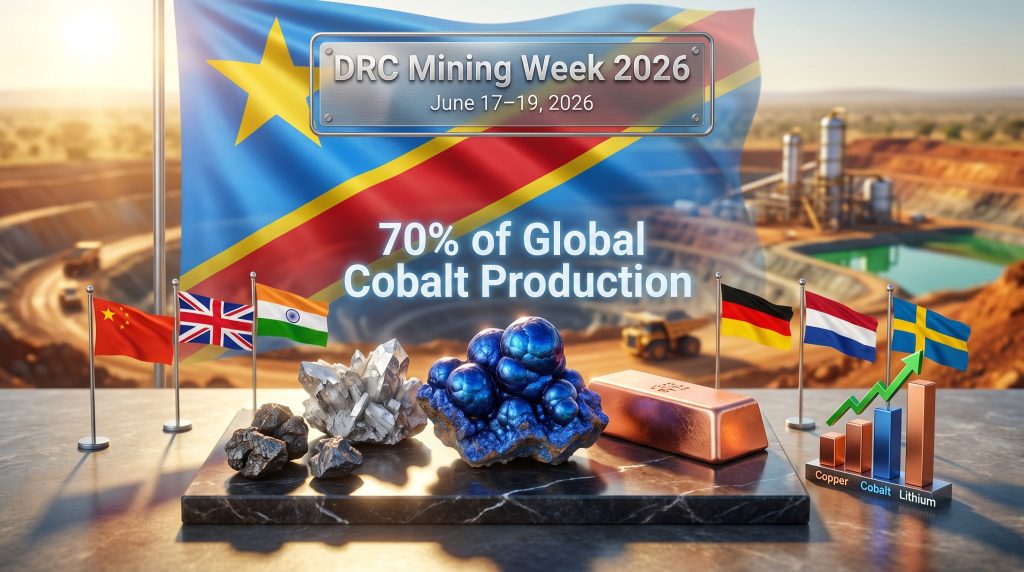
For decades, the DRC has functioned primarily as the raw material engine for the global battery industry. It produces roughly 70% of the world's cobalt according to the United States Geological Survey's Mineral Commodity Summaries 2024, a figure so dominant that no credible lithium-ion battery supply chain exists independently of it. Cobalt, the critical cathode stabiliser in NMC and NCA battery chemistries, flows overwhelmingly from the Katanga region, making the country structurally irreplaceable in the energy transition architecture underpinning everything from electric vehicles to grid-scale storage.
However, cobalt is only part of the picture. The DRC has simultaneously risen to become the world's second-largest copper producer, trailing only Chile, with copper output reaching approximately 1.3 million tonnes in 2023 according to USGS data. What makes the Congolese Copperbelt particularly attractive to sophisticated investors is not just volume — it is geology. Average copper ore grades in the region can reach 3-4% copper content, significantly superior to the global average, giving Copperbelt operators a structural cost and quality advantage that competitors in lower-grade jurisdictions cannot easily replicate.
It is within this geological and geopolitical context that DRC Mining Week 2026 takes on its full significance.
When big ASX news breaks, our subscribers know first
What DRC Mining Week 2026 Actually Is and Why the Timing Matters
Scheduled for June 17-19, 2026, at the Pullman Lubumbashi Grand Karavia Hotel in Lubumbashi, DRC Mining Week is the annual gathering that brings over 1,300 delegates from across Africa and internationally into direct commercial contact. With more than 280 exhibitors and 25+ conference sessions, the event functions simultaneously as an investment forum, a procurement marketplace, a technology showcase, and a regulatory engagement platform.
The event is organised by VUKA Group, which is marking its 20th anniversary with the 2026 edition, representing two decades of institutional network-building across African mining. The 2026 event carries particular weight because it arrives at a moment when the DRC is actively repositioning its identity within the global mining order.
The official theme, "The DRC's Shift: From Local Player to the World's Leading Hub for Critical Minerals," is not aspirational marketing language. It reflects a deliberate policy direction being pursued at the ministerial level. DRC's Minister of Mines Louis Watum Kabamba is among the confirmed participants, providing attendees with rare direct access to the regulatory and policy leadership guiding the country's industrial transformation.
The choice of Lubumbashi as the event's permanent home is itself strategically deliberate. As the commercial and operational capital of the Congolese Copperbelt, the city provides direct proximity to active mine sites, processing facilities, and logistics infrastructure. Hosting the event here means international capital engages with the market in its operational context, not from a conference room thousands of kilometres away.
The Operator Ecosystem: Who Is Actually in the Room
One of DRC Mining Week's defining commercial characteristics is the calibre and concentration of decision-makers it assembles. This is not an event where mid-level representatives attend on behalf of distant head offices. The attendance profile is curated to concentrate C-suite executives, investment directors, and senior government officials in a single, commercially active environment.
The major mining operators whose assets define the Congolese Copperbelt form the backbone of the participant ecosystem:
- Gécamines SA — the state-owned mining company that sits at the centre of DRC mineral governance, royalty structures, and joint venture arrangements with international operators
- Glencore plc — one of the world's largest diversified commodity producers, with significant copper and cobalt assets in the DRC through operations including Mutanda Mining
- Kamoa Copper SA — the joint venture between Ivanhoe Mines and Zijin Mining that operates what ranks among the world's highest-grade copper discoveries, with Phase 2 expansion targeting nameplate capacity of 600,000 tonnes of copper concentrate annually
- Kamoto Copper Company S.A. (KCC) — a significant copper and cobalt producer in the Katanga region
- Mutanda Mining Sarl (MUMI) — one of the world's largest producers of both cobalt and copper
- MMG Limited — operator of the Kinsevere copper mine with documented expansion ambitions
- Eurasian Resources Group Africa (ERG Africa) — a major integrated mining and processing group operating across the Copperbelt
- Barrick Gold Corporation — active across African gold operations with growing engagement in the DRC
Furthermore, financial institutions and development finance organisations attend with active mandates rather than observational interest. Engineering, procurement, and construction firms serving the Copperbelt's infrastructure demands are also well represented, as are mineral processing technology providers whose equipment is central to the beneficiation agenda the DRC government is now actively pursuing.
The Four Strategic Themes Defining the 2026 Conference Programme
Beneficiation and the Value Capture Imperative
Perhaps the most consequential theme running through DRC Mining Week 2026 is the question of where mineral value is captured along the supply chain. Historically, the DRC has exported raw ore and concentrate, with the majority of processing, refining, and manufacturing value accruing to downstream nations in Asia and Europe.
The current policy direction represents a fundamental challenge to that arrangement. The DRC government is designing frameworks to incentivise in-country processing, local value addition, and supply-chain localisation. Strategic industrial corridors are under development to connect mine sites to processing infrastructure. This is not a peripheral policy experiment; it is the central organising principle of the DRC's industrial strategy.
In addition, conference sessions will examine the structural requirements — including infrastructure investment, regulatory certainty, and capital market access — needed to make this viable at scale. Consequently, understanding the full breadth of the country's natural resource wealth is essential context for any investor attending these sessions.
A nation that supplies the majority of the world's cobalt yet captures only the smallest fraction of the battery value chain represents one of the most significant structural inefficiencies in global industrial economics. The DRC's beneficiation agenda is an attempt to correct that imbalance permanently.
ESG, Responsible Sourcing, and Institutional Capital Requirements
The ESG agenda at DRC Mining Week is commercially essential rather than performative. International institutional investors increasingly embed ESG compliance as a hard prerequisite before committing capital — not as a preference but as a risk management and regulatory obligation. For DRC mining projects to access the deepest pools of international capital, ESG alignment is non-negotiable.
With more than 25 dedicated conference sessions, the programme covers sustainable mining practices, environmental compliance frameworks, community engagement standards, and ESG reporting structures. The Cobalt Institute, represented by speaker Susannah McLaren, will contribute perspectives on responsible cobalt sourcing and supply chain transparency — a topic with direct commercial relevance given the scrutiny that cobalt provenance now receives from automotive OEMs and battery manufacturers.
Digital Transformation Across Copperbelt Operations
The productivity gap between leading global mining operations and the Congolese Copperbelt is narrowing, and digital technology is the primary mechanism driving that convergence. Automation, remote monitoring, predictive maintenance systems, and AI-assisted geological modelling are among the technologies being showcased by exhibitors.
However, what makes this theme particularly complex in the DRC context is the challenge of integrating advanced digital tools with existing legacy infrastructure. The computational demands of modern mineral exploration, particularly AI-driven sub-surface modelling, require both technical capacity and data infrastructure that is still developing across the region. The commercial opportunity for technology providers who can bridge this gap is substantial.
Energy Transition Demand Dynamics and Battery Metal Economics
The fundamental driver of investment activity across the entire DRC mining ecosystem is the structural demand pull created by global electrification programmes. Electric vehicle manufacturing targets, grid-scale energy storage deployment, and renewable energy infrastructure development are all materially dependent on cobalt and copper supply — commodities in which the DRC holds dominant positions.
The International Energy Agency has projected that global cobalt demand could exceed 2.2 million tonnes annually by 2030, driven primarily by battery manufacturing growth. Furthermore, the cobalt mining industry faces sustained structural demand pressure as copper tied to electrification infrastructure — from EV charging networks to power grid modernisation — is similarly positioned for long-term growth. These macro dynamics provide the investment thesis underpinning virtually every capital allocation decision made in the Copperbelt today.
KoBold Metals and the New Archetype of Technology-Driven Exploration Capital
One of the most revealing signals about the maturation of DRC investment is the confirmed participation of KoBold Metals at DRC Mining Week 2026. KoBold Metals operates as a science-driven exploration company, applying artificial intelligence and machine learning methodologies to identify mineral deposits with greater precision and lower geological risk than conventional exploration approaches.
The company is backed by prominent technology investors including Jeff Bezos and Bill Gates, and has announced plans to deploy over USD 50 million in lithium exploration within the DRC by 2027, representing one of the largest single-focus lithium exploration commitments in Central Africa. Their presence in Lubumbashi signals that data-led capital — the kind that builds proprietary sub-surface models before committing a single drill dollar — now views the DRC as a primary theatre of operation.
KoBold Metals' commitment illustrates a broader structural shift in how sophisticated exploration capital is being deployed. Rather than relying on traditional geological surveys and manual sampling, the company builds computational earth models that integrate geophysical, geochemical, and remote sensing data to narrow exploration targets before physical drilling commences. This approach can substantially reduce the capital destroyed in unsuccessful exploration programmes.
This is particularly relevant for DRC lithium, where the geological framework differs meaningfully from the brine-hosted lithium deposits of the Atacama or the hard-rock spodumene deposits of Western Australia. DRC lithium mineralisation is primarily associated with pegmatite-hosted deposits in the Kasai and Katanga regions — a geological context where AI-driven targeting methods may provide meaningful advantages over conventional approaches.
The Exhibition Floor: 280+ Exhibitors and Six International Pavilions
The DRC Mining Week 2026 exhibition accommodates more than 280 manufacturers and service providers, organised across mining equipment, processing technology, safety systems, power and energy solutions, and digital infrastructure. Critically, the event features dedicated international pavilions from China, the UK, India, Germany, the Netherlands, and Sweden, reflecting the breadth of national commercial interests converging on the DRC mining market.
The pavilion structure serves a dual function. It enables country-level trade promotion through coordinated national delegations whilst simultaneously allowing individual companies to conduct bilateral engagements. Key opportunity areas attracting exhibitor attention include:
- Mineral processing and beneficiation technology, where DRC policy is creating sustained demand for in-country processing equipment
- Off-grid and hybrid energy systems for remote mine sites, an underserved market given the DRC's power infrastructure constraints
- Water management and tailings systems, driven by rising environmental compliance requirements
- Underground safety and autonomous equipment, where Copperbelt operators are actively evaluating productivity-enhancing technology
The next major ASX story will hit our subscribers first
Infrastructure, Security, and the Conditions for Sustained Investment
Infrastructure remains the most significant structural bottleneck to realising the DRC's full industrial potential. Road, rail, and port connectivity between the Copperbelt and export corridors directly constrains both production volumes and the economics of downstream processing. Without logistics infrastructure capable of handling higher-value processed materials, the beneficiation agenda faces physical limitations regardless of policy intent.
Development finance institutions and multilateral lenders are increasingly engaged in DRC infrastructure financing, creating co-investment opportunities for private capital that earlier phases of the market's development rarely offered. On the security dimension, the DRC government has launched a USD 100 million mining security initiative to protect operational sites and supply routes across the country, according to Reuters reporting from April 28, 2026.
Improved operational security directly reduces the risk premiums embedded in project financing costs and insurance structures — factors that are among the most frequently cited barriers to accelerated foreign direct investment. Understanding the broader impact of export policy decisions on investor confidence is consequently essential reading for anyone assessing DRC risk-adjusted returns ahead of the event.
Comparing the DRC Against Competing Critical Mineral Jurisdictions
Understanding why capital is flowing toward the DRC rather than alternative jurisdictions requires a structured comparison of the factors that drive investment decisions:
| Factor | DRC | Chile | Australia | Indonesia |
|---|---|---|---|---|
| Cobalt Reserves | World's largest | Minimal | Moderate | Growing |
| Copper Ore Grade | High (3-4% in Copperbelt) | High (Atacama) | Moderate | Moderate |
| Lithium Potential | Emerging, pegmatite-hosted | Proven brine deposits | Proven hard rock | Limited |
| Political Risk | Elevated, improving trajectory | Low | Very low | Moderate |
| Infrastructure Maturity | Developing | Advanced | Advanced | Developing |
| In-Country Processing | Active policy priority | Established | Established | Expanding |
| Cobalt Co-Production | Dominant | Negligible | Minor | Negligible |
The DRC's competitive position rests on geological endowment that no other jurisdiction can replicate in cobalt, and copper grades that compete directly with Chile. The risk-adjusted case for DRC investment improves meaningfully when considering that competing jurisdictions for cobalt simply do not exist at comparable scale. Moreover, the US-China rivalry over Congolese cobalt adds a further geopolitical dimension that sophisticated investors cannot afford to ignore.
Who Benefits from Attending and Why the Window Is Narrowing
Different stakeholder categories extract distinct forms of value from DRC Mining Week 2026:
| Stakeholder | Primary Value Proposition |
|---|---|
| Global Investors | Direct access to project pipelines and ministerial policy direction before capital commitment |
| Mining Operators | Technology sourcing, supply chain partnerships, and regulatory engagement |
| Technology Providers | Market access to 280+ exhibitor ecosystem and 1,300+ operational decision-makers |
| Financial Institutions | Deal origination and co-financing opportunity identification |
| Service Companies | Procurement intelligence and direct operator engagement |
| Government Officials | Platform to communicate industrial policy and attract strategic capital |
The asymmetry of first-mover advantages in the DRC market is a factor that deserves serious consideration. As the country moves from extraction-led economics toward processing and industrial integration, the most valuable asset positions are those established before the market fully prices in the transformation. Relationships built at DRC Mining Week 2026 are being formed at a moment when the DRC's critical mineral identity is still evolving — not after it has hardened into a mature, efficiently-priced market.
Those who engage substantively with the DRC's industrial transition now — through the networks, partnerships, and policy intelligence that the 2026 conference programme uniquely provides — will occupy structurally advantaged positions as the next decade of Copperbelt development unfolds.
Disclaimer: This article contains forward-looking statements and projections regarding mineral demand, investment flows, and policy outcomes. These are based on publicly available information and cited sources and should not be construed as investment advice. Actual outcomes may differ materially from projections. Readers should conduct independent due diligence before making any investment decisions related to the DRC mining sector or any companies referenced in this article.
Want to Track the Next Major Mineral Discovery Before the Market Does?
Discovery Alert's proprietary Discovery IQ model delivers real-time alerts the moment significant ASX mineral discoveries are announced — including critical minerals like copper and cobalt — translating complex geological data into clear, actionable insights for both short-term traders and long-term investors. Explore how historic mineral discoveries have generated substantial returns and begin your 14-day free trial today to position yourself ahead of the broader market.