
August 4, 2026
When a Billion-Rand Expansion Meets a Bureaucratic Wall
South Africa's mining sector has long grappled with a paradox that frustrates investors and operators alike: the country sits atop some of the world's most significant mineral endowments, yet the administrative machinery required to unlock that value frequently lags decades behind the industry's needs. Water use licences that should take months stretch into years. Tailings facility approvals stall in departmental queues. The bottleneck is rarely geological or technical — it is institutional.
That tension sits at the heart of the DRDGold Vision 2028 permits delay, a story that has shifted the investment debate around one of South Africa's most strategically important surface gold operators from one about construction competence to one about regulatory timing.
When big ASX news breaks, our subscribers know first
Understanding Vision 2028: Architecture of a R10 Billion Commitment
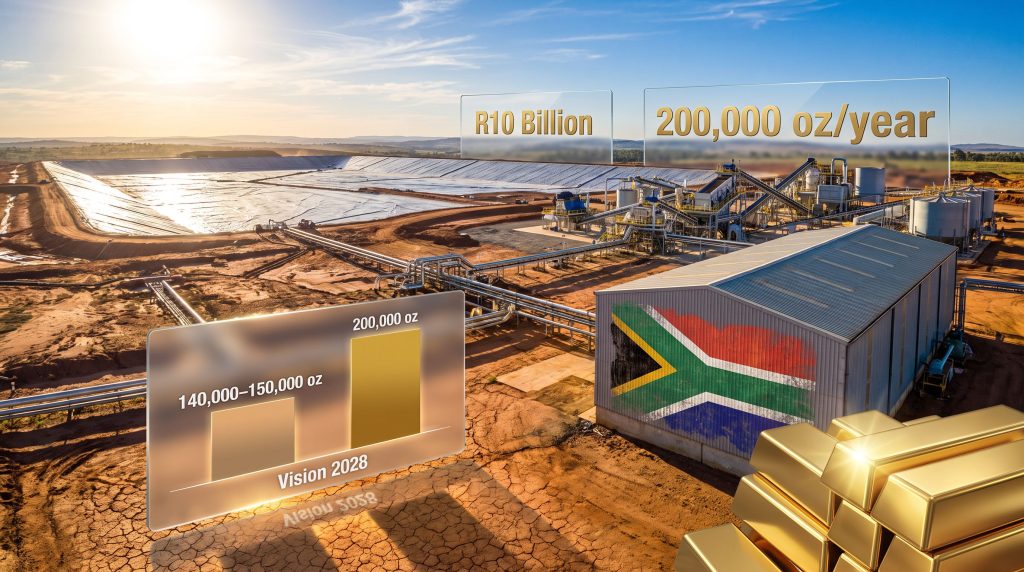
DRDGold's Vision 2028 is not a single project but a layered capital programme spanning two operational hubs — Far West Gold Recoveries (FWGR) in the West Rand and Ergo near Brakpan — with a combined budget of approximately R10 billion and a target of reaching 200,000 ounces of gold per year by the end of this decade. That would represent a roughly 33% uplift over current annual production guidance of 140,000 to 150,000 ounces.
The programme's centre of gravity is FWGR, which absorbs approximately R8 billion of the total spend. The interconnected components span processing plant expansions, new tailings infrastructure, pipeline development, and reclamation station construction across a geographically complex operating corridor.
| Project Component | Location | Function | Status |
|---|---|---|---|
| DP2 Processing Plant Expansion | FWGR, West Rand | Doubles processing throughput | First gold poured |
| RTSF Tailings Storage Facility | Near Carletonville | 800ha; 1.2Mt/month capacity | Awaiting beneficial occupation approval |
| Libanon Pump Station | Libanon (closed mine) | Reclaims unmined dumps; feeds DP2 | Awaiting water use licence |
| New Pipeline Infrastructure | FWGR corridor | Connects reclamation sites to processing | Under development |
| Daggafontein Tailings Facility | Ergo, near Brakpan | Extends Ergo's life by 20 years | Commissioned |
What makes Vision 2028 structurally different from most gold expansion programmes is that it involves no underground development whatsoever. DRDGold operates exclusively in the surface tailings reprocessing space — dissolving legacy dump material through a hydrometallurgical process and recovering residual gold that original processing methods left behind. You can explore the full scope of these initiatives through DRDGold's Vision 2028 big five projects.
The Tailings Reprocessing Model: Simpler on the Surface, Complex in Practice
Surface tailings reprocessing eliminates many of the physical risks and capital costs associated with underground mining. There is no shaft sinking, no ventilation engineering, no seismicity management. The resource is already excavated and sitting on the surface in the form of decades-old mine waste dumps.
However, this apparent simplicity conceals a formidable regulatory burden. Because these operations involve large-scale water management, geomembrane-lined tailings facilities, pump stations drawing from closed mine infrastructure, and the physical movement of millions of tonnes of material close to wetlands and communities, they intersect with a wide range of environmental and water-use legal frameworks. Furthermore, understanding mine reclamation importance helps contextualise why these regulatory requirements exist in the first place.
The gold grades in tailings reprocessing are inherently lower than primary ore — typically measured in fractions of a gram per tonne — which means throughput volume is the primary lever for profitability. DRDGold's business model depends on processing enormous quantities of material at tight margins, making scale infrastructure like RTSF and DP2 essential rather than incremental.
The Two Permits Blocking Execution
Water Use Licences: The Libanon Critical Path
DRDGold has lodged two separate water use licence (WUL) applications with South Africa's Department of Water and Sanitation. The more time-sensitive of the two covers the Libanon pump station — the infrastructure link that enables reclamation of unmined dump material and feeds it into the expanded DP2 processing plant.
Construction of the pump station is estimated at nine months from the date a WUL is granted. That nine-month clock has not yet started. Every month of departmental delay compresses the feasible window for achieving Vision 2028's production target before the decade ends.
DRDGold CEO Niël Pretorius has characterised the hold-up as a function of workload volume and resourcing constraints within the department — not a substantive objection to the applications themselves. The distinction is important for risk assessment purposes.
| Delay Type | Investor Implication | Resolution Probability |
|---|---|---|
| Technical objection to application | High risk; may require redesign | Lower |
| Departmental capacity constraint | Moderate risk; time-sensitive but not structurally blocked | Higher |
| Political obstruction | High risk; unpredictable | Low (current assessment) |
Beneficial Occupation: The RTSF's Seasonal Deadline
The Regional Tailings Storage Facility is physically constructed. It covers 800 hectares near Carletonville, is designed to receive 1.2 million tonnes of tailings per month, and is lined with a geomembrane that protects the surrounding environment from seepage. The facility sits adjacent to a wetland area, adding environmental sensitivity to the approval process.
Before DRDGold can legally begin commissioning the dam — even though construction is complete — it requires a formal beneficial occupation approval from the relevant government authority. This is the legal instrument that grants a company the right to take physical possession of a property and begin using it for its intended operational purpose.
The urgency surrounding this approval is amplified by a technical factor that most investors would not immediately recognise: the RTSF's geomembrane lining requires the dam to be filled with material before the summer rainy season to maintain its structural and thermal integrity. A plastic liner baking in intense summer sun without the thermal buffering effect of tailings slurry faces accelerated degradation.
This creates a hard seasonal deadline that transforms what might appear to be an administrative inconvenience into a genuine financial risk. If beneficial occupation is not granted by approximately September 2026, commissioning cannot begin in time for the pre-summer window, and the next viable commissioning opportunity shifts to April 2027 at the earliest — a six-month slip in the programme timeline.
Scenario Analysis: Approval Timing vs. Commissioning Outcomes
| Approval Scenario | Commissioning Start | Likely Outcome |
|---|---|---|
| Beneficial occupation by September 2026 | September–October 2026 | Dam fills ahead of summer rains; on-schedule commissioning |
| Approval delayed past September 2026 | April 2027 earliest | Six-month slip; production ramp delayed into mid-2027 |
| Further delays beyond April 2027 | TBD | Material impact on 200,000 oz timeline |
Pretorius has noted that an El Niño weather event is forecast for the upcoming summer, which adds further complexity. As a farm owner with direct experience of seasonal weather patterns, his attentiveness to the rainfall calendar goes beyond corporate risk management language — it reflects a practical understanding of what an earlier-than-normal wet season could mean for the commissioning window.
How Institutional Analysts Are Repricing the Risk
The DRDGold Vision 2028 permits delay has prompted a meaningful recalibration in institutional research coverage, with the analytical focus shifting away from construction delivery confidence toward regulatory timeline uncertainty.
New York-based investment bank HC Wainwright has noted that the programme's heaviest execution risk has now moved behind it, with Daggafontein commissioned and DP2 pouring first gold representing tangible proof of construction capability. The firm maintains long-term confidence in the 200,000 oz/year target while advising that near-term production expectations should be moderated to reflect permit acquisition timelines rather than physical build progress.
London-based Hannam and Partners reduced DRDGold's target price from R79 to R76 per share, updating capital expenditure assumptions and trimming production forecasts for the 2027 to 2029 window. Near-term investor attention has been redirected toward the annual production guidance release due in August, where DRDGold has guided to 140,000 to 150,000 ounces for the current year.
The analytical debate in institutional circles has effectively migrated from whether DRDGold can build Vision 2028 to when the South African government will approve it — repositioning sovereign regulatory capacity as the primary variable in the investment thesis rather than operational execution.
Near-Term Production vs. Vision 2028 Target
| Metric | Current Guidance | Vision 2028 Target | Gap |
|---|---|---|---|
| Annual Gold Production | 140,000–150,000 oz | 200,000 oz | |
| Key Enabler | Existing operations | Libanon + RTSF + DP2 | Permit-dependent |
| Timeline | FY2026 | End of decade | 3–4 years |
South Africa's Regulatory Environment: A Systemic Constraint on Capital Deployment
The DRDGold Vision 2028 permits delay is not an isolated case of a single company encountering administrative friction. It reflects a structural pattern in South Africa's mining regulatory framework, where the Department of Water and Sanitation functions as a gateway institution for virtually all significant mining infrastructure involving surface water interaction.
Water use licences are required for tailings facilities, pump stations, processing plants, and slurry pipelines — in other words, for most of the physical infrastructure that makes surface gold reprocessing possible. The department's processing capacity has been under sustained pressure across commodity sectors, with backlogs affecting multiple operators beyond the gold industry.
Several structural factors compound this challenge:
- Water use licence applications for large-scale mining infrastructure involve complex environmental assessments, hydrological modelling, and community consultation processes that are inherently resource-intensive to evaluate
- The department must weigh applications from mining, agriculture, municipal, and industrial water users simultaneously, creating competing priority queues
- Tailings facilities adjacent to wetlands, like the RTSF, face heightened scrutiny given their proximity to sensitive ecological zones
- The expertise required to evaluate advanced geomembrane-lined tailings engineering is specialised, and departmental capacity in this area is constrained
In addition, considering natural capital in mining reveals why departments balance ecological protection against the commercial imperatives of large-scale operators.
In a sustained high gold price environment, every quarter of regulatory delay represents a quantifiable opportunity cost — foregone cash flow for the company, and foregone royalties, taxes, and employment contributions for the South African fiscus. The cost of institutional capacity constraints is not abstract; it is measured in ounces not produced and dividends not paid.
The Sibanye-Stillwater Dimension: Strategic Ownership and Future Optionality
Any analysis of DRDGold's investment profile requires engagement with the role of its controlling shareholder, Sibanye-Stillwater, which holds a 50.1% stake acquired through the vending of the FWGR assets in 2020 across two tranches for a combined R1.08 billion.
At current market valuations, replicating that transaction would cost approximately R14 billion — making the FWGR-to-DRDGold vend one of the most capital-efficient transactions in recent South African mining history. Sibanye-Stillwater CEO Richard Stewart has publicly indicated he would welcome the opportunity to own more of DRDGold if circumstances permitted.
However, Sibanye-Stillwater is currently directing capital toward approximately R20 billion in planned expansions across its South African platinum group metals portfolio, alongside maintaining profitability in its existing gold operations. This capital prioritisation rules out near-term share accumulation in DRDGold, though Stewart has made clear the controlling stake is being held as a long-term strategic position rather than a tradeable asset. A delisting has been explicitly ruled out.
The Kloof Mine Adjacency: An Underappreciated Optionality Play
One dimension of DRDGold's long-term growth optionality that receives less mainstream attention is the geographic proximity of Sibanye-Stillwater's Kloof gold mine to FWGR's operational footprint. Kloof, one of the deepest and oldest of the Witwatersrand Basin mines, is approaching end-of-life.
As Kloof's underground operations wind down, its surface processing infrastructure — mills, plants, and related facilities — may become available for repurposing. Pretorius has indicated that such assets could potentially be integrated into DRDGold's surface operations, contingent on securing sufficient additional resource streams to justify the throughput. This represents a speculative but structurally logical future growth pathway that does not require greenfield capital allocation.
The next major ASX story will hit our subscribers first
The Post-2028 Financial Case: From Capital Consumer to Dividend Engine
DRDGold's capital expenditure profile is expected to taper materially through 2027 and into 2028 as the Vision 2028 build programme approaches completion. The financial logic of what follows is straightforward: a company with a substantially expanded production base, a depreciating capex burden, and exposure to gold prices as an inflation hedge becomes a powerful free cash flow generator.
Pretorius has framed the anticipated investor benefit in explicit income terms rather than capital appreciation terms. The post-2028 financial thesis centres on dividend flow improvement rather than share price re-rating — positioning DRDGold as a yield vehicle for shareholders once the expansion cycle reaches steady state.
Projected Capital Cycle Transition
| Phase | Period | Capital Profile | Cash Flow Implication |
|---|---|---|---|
| Build Phase | 2023–2026 | Heavy capex deployment | Constrained free cash flow |
| Transition Phase | 2027 | Capex tapering | Rising free cash flow |
| Harvest Phase | 2028 onwards | Minimal growth capex | Strong dividend generation potential |
This framing has implications for investor positioning. Those seeking near-term catalysts will focus on the August production guidance release and any permit milestone announcements. Those constructing a longer-duration thesis are effectively buying the dividend trajectory that materialises once regulatory approvals are secured and production ramps toward 200,000 ounces.
Furthermore, the gold price outlook for miners suggests sustained tailwinds that would amplify the financial benefit of achieving full-scale production, making timely permit resolution all the more consequential.
The elevated gold price environment amplifies both the urgency and the financial upside. Every quarter of delay at current spot prices represents substantial foregone revenue at the expanded production rate. Conversely, once permits are secured and ramp-up commences, the cash generation at 200,000 oz/year in a high gold price environment would dwarf the current income profile.
Moreover, understanding the gold price impact on mining equities is essential for appreciating why institutional analysts continue to maintain constructive long-term positions despite the near-term regulatory uncertainty. According to DRDGold's own strategic progress report, the company marked an exceptional year with record returns even as the build programme intensified, underscoring the resilience of its underlying business model.
Key Risk and Opportunity Summary
| Factor | Risk Level | Investor Relevance |
|---|---|---|
| Water use licence (Libanon pump station) | High — on critical path | Direct impact on production timeline |
| Beneficial occupation (RTSF) | High — seasonal deadline | Commissioning slip risk if delayed past September 2026 |
| Departmental capacity constraints | Moderate — systemic | Unlikely to be resolved quickly; requires monitoring |
| Daggafontein commissioning | Low — completed | De-risked; confirms execution capability |
| DP2 first gold | Low — achieved | Physical build programme credibility established |
| Sibanye-Stillwater stake stability | Low | Controlling shareholder committed; no overhang risk |
| Elevated gold price environment | Opportunity | Amplifies financial upside upon permit resolution |
| Post-2028 dividend potential | Opportunity | Income-generation thesis strengthens with each permit milestone |
This article is intended for informational purposes only and does not constitute financial advice. Forecasts, analyst price targets, and production projections involve inherent uncertainty and should not be relied upon as guarantees of future performance. Investors should conduct independent research and consult qualified financial advisers before making investment decisions.
Want to Track the Next Major ASX Mineral Discovery Before the Market Catches On?
While DRDGold navigates regulatory timelines on its path to 200,000 ounces per year, Discovery Alert's proprietary Discovery IQ model scans ASX announcements in real time, instantly alerting subscribers to significant mineral discoveries and actionable investment opportunities — visit the Discovery Alert discoveries page to understand how historic discoveries have generated exceptional returns, and begin your 14-day free trial today to position yourself ahead of the broader market.