June 5, 2026
The Hidden Dynamics Behind Drilling Consumable Supply Agreements in Global Mining
The mining industry has long operated on a fundamental tension between operational continuity and supply chain vulnerability. When a drill bit fails mid-shift in a remote Western Australian hard-rock operation, or a drill rod fractures at 3,000 metres below surface in a South African platinum mine, the downstream consequences ripple far beyond a single equipment replacement. Lost production time, safety risks, and cascading disruption to mine scheduling create financial exposure that dwarfs the cost of the consumable itself. This operational reality is precisely why the structure of drilling consumable supply agreements has evolved from transactional purchasing into long-term strategic partnerships, and why the recent confirmation of Robit supply agreements in mining markets across Australia, North America, and South Africa carries significance well beyond the immediate commercial figures.
Understanding this shift requires examining not just what these agreements cover, but the deeper market forces that have made multi-region supply partnerships the preferred procurement architecture for tier-1 mining operators worldwide. In addition, drilling programs have become increasingly complex, further elevating the importance of reliable consumable supply chains.
When big ASX news breaks, our subscribers know first
What Are Robit Supply Agreements and What Do They Cover?
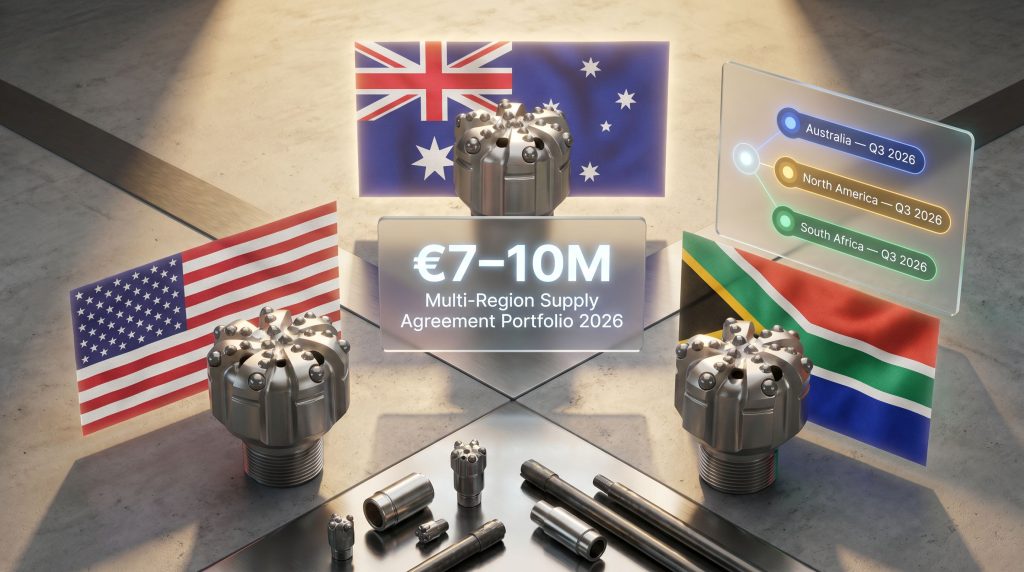
Robit, a Finland-headquartered drilling technology and consumables manufacturer, has formalised several supply agreements with mining operations across three of the world's most active mining jurisdictions. The combined net sales value of these signed agreements sits within the range of €7 million to €10 million, with deliveries scheduled to commence during the third quarter of 2026.
The agreements span two distinct but interconnected product categories:
- Drilling consumables: Wear-intensive components including drill bits, rods, couplings, and related items that require regular replacement under standard mining conditions.
- Drilling technology solutions: More sophisticated, engineered products that integrate performance design with site-specific operational data to improve drilling efficiency, bit longevity, and overall drilling productivity.
This dual-category structure is significant. It reflects a broader industry movement away from commodity-style consumable purchasing toward integrated solutions procurement, where suppliers are expected to contribute operational intelligence alongside physical products.
The distinction between consumables and technology solutions is not merely semantic. In practice, it determines whether a supplier is treated as an interchangeable vendor or as a technical partner embedded in the mine's operational planning cycle.
Key Contract Parameters Across Robit's Multi-Market Agreement Portfolio
| Market Region | Agreement Type | Estimated Combined Value | Delivery Commencement |
|---|---|---|---|
| Australia | Drilling consumables and technology solutions | Part of €7–10M combined | Q3 2026 |
| North America | Drilling consumables and technology solutions | Part of €7–10M combined | Q3 2026 |
| South Africa | Drilling consumables and technology solutions | Part of €7–10M combined | Q3 2026 |
| Finland (Pampalo Mine) | Long-term direct supply via Endomines | Undisclosed | Active |
| Finland (Hosko Mine) | Long-term supply via Veljekset Toivanen (contractor) | Undisclosed | Active |
The simultaneous Q3 2026 commencement across three separate continents points to a coordinated logistics infrastructure capable of supporting parallel rollouts, which is itself a meaningful operational achievement for a specialist industrial supplier.
Why Australia, North America, and South Africa Are Strategically Critical Mining Markets
These three regions were not selected arbitrarily. Each represents a distinct geological, regulatory, and operational environment that tests drilling consumables under genuinely demanding conditions. Performing credibly in all three simultaneously elevates a supplier's global reference portfolio in a way that single-market success cannot replicate.
Australia: Hard-Rock Productivity Under Extreme Conditions
Australia remains one of the world's foremost hard-rock mining jurisdictions, with operations spanning lithium, iron ore, gold, nickel, and copper. The geological hardness of formations in regions like the Pilbara and the Western Australian goldfields creates extraordinary wear demands on drilling components. Consumables that perform reliably here carry implicit validation for similar geological environments globally.
Australian mining operators also face heightened productivity expectations driven by tight labour markets, remote site logistics, and increasing automation adoption. These pressures create strong incentives to partner with consumable suppliers whose products can support automated and semi-automated drilling systems with consistent, predictable performance specifications. The rise of mining automation trends has consequently raised the bar for consumable consistency across the sector.
North America: Critical Minerals Momentum and Infrastructure Expansion
North American mining activity has intensified significantly as demand for battery metals, copper, and other critical minerals has accelerated across the energy transition supply chain. Exploration and development drilling programmes have expanded, increasing total drill footage and, consequently, consumable turnover volumes. Longer drilling campaigns and deeper targets are placing greater demands on rod and bit performance than were typical a decade ago.
South Africa: Deep-Level Mining and Specialist Demand
South Africa's mining sector is defined in part by its ultra-deep operations in the platinum group metals and gold sectors, where shafts can descend beyond 3,000 to 4,000 metres. These environments generate extreme heat, pressure, and rock stress conditions that render standard drilling consumables inadequate. Products validated under South African deep-level conditions carry significant credibility with mining engineers globally, precisely because the operational demands are so far beyond standard parameters.
Each of these three markets presents distinct geological and operational challenges, from Australia's hard-rock lithium and iron ore environments to South Africa's ultra-deep platinum and gold mines, requiring drilling consumables validated under extreme conditions rather than simply specified on paper.
How Product Validation Drives Supply Agreement Wins in Competitive Drilling Markets
One of the least understood aspects of drilling consumable procurement is how long and rigorous the qualification pathway is before a formal supply agreement is executed. Mining operators do not switch consumable suppliers lightly, and the qualification process reflects the operational stakes involved.
Robit's leadership has been explicit that the company's approach centres on demonstrating performance in customers' actual operating environments rather than relying on laboratory specifications or theoretical performance claims. This commitment to field validation has been a consistent strategic priority, and the multi-region agreement package reflects the commercial results of that approach. Furthermore, interpreting drill results from these validation trials forms a critical part of the supplier qualification decision.
Step-by-Step: How Drilling Consumable Suppliers Typically Win Multi-Year Mining Contracts
- Initial site assessment: The supplier evaluates rock formation characteristics, drilling methodology, production targets, and incumbent consumable performance data.
- Controlled product trial: Consumables are tested under live production conditions with defined key performance indicators including rate of penetration, bit life, and total footage drilled per component.
- Performance benchmarking: Trial results are compared against the existing supplier baseline or internal performance targets to quantify improvement or equivalence.
- Technical validation report: Documented performance data is presented to both operations and procurement decision-makers, shifting the conversation from specification comparison to measured outcomes.
- Commercial negotiation: Pricing structures, volume commitments, delivery schedules, and technical support arrangements are agreed with reference to the validated performance data.
- Supply agreement execution: A formal contract is executed with defined scope, term, and performance expectations embedded in the commercial framework.
This pathway explains why the announcement of Robit supply agreements across three major markets simultaneously is more significant than the headline contract value alone suggests. Each agreement represents the successful completion of this demanding qualification process in a different geological, regulatory, and operational context.
What Is Driving Demand for Drilling Consumables Across Global Mining Markets in 2026?
Several converging forces have elevated demand for high-performance drilling consumables across the markets where Robit has established its newest agreements.
Market Trend Summary: Key Forces Shaping Drilling Consumable Demand in 2026
| Demand Driver | Impact on Consumable Procurement | Affected Regions |
|---|---|---|
| Critical minerals exploration growth | Higher drill footage volumes and faster consumable turnover | Australia, North America |
| Mining automation adoption | Need for precision-engineered, consistent-spec consumables | Global |
| ESG-linked operational efficiency targets | Preference for longer-life, lower-waste products | Australia, South Africa |
| Deep-level and hard-rock expansion | Demand for high-durability, heat-resistant drill bits and rods | South Africa, North America |
| Supply chain localisation pressures | Preference for suppliers with regional logistics capability | All markets |
The automation trend deserves particular attention. As drilling rigs become increasingly autonomous, the tolerance for performance variability in consumable components narrows substantially. AI in drilling and blasting has further compressed acceptable variability margins, as automated systems optimise drilling parameters in real time based on expected component behaviour. Suppliers whose products deliver consistent, predictable performance specifications across production batches are consequently the preferred partners for mines investing in automated drilling systems.
Simultaneously, ESG frameworks have introduced new procurement considerations. Mining operators under sustainability reporting obligations increasingly scrutinise consumable waste volumes and material sourcing practices, creating demand for longer-life products that reduce replacement frequency and associated waste streams.
How Robit's Finland Agreements Fit Into Its Global Supply Strategy
The Finland-based supply arrangements at Pampalo and Hosko mines serve a strategic function that extends beyond their local commercial contribution. Finland's geological conditions, characterised by ancient Precambrian basement rocks with high abrasivity, provide a technically demanding baseline for product testing and performance validation.
Crucially, the two Finnish agreements operate under structurally different contractual models. The Pampalo Mine arrangement with Endomines is a direct supply relationship between Robit and the mining operator, enabling deeper operational integration and direct performance feedback loops. The Hosko Mine supply flows through Veljekset Toivanen, a mining contractor, demonstrating Robit's capacity to operate effectively within contractor-mediated supply chains.
This dual-model competency is strategically valuable. Different regional markets favour different supply chain architectures, and suppliers that can only operate through direct relationships with mine operators are automatically excluded from markets where contractor-operated mining dominates. Robit's demonstrated capability across both models positions it to pursue agreements regardless of how individual mining operations structure their supply chains.
The next major ASX story will hit our subscribers first
What a €7–10 Million Multi-Region Agreement Portfolio Signals for the Drilling Consumables Sector
Interpreting this agreement package purely as a revenue event understates its strategic implications. A €7–10 million contract portfolio spanning three tier-1 mining jurisdictions simultaneously performs a market credibility function that compounds over time.
Reference agreements in Australia, North America, and South Africa reduce procurement friction in adjacent markets by providing verifiable performance evidence across diverse geological and operational conditions. Mining procurement teams in Southeast Asia, Latin America, and Central Asia, where similar geological environments exist, can access validated performance data from comparable hard-rock and deep-level applications rather than relying on unproven claims from a new supplier entrant.
Comparison Framework: Supply Agreement Models in the Drilling Consumables Sector
| Model Type | Structure | Typical Duration | Key Advantage |
|---|---|---|---|
| Direct OEM supply | Supplier to mine operator | 1–3 years | Price control and direct operational relationship |
| Contractor-mediated supply | Supplier to mining contractor | 6–24 months | Broader reach via established contractor networks |
| Framework agreements | Pre-agreed terms with call-off orders | 2–5 years | Procurement flexibility and volume certainty |
| Performance-linked contracts | Payment tied to drill footage or uptime | Variable | Aligns supplier and operator incentives |
The shift toward performance-linked contract models is worth monitoring as an emerging trend. In these structures, supplier compensation is at least partially tied to measurable operational outcomes rather than unit volumes, creating powerful incentives for suppliers to prioritise product quality and operational support over margin-driven cost reduction in manufacturing.
How Mining Procurement Teams Should Evaluate Drilling Consumable Suppliers
For mining procurement and operations teams assessing drilling consumable suppliers for long-term partnerships, the evaluation framework has grown considerably more complex than simple price-per-unit comparison. In addition, thorough drill results interpretation from supplier validation trials should form a core part of any procurement assessment process.
Procurement Checklist: Evaluating Drilling Consumable Suppliers for Long-Term Agreements
- Documented field trial results across comparable geological environments to the target operation
- Demonstrated logistics capability within the target region, including lead times and local inventory positioning
- Technical support availability aligned with operational shift schedules, including remote site coverage
- Confirmed compatibility with existing drill rig fleet specifications and any automation systems in use
- Clear performance warranty or component replacement commitment terms documented in the agreement
- ESG credentials including product lifespan data, material sourcing transparency, and waste reduction metrics
- Verifiable reference agreements with comparable mining operations in similar geological environments
The hidden cost most frequently underestimated in consumable supplier switching decisions is the transition period itself. When a mine changes drill bit or rod suppliers mid-operation, drilling parameters calibrated to the incumbent product require recalibration for the new product, creating a productivity dip that can persist for weeks or months depending on the complexity of the operation. This transition cost creates genuine switching inertia that makes initial product qualification both more difficult for new suppliers and more durable once achieved.
The Broader Competitive Landscape: Where the Drilling Consumables Market Stands in 2026
The global drilling consumables market encompasses a range of suppliers, from large diversified mining equipment manufacturers that include consumables as part of broader equipment portfolios, to specialist manufacturers focused exclusively on drilling components. Robit occupies a position in the specialist category, where competitive differentiation rests primarily on product performance, technical expertise, and customer support capability rather than balance sheet scale.
The competitive dynamics in this segment have shifted meaningfully over the past decade. Historically, procurement decisions in mining consumables were heavily price-driven, with commoditised products sourced from the lowest-cost qualified supplier. The increasing complexity of mining operations, driven by deeper targets, harder rock formations, and automation adoption, has elevated performance and reliability considerations relative to price in procurement weighting.
This shift benefits suppliers that have invested in engineering capability and field validation infrastructure, as these investments create differentiation that price competition alone cannot overcome. The willingness of major mining operators to formalise multi-year supply agreements for drilling consumables, rather than maintaining spot purchasing flexibility, reflects confidence in supplier performance consistency that was less common in the commoditised procurement environment of earlier years.
Simultaneous multi-region contract wins indicate that a supplier has passed the credibility threshold across multiple independent procurement processes, each with its own technical standards and validation requirements. This cannot be manufactured through marketing or specification documents alone.
Frequently Asked Questions: Robit Supply Agreements in Mining Markets
What types of products are covered under Robit's mining supply agreements?
The agreements cover two product categories: drilling consumables, which are regularly replaced wear items used in active mining operations, and drilling technology solutions, which are engineered products designed to optimise drilling performance in specific operational environments.
Which mining regions are currently covered by Robit's active supply agreements?
Active and announced agreements span Australia, North America, South Africa, and Finland, with the latter covering Pampalo and Hosko mines under direct and contractor-mediated supply models respectively.
When will deliveries under the 2026 multi-market agreements begin?
Deliveries across all three new regional agreements, covering Australia, North America, and South Africa, are scheduled to commence during the third quarter of 2026.
How does Robit validate product performance before finalising supply agreements?
Robit employs field-based performance validation, testing products under live production conditions in customers' actual operating environments before finalising supply terms. This approach prioritises measured operational outcomes over theoretical specifications.
What is the significance of simultaneous supply agreements across multiple continents?
Multi-region simultaneous agreements demonstrate that a supplier has passed independent technical and commercial qualification processes across different geological, regulatory, and operational environments, substantially strengthening market credibility and reducing procurement friction in new markets.
How do long-term drilling consumable agreements benefit mining operators financially?
Long-term agreements provide operational continuity, reduce the productivity disruption associated with supplier transitions, enable supply chain planning integration, and in many cases unlock preferential pricing through volume commitment structures.
Key Takeaways: What the Robit Agreement Expansion Reveals About Mining Supply Chain Strategy
The Robit supply agreements in mining markets across Australia, North America, and South Africa collectively illustrate several important trends reshaping the global drilling consumables sector. However, the full significance of these agreements extends well beyond their headline contract value, pointing instead to a structural shift in how the world's largest mining operations manage drilling consumable procurement.
- Performance validation has become the primary currency of trust in drilling consumable procurement, displacing price as the dominant selection criterion in high-stakes mining environments.
- Multi-region reference portfolios compound in strategic value over time, as each tier-1 market agreement reduces the qualification burden in adjacent markets with comparable geological conditions.
- Simultaneous Q3 2026 delivery commencement across three continents signals that Robit has developed the logistics infrastructure necessary to support coordinated multi-regional supply operations, a non-trivial operational capability for a specialist manufacturer.
- The dual contractual model approach, demonstrated through Finland's direct and contractor-mediated agreements, positions Robit to engage with diverse operational structures across global mining markets without being constrained by a single supply chain architecture.
- Drilling technology solutions represent a strategic evolution beyond commodity consumable supply, embedding suppliers more deeply into mine operational planning and creating more durable commercial relationships than transactional purchasing alone can support.
For further detail on Robit's recent supply agreement announcements and commercial developments, the Robit Group news section provides regularly updated information on their global partnership activity.
Disclaimer: This article is intended for informational purposes only and does not constitute financial or investment advice. Forward-looking statements regarding market trends, contract values, and operational timelines involve inherent uncertainty. Readers should conduct independent due diligence before making any investment or procurement decisions.
Want to Stay Ahead of the Next Major ASX Mineral Discovery?
Discovery Alert's proprietary Discovery IQ model delivers real-time alerts the moment significant mineral discoveries are announced on the ASX, transforming complex geological data into clear, actionable insights for both short-term traders and long-term investors — explore Discovery Alert's discoveries page to see the historic returns major mineral discoveries have generated, then begin your 14-day free trial to position yourself ahead of the broader market.