
August 6, 2026
Economic Adaptations in Post-Conflict Mining Communities
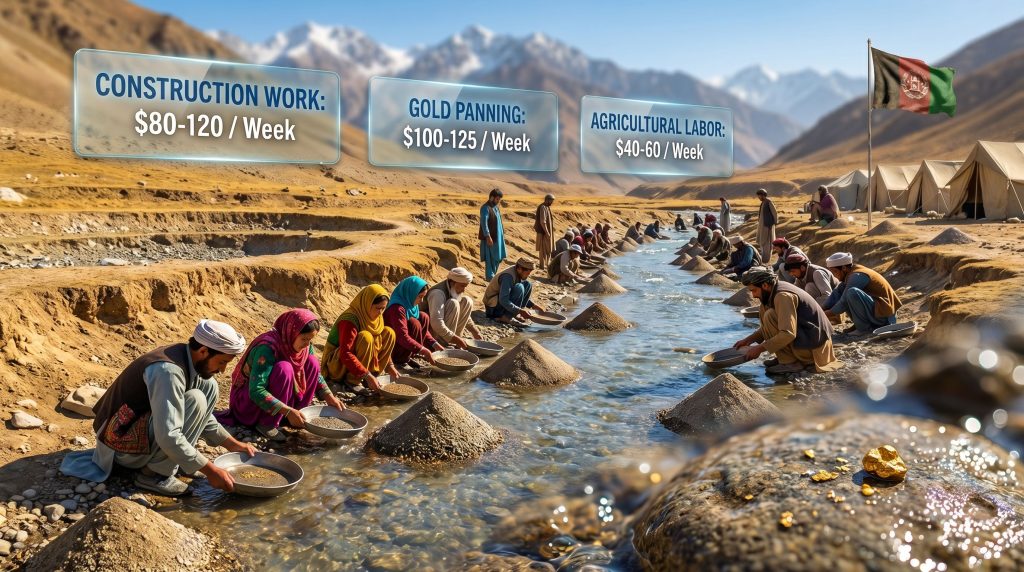
Economic transformations in post-conflict societies often reveal surprising adaptations as communities navigate scarce formal employment opportunities. Afghan villagers turn to gold panning as traditional economic structures collapse and informal resource extraction emerges as a critical survival mechanism. These circumstances create unique microeconomies that operate outside conventional regulatory frameworks while generating substantial local economic activity.
The evolution of artisanal mining in conflict-affected territories demonstrates how communities leverage available natural resources to compensate for disrupted formal labour markets. When conventional employment becomes unavailable, populations often migrate toward areas where low-barrier extraction activities can provide immediate income generation. Furthermore, the gold market performance influences these economic decisions significantly.
When big ASX news breaks, our subscribers know first
Economic Displacement and Resource Migration Patterns
Afghanistan's informal gold mining sector illustrates how economic displacement drives resource-based adaptation strategies. In the Hindu Kush mountains of eastern Afghanistan, thousands of individuals have transitioned from formal employment to artisanal gold extraction, creating a substantial informal economy centred on traditional panning techniques.
The migration pattern from urban centres to resource-rich regions reflects systematic economic adaptation. Workers like Delawar, a 45-year-old construction worker and father of eight, exemplify this transition by leaving formal employment in Kabul to pursue gold panning operations seven hours away in Kunar province. This geographic shift represents a calculated economic decision driven by limited formal sector opportunities.
Key factors driving this economic transition include:
- Scarcity of formal employment opportunities in urban centres
- Accessibility of alluvial gold deposits requiring minimal capital investment
- Weekly earning potential of approximately $125 for one gram of gold
- Low technological barriers enabling immediate participation
The provincial information chief, Najibullah Hanif, confirms that gold panning activities have operated in Kunar for more than 10 years. This timeline indicates sustained economic viability rather than temporary adaptation, whilst the mining industry evolution provides broader context for these developments.
Traditional Extraction Methodologies and Economic Returns
The operational framework for manual gold extraction demonstrates sophisticated adaptation of traditional techniques to riverine environments. In locations such as Kharwalu village in Naray district and Ghaziabad district, workers have developed systematic approaches to alluvial gold recovery using minimal equipment and water-based separation methods.
Technical Operations and Equipment Systems
The extraction process follows a structured sequence beginning with excavation of dry riverbed sections before transitioning to water-based processing. Workers utilise yellow containers attached to wooden handles to direct river water over sieves, enabling gravity-based separation of potentially gold-bearing materials onto collection mats.
The multi-stage filtration system includes:
- Initial excavation of rocky materials from dry riverbed areas
- Primary washing with Kunar River water
- Sieving through progressively finer mesh systems
- Secondary and tertiary siftings on collection mats
- Final concentration in metal pans for gold recovery
This methodological approach requires minimal capital investment whilst maximising recovery efficiency through gravity separation principles. The equipment consists primarily of sieves, metal pans, wooden-handled containers, and collection mats. Additionally, the mineral exploration importance becomes evident in these community-driven operations.
Production Economics and Income Generation
Economic returns from traditional gold panning demonstrate competitive income potential compared to formal sector employment. Gul Ahmad Jan, a 35-year-old gold panner, reports weekly earnings of approximately $125 for one gram of gold, representing significant income in Afghanistan's economic context.
The recovered gold typically appears as particles smaller than wheat grains, indicating fine placer deposits accessible through manual extraction methods. This particle size requires systematic processing but remains economically viable given current gold valuations and local wage structures.
| Income Source | Weekly Earnings | Equipment Investment | Skill Requirements |
|---|---|---|---|
| Gold Panning | $125 | Low ($20-50) | Moderate |
| Construction Work | $40-80* | Minimal | Moderate |
| Agricultural Labour | $30-50* | None | Low |
*Estimated based on regional economic conditions
Environmental Governance and Community Regulation
The environmental management of artisanal gold mining reflects community-driven governance mechanisms that distinguish between acceptable traditional methods and problematic mechanised extraction. Local communities have successfully advocated for regulatory intervention when mining activities threaten riverine and mountainous ecosystems.
Traditional vs. Mechanised Extraction Conflicts
Community environmental advocacy emerged when mechanised excavation using heavy equipment prompted local residents to petition Taliban authorities for intervention. This regulatory request specifically cited concerns that mechanical extraction destroys rivers and mountains, contrasting with traditional manual methods.
The governmental response demonstrates recognition of environmental differentiation between extraction methodologies. Traditional panning methods receive official sanction, whilst mechanised operations face community opposition and regulatory restrictions. This policy framework suggests environmental sustainability considerations within informal mining governance.
Environmental protection measures include:
- Official sanctioning of manual extraction techniques
- Community oversight of mechanised equipment use
- Regulatory response to environmental degradation complaints
- Distinction between riverbed and mountainside extraction impacts
Water Resource Management and Riverine Access
The operational dependence on Kunar River water for processing activities creates direct interaction between mining operations and hydrological systems. The technical requirement for continuous water access influences both operational location decisions and environmental impact patterns.
Processing activities occur directly adjacent to riverine environments, with workers utilising flowing water for gravity separation processes. This proximity enables efficient operations whilst creating potential for sediment displacement and water quality impacts requiring ongoing community management.
Afghanistan's Strategic Mineral Position and Development Potential
Afghanistan's mineral wealth positioning reflects decades of underutilised geological resources due to prolonged conflict periods. The country's natural resources remained largely unexploited during decades of conflict, creating substantial untapped potential for both artisanal and industrial-scale extraction operations.
International Investment Interest and Policy Environment
Current governmental policies actively promote mining sector development, with Taliban authorities promoting mining operations throughout the country. This strategic positioning has attracted both domestic and international investors seeking access to Afghanistan's mineral resources across multiple commodity categories.
The policy environment represents a significant shift toward resource-based economic development, utilising mineral wealth as a foundation for economic recovery and growth. International investor interest indicates external recognition of Afghanistan's geological potential despite political and infrastructure challenges. Moreover, Afghan workers turn to gold panning along the Kunar River as jobs remain scarce across the region.
Strategic development factors include:
- Active governmental promotion of mining activities
- International investor engagement across multiple commodities
- Transition from conflict-related resource neglect to systematic exploitation
- Integration of traditional and commercial extraction approaches
Geological Accessibility and Resource Distribution
The rocky Kunar riverbed and accessible mountainside deposits demonstrate favourable geological conditions for manual extraction operations. Multiple operational sites across Naray, Ghaziabad, and Song districts indicate geographically distributed rather than concentrated mineral resources.
This distribution pattern enables widespread community participation in extraction activities whilst reducing geographic concentration risks. The alluvial deposit characteristics facilitate manual recovery methods without requiring substantial technological infrastructure or capital investment, similar to techniques analysed in gold deposits analysis.
Economic Development Models and Community Integration
Artisanal mining communities demonstrate organic economic development patterns that integrate traditional resource extraction with existing agricultural and residential infrastructure. The mud-brick homes and terraced wheat fields of Kharwalu village exemplify this integration, where mining activities complement rather than replace traditional economic activities.
Microeconomic Ecosystem Formation
Local economic systems emerge around mining operations, creating supply chains and service networks that extend beyond direct extraction activities. Hundreds of workers engage in coordinated activities ranging from excavation to processing, generating employment multiplier effects throughout participating communities.
The cooperative nature of processing activities, where multiple individuals contribute to different stages of extraction and separation, demonstrates collaborative economic models that maximise efficiency whilst distributing economic benefits across participating households.
Community economic integration features:
- Integration with existing agricultural and residential infrastructure
- Collaborative processing systems maximising efficiency
- Seasonal employment complementing traditional economic activities
- Skills transfer and knowledge sharing networks
Scalability and Technology Transfer Potential
The transition from individual traditional methods to coordinated community operations indicates scalability potential for artisanal mining systems. The documented expansion from localised activities to thousands of participants demonstrates organic growth patterns that could support additional technological integration.
Technical knowledge transfer occurs through community networks, with local residents learning panning techniques from miners arriving from gold-rich provinces. This knowledge diffusion mechanism enables rapid skills development and operational expansion without formal training infrastructure.
The next major ASX story will hit our subscribers first
Geographic and Climatic Operational Factors
Seasonal and geographic variables significantly influence mining viability and production patterns. The snow-capped peaks in April indicate climatic conditions that affect accessibility and operational windows, particularly in mountainous terrain requiring manual material transport.
Seasonal Production Dynamics
The April reporting period, with visible snow coverage on mountain peaks, suggests seasonal variation in extraction conditions. Steep slopes requiring manual transport of heavy material sacks indicate weather-dependent accessibility that likely influences annual production patterns.
Water availability from the Kunar River provides consistent processing capability, though seasonal flow variations may affect extraction efficiency. The riverine location near the Pakistan border creates potential for cross-border economic integration and market access. Furthermore, Afghans comb riverbed in search of gold dust across multiple provinces.
Geographic operational advantages:
- Consistent water access through riverine systems
- Multiple accessible sites across district boundaries
- Proximity to international borders enabling market access
- Mountainous terrain providing diverse deposit types
Cross-Border Economic Implications
The Pakistan border proximity creates strategic positioning for potential trade relationships and market access. This geographic advantage enables economic integration beyond domestic markets whilst maintaining operational security within Afghan territorial boundaries.
Regional positioning facilitates knowledge transfer, equipment acquisition, and market development opportunities that extend beyond purely domestic economic systems. The border location provides strategic flexibility for economic development whilst maintaining community-controlled operations.
Risk Management and Safety Protocols
Artisanal mining operations demonstrate community-developed safety and economic risk management strategies adapted to local conditions and resource constraints. Afghan villagers turn to gold panning despite inherent risks, developing systematic approaches to both physical safety and economic uncertainty management.
Operational Safety in Manual Extraction
Heavy sack transport down steep mountain slopes represents the primary physical risk factor in extraction operations. Community workers have developed systematic approaches to material handling that minimise injury risk whilst maintaining operational efficiency.
The riverine processing environment requires water safety awareness and emergency response capabilities. Operations adjacent to flowing water systems necessitate community-based safety protocols and rescue capabilities for workers engaged in water-dependent processing activities.
Risk mitigation strategies include:
- Systematic approaches to manual material transport
- Community-based emergency response capabilities
- Collective safety oversight during processing activities
- Traditional knowledge application to hazard management
Economic Diversification Approaches
Workers maintain multiple income sources rather than relying exclusively on gold extraction activities. The integration of mining operations with traditional agricultural activities and seasonal employment provides economic stability during periods of reduced mineral production.
Delawar's transition from construction employment exemplifies strategic economic diversification, maintaining skills and networks that enable return to formal sector employment when opportunities arise. This flexible employment strategy reduces dependence on single income sources whilst maximising economic opportunities.
Successful artisanal operations typically combine traditional resource knowledge with flexible employment strategies, enabling communities to adapt to seasonal variations whilst maintaining economic stability through diversified income portfolios.
Technology Integration Opportunities and Capacity Building
The existing manual extraction framework provides a foundation for selective technological enhancement that could improve efficiency without disrupting community-controlled operations. Current traditional methods sanctioned by authorities create regulatory precedent for appropriate technology integration.
Appropriate Technology Solutions
Enhanced sieving systems and improved gravity separation equipment could increase recovery efficiency whilst maintaining the manual operational character preferred by communities and regulators. Low-cost mechanisation options that complement rather than replace manual labour could provide productivity improvements.
Mobile processing units designed for remote mountainous locations could extend operational reach whilst maintaining community ownership and control. Furthermore, gold investment insights suggest digital payment systems could facilitate market transactions.
Technology enhancement opportunities:
- Improved gravity separation equipment for higher recovery rates
- Mobile processing units for remote location operations
- Digital payment systems for secure market transactions
- Enhanced safety equipment for manual material handling
Skills Development and Business Formation
The existing knowledge transfer networks provide infrastructure for technical training programmes and business development initiatives. Community-to-community learning systems demonstrate effective models for skills diffusion that could incorporate enhanced technological approaches.
Cooperative formation around processing activities could enable collective investment in improved equipment whilst maintaining individual operational flexibility. Business development training could enhance market access and financial management capabilities for mining communities.
Policy Frameworks for Sustainable Development
Effective governance of artisanal mining requires policy frameworks that balance resource access with environmental protection whilst supporting community economic development. The demonstrated distinction between sanctioned traditional methods and restricted mechanised extraction provides a foundation for nuanced regulatory approaches.
Regulatory Balance and Environmental Protection
The successful community advocacy against destructive mechanised extraction demonstrates effective environmental governance mechanisms. Community requests to the Islamic Emirate for intervention against river and mountain destruction resulted in policy differentiation between acceptable and problematic extraction methods.
This regulatory framework enables continued economic activity whilst protecting environmental resources, suggesting sustainable governance models for artisanal mining development. The policy distinction supports traditional livelihoods whilst preventing industrial-scale environmental degradation.
Sustainable policy elements include:
- Community participation in environmental oversight
- Regulatory differentiation between extraction methodologies
- Traditional knowledge integration in governance frameworks
- Environmental protection standards for informal mining operations
Economic Integration and Development Planning
The integration of artisanal mining with existing community infrastructure demonstrates organic development models that could inform broader economic development planning. Agricultural and mining activity integration provides templates for sustainable resource-based economic development.
Policy frameworks that support rather than restrict traditional extraction methods whilst providing pathways for technological enhancement and market development could maximise community economic benefits whilst maintaining environmental sustainability. Ultimately, Afghan villagers turn to gold panning as both an immediate survival strategy and a foundation for long-term economic development.
This analysis is based on information available as of April 2026 and reflects conditions that may change over time. Economic projections and policy assessments should be verified with current sources before making investment or operational decisions. The informal nature of artisanal mining operations means that regulatory frameworks and economic conditions may evolve rapidly.
Ready to Capitalise on the Next Major Mineral Discovery?
Discovery Alert's proprietary Discovery IQ model delivers real-time alerts on significant ASX mineral discoveries, instantly empowering subscribers to identify actionable opportunities ahead of the broader market. Understand why major mineral discoveries can lead to substantial market returns by exploring Discovery Alert's dedicated discoveries page, showcasing historic examples of exceptional outcomes, and begin your 14-day free trial today to position yourself ahead of the market.