May 12, 2026
Economic Sanctions Transform Modern Energy Warfare
Global energy security faces unprecedented challenges as traditional military confrontations evolve into sophisticated economic warfare campaigns. The modern geopolitical landscape demonstrates how financial instruments, trade restrictions, and market manipulation now serve as primary tools for achieving strategic objectives without conventional armed conflict. This transformation reflects broader shifts in international relations, where economic leverage often proves more effective than kinetic action in pursuing national interests.
Energy markets have become central battlegrounds where nations deploy complex sanctions architectures, banking restrictions, and insurance market exclusions to constrain adversaries. These mechanisms create cascading effects throughout global supply chains, fundamentally altering how commodities flow between nations and reshaping long-established trading relationships.
When big ASX news breaks, our subscribers know first
Strategic Framework: From Military to Economic Pressure
The architectural shift toward economic pressure mechanisms represents a fundamental recalibration of strategic thinking among major powers. Traditional military engagement carried significant costs in personnel, equipment, and international legitimacy, while economic warfare offers precision targeting with reduced immediate risks to domestic constituencies.
Congressional Authorization Dynamics
Recent legislative developments demonstrate the sustained political commitment required for extended economic pressure campaigns. The U.S. House rejection vote margin of 213-214 reflects deeply polarised perspectives on engagement strategy, with partisan divisions largely determining outcome trajectories. This razor-thin margin, combined with similar Senate voting patterns, establishes a framework where continued operations depend on maintaining fragile political coalitions.
The War Powers Act deadline approaching May 1, 2026, creates additional legislative pressure points that could fundamentally alter operational parameters. With at least 13 U.S. service member deaths documented and substantial expenditure requirements, domestic opposition has intensified despite strategic objectives remaining unrealised.
Insurance Market Evolution
War risk insurance premiums have experienced dramatic escalation, jumping from 0.02-0.05% of vessel value to 5-10% for Gulf passage operations. This 200-300% increase represents more than pricing adjustment; it fundamentally transforms the economic viability of regional trade operations.
Market participants now factor war risk premiums as permanent cost elements rather than temporary adjustments, indicating structural shifts in how energy transportation costs are calculated.
Banking Sector Restrictions
Financial isolation mechanisms operate through multiple reinforcing channels, creating compliance costs that extend far beyond direct sanctions targets. Primary sanctions directly restrict specific Iranian actors, while secondary measures threaten third-party financial institutions engaging in prohibited transactions. Tertiary impacts manifest through insurance exclusions and shipping restrictions that increase transaction costs to prohibitive levels.
These layered restrictions force market participants to develop alternative payment systems, including cryptocurrency channels, barter arrangements, and bilateral clearing mechanisms that bypass traditional international banking networks.
Geographic Chokepoint Analysis
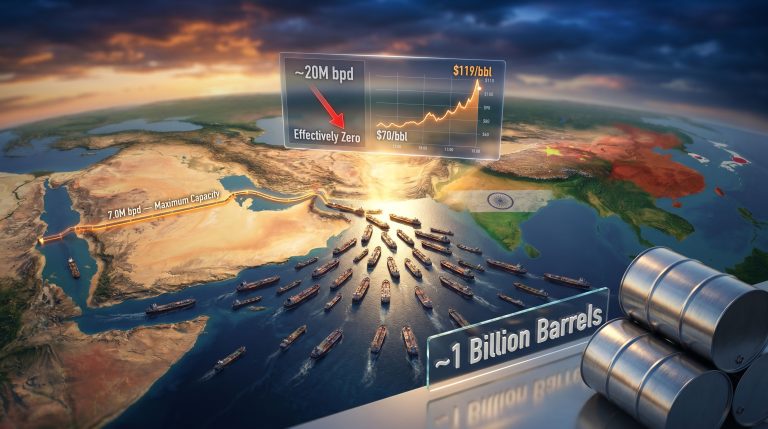
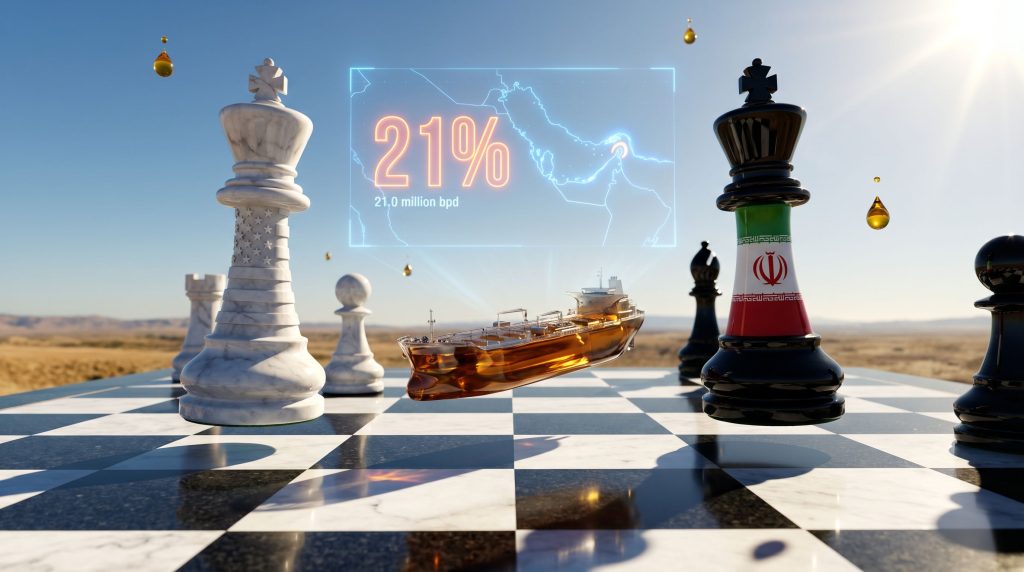
The Strait of Hormuz controls approximately 21% of global petroleum liquids transit, processing roughly 21 million barrels per day through its narrow shipping channels. This geometric constraint creates unique vulnerabilities that extend beyond simple supply disruption scenarios.
| Transit Category | Daily Volume | Global Share | Strategic Dependency |
|---|---|---|---|
| Crude Oil Transit | 21.0 million bpd | 21% | Critical |
| LNG Flows | 3.5 billion cubic feet | 25% | High |
| Regional Production Access | 18.5 million bpd | Saudi, UAE, Kuwait, Iraq | Essential |
Supply Flow Dependencies
Regional producers demonstrate varying degrees of Hormuz dependency, creating asymmetric vulnerabilities across different supply sources. Saudi Arabia exports approximately 7 million barrels per day, with significant portions requiring Hormuz transit despite alternative pipeline infrastructure. UAE production of 3 million barrels per day remains heavily Hormuz-dependent, while Kuwait's 2.5 million barrel daily exports lack sufficient alternative routing capacity.
Vessel Tracking and Enforcement
The strait narrows to approximately 34 kilometres at its most constrained point, reducing navigable shipping channels to 2-3 lanes in each direction. This geometric reality makes individual vessel tracking technically feasible whilst simultaneously increasing collision risks as naval presence intensifies.
Current blockade assessments indicate removal of approximately 10 million barrels per day from global supply, representing nearly 50% of typical Hormuz traffic. Additional disruption potential exists, with analytical estimates suggesting full blockade scenarios could eliminate another 2.3 million barrels per day.
Market Response and Pricing Dynamics
Oil market structures reveal sophisticated risk assessment mechanisms that distinguish between temporary policy-driven disruptions and permanent structural supply changes. Front-month Brent contracts traded at $99.39 per barrel on April 16, 2026, whilst 12-month forward positions remained stable in the $68-70 range.
Price Structure Analysis
The significant spread between immediate delivery contracts and deferred positions indicates markets expect near-term volatility with eventual stabilisation. This forward curve steepness reflects active pricing of elevated war premiums rather than fundamental scarcity beliefs.
- Front-month premiums: Elevated 15-20% above historical averages
- Deferred contract stability: Trading within normal volatility ranges
- Risk premium estimation: $10-20 above pre-conflict levels
- Volatility index: 300% above historical benchmarks
Natural Gas Market Resilience
Despite Middle Eastern supply disruptions, natural gas price forecast demonstrates remarkable stability through supply diversification and demand flexibility. Henry Hub prices retreated from above $7.40/MMBtu to $2.65/MMBtu, whilst European natural gas futures declined from €60+ to €42.42/MMBtu.
This resilience stems from multiple factors including enhanced U.S. LNG export capacity, European strategic storage adequacy, industrial fuel-switching capabilities, and alternative pipeline routing options that reduce chokepoint dependency.
China's Strategic Position in Energy Geopolitics
China's role as Iran's largest oil customer creates complex three-way dynamics that fundamentally differ from bilateral confrontation scenarios. The US-China trade war impact reveals how Chinese energy security needs often outweigh sanctions compliance concerns, particularly when discounted Iranian crude offers significant cost advantages.
Strategic Calculations
Chinese entities continue Iranian oil purchases despite secondary sanctions threats, viewing energy security as paramount to long-term economic stability. This approach creates opportunities for relationship building with Iran whilst simultaneously challenging U.S. sanctions effectiveness.
Analysis suggests China maintains stockpiled Iranian oil reserves that provide cushioning against supply disruption scenarios. These strategic inventories enable continued refinery operations even during peak enforcement periods, demonstrating sophisticated supply chain management approaches.
U.S. Response Framework
American counter-measures target Chinese compliance through multiple channels, including secondary sanctions on Chinese entities, diplomatic pressure through trade negotiations, technology export restrictions, and intelligence sharing limitations. However, enforcement effectiveness remains constrained by broader U.S.-China relationship management requirements.
The economic relationship complexity makes comprehensive sanctions enforcement challenging, as escalation risks extend beyond energy markets into technology transfer, manufacturing supply chains, and financial system integration.
Escalation and De-escalation Pathways
Multiple scenario pathways exist for conflict evolution, ranging from maritime incident escalation to comprehensive regional security architecture development. Analysis of U.S. blockade effectiveness suggests current measures achieve significant pressure whilst maintaining operational flexibility.
Maritime Incident Risks
Increased naval presence in confined waterways raises collision probability and creates unintended escalation triggers. Insurance markets already price these risks through elevated war premiums, reflecting institutional assessment that incident probability has increased substantially.
Current ceasefire agreements with proxy forces, including the May 2025 Houthis arrangement, provide temporary stability but remain vulnerable to broader conflict escalation.
Proxy Expansion Scenarios
Iran maintains capability to activate regional proxy forces, particularly targeting the Bab al-Mandeb strait through Houthi operations. Such activation would create second chokepoint crisis conditions, potentially doubling current oil market volatility whilst forcing additional shipping route diversification.
Cyber Warfare Implications
Both adversaries possess sophisticated cyber capabilities targeting energy infrastructure, trading systems, and refinery operations. Cyber attacks offer deniable escalation options that avoid direct military confrontation whilst creating significant supply disruption potential.
The next major ASX story will hit our subscribers first
Long-term Energy Security Implications
The U.S.-Iran oil conflict accelerates existing trends toward energy supply diversification, with consuming nations actively seeking alternatives to Middle Eastern sources. These shifts create permanent structural changes in global energy flows that will persist beyond current conflict resolution.
Supply Chain Diversification Trends
Investment patterns increasingly favour politically stable regions despite higher production costs. This security premium in capital allocation reflects lessons learnt from current crisis experiences and expectations of future geopolitical volatility.
- Western Hemisphere Focus: Enhanced investment in U.S., Canadian, and Brazilian production capacity
- African Alternative Development: Strengthened partnerships with Nigeria, Angola, and emerging producers
- Renewable Energy Acceleration: Crisis-driven investment in domestic energy independence capabilities
- Pipeline Infrastructure Expansion: Alternative routing development to reduce chokepoint dependency
Strategic Reserve Policy Evolution
Nations reassess strategic petroleum reserve adequacy, with many considering capacity expansions beyond current 90-day import coverage standards. Regional distribution improvements and coordination mechanisms gain strategic importance as supply chain vulnerabilities become apparent.
Investment Pattern Transformation
Energy investment frameworks incorporate geopolitical risk assessment more systematically, moving beyond traditional economic factors to include political stability metrics, sanctions risk exposure, and supply chain resilience considerations.
Capital Allocation Priorities
Energy security investments receive elevated priority compared to purely economic optimisation approaches. Furthermore, tariffs economic implications demonstrate how technology development focuses on strategic storage enhancement, alternative fuel development, shipping route diversification, and energy efficiency improvements that reduce import dependency.
Financial Market Evolution
New financial instruments emerge to address geopolitical risk management, including political risk insurance expansion, supply disruption derivatives, and energy security investment vehicles. These mechanisms provide market-based solutions for managing elevated uncertainty environments.
The development of standardised risk assessment frameworks enables more sophisticated pricing of geopolitical premiums across different energy assets and investment opportunities.
Strategic Implications for Global Energy Architecture
The transformation from military to economic warfare in energy geopolitics establishes precedents that will influence future conflict management strategies. Success metrics shift from traditional battlefield assessments to economic pressure effectiveness and market stability maintenance capabilities.
This paradigm evolution normalises economic warfare as the preferred mechanism for addressing energy security challenges, potentially reducing armed conflict risks whilst creating new categories of economic vulnerability and resilience requirements.
Market Stability Indicators
Key monitoring frameworks include oil price volatility patterns, forward curve structure analysis, Chinese sanctions compliance trends, regional proxy activity levels, and international diplomatic engagement effectiveness. Strategic petroleum reserve utilisation rates provide additional insight into crisis management capabilities.
The resolution of current tensions will significantly influence global energy investment patterns, supply chain strategies, and international cooperation frameworks for decades to come. Economic warfare effectiveness in achieving strategic objectives without conventional military engagement may reshape fundamental approaches to international conflict resolution.
Future Scenario Planning
Energy market participants must develop sophisticated scenario planning capabilities that account for rapid policy shifts, technological disruption potential, and evolving geopolitical alliance structures. Traditional supply-demand analysis requires integration with political risk assessment and strategic relationship mapping to generate accurate market forecasts.
The emergence of economic warfare as primary strategic tool necessitates enhanced cooperation between financial institutions, energy companies, and government agencies to manage systemic risks whilst maintaining market functionality during extended crisis periods. However, US tariffs & inflation considerations suggest additional complexity in managing global economic relationships during periods of elevated geopolitical tension.
Moreover, OPEC oil production impact analysis reveals how multilateral coordination becomes increasingly critical when traditional supply mechanisms face disruption through economic warfare approaches. The Congressional analysis framework provides institutional perspective on how legislative oversight adapts to these evolving strategic paradigms.
Looking to Navigate Energy Market Volatility?
Discovery Alert's proprietary Discovery IQ model delivers real-time alerts on significant ASX mineral discoveries, helping investors identify actionable opportunities during periods of geopolitical uncertainty and market volatility. Explore how major mineral discoveries have historically provided substantial returns for investors who positioned themselves ahead of market shifts, and begin your 14-day free trial to gain strategic market advantages during these turbulent energy market conditions.