May 12, 2026
The Billion-Barrel Hole: Why Global Oil Markets Face a Long Road Back From the Hormuz Shock
Few stress tests in modern energy history have exposed the fragility of global supply architecture as completely as a major chokepoint closure. Aramco sees slow oil market recovery after the Strait of Hormuz supply shock, and the world's oil market is not a flexible, self-correcting system that bounces back the moment a blockage is removed. It is a deeply interconnected network of tanker routes, refinery contracts, storage facilities, and forward purchasing agreements, where a sustained interruption at a single point can hollow out months of carefully accumulated inventory.
The 2026 Strait of Hormuz disruption is precisely that kind of event, and the consensus forming among the world's most senior energy executives points to one sobering conclusion: reopening the shipping lane is only the beginning of a much longer recovery process. Furthermore, understanding crude oil price volatility helps contextualise just how severe the market distortion has become.
When big ASX news breaks, our subscribers know first
The Scale of What Has Already Been Lost
To understand why analysts and major oil company executives are warning about a multi-month recovery timeline, it is necessary to first grasp the sheer magnitude of the supply that has vanished from global markets since late February 2026.
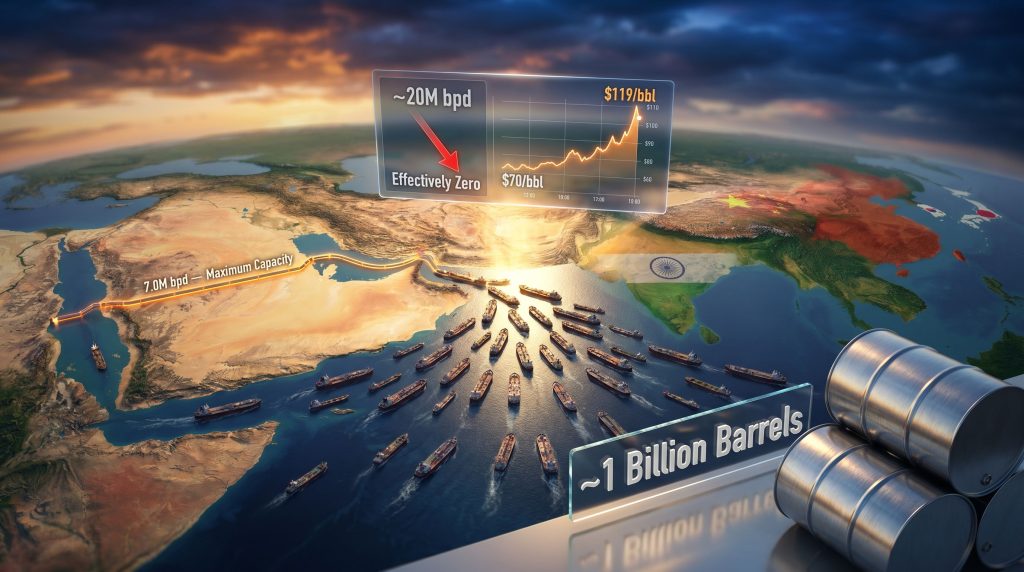
The Strait of Hormuz carries approximately 20 million barrels of oil per day under normal operating conditions, representing close to 20% of all oil traded globally. It is also a critical corridor for liquefied natural gas shipments bound for Asia. When the blockade took effect following U.S. and Israeli military operations against Iran, that flow did not slow down gradually. It effectively stopped.
Over the roughly two and a half months that followed, the cumulative supply loss reached an estimated 1 billion barrels, a figure that Saudi Aramco CEO Amin Nasser described to Reuters as the defining challenge for market recovery. Nasser's message was direct: restoring access to a shipping lane and restoring the oil that was never produced or delivered are entirely different problems. The route can be reopened by a diplomatic agreement. The missing barrels cannot be retroactively created.
Key Crisis Metrics at a Glance
| Metric | Pre-Crisis Baseline | Crisis Period |
|---|---|---|
| Strait of Hormuz daily oil throughput | ~20M bpd | Effectively zero |
| Cumulative supply loss (2.5 months) | — | ~1 billion barrels |
| Brent Crude (late February 2026) | ~$70/bbl | Peak: $119/bbl |
| Aramco East-West Pipeline capacity | ~2.8M bpd | 7.0M bpd (maximum) |
| Aramco Q1 2026 net profit | Q1 2025 baseline | $32.5B (+25% YoY) |
| Global inventory drawdown rate | — | 10–13M bpd |
| OPEC collective output | Multi-year norm | 26-year low |
| Inventory level | — | 5-year seasonal low |
Disclaimer: Price figures, profit data, and supply estimates cited throughout this article are drawn from executive statements, Reuters reporting, and OilPrice.com coverage as of May 2026. All forward-looking assessments reflect current analyst and executive projections, not guaranteed outcomes.
Why the Strait of Hormuz Has No Real Alternative
The geography of the Persian Gulf creates a structural vulnerability that cannot be engineered away. The Strait of Hormuz is a narrow passage roughly 33 kilometres wide at its most constrained navigable point, and it forms the only maritime exit from a basin that holds some of the most prolific oil-producing territories on earth. Saudi Arabia, Iraq, Kuwait, the UAE, Qatar, and Bahrain all depend on this single corridor for the majority of their seaborne exports.
The pipelines and overland routes that exist as alternatives are instructive precisely because of their limitations. Saudi Aramco's East-West Pipeline, a 750-mile overland corridor connecting Persian Gulf production fields to the Red Sea terminal at Yanbu, represents the most significant bypass infrastructure in the region. Under normal conditions it moves approximately 2.8 million barrels per day. During the crisis, Aramco scaled it to its absolute maximum rated capacity of 7.0 million bpd, a significant operational achievement, but one that covers only around 70% of pre-war Saudi export volumes. The remaining 30% has no comparable rerouting option.
Beyond Saudi Arabia's pipeline, the alternatives are even more constrained:
- Pakistan opened six overland land corridors through Iranian territory as regional importers scrambled for viable supply paths
- U.S. fuel exports reached record highs as American producers filled some of the void traditionally served by Gulf exporters
- Japan received its first cargo of Central Asian crude since the conflict began, representing a significant but small-volume diversification
- South Korea recorded only one successful tanker transit through the Strait in the weeks following the initial closure, underscoring how rare such passages had become
None of these channels comes close to replacing the 20 million barrels per day that moved through Hormuz daily before the conflict. In addition, the LNG supply outlook remains deeply uncertain for Asian importers facing structural dependence on Gulf corridors.
Alternative Route Comparison
| Route or Source | Effective Capacity | Key Limitation |
|---|---|---|
| Aramco East-West Pipeline (Yanbu) | 7.0M bpd at maximum | Covers ~70% of Saudi pre-war exports only |
| Pakistan-Iran overland corridors | 6 corridors operational | Limited throughput; geopolitical complexity |
| U.S. fuel exports | Record high volumes | Distance logistics; grade mismatch |
| Central Asian crude (alternative routing) | Small volumes | Long transit times; minimal scale |
| Canadian oil sands expansion | Pipeline-constrained | Infrastructure timeline measured in years |
Aramco's Q1 2026 Earnings: Record Profits, Hidden Limits
Saudi Aramco's first-quarter 2026 results presented what appears on the surface to be a paradox. The company reported a net profit of $32.5 billion, a 25% year-on-year increase, even as the waterway that handles the majority of regional oil exports remained effectively closed.
The explanation lies in price arithmetic. Brent crude's surge from roughly $70 per barrel in late February 2026 to a peak exceeding $119 per barrel dramatically expanded revenue per barrel exported, more than offsetting the volume constraint imposed by the Hormuz closure. Aramco's ability to reroute exports through the East-West Pipeline to Yanbu kept substantial volumes moving to international customers, and the elevated price environment turned reduced output into record earnings.
Amin Nasser described the pipeline rerouting as a demonstration of critical operational flexibility, allowing Aramco to provide meaningful relief to customers who would otherwise have faced total supply interruption. However, the same statement contains an important admission: the pipeline is now operating at its absolute maximum rated capacity of 7.0 million bpd. There is no further headroom. Any additional volumes that cannot move through Hormuz simply cannot move.
A drone strike on the Ras Tanura refinery complex added further complexity to Aramco's operational picture during the quarter, with partial restart timelines creating additional uncertainty around domestic refining capacity and downstream product availability.
The record profits also highlight a tension that is increasingly visible across the major integrated oil companies. Supermajors facing investor pressure to maintain dividends and buyback programmes are structurally reluctant to redirect capital toward emergency output expansion, even during a geopolitical supply crisis. This is a longer-cycle capital discipline problem with no fast resolution.
Three Structural Reasons Recovery Takes Months, Not Weeks
Shell CEO Wael Sawan described the cumulative supply deficit during his company's first-quarter 2026 earnings call as "a hole of close to 1 billion barrels", comprising both barrels locked in transit and volumes that were simply never extracted during the closure period. He characterised the return to market balance as "a long journey." That framing reflects a structural reality with three distinct components.
1. Lost and Unproduced Barrels Are Permanent
Every barrel that was either stranded in a vessel unable to transit the Strait, or that was never pumped from the ground due to force majeure declarations across UAE, Kuwait, and Iraq, represents a permanent withdrawal from the global supply balance. These barrels cannot be retroactively produced once the Strait reopens. The deficit is a historical fact, and replenishing it requires sustained above-normal production over an extended period, which itself assumes that production capacity was not damaged during the conflict.
2. Inventory Buffers Are Near Exhaustion
TotalEnergies CEO Patrick Pouyanné confirmed during his company's earnings call that global hydrocarbon inventories were being drawn down at a rate of 10 to 13 million barrels per day to sustain market function during the closure. At that rate of depletion, stockpiles across key consuming regions have fallen to 5-year seasonal lows, and Morgan Stanley analysts have warned that these oil buffers could run out before the Strait even reopens.
Strategic petroleum reserves, designed to cover disruptions of up to 90 days under standard IEA protocols, are being depleted at rates that compress effective coverage windows far below that threshold.
3. The Physical Logistics of Resumption Take Weeks Alone
ExxonMobil CEO Darren Woods made explicit during his first-quarter earnings call that even if the Strait were to open unconditionally today, markets should expect a one-to-two month lag before normalised tanker flows resume. This lag reflects the physical reality of maritime logistics: vessel queues must clear, port congestion must resolve, insurance coverage must be reinstated for Hormuz-adjacent routes, and tanker operators who have been running vessels dark to exit the Strait must resume standard operations.
Taken together, the three factors mean that a diplomatic resolution, while necessary, is far from sufficient for market normalisation. Full inventory replenishment would require several additional months beyond the initial tanker flow recovery window.
What Major Oil Executives Have Communicated
| Executive | Company | Core Assessment |
|---|---|---|
| Amin Nasser | Saudi Aramco | Route reopening is distinct from rebalancing a market deprived of 1 billion barrels |
| Wael Sawan | Shell | Characterised the supply deficit as a deepening hole; described recovery as a long journey |
| Darren Woods | ExxonMobil | Projected a one-to-two month lag between Strait reopening and normalised flow |
| Patrick Pouyanné | TotalEnergies | Confirmed inventory drawdown at 10-13M bpd; noted the anticipated 2026 supply surplus has been entirely eliminated |
The Cascade of Consequences Across Global Markets
The Hormuz supply shock has not been contained within crude oil markets. Consequently, its effects have propagated across energy sectors and broader economies with particular severity in Asia-Pacific importing nations.
Regional stress points:
- India faces the most acute near-term pressure, with more than 40 India-bound vessels reported stranded near the Strait; Prime Minister Modi urged citizens to conserve fuel as inflation accelerated
- Japan's emergency procurement of Central Asian crude marks a significant shift in sourcing strategy, though volumes remain small relative to the country's structural dependence on Middle Eastern oil
- South Korea recorded only one successful tanker transit through the Strait, highlighting how isolated successful passages have become
- China is experiencing rising consumer price index pressure as energy costs escalate, with car sales declining as gasoline demand contracts among price-sensitive consumers
Sector spillovers beyond crude:
- LNG markets face tight supply through at least 2030 according to IEA projections, with Asian supply chains significantly disrupted
- Petrochemical and plastics manufacturing across Asia is confronting input shortages as feedstock availability collapses
- Global jet fuel exports reached a 10-year seasonal low in April, prompting European regulators to debate compensation obligations for fuel-related flight cancellations
- Agricultural and food supply chains face elevated input cost pressure through energy-intensive logistics and fertiliser production
- The shipping insurance market has effectively seized up for Hormuz-adjacent routes, with tanker operators running vessels dark to exit the waterway
The next major ASX story will hit our subscribers first
Geopolitical Variables and the Three Scenario Framework
The single most important determinant of market recovery speed is not infrastructure or inventory, but geopolitics. As of early May 2026, U.S. President Donald Trump publicly rejected Iran's response to a U.S.-drafted peace proposal, pushing oil prices sharply higher and extending uncertainty over the timeline for any Strait reopening. These oil market disruption impacts have reverberated well beyond crude, touching financial markets and trade flows across multiple continents.
A Reuters survey conducted during this period identified OPEC collective output at its lowest level in 26 years, a figure that reflects both the war-related disruptions across multiple member states and pre-existing production adjustments of approximately 2.5 million bpd that were already in place before the conflict began. Understanding OPEC's market influence is therefore essential to assessing when meaningful supply relief might materialise.
Three Resolution Scenarios and Their Market Implications
| Scenario | Hormuz Status | Estimated Market Stabilisation |
|---|---|---|
| Rapid Diplomatic Resolution | Reopens within 30 days | 2-3 months for normalised flows; 6+ months for full inventory rebuild |
| Protracted Stalemate | Remains closed 90-180 days | Strategic reserve depletion; structural price floor reset; severe Asian economic stress |
| Partial or Contested Reopening | Limited, intermittent access | Sustained price volatility; insurance and shipping paralysis continues |
The protracted stalemate scenario carries the most severe structural risks, particularly for Asian economies where import dependency ratios leave limited margin for sustained supply constraint.
What This Crisis Has Revealed About Energy Security Architecture
The Hormuz disruption has functioned as a live stress test of assumptions that underpinned decades of global energy trade design. The dominant model, built on just-in-time logistics, lean inventory management, and geographic concentration of supply, proved deeply vulnerable once its single most critical node was removed.
Several structural weaknesses have been brought into sharp relief:
- Chokepoint concentration risk: No engineering solution exists that can replicate the throughput of a major maritime passage on short notice. Pipelines, overland routes, and alternative sea lanes each carry capacity constraints that are orders of magnitude below the disrupted flow
- Strategic reserve adequacy: Reserves designed for 90-day coverage at normal drawdown rates are being depleted at rates that compress effective protection windows significantly, as confirmed by the 10-13 million bpd drawdown rate
- Supermajor capital allocation: The reluctance of major integrated producers to prioritise output expansion over shareholder returns during a geopolitical supply emergency exposes a structural misalignment between short-cycle capital discipline and long-cycle energy security requirements
- Spare capacity geography: The concentration of the world's swing production capacity within the Persian Gulf region means that the producers best positioned to mitigate a Hormuz closure are also the ones most directly constrained by it
The IEA's assessment that tight gas markets will persist through 2030 suggests the energy security implications of this crisis will extend well beyond the immediate crude oil supply disruption. For further context on how supply shocks translate into price action, the oil price crash dynamics of prior episodes offer instructive parallels.
Frequently Asked Questions
How much oil flows through the Strait of Hormuz each day?
Approximately 20 million barrels per day, representing close to 20% of all oil traded globally, moved through the Strait under pre-crisis conditions. A significant volume of LNG shipments also transits the same corridor, making it the world's single most consequential energy chokepoint.
How long will it take for oil markets to recover after the Strait reopens?
Based on executive assessments from Aramco, Shell, ExxonMobil, and TotalEnergies, markets should expect a minimum one-to-two month lag between route reopening and normalised tanker flows. Full inventory replenishment will likely require several additional months given the estimated 1 billion barrel cumulative supply deficit. As reported by Reuters, Aramco sees slow oil market recovery extending potentially into 2027 under certain scenarios.
Why can't Saudi Arabia simply increase output to replace the lost supply?
Aramco's East-West Pipeline is already running at its maximum rated capacity of 7.0 million bpd, covering approximately 70% of pre-war export volumes. There is no further infrastructure headroom, and the barrels that were stranded or never produced during the closure period cannot be retroactively replaced.
What is happening to global oil inventories during the crisis?
Global hydrocarbon inventories are being drawn down at an estimated 10 to 13 million barrels per day to sustain market function, with stockpiles at 5-year seasonal lows across key consuming regions. Morgan Stanley has warned that these buffers could be exhausted before the Strait reopens.
Which countries are most affected by the Hormuz disruption?
Asian economies, particularly India, Japan, South Korea, and China, face the most severe constraints given their structural dependence on Middle Eastern crude. India has implemented active fuel conservation measures. Japan and South Korea are pursuing emergency alternative sourcing arrangements.
How have oil prices moved during the crisis?
Brent crude rose from approximately $70 per barrel in late February 2026 to a peak exceeding $119 per barrel before settling in the $92 to $104 range by mid-May 2026, representing a year-to-date increase of approximately 55%.
Key Indicators to Watch as the Crisis Evolves
For investors and market observers tracking the pace of recovery, the following signals carry the highest forward-looking significance:
- Progress or absence of U.S.-Iran diplomatic engagement, which remains the single most important variable for Strait reopening
- Weekly tanker transit data through the Strait, which functions as the most reliable leading indicator of any reopening
- Global inventory drawdown rates relative to strategic reserve thresholds, which determine how much time markets have before buffer capacity is exhausted
- OPEC production decisions and any emergency output waivers that might partially offset the supply deficit
- Demand destruction signals from major Asian importing economies, where sustained high prices are already beginning to suppress consumption
The arithmetic of the situation is stark. A billion-barrel hole takes a long time to fill, regardless of when the Strait reopens. The executives overseeing the world's largest oil producers are not signalling optimism, and the structural conditions that created this vulnerability have not changed. Aramco sees slow oil market recovery as already underway, and the assessment is not a forecast to be debated — it is an observable reality unfolding in real time across tanker queues, inventory reports, and price curves worldwide.
Want to Stay Ahead of the Market Shifts Driving the Next Wave of Commodity Discoveries?
While global oil markets grapple with a billion-barrel supply deficit and a multi-month recovery horizon, Discovery Alert's proprietary Discovery IQ model scans ASX announcements in real time, delivering instant alerts on significant mineral discoveries across more than 30 commodities — turning complex market signals into actionable investment opportunities before the broader market reacts. Explore how historic discoveries have generated substantial returns and begin your 14-day free trial today to position yourself ahead of the next major find.