August 7, 2026
The Quiet Revolution Reshaping Iron Ore Trade Flows
For most of the past two decades, the global iron ore trade has operated within a remarkably stable duopoly. Australia and Brazil supplied the world's steel mills with a reliability that made their combined 78% market share feel almost structural in nature. However, concentrated supply hierarchies in commodity markets rarely stay undisturbed forever. When a new entrant finally arrives, it tends to carry not just volume, but a different set of rules entirely.
The Simandou iron ore shipments record represents precisely this kind of inflection point. What began as one of the most anticipated, delayed, and debated resource projects in modern mining history is now generating monthly shipment records and systematically challenging assumptions about where China iron ore demand will be met through the rest of this decade.
When big ASX news breaks, our subscribers know first
Breaking Down the April 2026 Shipment Record
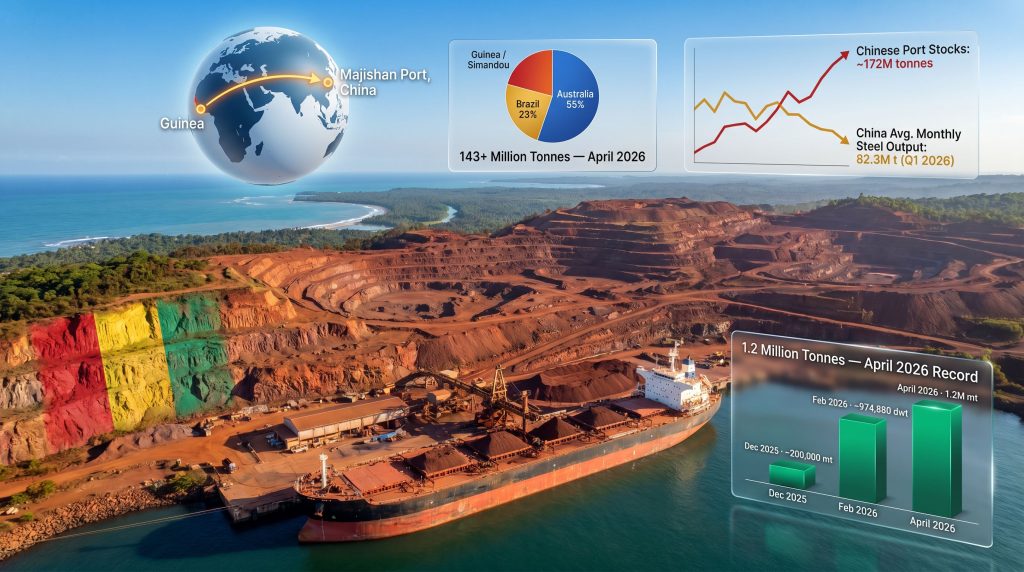
The 1.2 million tonnes exported from Simandou in April 2026 marked the highest single-month volume recorded since the project's commercial operations began in late 2025, according to reporting from Brasil Mineral (May 11, 2026). To appreciate the significance of that figure, it helps to trace the acceleration from day one.
The project's first commercial cargo departed Guinea's Morebaya port on December 2, 2025, aboard the vessel Winning Youth, carrying approximately 200,000 tonnes bound for China's Majishan port. The voyage took roughly 46 days, arriving in January 2026. By early February, five vessels had collectively loaded approximately 974,880 deadweight tonnes, approaching the cumulative one-million-tonne threshold ahead of schedule.
The ramp-up trajectory, placed in context, is striking:
| Period | Key Event | Volume |
|---|---|---|
| December 2025 | First commercial shipment (Winning Youth) | ~200,000 mt |
| January to February 2026 | Five vessels collectively loaded | ~974,880 dwt |
| April 2026 | Monthly record established | 1.2 million mt |
| Full optimisation (projected) | Both consortia at capacity | ~120 million mt/year |
At full operational capacity across both the SimFer and Winning consortia, Simandou is engineered to export approximately 10 million tonnes per month, or 120 million tonnes annually. April's record therefore represents roughly 12% of that ceiling, suggesting the ramp-up is tracking faster than many commodity analysts had modelled.
Infrastructure constraints remain a meaningful caveat. Port construction at the Winning Consortium terminal and SimFer's dedicated facility were both still in active development as of May 2026, meaning rail throughput and loading capacity, rather than mining production itself, may be the binding constraints on near-term volume growth.
Furthermore, according to reporting on Simandou's shipments, iron ore exports from Guinea surpassed one million tonnes earlier than many market participants had anticipated, underscoring the pace of the project's commercial acceleration.
April 2026 in the Context of Global Iron Ore Flows
Simandou's milestone did not occur in isolation. According to Brasil Mineral (May 11, 2026), global iron ore flows exceeded 143 million tonnes in April 2026, representing growth of just under 7% year-on-year and a near-identical 7% month-on-month increase. This dual-directional consistency suggests the growth is structural rather than driven by calendar effects or seasonal shipping patterns.
China's position within that flow remained dominant but unchanged in proportional terms. The China steel and iron ore market continues to define global commodity dynamics, as the figures below confirm:
| Destination | April 2026 Volume | Share of Global Flow | YoY Change |
|---|---|---|---|
| China | ~105.8 million mt | ~74% | +7 million mt absolute |
| East and Southeast Asia (ex-China) | ~37 million mt | ~26% | +5% YoY |
While China's 74% share held steady relative to April 2025, the larger overall volume base meant it absorbed over 7 million additional tonnes in absolute terms compared to the prior year. East Asian and Southeast Asian nations outside China posted the strongest percentage growth among all non-Chinese import destinations.
On the supply side, the origin breakdown remained consistent with multi-year averages, as reported by Brasil Mineral (May 11, 2026):
- Australia: 55% of global flows, in line with its long-run average since 2022
- Brazil: 23% of global flows, also consistent with its multi-year norm
- Guinea (Simandou): Emerging as the most consequential structural entrant in the supply hierarchy
The combined Australian and Brazilian share of approximately 78% leaves around 31.5 million tonnes per month originating from other geographies, a segment that Simandou is now actively beginning to contest.
Why Simandou's Ore Is Not Just Another Tonne of Iron
The Grade Advantage and Its Industrial Consequences
Not all iron ore is functionally equivalent in a steel mill. Simandou's ore grades at approximately 65% iron (Fe), placing it among the highest-grade iron ore deposits in commercial production globally. This distinction carries meaningful downstream consequences that extend well beyond simple quality comparisons.
Higher-grade feedstock requires less coking coal per tonne of finished steel, produces lower volumes of slag, and generates fewer carbon emissions per unit of output. In an era where Chinese steelmakers face tightening environmental compliance benchmarks, the difference between 62% Fe ore and 65% Fe ore translates directly into measurable cost and regulatory exposure.
Brasil Mineral (May 11, 2026) notes that Australian lower-grade exports face structural cost and emissions disadvantages as Chinese steel producers navigate stricter environmental targets. This is not a near-term trading dynamic but a multi-year structural pressure point that will intensify as China's industrial decarbonisation agenda advances. In addition, the iron ore surplus risks created by growing Simandou volumes could compound price pressure on lower-grade material from incumbent suppliers.
Ownership Architecture and Strategic Integration
Simandou's ownership structure distinguishes it from any comparable iron ore project in recent history. The operation is divided between two consortia:
- SimFer (Blocks 3 and 4): Rio Tinto holds a majority stake; estimated reserves of approximately 1.5 billion tonnes (Brasil Mineral, May 11, 2026)
- Winning Consortium (Blocks 1 and 2): Backed by Chinese capital, creating direct supply chain alignment between the mine and Chinese steel producers
The first Simandou cargo was received by China Baowu Steel Group, the world's largest steelmaker by volume, confirming that the project's highest-priority offtake relationships are already active and operating at the most senior levels of China's steel industry (Brasil Mineral, May 11, 2026).
Simandou is not simply a new source of iron ore competing on the spot market. Its partial Chinese ownership creates a vertically integrated supply instrument designed to reduce China's reliance on suppliers who operate independently of its industrial policy objectives, an arrangement with no equivalent precedent in Australian or Brazilian iron ore exports.
This ownership dynamic also means that as Simandou's volumes grow, the substitution of Australian supply may not be purely price-driven. Strategic supply chain preferences, embedded through ownership and offtake agreements, could accelerate the shift even in periods when Australian ore is price-competitive on the spot market.
China's Iron Ore Paradox: Buying More, Using Less
Perhaps the most important and least widely understood dynamic in the current iron ore market is the divergence between rising import volumes into China and declining domestic steel production. Understanding this gap is critical for evaluating the true demand environment into which Simandou's growing volumes are being delivered.
According to Brasil Mineral (May 11, 2026), Chinese port iron ore inventories reached approximately 172 million tonnes in the final week of April 2026, compared to roughly 139 million tonnes during the same period in 2025. This represents a year-on-year increase of approximately 33 million tonnes, or 24%, in port-held stock.
The picture sharpens further when inventory is measured in terms of consumption coverage:
| Period | Avg. Monthly Steel Output | Port Iron Ore Stocks | Implied Days of Supply |
|---|---|---|---|
| Q1 2025 | 86.4 million mt/month | ~139 million mt | ~30 days |
| Q1 2026 | 82.3 million mt/month | ~172 million mt | ~39 days |
The implied days of supply increased from 30 to 39 days, a 30% expansion in inventory coverage relative to actual consumption, during a period when steel production was simultaneously declining. Crude steel output has followed a structural downward trajectory since 2021, and Q1 2026's average of 82.3 million tonnes per month represents a further decline from Q1 2025's 86.4 million tonnes (Brasil Mineral, May 11, 2026).
The inventory paradox is clear: China is importing more iron ore into a system that is producing less steel. This dynamic reflects import momentum and supply-side growth rather than genuine downstream demand recovery, and it carries a direct implication for future pricing and flow volumes.
The practical consequence is that port stocks at historically elevated levels create a natural brake on future import demand. Mills with 39 days of ore coverage on the dock have limited incentive to continue purchasing at current rates, particularly when finished steel demand remains subdued. A contraction in Chinese iron ore purchasing appetite is, as Brasil Mineral (May 11, 2026) concludes, the most probable near-term outcome.
Which Producers Face the Greatest Structural Risk?
Australia's Exposure Is Disproportionate
Australia's iron ore dominance — built on a 55% share of global iron ore flows — makes it the single largest origin market by a significant margin. However, scale creates concentration risk when the buyer representing the vast majority of demand begins to redirect purchasing preferences toward higher-grade alternatives with embedded supply chain relationships.
The structural vulnerability is multi-layered:
- The majority of Australia's export volumes are lower-grade relative to Simandou's 65% Fe benchmark
- Chinese environmental compliance requirements are progressively increasing the cost disadvantage of processing lower-grade ore
- The Winning Consortium's Chinese ownership creates non-price preferential purchasing dynamics that Australian producers cannot replicate through competitive pricing alone
- Any pullback in Chinese aggregate import volumes, which the port inventory data strongly signals, is disproportionately likely to affect Australian lower-grade material first
Brasil Mineral (May 11, 2026) states directly that Australia is likely to be the most affected origin if Simandou's high-grade material displaces lower-quality supply from China's import mix. This is a structural assessment, not a cyclical one.
Brazil's Relative Positioning
Brazil occupies a more defensible position due to the grade characteristics of its primary export products. Vale's Carajás-grade material, which carries high iron content comparable in premium positioning to Simandou ore, provides a degree of natural insulation from direct substitution pressure.
Brazil's 23% market share combined with higher-grade positioning means it competes in a different segment of the Chinese import market than the bulk of Australian supply.
Hypothetical Displacement Scenario
If Simandou reaches its projected 120 million tonne annual capacity and Chinese total iron ore imports remain broadly flat at approximately 1.26 billion tonnes per year, a direct substitution of lower-grade material could theoretically displace 8 to 10% of Australia's current export volumes. This would constitute a structural, not cyclical, market share loss for Australian iron ore producers.
Disclaimer: This scenario analysis is speculative and dependent on multiple variables including Chinese steel demand trajectories, Simandou ramp-up pace, and price dynamics across ore grades. It should not be interpreted as a forecast.
The next major ASX story will hit our subscribers first
The Freight Market Multiplier Effect
One of the least appreciated dimensions of the Simandou iron ore shipments record is its impact on global bulk freight markets, specifically Capesize vessels. The mathematics of voyage distance create a structural multiplier that benefits freight operators even if total iron ore tonnages remain constant.
The Guinea-to-China voyage covers approximately 46 days, compared to 10 to 14 days for Australia-to-China routes and 35 to 40 days for Brazil-to-China voyages. When measured in tonne-miles, the metric that fundamentally drives vessel utilisation and freight rates, each tonne shipped from Guinea generates substantially more demand than an equivalent tonne shipped from Western Australia.
At full Simandou capacity of 120 million tonnes per year, sustaining that flow would require approximately 693 Capesize voyages annually, roughly two vessel loadings per day. Even at current volumes, the incremental tonne-mile demand created by Simandou shipments is visible in Capesize utilisation data.
Guinea's existing bauxite export sector already generates robust Capesize demand in the region, meaning that expanding iron ore volumes would layer onto an established freight infrastructure. Brasil Mineral (May 11, 2026) notes that West African Capesize demand appears positioned for continued structural support as the project approaches Q3 2026, with bauxite and iron ore flows reinforcing each other in the same shipping lanes.
A partial substitution of Australian iron ore with Simandou supply, even at equivalent tonnage, would generate materially higher tonne-mile demand due to the extended voyage distance. This creates a structural freight rate tailwind for Capesize operators that operates independently of total iron ore volume growth.
Consequently, the broader implications for iron ore trade flows extend well beyond the mine gate, reshaping logistics chains and shipping economics simultaneously. Furthermore, as analysts at S&P Global have noted, Simandou's shipments signal a major industry shift in how iron ore trade routes are structured globally.
The Road Ahead: Key Variables for the Rest of 2026
Brasil Mineral (May 11, 2026) projects that Simandou will export between 18 and 20 million tonnes across full-year 2026, a fraction of its eventual annual ceiling but a volume already large enough to influence market structure at the margins.
The variables most likely to determine how these dynamics play out through the second half of 2026 include:
- Chinese steel demand recovery: Any sustained rebound in downstream construction or manufacturing activity would absorb both Simandou volumes and existing Australian and Brazilian supply without forcing displacement, changing the calculus significantly
- Infrastructure ramp-up pace: Port construction timelines at both the WCS terminal and SimFer's dedicated facility will constrain how quickly monthly volumes can move from 1.2 million tonnes toward the 10 million tonne monthly ceiling
- Chinese environmental policy acceleration: Tighter industrial emissions targets would amplify the premium commanded by high-grade ore, increasing the structural pressure on lower-grade Australian exports
- Capesize freight rate signals: Rate movements in the Capesize segment will function as a real-time proxy for the geographic rebalancing of iron ore trade flows, as substitution of Australian with West African volumes translates directly into tonne-mile expansion
- Port inventory drawdown pace: A normalisation of the 39-day inventory coverage figure back toward 30 days would indicate genuine demand recovery and would reduce near-term price and volume pressure
Global Iron Ore Flows: April 2026 Summary Statistics
| Metric | Value | Context |
|---|---|---|
| Simandou April 2026 exports | 1.2 million mt | Monthly record since December 2025 start |
| Global iron ore flows (April 2026) | 143+ million mt | +7% YoY and month-on-month |
| China's share of global flows | ~74% | Consistent with April 2025 |
| China's incremental April imports vs. 2025 | +7 million mt | Absolute volume increase |
| Chinese port iron ore stocks (late April 2026) | ~172 million mt | vs. ~139 mt in April 2025 |
| Implied days of port supply (Q1 2026) | 39 days | Up from 30 days in Q1 2025 |
| China Q1 2026 avg. monthly steel output | 82.3 million mt/month | Down from 86.4 mt in Q1 2025 |
| Simandou 2026 full-year export projection | 18 to 20 million mt | En route to 120 mt/year ceiling |
| Simandou full-capacity monthly output | ~10 million mt/month | ~693 Capesize voyages/year required |
| Australia's share of global iron ore flows | 55% | Long-run average since 2022 |
| Brazil's share of global iron ore flows | 23% | Long-run average since 2022 |
Frequently Asked Questions
What was the Simandou iron ore shipment record set in April 2026?
Simandou exported 1.2 million tonnes of iron ore in April 2026, the highest monthly volume recorded since commercial operations commenced in December 2025, according to Brasil Mineral (May 11, 2026).
When did Simandou's first iron ore shipment depart?
The inaugural commercial cargo departed Guinea's Morebaya port on December 2, 2025, aboard the vessel Winning Youth, completing a 46-day voyage to China's Majishan port in January 2026.
What is Simandou's maximum production capacity?
At full operational optimisation across both the SimFer and Winning consortia, Simandou is designed to produce approximately 120 million tonnes per year, equivalent to roughly 10 million tonnes per month.
Why are Chinese iron ore port inventories rising if steel production is falling?
Chinese port iron ore stocks reached approximately 172 million tonnes in late April 2026, up from around 139 million tonnes a year earlier, while crude steel production declined from an average of 86.4 million tonnes per month in Q1 2025 to 82.3 million tonnes per month in Q1 2026. This divergence reflects import momentum and supply-side growth rather than genuine downstream demand, pointing toward future downward pressure on Chinese purchasing volumes (Brasil Mineral, May 11, 2026).
How does Simandou's iron ore grade compare to Australian supply?
Simandou ore grades at approximately 65% Fe, which is higher than the majority of Australian iron ore exports. This grade advantage reduces processing costs and carbon emissions per tonne of finished steel, making Simandou increasingly attractive as Chinese steelmakers face tighter environmental compliance requirements.
What impact could Simandou have on Capesize freight rates?
The Guinea-to-China voyage takes approximately 46 days, compared to 10 to 14 days from Australia. This extended distance generates significantly more tonne-mile demand per cargo, providing structural support for Capesize freight rates as Simandou volumes grow, even if total iron ore tonnages remain stable. Moreover, Guinea's Simandou project could reshape the global green steel market by directing high-grade feedstock to producers seeking lower-emissions pathways.
Disclaimer: This article contains forward-looking statements, market projections, and scenario analyses derived from publicly available reporting. All projections are inherently speculative and subject to change based on market conditions, infrastructure developments, and policy shifts. This content is intended for informational purposes only and does not constitute financial, investment, or trading advice.
Want to Know Which ASX Mineral Discoveries Could Deliver the Next Major Market Return?
As global iron ore trade flows reshape and new commodity dynamics emerge, Discovery Alert's proprietary Discovery IQ model delivers real-time alerts on significant ASX mineral discoveries, instantly translating complex mineral data into actionable investment insights for both short-term traders and long-term investors. Explore historic discovery returns on Discovery Alert's dedicated discoveries page and begin your 14-day free trial to position yourself ahead of the next major market shift.