
May 31, 2026
The Ancient Terrain That Modern Gold Explorers Are Racing to Rediscover
Long before modern drilling rigs and satellite imagery, ancient civilisations were already extracting gold from the rocks of northeastern Africa. The pharaohs of Egypt drew enormous wealth from the Eastern Desert's Precambrian basement, leaving behind thousands of ancient mine workings that still dot the landscape today. Yet despite this millennia-long mining heritage, the region remains one of the least systematically explored gold provinces on earth when measured against its known geological endowment. That paradox is now attracting the attention of international mining operators, exploration geologists, and institutional investors who recognise that the tools available in the 21st century are fundamentally different from anything previously applied to this terrain.
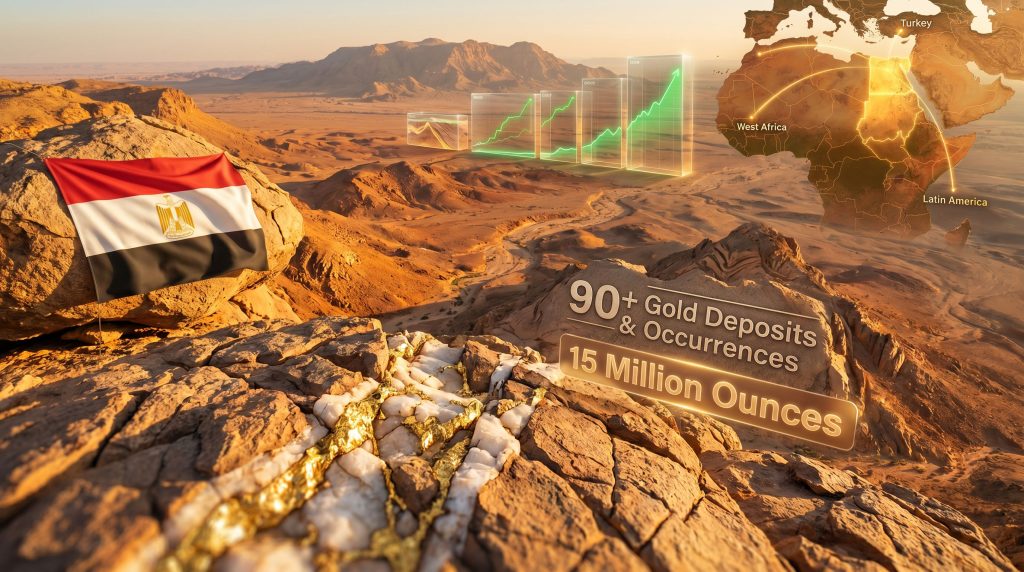
For investors evaluating frontier gold provinces, the Egypt Eastern Desert gold deposits assessment is increasingly difficult to ignore. The combination of a well-documented Precambrian gold system, more than 90 identified mineral occurrences, and a regulatory environment undergoing active reform creates a convergence of geological prospectivity and commercial opportunity that rarely presents itself in mature mining jurisdictions. Understanding the mineral exploration importance of this region is, consequently, essential for any serious investor or geologist working across frontier terranes.
When big ASX news breaks, our subscribers know first
The Nubian Shield: Understanding Why This Geology Matters
The Eastern Desert sits atop one of Africa's most significant Precambrian basement terranes, the Nubian Shield, which extends across northeastern Africa and connects geologically with the Arabian Peninsula. This basement complex formed during the Neoproterozoic era, roughly 900 to 550 million years ago, through a series of tectonic collision and accretion events that assembled what geologists call the Arabian-Nubian Shield.
What Makes This Terrain So Prospective?
What makes this geological history relevant to gold prospectivity is the diversity of rock types it produced. The basement hosts greenstones, ophiolites, arc-related volcanics, and granitoid intrusions, all of which are lithologies associated with orogenic gold mineralisation globally. The tectonic forces that assembled this terrain also created the structural architecture — shear zones, fold axes, and fault corridors — through which gold-bearing hydrothermal fluids migrated and concentrated.
The Eastern Desert's geological credentials are not theoretical. Ancient Egyptian miners identified and exploited these gold systems thousands of years ago, and modern geochemical surveys continue to confirm their presence across the basement terrane.
Furthermore, with over 90 documented gold deposits and mineral occurrences identified across the Eastern Desert's Precambrian rocks, the density of known mineralisation rivals some of Africa's most celebrated gold belts. However, the application of modern exploration technology to this terrain remains in its early stages, creating a compelling opportunity for first movers.
Four Deposit Types and Why Classification Drives Capital Allocation
One of the less commonly appreciated aspects of the Egypt Eastern Desert gold deposits assessment is the mineralogical diversity of the region. Not all gold deposits in the Eastern Desert are created equal, and understanding deposit typology is critical for directing exploration spending efficiently. For a broader framework on how deposits are ranked globally, mineral deposit tiers provide a useful classification lens.
| Deposit Type | Host Environment | Key Characteristics |
|---|---|---|
| Orogenic Quartz-Vein | Shear zones in metamorphic and igneous rocks | Structurally controlled; highest discovery priority |
| Disseminated Gold | Hydrothermally altered wall rocks | Associated with argillic, phyllic, propylitic zones |
| Stratabound (BIF/VMS-style) | Banded iron formations and volcanogenic sequences | Laterally continuous; amenable to bulk mining approaches |
| Placer Deposits | Alluvial and eluvial surface settings | Near-surface; lower initial evaluation cost |
Why Orogenic Vein Systems Attract the Most Exploration Capital
Among these four categories, structurally controlled orogenic quartz-vein systems consistently attract the highest exploration priority across the Eastern Desert. These deposits form where deep-seated hydrothermal fluids, mobilised during major tectonic events, migrate upward through shear zones and intersect competency contrasts within the host rock sequence. Gold precipitates at these structural traps, often in high concentrations relative to the surrounding rock mass.
Modern remote sensing techniques have significantly enhanced the ability to identify these systems from surface signatures. Satellite-based multispectral analysis, particularly using ASTER and Sentinel-2 platforms, can map argillic, phyllic, and propylitic alteration halos that form in the wall rocks surrounding active hydrothermal conduits. These alteration zones are spatially linked to the structural corridors where economic gold mineralisation is most likely to concentrate.
Critically, Scanning Electron Microscopy analyses of alteration samples collected from the Central Eastern Desert have directly confirmed gold presence within hydrothermally modified zones, validating the surface-to-subsurface targeting methodology that underpins modern exploration programmes in the region.
A point that is not widely appreciated outside technical exploration circles is that barren alteration zones and genuinely gold-bearing hydrothermal systems can look similar at the surface. Distinguishing between the two requires multi-element geochemical pathfinder suites, typically including gold, arsenic, antimony, tellurium, and bismuth. A geochemical anomaly defined by this pathfinder suite carries substantially higher predictive value than alteration mapping alone. In addition, soil sampling methods play a critical role in validating surface anomalies before committing to costly drilling campaigns.
Sukari as the Benchmark: What a 15+ Million Ounce System Tells Investors
No analysis of Eastern Desert gold prospectivity is complete without examining the Sukari Gold Mine, Egypt's only large-scale modern gold operation and the deposit that reshaped international perceptions of the region's resource potential.
Sukari hosts a reported resource base exceeding 15 million ounces of gold, hosted within a deformed granitoid intrusion in the south-central Eastern Desert. The deposit's scale places it firmly within the tier-one category by global standards, comparable to world-class systems in West Africa and the Americas.
Sukari's endowment is not just a local milestone. It is geological proof that the Eastern Desert's basement can host world-class gold systems, and it recalibrates what exploration-stage operators should be targeting when they enter the region.
For investors, Sukari functions as a prospectivity benchmark. If a single intrusion-hosted system in the south-central Eastern Desert can accumulate more than 15 million ounces, then the broader basement terrane — much of which has never been subjected to systematic modern exploration — carries material discovery upside. The key insight is that Sukari was not anomalous geology; it was a geological system waiting to be found with the right tools.
Comparing Egypt's Eastern Desert to African Peer Provinces
Placing the Eastern Desert within a continental context helps calibrate both prospectivity expectations and investment maturity assessments. A thorough gold deposit analysis of comparable Precambrian terranes elsewhere further illustrates why systematic data acquisition is so transformative at this stage of exploration.
| Metric | Egypt Eastern Desert | West African Birimian Belt | East African Orogenic Belt |
|---|---|---|---|
| Shield Age | Neoproterozoic (~900-550 Ma) | Paleoproterozoic (~2,100 Ma) | Neoproterozoic-Paleoproterozoic |
| Known Occurrences | 90+ documented | Hundreds of deposits | Multiple world-class mines |
| Exploration Maturity | Early-to-intermediate | Mature | Intermediate-to-mature |
| Primary Deposit Style | Orogenic vein, intrusion-related | Orogenic vein, shear-hosted | Orogenic vein, BIF-hosted |
| Investment Climate | Active reform agenda underway | Established frameworks | Variable by jurisdiction |
The comparison with the West African Birimian Belt is particularly instructive. That belt, which hosts some of the world's most prolific orogenic gold systems in Ghana, Burkina Faso, and Mali, has been explored intensively for decades and carries correspondingly high land acquisition costs. The Eastern Desert, by contrast, offers early-mover positioning in a geological setting with demonstrably comparable deposit styles at a stage where systematic modern data acquisition is only just beginning.
Egypt's Regulatory Overhaul and the MRMIA Framework
The investment case for Eastern Desert gold exploration is reinforced by a structural shift in Egypt's mining sector governance. The Mineral Resources and Mining Industries Authority (MRMIA) has become the central commercial and regulatory interface for international operators, handling everything from exploration licence issuance to the execution of bilateral cooperation agreements.
Recent international engagement underscores this trend. Turkey-based OZ Mining has executed a memorandum of understanding with MRMIA to conduct preliminary studies and assessments of gold ore deposits in the Eastern Desert. The agreement was witnessed by Egypt's Minister of Petroleum and Mineral Resources, Karim Badawi, reflecting the level of governmental interest in facilitating these partnerships.
The MoU mechanism serves a specific commercial function in Egypt's mining framework. It allows international companies to conduct technical due diligence, access geological data, and evaluate specific concession areas before committing to full exploration licence applications. This staged approach reduces early-stage political and commercial risk for incoming operators.
Key Regulatory Milestones Shaping the Investment Environment
- Egypt recently signed a landmark agreement to conduct its first airborne mineral survey in 42 years, a development that will generate a transformative regional dataset for target generation across previously data-poor areas of the Eastern Desert
- The Egypt Mining Forum, scheduled for late September in the New Administrative Capital and held under the patronage of President Abdel Fattah El-Sisi, is designed to bring global mining companies and institutional investors into direct engagement with Egypt's mineral estate
- Streamlined licensing frameworks and enhanced investment incentives form part of a broader policy agenda to increase Egypt's competitiveness as a mining investment destination
- The bilateral MoU model, exemplified by the MRMIA-OZ Mining agreement, has emerged as the standard entry mechanism for international operators conducting preliminary geological assessments
It is important to note that these represent the general direction of Egypt's mining policy framework. Project-specific outcomes, including licence approvals, concession grants, or formal exploration rights, will depend on each operator's individual technical and commercial negotiations with MRMIA.
The next major ASX story will hit our subscribers first
A Three-Stage Exploration Methodology for Eastern Desert Targets
Understanding the technical pathway from initial target identification to drill-ready status helps investors and analysts evaluate the credibility of exploration programmes in the region.
Stage 1: Regional Remote Sensing and Structural Analysis
- Satellite multispectral and hyperspectral imagery maps alteration zones across large areas of logistically challenging desert terrain
- Lineament analysis identifies fault systems, shear zones, and fold axes that serve as primary fluid pathways
- This stage allows exploration teams to rank target areas and prioritise ground follow-up before significant capital commitment
Stage 2: Geochemical Sampling and Field Validation
- Stream sediment, soil, and rock chip programmes ground-truth anomalies identified from imagery
- Multi-element pathfinder suites (Au, As, Sb, Te, Bi) distinguish productive from barren alteration
- SEM-EDS analysis provides direct mineralogical confirmation of gold-bearing assemblages in collected samples
Stage 3: Geophysical Surveys and Drill Programme Design
- Ground magnetic and Induced Polarisation surveys define subsurface structural architecture and sulphide zones
- Airborne geophysical surveys provide broader coverage ahead of ground-based programmes
- Drill programmes test highest-ranked targets to establish whether resource-grade intersections can be delineated
Risk Factors Every Investor Should Understand
A balanced Egypt Eastern Desert gold deposits assessment must account for the genuine risks that accompany the prospectivity opportunity.
Geological risks include:
- Heterogeneous mineralisation across the basement — not all alteration systems will prove economically gold-bearing at depth
- The requirement for multi-stage validation means that considerable time and capital is consumed before resource-grade intersections are confirmed
- Near-surface placer and artisanal workings do not reliably predict the scale of mineralisation accessible to modern bulk-mining methods
Operational and logistical challenges include:
- Remote desert terrain imposes real constraints on water supply, access infrastructure, and workforce deployment
- Extreme heat and aridity affect field programme scheduling and operational efficiency
Commercial and regulatory considerations include:
- Transition from MoU-stage assessment to full exploration licence requires navigating MRMIA's approval processes, timelines for which are not guaranteed
- Currency and profit repatriation considerations remain relevant risk factors for foreign operators evaluating Egypt's investment framework
Disclaimer: This article contains forward-looking statements and speculative analysis regarding mineral exploration outcomes, investment potential, and regulatory developments. Such statements involve inherent uncertainty and should not be construed as financial advice. Exploration results, resource estimates, and regulatory timelines are subject to change. Investors should conduct their own due diligence before making any investment decisions related to the mining sector or specific operators mentioned in this article.
Near-Term Catalysts and the Long-Term Investment Thesis
Several near-term developments have the potential to meaningfully accelerate exploration activity across the Eastern Desert over the next 12 to 36 months. Reviewing current gold exploration trends confirms that frontier terranes like Egypt's Eastern Desert are drawing increasing institutional attention as mature provinces become saturated and overpriced.
The completion of Egypt's first airborne mineral survey in 42 years represents the single most transformative data event for the region in recent memory. Airborne geophysical datasets — typically combining magnetic, radiometric, and electromagnetic measurements — enable the rapid characterisation of basement geology across vast areas and provide the foundational layer on which modern exploration targeting programmes are built. For a terrane as large and data-poor as the Eastern Desert, this survey represents a genuine step-change in available information.
Global gold prices sustaining above multi-year highs further improve the economic threshold for advancing early-stage Eastern Desert targets. Projects that might not have justified systematic evaluation at lower gold prices become commercially viable at current price levels, expanding the universe of targets worth drilling. Furthermore, according to research published in Nature, advances in remote sensing and geochemical integration are dramatically improving target delineation success rates across comparable Precambrian terranes globally.
Over the longer term, the Eastern Desert's investment case rests on three intersecting advantages: geological prospectivity validated by over 90 known occurrences and a 15+ million ounce proof-of-concept at Sukari; relative under-exploration compared to analogous African gold provinces; and an improving regulatory environment designed to attract and retain international mining capital. For exploration-focused investors with appropriate risk tolerance, this combination represents the kind of asymmetric opportunity that frontier gold provinces occasionally offer before they transition to mature, competitive districts.
For ongoing coverage of Egypt's mineral sector developments and North African mining investment trends, Zawya's Mining and North Africa reporting at zawya.com provides regularly updated coverage of regional project activity, regulatory changes, and investment flows across the MENA mining landscape.
Want to Be First When the Next Major Mineral Discovery Hits the ASX?
Discovery Alert's proprietary Discovery IQ model delivers real-time alerts on significant ASX mineral discoveries — transforming complex geological data into actionable investment insights, much like the frontier opportunities emerging from Egypt's Eastern Desert. Explore how historic discoveries have generated substantial returns on Discovery Alert's dedicated discoveries page, and begin your 14-day free trial today to position yourself ahead of the broader market.