July 25, 2026
The Production Equation That Determines Egypt's Fiscal Future
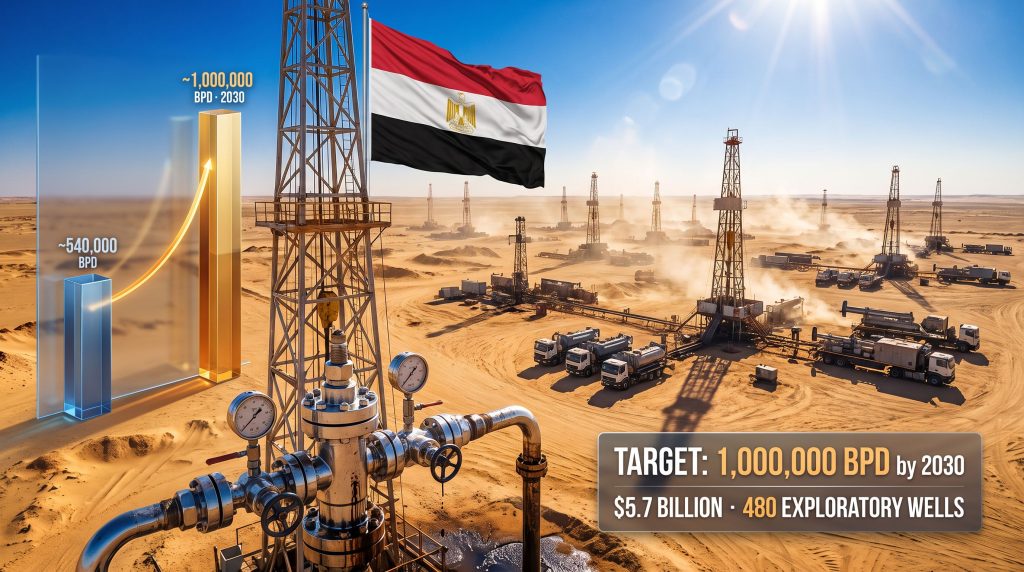
Across mature hydrocarbon basins worldwide, the trajectory from decline to revival rarely follows a straight line. It typically requires a convergence of three forces: restored investor confidence, capital commitment, and the right technical toolkit. Egypt's upstream oil sector is now attempting precisely this convergence, and the scale of the ambition is difficult to overstate. The country's Ministry of Petroleum has outlined a plan for Egypt to double oil output by 2030, a target that would push output toward approximately 1 million barrels per day from a current baseline of roughly 540,000 bpd. Understanding why this goal matters, and whether it is achievable, requires looking well beyond the headline number.
When big ASX news breaks, our subscribers know first
From Arrears Crisis to Upstream Reset: What Changed
The starting point for any analysis of Egypt's 2030 production ambitions is the breakdown that preceded them. From 2021 onward, Egyptian crude output entered a sustained decline driven not by geological exhaustion, but by a financial rupture with the international oil companies (IOCs) responsible for a substantial share of upstream activity.
Outstanding payments to foreign energy partners accumulated over successive years, eventually exceeding $6 billion at their peak. For IOCs operating under production-sharing agreements and cost recovery frameworks, unpaid obligations of this magnitude represent an existential commercial risk. The rational response was to reduce discretionary capital deployment in Egypt, scale back drilling campaigns, and defer field development decisions until the payment situation improved.
The arrears problem was not merely a cash flow issue. It signalled deeper concerns about Egypt's fiscal management and the reliability of the state as a commercial partner, which are considerations that weigh heavily in IOC capital allocation decisions globally.
The gradual repayment of these obligations has repositioned Egypt within the IOC community. According to Reuters reporting on Egypt's upstream ambitions, production has already begun recovering, climbing from trough levels to approximately 540,000 bpd following the completion of oilfield development work by returning foreign partners. This recovery forms the baseline against which the 2030 doubling target is measured.
Inside the Five-Year Upstream Plan: Capital, Wells, and Technology
The Egyptian General Petroleum Corporation (EGPC) sits at the centre of the five-year upstream programme, coordinating between the state and IOC partners to execute what is effectively one of the most aggressive drilling schedules in Egypt's recent upstream history.
The core parameters of the plan are as follows:
- Total planned investment: approximately $5.7 billion over five years
- Exploratory well target: 480 wells over the programme period
- Primary growth engine: onshore oilfields, which offer faster well commissioning timelines than offshore equivalents
- Technology focus: horizontal drilling and hydraulic fracturing as the primary enhanced recovery methods
The choice to prioritise onshore development is strategically sound in the near term. Onshore wells in Egypt can typically be drilled and brought into production significantly faster than deepwater or complex offshore projects, allowing the programme to demonstrate early production gains that build IOC confidence and sustain political support for the broader plan. Furthermore, oil price movements in recent years have reinforced the urgency of maximising domestic output while conditions remain commercially viable.
Horizontal Drilling: Why Geometry Matters in Mature Basins
Horizontal drilling is a technique where the wellbore is steered from a vertical trajectory to a near-horizontal orientation within the target reservoir. The practical effect is that the well intersects far more of the productive rock formation than a conventional vertical well could from the same surface location.
In reservoirs that are laterally extensive but relatively thin, or in formations where natural fractures run vertically, horizontal wells can achieve per-well production rates two to five times higher than vertical counterparts drilled into comparable rock. For Egypt's mature onshore fields, where reservoir pressures have declined over decades of production and remaining hydrocarbons are increasingly distributed through lower-permeability zones, horizontal completion geometry is a logical response to diminishing vertical well returns.
Hydraulic Fracturing: Unlocking Tight Formations
Hydraulic fracturing involves injecting a high-pressure fluid mixture of water, sand, and chemical additives into a wellbore under sufficient pressure to physically fracture the surrounding rock. The sand particles, known in industry terminology as proppant, lodge inside the created fractures and hold them open after pressure is released, creating permeable pathways through which previously trapped hydrocarbons can flow to the wellbore.
This technique is particularly relevant for Egypt because significant volumes of hydrocarbons are believed to reside in tight rock formations where natural permeability is insufficient to support commercial flow rates without stimulation. The technique is not entirely new to the MENA region. Oman has already deployed hydraulic fracturing as part of its strategy to stabilise production and arrest field decline rates, providing a regional reference case for Egypt's operators to draw on.
A less widely understood aspect of fracking in mature basin contexts is that it is often applied not just to new wells but as a re-stimulation technique on existing wellbores. This means Egypt's older producing wells may be candidates for fracturing treatments that can extend productive life and increase recovery from already-developed reservoirs, without the full capital cost of new well construction.
Scenario Analysis: Three Pathways to 2030
The doubling target carries genuine ambition, but the pathway to achieving it is far from linear. The following scenario framework illustrates the range of plausible outcomes:
| Scenario | Key Assumptions | Projected 2030 Output |
|---|---|---|
| Accelerated Execution | Full technology rollout, early IOC contract resolution, stable macroeconomics | 900,000 to 1,000,000 bpd |
| Base Case | Partial IOC re-engagement, 60-75% of well target achieved, moderate delays | 700,000 to 850,000 bpd |
| Downside Case | Renewed arrears pressure, technical challenges in tight formations, weak oil prices | 550,000 to 650,000 bpd |
The base case implies meaningful production growth that would strengthen Egypt's fiscal position considerably, even if the headline doubling figure proves elusive. The downside case, however, would represent a missed strategic opportunity at a critical moment for the Egyptian economy.
One underappreciated factor in these scenarios is decline rate management. Egypt's legacy onshore fields are mature assets that naturally lose production capacity over time. New wells must first offset this natural decline before generating net production growth. If the drilling programme encounters delays, the treadmill effect of decline rates absorbing new well output could compress headline growth figures even in a technically successful programme.
The Contractual Dimension: Reform as a Growth Prerequisite
Debt repayment is a necessary but not sufficient condition for upstream growth. Egypt also needs to revise the commercial frameworks governing IOC participation to make incremental capital deployment genuinely attractive. This means revisiting concession terms, cost recovery mechanisms, and production-sharing structures to ensure that the economics of enhanced recovery operations, which are inherently more capital-intensive than conventional drilling, meet IOC investment hurdle rates.
The complexity here should not be underestimated. Contract renegotiations involve balancing Egypt's desire to maximise sovereign resource capture against IOC requirements for sufficient return on invested capital. Striking agreements that satisfy both sides, particularly for technically demanding hydraulic fracturing and horizontal drilling programmes, requires sophisticated negotiating frameworks and can be time-consuming even when both parties are broadly aligned. In addition, monitoring crude oil price trends will remain critical throughout this process, as price volatility directly influences IOC willingness to commit fresh capital.
Macroeconomic Stakes: Why Output Matters Beyond Upstream
Egypt's economy, the third largest in the Arab world, has been navigating a demanding macroeconomic environment characterised by currency devaluation, elevated inflation, and ongoing engagement with IMF programme conditions. In this context, the upstream oil expansion programme carries significance well beyond the energy sector.
Each additional 100,000 bpd of crude production translates, at prevailing oil prices, into a material improvement in export revenues, foreign exchange earnings, and the government's capacity to service external obligations. The programme therefore operates simultaneously as an energy policy initiative and a sovereign balance sheet repair mechanism. Consequently, the inflation and debt pressures shaping global economies make Egypt's production ambitions all the more strategically urgent.
Additionally, higher domestic production reduces Egypt's dependence on imported refined products, easing pressure on foreign currency reserves that have been under sustained strain. The broader goal of energy self-sufficiency, which encompasses natural gas production alongside crude oil, amplifies this macroeconomic logic further. Egypt's giant Zohr natural gas field, operated by ENI, has itself experienced output challenges in recent years, making the overall energy self-sufficiency objective more complex to achieve than crude oil targets alone suggest.
The next major ASX story will hit our subscribers first
How Egypt Compares to Regional Peers
| Country | Strategic Approach | Key Technologies | Output Direction |
|---|---|---|---|
| Egypt | Doubling target via enhanced recovery and new drilling | Horizontal drilling, hydraulic fracturing | Growth-oriented |
| Oman | Decline arrest and reserves growth | Hydraulic fracturing, EOR | Stabilisation with modest growth |
| Libya | Conflict recovery and infrastructure rehabilitation | Conventional restoration | Aspirational growth from low base |
| Algeria | Mature field redevelopment and new exploration | Enhanced oil recovery | Moderate growth trajectory |
Egypt's approach stands out within this peer group for its explicit technology-first framing and the sheer volume of planned exploratory drilling. The 480-well target would position Egypt among the most active upstream drilling markets in the broader MENA region over the coming five years, assuming execution keeps pace with planning. Shell's commitment to advancing plans to double Egypt's output by 2030 further underscores the seriousness with which major IOCs are engaging with this programme.
Risk Factors That Cannot Be Ignored
Any credible assessment of whether Egypt can double oil output by 2030 must account for the structural risks that could deflect the programme from its intended course:
- Geological uncertainty in tight formations: Not every tight rock formation responds equally to hydraulic fracturing. Reservoir heterogeneity, natural fracture orientation, and fluid properties all influence stimulation outcomes, and Egypt's subsurface is not uniformly amenable to the techniques being proposed.
- Foreign currency constraints on equipment procurement: Horizontal drilling and fracturing operations require specialised equipment, completion tools, and chemical additives that must largely be imported. Egypt's ongoing foreign currency pressures could create procurement bottlenecks that slow the drilling programme.
- Re-accumulation of IOC arrears: If macroeconomic stress prevents Egypt from maintaining its payment schedule with foreign partners, confidence could erode again rapidly. This is the single most consequential downside risk for the programme.
- Global oil price sensitivity: If Brent crude prices decline materially from current levels, the economics of capital-intensive enhanced recovery operations weaken, potentially causing IOC partners to scale back investment commitments. Tracking current crude oil prices is therefore essential for assessing programme viability on an ongoing basis.
- Personnel and skills availability: Hydraulic fracturing at scale requires a workforce with specialised competencies that are not currently abundant in Egypt's upstream labour pool. Building or importing this capacity adds time and cost to the programme.
What the 2030 Target Signals to the International Energy Investment Community
For IOCs and international energy investors evaluating Egypt, the Ministry of Petroleum's five-year programme represents the clearest upstream policy signal the country has sent in years. The combination of debt resolution, contract reform efforts, and a defined technology roadmap creates a more legible investment narrative than Egypt's upstream sector has offered since the arrears crisis began.
Investors with existing Egyptian concessions face a genuine decision point: engage with the revised commercial framework early and potentially secure more favourable terms, or adopt a wait-and-see posture and risk being disadvantaged relative to partners who commit capital sooner. The competitive dynamic among IOC partners in this environment is itself a factor that could accelerate the programme's early stages. Furthermore, the trade war impact on oil markets globally adds another layer of complexity to investment timing decisions.
It is worth noting that Egypt's upstream expansion plans exist within a global energy transition context where capital allocation to fossil fuel projects faces increasing scrutiny. However, Egypt's position reflects a broadly shared pragmatic calculus among emerging market hydrocarbon producers: maximising resource revenues during the current decade to fund economic stabilisation, before the long-term trajectory of global oil demand becomes clearer.
Frequently Asked Questions: Egypt Oil Production and the 2030 Plan
What is Egypt's current oil production level?
Egypt's crude oil production has recently been reported at approximately 540,000 barrels per day, following the resumption of field development activity by international partners as debt repayments have progressed.
What is Egypt's oil production target for 2030?
The Egyptian Ministry of Petroleum's five-year plan targets a scenario where Egypt to double oil output by 2030 becomes a reality. Based on current output levels, this implies a target in the range of approximately 1 million barrels per day.
How much is Egypt investing in upstream oil development?
The approved five-year upstream plan involves a total investment commitment of approximately $5.7 billion, with 480 exploratory wells planned across the programme period.
Why did Egypt's oil output decline from 2021?
The decline was driven primarily by the accumulation of unpaid obligations to international oil company partners, which exceeded $6 billion at their peak. This financial impasse caused IOCs to reduce new investment and suspend field development activity until repayments resumed.
Is hydraulic fracturing already used in the MENA region?
Yes. Oman has already incorporated hydraulic fracturing into its upstream production strategy, providing Egypt with a relevant regional reference case for deploying the technique in comparable geological and operational contexts.
What are the biggest risks to Egypt achieving its 2030 oil production target?
The principal risks include the potential re-accumulation of IOC payment arrears, geological challenges in tight rock formations, foreign currency constraints limiting equipment procurement, global oil price weakness, and delays in completing contract renegotiations with international partners.
Want To Stay Ahead of the Next Major Resource Discovery?
Discovery Alert's proprietary Discovery IQ model delivers real-time alerts on significant ASX mineral discoveries, instantly translating complex data across 30-plus commodities into clear, actionable investment insights — ideal for both short-term traders and long-term investors. Explore historic discoveries and their remarkable returns, then begin your 14-day free trial at Discovery Alert to position yourself ahead of the broader market.