June 10, 2026
The Eastern Mediterranean's Emerging Energy Architecture and What It Means for US Capital
Rarely does a single bilateral relationship capture as many converging global forces as the one now deepening between Egypt and the United States across energy and mining. The Eastern Mediterranean has quietly evolved from a peripheral energy zone into one of the world's most consequential arenas for natural gas diplomacy, offshore exploration, and critical mineral development. For investors and policy analysts tracking Egypt US energy investments and mining cooperation, understanding the structural forces driving this relationship is far more valuable than following individual announcements.
This is not simply about two governments exchanging pleasantries. It is about the intersection of geological endowment, regulatory reform, geopolitical repositioning, and the race to secure mineral and energy supply chains that will define the next several decades of global economic competition.
When big ASX news breaks, our subscribers know first
Egypt's Strategic Weight in the Eastern Mediterranean Energy System
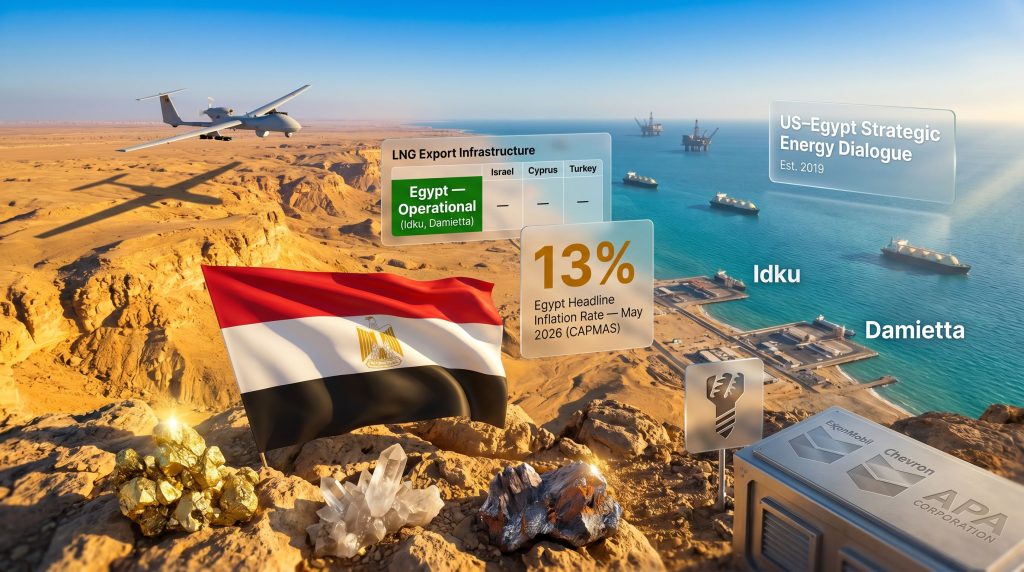
Egypt's geography alone would make it significant. Positioned at the convergence of Africa, the Middle East, and the Eastern Mediterranean, it controls the Suez Canal, one of the world's most critical chokepoints for energy trade. However, Egypt's strategic relevance extends well beyond transit. The country operates two operational LNG liquefaction and regasification facilities at Idku and Damietta, making it one of very few Eastern Mediterranean nations capable of aggregating regional gas production and re-exporting it to global markets.
This physical infrastructure matters enormously in the current geopolitical climate. European efforts to reduce dependency on Russian pipeline gas have created sustained demand for flexible LNG supply routes, and Egypt sits precisely at the intersection of Mediterranean offshore gas fields and the logistics infrastructure needed to monetise them.
Egypt is also a founding member of the East Mediterranean Gas Forum (EMGF), a multilateral body that has gradually evolved from a technical coordination mechanism into a genuine instrument of regional energy governance. The forum's 10th Ministerial Meeting, hosted in Washington by the US Department of Energy, signals a meaningful deepening of American institutional engagement with Eastern Mediterranean energy architecture. Furthermore, for Egypt, this elevates the bilateral relationship with the United States into a more formal governance context, with implications for investment certainty and regulatory credibility.
Regional Positioning Context: Egypt's combination of operational LNG infrastructure, EMGF founding membership, and Mediterranean offshore acreage creates a profile that no other Eastern Mediterranean state can currently replicate in full. This structural advantage underpins the depth and durability of American interest in the partnership.
How Does Egypt's Position Compare Regionally?
The geopolitical mining landscape across the Eastern Mediterranean has shifted considerably in recent years. Egypt's dual role as both a producer and transit hub gives it a structural advantage that neighbouring states cannot easily replicate, particularly given its existing LNG export capacity and established international operator relationships.
The US-Egypt Strategic Energy Dialogue: Architecture and Scope
The formal framework governing bilateral cooperation is the US-Egypt Strategic Energy Dialogue, established in 2019. What distinguishes this mechanism from more transactional energy agreements is its breadth. Rather than focusing narrowly on oil and gas trade, it covers a remarkably wide range of cooperation verticals.
| Cooperation Domain | Policy Mechanism | US Engagement Mode |
|---|---|---|
| Oil and Gas Exploration | Bilateral investment frameworks | ExxonMobil, Chevron, APA Corporation |
| Offshore Mediterranean Development | Concession and regulatory reform | Technical advisory and commercial investment |
| Carbon Capture and CCUS | Technical cooperation protocols | National laboratory partnerships |
| Methane Emissions Reduction | Operational efficiency standards | Technology transfer programs |
| Digital Transformation and AI | Innovation partnerships | US technology company engagement |
| Workforce Development | Training program frameworks | American institutional cooperation |
| Mining Sector Reform | Royalty and tax system modernisation | Investment facilitation |
The dialogue operates at both government-to-government and private-sector levels, which is what gives it practical traction beyond policy statements. Egypt's Minister of Petroleum and Mineral Resources, Karim Badawi, and US Secretary of Energy Chris Wright have both been active participants in advancing the agenda. Recent discussions have covered investment climate improvements, offshore exploration, technology cooperation, and the development of Egypt's mining sector.
The breadth of this framework also reflects something important about how both sides conceptualise the relationship. For Washington, Egypt is not merely an oil and gas supplier but a partner in broader energy security architecture. Consequently, for Cairo, the relationship with American firms and institutions provides access to technologies, capital structures, and governance models that can accelerate sector modernisation. The US and Egypt's strategic energy dialogue has formalised this vision into an actionable policy framework.
American Corporate Exposure to Egypt's Energy Sector
The depth of US private-sector investment in Egyptian energy is often underappreciated outside specialist circles. Several major American operators maintain active exploration and production commitments in the country.
- ExxonMobil and Chevron both hold exploration interests that span Mediterranean offshore and domestic acreage
- APA Corporation has maintained a long-standing Egyptian upstream presence, with the country historically representing a meaningful portion of the company's international production portfolio
- SLB (formerly Schlumberger) and Halliburton operate across the full spectrum of oilfield services, supporting both new exploration campaigns and production optimisation at mature fields
- Bechtel and Fluor have contributed engineering expertise to large-scale infrastructure projects, including phosphate-related feasibility work that extends US technical involvement beyond conventional upstream operations
Egypt has undertaken targeted regulatory measures to stimulate further activity, particularly in offshore Mediterranean exploration where regulatory complexity had previously created friction for some international operators. Parallel initiatives are encouraging productivity improvements at mature onshore fields through technology-intensive intervention methods, an area where US service companies hold a demonstrable competitive advantage.
Investor Note: Local content requirements remain a material compliance consideration for US firms bidding on Egyptian energy contracts. These mandates require technology transfer commitments and local workforce integration as conditions of contract award, which can affect project cost structures and delivery timelines.
Egypt's Mining Sector: The 42-Year Geological Data Gap and What It Means
Perhaps the most consequential and least widely understood development in current Egypt US energy investments and mining cooperation is the mining sector dimension. Egypt's Eastern Desert hosts a geologically complex terrain containing significant known deposits of gold, phosphate, iron ore, and a range of associated mineral resources. However, the investment case for this territory has long been constrained by a fundamental data problem.
Egypt has launched its first comprehensive aerial mineral resources survey in 42 years. The significance of this cannot be overstated for anyone analysing the mining investment opportunity.
Aerial geophysical surveys, particularly those using airborne electromagnetic, magnetic, and radiometric methods, generate the foundational datasets that underpin modern mineral exploration. Without current data, exploration companies are effectively working with geological maps that predate satellite-guided drilling, modern geochemical analysis techniques, and the full development of structural geology methodologies that have transformed deposit discovery rates over the past four decades. The mineral exploration importance of updated geophysical data cannot be understated when assessing new concession opportunities.
Technical Insight: A four-decade gap in systematic aerial geological mapping means that Egypt's current mineral resource inventory reflects the analytical capabilities of the early 1980s. Modern airborne surveys can detect subsurface anomalies at depths and with spatial resolutions that were simply not achievable with the instrumentation available during the last survey cycle. The new dataset is therefore not an update but a structural reconstruction of the country's geological knowledge base.
What Does This Mean for Capital Allocation?
This matters for capital allocation in a specific and actionable way. When the survey results begin to be released and incorporated into new concession rounds, they will likely reveal deposit systems and mineralised corridors that have no prior documentation. This creates a classic first-mover information asymmetry that historically generates substantial value for companies capable of moving quickly on new data.
Egypt's 2019 mining sector reforms have already addressed the regulatory framework, replacing production-sharing agreement structures with royalty and tax-based systems that meaningfully improve the risk-adjusted return profile for foreign investors. The combination of updated geological data with a modernised investment framework creates conditions that are materially more attractive than what existed even five years ago.
Furthermore, the critical minerals demand driving global energy transition strategies makes Egypt's untapped mineral endowment increasingly relevant to international capital flows. American corporate involvement in Egyptian gold mining has historical precedent, with joint venture activity in the Eastern Desert establishing a baseline of US-linked mineral investment that predates the current policy dialogue.
Carbon Management and the Sustainability Dimension
Bilateral cooperation on carbon management represents a technically sophisticated workstream that goes beyond standard emissions reduction rhetoric. Carbon capture, utilisation, and storage (CCUS) has been formally integrated into the bilateral agenda, with US national laboratories positioned as knowledge partners for technical development and pilot project conceptualisation.
CCUS technology in the context of natural gas production serves a dual function for Egypt. It allows the country to continue monetising its hydrocarbon endowment, which remains critical to government revenues and energy security, while building a credible international environmental profile. For US technology providers, Egypt offers a scale and geological context that makes it a viable demonstration environment for CCUS applications in Mediterranean basin geology.
Methane emissions reduction has emerged as a parallel workstream with near-term commercial logic. Gas losses across production and transmission infrastructure represent both an environmental liability and a direct revenue loss. Operational efficiency improvements that reduce methane leakage therefore simultaneously address climate commitments and improve the economics of gas production, creating a compelling case for technology deployment that does not depend on carbon price mechanisms alone. In addition, advanced extraction technologies developed in other resource contexts are increasingly being adapted to improve operational performance across Egyptian energy infrastructure.
The next major ASX story will hit our subscribers first
Risk Factors and Structural Challenges for Investors
A balanced assessment of Egypt US energy investments and mining cooperation requires honest engagement with the risk environment.
Macroeconomic pressures remain real. Egypt's annual headline inflation rate reached 13% in May 2026 according to CAPMAS data, reflecting ongoing economic adjustment pressures. For US firms with US-dollar cost structures operating in an Egyptian-pound revenue environment, currency dynamics require careful financial modelling.
The competitive investment environment is intensifying. China National Tire and Rubber's announced $550 million expansion plan in Egypt is emblematic of a broader pattern in which Chinese capital is actively competing for position across Egyptian industrial sectors. US firms cannot assume preferential access on the basis of historical relationships alone; they must compete on technology quality, financing terms, and operational capability.
Regulatory transition risk in mining deserves specific attention. The shift from production-sharing to royalty-and-tax frameworks, while investor-friendly in principle, introduces a period in which new licensing mechanisms are being operationalised alongside legacy concession structures. Companies navigating this transition need detailed regulatory intelligence that goes beyond publicly available information.
| Risk Factor | Nature | Mitigation Approach |
|---|---|---|
| Currency and FX repatriation | Macroeconomic | Contractual USD denomination, hedging structures |
| Local content compliance | Regulatory | Early engagement with localisation planning |
| Regulatory transition in mining | Framework uncertainty | Specialist legal and regulatory advisory |
| Geopolitical regional dynamics | External environment | Scenario-based project contingency planning |
| Inflation at 13% (May 2026, CAPMAS) | Cost escalation | Indexed pricing mechanisms in long-term contracts |
The Long-Term Horizon: Hydrogen, AI, and the Next Phase of Cooperation
Looking beyond the immediate investment cycle, several structural opportunity vectors are taking shape within the broader Egypt-US cooperation framework.
Egypt's substantial renewable energy potential, combined with its existing gas infrastructure and Mediterranean coastal access, creates credible conditions for a future green and blue hydrogen export industry. The trajectory of this opportunity depends on cost curves for electrolysis, international hydrogen pricing mechanisms, and the pace of European demand development, but the underlying physical assets are already in place.
Securing Critical Mineral and Energy Supply Chains
The development of rare earth supply chains is increasingly being incorporated into bilateral strategic conversations, reflecting broader Western efforts to diversify critical mineral sourcing away from single-nation dependencies. Egypt's Eastern Desert geology makes it a credible contributor to this supply chain diversification agenda, particularly as Western governments intensify support for allied-nation mineral development.
Artificial intelligence applications in subsurface modelling and reservoir management represent a sustained demand for US technology partnerships. Egyptian operators are actively seeking access to AI-driven seismic interpretation platforms and machine-learning-assisted reservoir characterisation tools, areas where American technology providers and research institutions remain at the frontier of global capability.
The workforce development dimension, linking Egyptian professionals with US national laboratories and academic institutions, is building the human capital base that will be required to sustain long-term sector transformation. This is often overlooked in investment analysis but historically proves to be one of the most durable foundations for sustained bilateral economic engagement. For instance, the Egypt Mining Forum's strategic conference has increasingly served as a platform where these workforce and investment themes converge in a structured industry dialogue.
Readers seeking additional context on Egypt's energy and investment landscape may find related reporting and analysis through Zawya's North Africa Economy coverage at zawya.com. This article is intended for informational purposes only and does not constitute financial or investment advice. Forecasts, projections, and assessments of investment opportunities involve inherent uncertainty and should not be relied upon as the sole basis for any investment decision.
Want to Stay Ahead of the Next Major Mineral Discovery in Emerging Markets Like Egypt?
Discovery Alert's proprietary Discovery IQ model delivers real-time alerts on significant ASX mineral discoveries, transforming complex geological data into actionable investment insights the moment they are announced — explore historic discoveries and the returns they generated to understand the scale of opportunity, then begin your 14-day free trial at Discovery Alert to position yourself ahead of the broader market.