
June 10, 2026
The Cadastral Crisis Hiding in Plain Sight
There is a particular kind of institutional failure that announces itself not with a dramatic collapse, but with silence. Deadlines pass unremarked. Demonstrations are promised but never scheduled. Consultation processes produce warm language and cold outcomes. The South Africa mineral cadastre rollout, now well into its second year of phased deployment, is beginning to exhibit precisely these symptoms, and the mining sector is taking notice in ways that matter to capital allocation decisions.
Understanding why this matters requires stepping back from the immediate controversy and examining what a mineral cadastre actually does, and what happens to an extractive economy when it stops doing it well.
When big ASX news breaks, our subscribers know first
What a Mineral Cadastre Does and Why Its Failure Has Cascading Consequences
The Registry as the Foundation of Tenure Security
A mineral cadastre is not merely an administrative database. It is the institutional foundation upon which every investment decision in the extractive sector ultimately rests. When a company acquires an exploration licence, commissions definitive feasibility studies, or secures project financing, the entire transaction chain depends on the assumption that the underlying mineral rights are unambiguously registered, correctly bounded, and not subject to competing claims.
South Africa's predecessor system, SAMRAD, had deteriorated to the point where none of these assumptions could be reliably made. Chronic processing backlogs, opaque adjudication procedures, and a growing volume of disputed or double-granted rights created an environment where even legally sound applications existed in a state of administrative uncertainty for years.
The consequences were not abstract. When tenure security erodes, the carrying cost of exploration-stage projects increases as timelines stretch. Financiers demand higher risk premiums. Geological targets that would attract capital in a well-functioning jurisdiction remain untested because the administrative overhead is prohibitive relative to the expected return.
What SAMRAD's Collapse Actually Measured in Investment Terms
The correlation between licensing dysfunction and declining exploration expenditure is not coincidental. The mineral exploration importance of a functioning administrative system is reflected in Stats SA data, which reveals a collapse in real exploration spending that tracks closely with the deterioration of the administrative environment:
| Year | Real Exploration Expenditure (ZAR) |
|---|---|
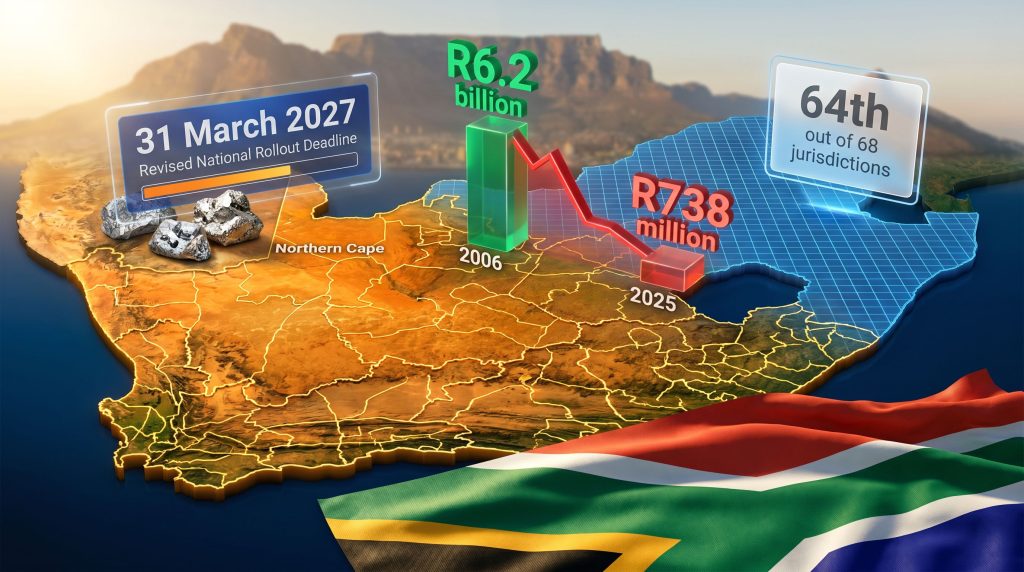
| 2006 (peak) | R6.2 billion |
| 2024 | R781 million |
| 2025 | R738 million |
South Africa's exploration spend now represents less than 1% of global exploration expenditure. The Department of Mineral and Petroleum Resources has publicly targeted a 5% share of global exploration spend, a figure that current trajectories make structurally unachievable without significant improvement in both policy and administrative conditions. Exploration investment functions as a leading indicator: its sustained collapse precedes production decline by years, making the current data a medium-term warning signal for the sector's output capacity.
The PMG Consortium Selection and the Grid-Block Controversy
A Vendor With a Proven Track Record in the Wrong Geography
The PMG Consortium, led by Pacific GeoTech Systems, brings genuine credentials to this project. With more than 23 years of operational history, the vendor has delivered functioning resource management systems across multiple jurisdictions, including British Columbia, Manitoba, Ontario, Yukon, Colombia, and Greenland.
| Deployment Region | Cadastral Methodology |
|---|---|
| British Columbia, Canada | Grid-block |
| Manitoba / Ontario / Yukon | Grid-block |
| Colombia | Grid-block |
| Greenland | Grid-block |
| South Africa (pilot) | Grid-block (contested fit) |
The consistent thread across all of these deployments is the grid-block cadastral methodology, a system in which mineral rights are delineated by uniform rectangular or square blocks overlaid on a standardised coordinate grid. This approach works exceptionally well in jurisdictions where land administration has historically been organised around regular survey grids, as is common across much of Canada.
South Africa is not such a jurisdiction.
The 150-Year Boundary Legacy That Software Cannot Simply Override
South Africa's land and mineral rights administration is built on irregular surveyed farm boundaries, a system embedded over 150 years of cadastral development. These boundaries do not follow tidy geometric grids. They follow topography, historical settlement patterns, negotiated survey lines, and administrative decisions made across multiple colonial and post-colonial legal frameworks.
Critically, these irregular boundaries are not merely an archival relic. They underpin voting districts, provincial demarcations, infrastructure corridors, agricultural boundaries, and every mining right issued since the Mineral and Petroleum Resources Development Act came into force in 2004. The physical landscape itself, including power line routes, fence lines, road alignments, and plantation boundaries, is organised around these surveyed farm parcels.
Industry sources have raised the concern that migrating mineral licences to a cadastral grid system can generate a negative return on investment in terms of time, money, and administrative goodwill. This perspective has been documented in cadastral reform literature since at least 2017, with Cape Town-based Spatial Dimension having articulated these risks in published research.
The practical implication is significant: even if grid blocks are made granular enough to approximate irregular farm shapes, every new mineral right granted under the system would require a professional surveyor to reconcile the grid-defined boundary with the legacy farm parcel it overlaps. This adds cost and complexity to every future application, systematically disadvantaging smaller operators with limited technical resources.
The Locally Available Alternative That Was Not Selected
What makes the procurement decision particularly difficult to explain is the existence of a domestically developed, locally adapted alternative. Landfolio, formerly known as FlexiCadastre and developed by Cape Town-based Spatial Dimension, is already in active use by South African mining companies and has been deployed internationally, including in Egypt.
The fact that a locally compatible, commercially proven system existed and was not selected has generated questions within the industry that have not received satisfactory official answers. One perspective circulating in industry circles, described by sources close to the process, is that the complexity introduced by an incompatible grid system may serve interests that benefit from continued uncertainty in mineral rights allocation. This remains an unverified speculative interpretation, but its circulation among experienced sector participants is itself a signal of institutional trust breakdown. For further context, the mining cadastre Western Cape implementation provides a useful illustration of how these tensions have played out on the ground.
The Confidence Erosion Timeline: From Celebration to Scepticism
From the Western Cape Pilot to a Stalled National Rollout
The South Africa mineral cadastre rollout officially commenced in the Western Cape in October 2025, with the province selected specifically because it presents the least complex administrative profile: lower backlog density, fewer contested rights, and a smaller volume of active applications compared with major mining provinces such as Limpopo or the Northern Cape.
The first confirmed milestone was the registration of 37 rightholders in the Western Cape, a modest but symbolically important benchmark given the years of dysfunction that preceded it.
The problem is what has happened since. The original national deployment target of June 2025 was missed entirely. The revised national rollout deadline is now 31 March 2027, representing a substantial extension that has not been accompanied by transparent explanation of what technical or administrative obstacles necessitated the revision.
As of late May 2026, the Minerals Council South Africa had not attended a live demonstration of the operational system, despite the Western Cape rollout having been underway for several months. Minerals Council CEO Mzila Mthenjane articulated the industry's position at the organisation's annual general meeting on 27 May: the longer deployment extends beyond its committed timelines, the less predictable the final product becomes, and the more speculative interpretation fills the vacuum created by official silence.
DMPR Director-General Jacob Mbele has indicated that extensive workshopping and training sessions have taken place with Western Cape licensees and committed to direct engagement with the Minerals Council following the AGM commentary. However, the gap between assurances of progress and independently verifiable evidence of system functionality remains a source of sustained concern, as reported by Daily Maverick.
South Africa's Policy Perception Problem: The Fraser Institute Context
Where South Africa Sits in the Global Mining Investment Landscape
The Fraser Institute's 2025 Annual Survey of Mining Companies ranked South Africa 64th out of 68 global mining jurisdictions on mining policy perception alone. The jurisdictions ranked below South Africa include Guinea, Burkina Faso, and Mali.
It is worth pausing on the Burkina Faso comparison. The country is currently governed by a military administration whose leadership publicly rejected democratic governance in April 2025. That South Africa sits in close proximity to such jurisdictions on an international policy perception index represents a reputational signal that demands serious institutional attention.
Critics of the Fraser methodology note that the 2025 findings were derived from 256 responses out of 2,304 individuals polled, a response rate that introduces limitations on statistical confidence. However, the directional findings align closely with the observable investment data presented above, lending them credibility despite the sample size constraint.
The Fraser composite ranking, which incorporates geological attractiveness alongside policy perception, shows that South Africa's extraordinary mineral endowment partially offsets its policy deterrence for some investor categories. Platinum group metals, manganese, chrome, and base metal deposits of global significance continue to attract capital that would not consider the jurisdiction on policy grounds alone. Furthermore, the broader mining geopolitical landscape plays a significant role in shaping how international investors weigh these competing factors.
The MPRDA Amendment Bill: A Second Front of Legislative Uncertainty
Why the Proposed Amendments Compound the Cadastre Risk
The Mineral and Petroleum Resources Development Act of 2002 has guided a full generation of empowerment compliance across the South African mining sector. Every JSE-listed miner is currently structured around its requirements. A new amendment bill gazetted in parliament introduces proposed changes with the potential to impose fresh empowerment targets on companies undergoing changes of control, along with requirements for new transactional arrangements around tailings deposits that were not captured under the original 2002 legislation.
Minerals Council president Paul Dunne has described the consultative process with the DMPR as productive and has indicated that industry submissions appear to have been heard. The residual concern, however, is structural: being engaged in a consultation process does not guarantee that the substance of submissions will be reflected in the final legislative text.
Hulme Scholes, a partner at Malan Scholes Attorneys, has stated plainly that the second draft of the amendment bill is unlikely to fully incorporate the industry's representations, describing this outcome as consistent with how South African legislative reform in this sector has historically functioned.
The convergence of a contested licensing system and an unpredictable legislative amendment creates a compounding risk environment for capital allocation. Investors evaluating South African mineral assets must simultaneously price administrative uncertainty around the cadastre and regulatory uncertainty around the MPRDA amendments into their risk models, a combination that raises the effective cost of capital for new projects.
The next major ASX story will hit our subscribers first
Where Investment Confidence Persists Despite the Headwinds
Geological Premium as a Partial Offset
Not all capital has retreated. Several significant commitments signal that South Africa's mineral endowment retains sufficient pull to attract investment even against a challenging policy backdrop:
- Orion Minerals (dual-listed on the JSE and ASX) is progressing toward a R5 billion fundraising for brownfield copper projects in the Northern Cape
- BHP, the world's largest diversified miner, has indicated renewed willingness to consider exploration activity in South Africa
- Anglo American has committed R600 million to the Council for Geoscience's exploration fund, bringing the total fund to R1 billion
These commitments reflect a calculated bet on geological quality over administrative reliability, a bet that carries its own risk. The question being asked in mining finance circles is how long geological premium can compensate for deteriorating administrative and legislative conditions before capital allocation permanently redirects to jurisdictions that offer both resource quality and institutional predictability. The broader exploration investment landscape suggests that this patience has finite limits.
The Reframing Argument: Capital First, Transformation as Complement
Former Anglo American CEO Mark Cutifani has identified what he describes as a fundamental misalignment in the relationship between South African mining policy and investment. His position, as reported by MiningMX, is that expectations about the pace of transformation did not adequately account for how sensitively capital responds to uncertainty. His proposed reframing places the investment conditions as the foundational policy objective, with transformation outcomes embedded as a complementary subset rather than a competing imperative.
The argument has merit on empirical grounds: a sector that is attracting capital generates the tax revenues, employment, and economic activity within which transformation objectives can be meaningfully pursued. A sector from which capital has retreated produces none of these outcomes regardless of the legislative framework nominally governing it. In addition, effective junior explorers funding models from other jurisdictions demonstrate how enabling environments can be constructed without sacrificing broader developmental goals.
Frequently Asked Questions: South Africa Mineral Cadastre Rollout
What is a mineral cadastre and why does South Africa need one?
A mineral cadastre is a centralised digital registry that records, manages, and administers mineral rights, including applications, grants, renewals, and transfers. South Africa's previous system, SAMRAD, became operationally unreliable, creating backlogs and transparency deficits that undermined investor confidence and administrative integrity.
Why was the Western Cape chosen for the pilot rollout?
The Western Cape was selected because it presents the least administratively complex profile of any South African province, with lower application volumes, fewer contested rights, and a more manageable jurisdictional footprint than major mining provinces.
What is the current national rollout timeline?
The national deployment has been revised to 31 March 2027, following the failure to meet the original June 2025 target.
What is the core technical concern with the new system?
The central debate is whether a grid-block cadastral methodology derived from Canadian resource management practice is structurally compatible with South Africa's legacy system of irregular surveyed farm boundaries, which underpin all mining rights issued since 2004 and are embedded throughout the country's physical and administrative geography.
Has the Minerals Council seen the system operating live?
As of late May 2026, the Minerals Council South Africa had not participated in a live interactive demonstration of the system, despite the Western Cape pilot having commenced in October 2025.
How does the cadastre issue connect to broader investment concerns?
The South Africa mineral cadastre rollout sits within a wider policy risk environment encompassing proposed MPRDA amendments, a near two-decade decline in real exploration expenditure, and a deteriorating position in global mining policy perception rankings, all of which collectively shape the risk calculations of investors evaluating South African mineral assets.
Key Statistics at a Glance
| Metric | Figure |
|---|---|
| Fraser Institute policy perception ranking (2025 survey) | 64th out of 68 jurisdictions |
| Real exploration spend, 2025 | R738 million |
| Real exploration spend, 2006 peak | R6.2 billion |
| South Africa's share of global exploration spend | Less than 1% |
| DMPR's stated exploration spend target | 5% of global spend |
| Western Cape pilot milestone | 37 rightholders registered |
| National rollout revised deadline | 31 March 2027 |
| Anglo American geoscience fund contribution | R600 million (total fund: R1 billion) |
| Orion Minerals Northern Cape fundraising target | R5 billion |
Disclaimer: This article contains forward-looking statements, forecasts, and analysis based on publicly available information as of mid-2026. Nothing in this article constitutes financial or investment advice. Readers should conduct independent due diligence before making any investment decisions.
Want to Stay Ahead of Significant ASX Mineral Discoveries as They Happen?
While South Africa's cadastral uncertainty continues to weigh on capital allocation decisions, Discovery Alert's proprietary Discovery IQ model delivers real-time alerts on significant ASX mineral discoveries, translating complex geological data into actionable investment insights for both short-term traders and long-term investors. Explore Discovery Alert's discoveries page to understand the historic returns major mineral discoveries have generated, and begin your 14-day free trial today to position yourself ahead of the broader market.