June 10, 2026
The Architecture of Exclusion: How US Trade Restriction Policy Is Redrawing the Global Battery Storage Map
Few forces reshape industrial supply chains more decisively than the stroke of a regulatory pen. When the US government restricts trade with Chinese storage companies and classifies commercial energy firms as security risks, the downstream consequences extend far beyond defence procurement desks. They ripple through project finance committees, insurance underwriting models, utility sourcing strategies, and the boardrooms of battery manufacturers on three continents. Understanding why this is happening, and what it means structurally, requires looking past the headlines and into the policy machinery itself.
When big ASX news breaks, our subscribers know first
The Chinese Military Company Designation: A Policy Tool With Expanding Reach
The Chinese Military Company (CMC) designation framework is authorised under the National Defense Authorization Act (NDAA) and administered by the US Department of Defense. Its core function is to identify entities perceived as operating in support of, or in structural proximity to, China's military apparatus. Crucially, the threshold for designation does not require evidence of direct weapons development or active military contracting.
Under the current statutory framework, perceived structural ties to the Chinese state, participation in sectors deemed strategically sensitive, or commercial operations in the United States are sufficient grounds for CMC designation. Active military involvement is not a prerequisite.
This distinction matters enormously for clean energy companies. The framework captures firms engaged in manufacturing, exporting, or providing commercial services within the United States, whether directly or through subsidiary structures. As energy storage and solar infrastructure have been reclassified as critical national security assets, the CMC list has expanded far beyond its original defence-technology focus.
The CMC designation also operates differently from other US trade restriction instruments. Understanding how these mechanisms layer together is essential for any organisation operating in the battery storage procurement space.
How the CMC List Fits Within the Broader US Trade Restriction Architecture
The US government deploys multiple overlapping restriction mechanisms against Chinese firms, each with distinct legal authority, scope, and enforcement consequences. Furthermore, China's export restrictions add another layer of complexity to this already intricate landscape:
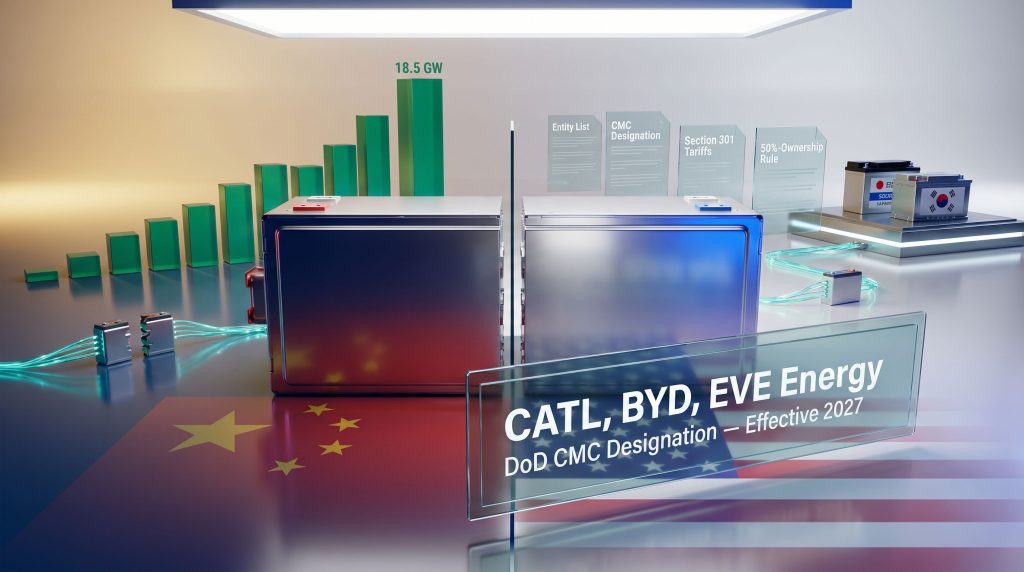
- Entity List (Bureau of Industry and Security / Commerce Department): Requires export licences for technology transfers to listed firms, targeting dual-use technology flows.
- CMC Designation (Department of Defense): Prohibits the DoD from procuring goods or services from designated entities, effective from a specified enforcement date.
- Section 301 Tariff Schedules (USTR): Imposes additional import duties on Chinese-origin goods, including lithium-ion batteries, battery modules, and related components.
- 50%-Ownership Subsidiary Rule: Extends applicable restrictions to entities at least 50% owned by a blacklisted company, capturing subsidiaries, joint ventures, and affiliated structures incorporated outside China.
This layered architecture means that a battery storage developer procuring components through an intermediary incorporated in, say, Vietnam or South Korea cannot automatically assume exemption. If the upstream manufacturer is a designated entity and the intermediary falls within the 50%-ownership threshold, export licensing requirements may still apply.
Compliance Alert: Organisations sourcing battery energy storage system (BESS) components through third-party distributors must now trace upstream ownership structures against the 50%-ownership rule. This requirement substantially increases due diligence costs and compliance complexity across the entire BESS procurement chain.
The June 2026 DoD Update: What Changed and Who Is Now Listed
On June 9, 2026, US Deputy Secretary of Defense Stephen A. Steinberg updated the CMC designation list. The revision is notable for one structural reason above all others: the concentration of clean energy and battery storage companies within a list historically dominated by aerospace, telecommunications, and defence-adjacent technology firms.
| Sector | Companies Designated (June 2026 Update) |
|---|---|
| Battery and Energy Storage | CATL, BYD, EVE Energy |
| Solar Manufacturing | JA Solar, Trina Solar |
| Energy Infrastructure | Three Gorges |
| Technology and Telecommunications | Huawei |
| E-Commerce and Technology | Alibaba |
| Nuclear Energy | China General Nuclear Power Corp. |
| Electronics | China Electronics Corp. |
The restrictions carry a 2027 effective date, meaning a transition window exists for existing procurement pipelines and supply contracts to be restructured before enforcement begins. This built-in adjustment period signals recognition by policymakers that immediate enforcement would create significant market disruption, particularly given how deeply Chinese battery manufacturers are embedded within the US grid-scale storage supply chain.
What the DoD Procurement Ban Actually Prohibits
The designation prohibits the US Department of Defense from purchasing products, contracting for services, or conducting business with designated entities. It does not constitute a blanket civilian market ban. Commercial and utility-scale energy storage projects operating entirely outside defence contracting channels are not directly prohibited from procuring listed companies' products under this specific designation alone.
However, characterising this as a purely defence-sector issue would be a significant analytical error. CMC designations have historically functioned as de facto market exclusion signals even beyond their formal legal scope. The Huawei precedent is instructive: following its CMC listing, the company's exclusion from commercial infrastructure projects accelerated far beyond what the legal text of the designation technically mandated, driven by financing conditions, insurance requirements, and institutional investor pressure.
Supply Chain Exposure: How Concentrated Is the Risk?
The scale of Chinese dominance in lithium-ion battery manufacturing is the central reason this policy creates such significant downstream consequences. CATL, BYD, and EVE Energy collectively account for a substantial portion of global battery cell production capacity. For a US grid-scale storage market with an active pipeline of proposed capacity exceeding 18.5 GW in utility RfP, site application, and proposal activity as of end-2024 (ESS News, March 2025), the sourcing implications are considerable.
The core challenge facing US energy storage developers is not simply finding alternative suppliers. It is finding alternative suppliers who can match Chinese manufacturers on cost, delivery timelines, and technical specifications at the scale the US pipeline demands. In addition, the battery raw materials market presents its own set of supply constraints. South Korean manufacturers including Samsung SDI, LG Energy Solution, and SK On represent the most commercially mature Western-aligned alternatives, but capacity constraints and cost premiums relative to Chinese lithium-ion cells remain real friction points.
Short, Medium, and Long-Term Market Impact Scenarios
| Timeframe | Likely Market Dynamic |
|---|---|
| 2026 to 2027 (Pre-Enforcement) | Accelerated inventory procurement; contract restructuring; legal review of existing supply agreements |
| 2027 to 2029 (Early Enforcement) | Supply tightening on DoD-adjacent projects; upward price pressure on non-Chinese alternatives; qualification timelines for new suppliers emerge as critical path items |
| 2030 and Beyond (Structural Adjustment) | Supply chain diversification toward South Korean, Japanese, and domestic US producers; alternative battery chemistries gain commercial traction |
Panasonic's announcement of a $2 billion investment targeting US battery manufacturing capacity and data centre storage demand represents exactly the kind of strategic repositioning this policy environment is designed to accelerate (ESS News, June 2026). The investment includes a new US production line, expanded Osaka capacity, and a broader Mexican manufacturing footprint, with the company targeting tripled DC energy storage revenues.
China's Counter-Architecture: The Asymmetric Response
Trade restriction escalation between the US and China is not a one-directional phenomenon. China maintains its own export control framework and has deployed "unreliable entity" designations against US firms. More consequentially for Western battery supply chains, China holds dominant processing positions across the minerals that underpin battery manufacturing. The growing critical minerals demand driven by the energy transition makes this leverage increasingly significant.
Chinese firms control a disproportionate share of global processing capacity for:
- Lithium carbonate and lithium hydroxide (battery-grade processing)
- Cobalt refining (predominantly through Democratic Republic of Congo sourcing)
- Manganese sulphate (critical for NMC cathode chemistry)
- Synthetic graphite (dominant in anode manufacturing)
Export licensing applied to processed battery materials functions as a countermeasure to US procurement bans, targeting a different but equally critical point in the supply chain. Western battery supply chains that have not achieved upstream mineral processing independence remain structurally exposed to this form of retaliatory pressure, independent of which battery cell manufacturers they source from.
The bidirectional nature of trade restriction escalation means both governments are now using entity-based controls as strategic instruments simultaneously. The risk for Western developers is being caught in the crossfire of two overlapping restriction regimes affecting both the hardware and the raw material inputs of battery storage systems.
Western Policy Alignment: The EU Parallel and What It Signals
The DoD's CMC expansion is not occurring in geopolitical isolation. The European raw materials strategy reflects a parallel restriction trajectory, and the European Investment Bank has extended its funding ban on high-risk inverters to cover BESS power conversion systems. This policy took effect in 2026 and affects billions in EU financing across renewable energy projects including standalone and co-located storage (ESS News, May 2026).
While the legal mechanisms differ, the policy logic is converging: Western institutional financing is being progressively conditioned on supply chain provenance in ways that functionally exclude high-risk Chinese suppliers, even where no formal civilian purchase ban exists.
Germany's stationary battery storage market illustrates the scale of what is at stake in this realignment. The market added 6.57 GWh of new capacity in 2025, bringing total installed capacity to approximately 24 GWh, representing an 8% year-on-year expansion according to analysis from the Battery Charts data platform of the Institute for Power Electronics and Electrical Drives (ISEA) at RWTH Aachen University (ESS News, January 2026). How this market sources its next wave of capacity will serve as an important indicator of whether EU restriction policy translates into meaningful procurement diversification.
The next major ASX story will hit our subscribers first
The Long-Duration Storage Opportunity in a Restriction Environment
One analytically underappreciated consequence of CMC designation policy is its potential to accelerate the commercial timeline for battery technologies that operate largely outside Chinese lithium-ion supply chains. Global deployment of long-duration energy storage (LDES) technologies exceeded 15 GWh in 2025, with 49% year-on-year growth, according to Wood Mackenzie (ESS News, March 2026).
Despite this momentum, declining venture capital investment and historically low Chinese lithium-ion battery prices have constrained LDES commercial viability. However, innovations such as direct lithium extraction may help alternative chemistries close the gap over time.
If restriction policy structurally elevates the cost floor of Chinese lithium-ion supply in Western markets, the cost-competitiveness gap separating LDES technologies narrows. This creates a policy-driven commercial opening for:
- Flow batteries (vanadium redox and zinc-bromine chemistries)
- Iron-air systems (long-duration discharge at low material cost)
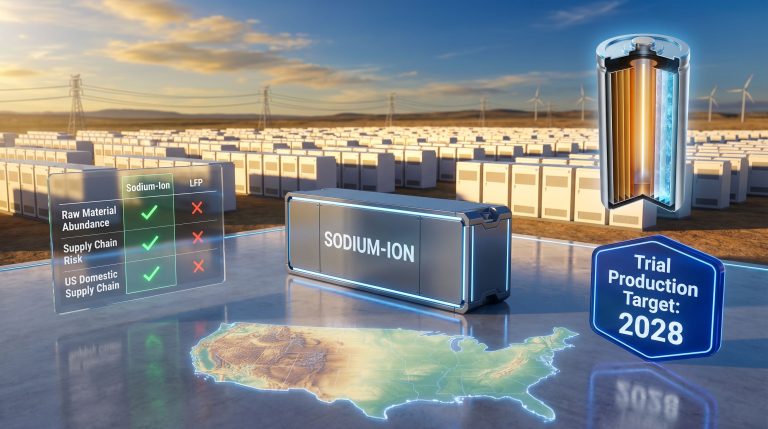
- Sodium-ion batteries (lithium-independent chemistry with Chinese manufacturing exposure but different restriction risk profile)
- Nickel-hydrogen batteries (as being pursued by companies including Enervenue, which is targeting 1 GWh production capacity by 2027)
- Compressed air and thermal storage (geography-dependent but financing-friendly)
Strategic Observation: The fact that the US government restricts trade with Chinese storage companies may prove to be the most consequential demand-side catalyst that alternative battery chemistries have encountered. Not through technological breakthrough, but through the regulatory repricing of their primary competitor.
Compliance Imperatives: What Energy Developers Must Do Before 2027
The 2027 enforcement date creates a defined but finite window for organisations to audit and restructure their procurement exposure. The following steps represent a practical compliance framework for energy storage project developers operating in or adjacent to US markets:
- Conduct a full supplier audit to identify direct or indirect procurement relationships with CMC-designated entities across all BESS components, including battery cells, modules, battery management systems, and power conversion equipment.
- Apply the 50%-ownership test to every upstream supplier, regardless of the country of incorporation of the immediate counterparty.
- Engage trade compliance counsel to assess export licensing obligations under BIS regulations for any technology transfers involving listed entities or their subsidiaries.
- Evaluate alternative supplier qualification timelines against project delivery schedules, recognising that qualification of new battery cell suppliers can take 12 to 24 months under standard utility procurement processes.
- Review all existing supply agreements for clauses that may create legal exposure or cost liability under changed sourcing requirements post-2027.
- Assess project financing conditions with lenders and institutional investors, as financing covenants related to CMC exposure may be imposed independently of formal legal requirements.
- Monitor DoD list updates continuously, as the CMC list is subject to ongoing revision and new designations may affect procurement decisions mid-project.
Frequently Asked Questions
What is the CMC designation and what does it restrict?
The CMC designation is a classification applied by the US Department of Defense under the NDAA framework. Designated companies are prohibited from conducting business with the DoD or supplying products to US defence procurement channels. The designation does not automatically restrict civilian commercial sales.
Which clean energy companies were added to the DoD list in June 2026?
The June 2026 update designated CATL, BYD, EVE Energy, JA Solar, Trina Solar, Three Gorges, Huawei, Alibaba, China Electronics Corp., and China General Nuclear Power Corp., among others.
When do the restrictions take effect?
The procurement ban is scheduled to take effect in 2027, providing a transition window for existing contracts and supply pipelines to be restructured.
Does the ban affect civilian purchases of Chinese battery storage systems?
The DoD procurement ban applies specifically to defence department purchasing. Civilian and commercial procurement of listed companies' products is not directly prohibited under this designation alone. However, secondary market effects through financing, insurance, and institutional investment decisions may affect broader commercial access over time.
How does the 50%-ownership subsidiary rule work?
US export control policy extends applicable restrictions to entities at least 50% owned by blacklisted companies. Subsidiaries, joint ventures, and affiliated entities of designated firms may require export licensing even if incorporated outside China.
Are other Western governments implementing similar policies?
The European Union has extended its funding ban through the European Investment Bank to cover high-risk Chinese BESS power conversion systems, representing a parallel policy trajectory with distinct but directionally aligned objectives. Consequently, the trend of the US government restricting trade with Chinese storage companies appears to be gaining broader Western institutional momentum.
Readers seeking ongoing coverage of energy storage market and policy developments across global markets are encouraged to follow ESS News (ess-news.com).
This article contains forward-looking analysis and scenario projections based on current publicly available information. It does not constitute financial, legal, or investment advice. Regulatory frameworks are subject to change, and readers should seek independent professional guidance for compliance or investment decisions.
Want to Know Which ASX Companies Are Positioned to Benefit From the Global Battery Storage Shake-Up?
As Western nations accelerate supply chain diversification away from Chinese battery manufacturers, the search for alternative critical mineral sources and domestic producers is creating significant discovery opportunities on the ASX. Discovery Alert's proprietary Discovery IQ model delivers real-time alerts the moment significant mineral discoveries are announced on the ASX, transforming complex geological and commodity data into actionable insights — explore historic discoveries and the returns they generated to understand the opportunity, then begin your 14-day free trial to position yourself ahead of the market.