June 10, 2026
When the Debt Clock Finally Stops: What Egypt's Arrears Clearance Means for Upstream Investment
Across the history of petroleum-producing nations, few obstacles have proven as corrosive to long-term upstream investment as sovereign payment arrears. Unlike regulatory uncertainty or geological risk, which investors can model and price, unpaid government obligations create an entirely different category of risk. Egypt clears arrears to oil and gas companies in a process that signals the end of systemic fiscal dysfunction and the rebuilding of bilateral trust that underpins international oil company partnerships. Egypt's experience between 2022 and 2026 offers a case study in how a foreign currency crisis can cascade through an entire upstream sector, and what it takes to rebuild the conditions necessary for capital to return.
When big ASX news breaks, our subscribers know first
The Architecture of a $6.1 Billion Problem
Understanding how Egypt clears arrears to oil and gas companies at the scale that emerged requires examining the structural mechanics that caused them to accumulate in the first place. Egypt's upstream oil and gas sector operates predominantly through production-sharing agreements and joint venture structures with international oil companies (IOCs), where the government's share of revenues and partner cost recovery obligations are denominated in US dollars. When Egypt's foreign currency reserves came under severe pressure from 2022 onward, the government's ability to service these USD-denominated obligations became critically constrained.
The situation created a compounding dynamic that sector analysts sometimes describe as a payment trap:
- Domestic energy revenues were collected primarily in Egyptian pounds, while partner payments were owed in hard currency
- Foreign exchange rationing within Egypt's financial system prioritised critical imports, leaving energy payment obligations at the back of the queue
- Each month of delayed payment added to the cumulative backlog, while simultaneously reducing IOC willingness to commit fresh capital to new drilling or development programmes
- Reduced capital deployment lowered production volumes, which in turn suppressed the hard currency revenues Egypt needed to service its obligations
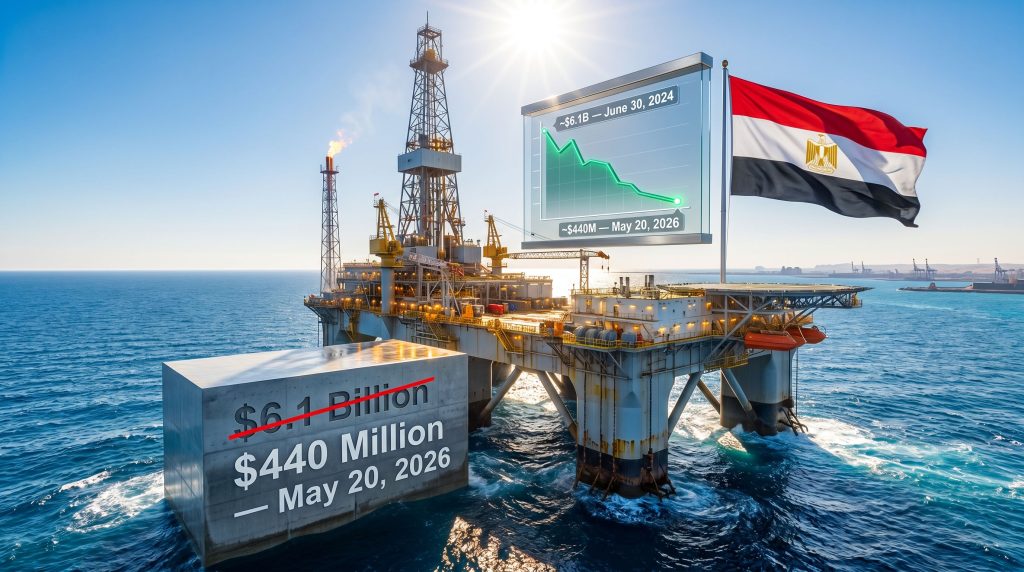
By June 30, 2024, the total outstanding balance owed to foreign energy partners had reached approximately $6.1 billion, making it one of the largest sovereign arrears accumulations in the history of African upstream oil and gas. The figure became widely referenced as a benchmark indicator of the depth of Egypt's fiscal stress and the severity of its foreign currency shortage.
Furthermore, the global trade war impacts on commodity-producing nations during this period compounded Egypt's foreign exchange difficulties, as shifting trade dynamics tightened the availability of USD liquidity across emerging markets.
The compounding feedback loop between payment delays, reduced IOC investment, and declining production represents one of the most underappreciated transmission mechanisms through which a currency crisis converts into a structural energy problem. By the time the peak arrears figure was established, Egypt's gas output had already been visibly impacted.
From $6.1 Billion to $440 Million: The Mechanics of Repayment
The pathway from peak arrears to near-full clearance required a combination of macroeconomic adjustment, structured payment scheduling, and deliberate fiscal prioritisation. Several enabling conditions converged to make the repayment trajectory possible.
IMF Program Engagement: Egypt's participation in an International Monetary Fund program provided both emergency liquidity and the reform conditionality framework necessary to stabilise the foreign exchange environment. The program introduced fiscal adjustments that created room for hard currency allocation toward energy partner payments.
Currency Liberalisation: The managed depreciation of the Egyptian pound was among the more consequential policy adjustments. By allowing the exchange rate to move closer to market-clearing levels, Egypt reduced the structural gap between domestic revenues and foreign currency obligations, easing the underlying tension that had generated the arrears in the first place.
Structured Monthly Payment Schedules: Rather than attempting a lump-sum settlement, Egypt adopted a phased approach, deploying regular monthly payments against the accumulated backlog while simultaneously honouring current obligations to prevent further accumulation.
Incentive Mechanisms for IOC Continuity: Alongside the repayment programme, the Egyptian government introduced parallel incentive arrangements designed to encourage international energy companies to maintain operational activity during the settlement period rather than scaling back their Egyptian footprints further. According to reporting on Egypt's arrears settlement, this structured approach was instrumental in retaining IOC operational presence throughout the repayment period.
The resulting repayment trajectory is summarised below:
| Milestone | Outstanding Arrears | Period |
|---|---|---|
| Peak arrears level | ~$6.1 billion | June 30, 2024 |
| Progressive repayment | ~$5.0 billion cleared | Mid-2024 to May 2026 |
| Remaining balance | ~$440 million | May 20, 2026 |
| Full settlement target | $0 | End of June 2026 |
The reduction of approximately $5 billion in arrears over roughly two years represents a significant fiscal commitment. The Egyptian petroleum ministry's decision to treat IOC debt clearance as a strategic priority reflects an understanding that the upstream sector's recovery was contingent on resolving this obligation first.
Investment Implications: Why Arrears Clearance Is a Prerequisite, Not Just a Positive Signal
Egypt's Petroleum Minister Karim Badawi characterised the full settlement of IOC arrears as a defining inflection point, noting that resolution of the payment backlog rebuilds investor confidence and opens pathways for expanded upstream activity and accelerated development programmes across the sector.
The significance of this statement extends beyond diplomatic language. For international oil companies evaluating capital allocation across their global portfolios, sovereign payment reliability is a foundational criterion. When a host government demonstrates a sustained pattern of payment delays, the investment calculus shifts in several ways:
- Risk-adjusted return thresholds rise — IOCs require higher expected returns to compensate for the additional counterparty risk, making marginal projects uneconomical
- New commitment timelines extend — Internal approval processes for new capital in markets with active arrears require additional escalation and justification
- Operational footprints are rationalised — Companies prioritise maintenance of existing production over new exploration, reducing the pipeline of future output
- Concession renegotiations become more common — IOCs use renewal discussions as leverage to extract better commercial terms as compensation for payment uncertainty
Full clearance of the arrears, assuming it is completed on schedule by end-June 2026, removes all four of these deterrents simultaneously. The sectors most likely to benefit from renewed IOC engagement include:
- Mediterranean deepwater exploration and development, which represents the highest-capital opportunity in Egypt's upstream portfolio and requires the most demanding threshold of host-government payment confidence
- Onshore mature field redevelopment, where deferred maintenance investment during the arrears period created a backlog of workover and infill drilling opportunities
- New concession rounds, which the petroleum ministry is expected to advance once the investment climate has demonstrably stabilised
- Gas infrastructure development, particularly given that Egypt accounts for approximately 33.6% of Africa's natural gas consumption as of 2024 data, underscoring the domestic strategic imperative of restoring production capacity
In addition, the broader LNG market implications of Egypt restoring its upstream production capacity are considerable, given the country's role in global LNG supply chains and its strategic position as a regional energy transit hub.
Mediterranean deepwater projects are among the most capital-intensive and time-sensitive opportunities in the global upstream landscape. Fields of this type typically require multi-year development timelines and billions of dollars in pre-production investment. The decision to commit that scale of capital is made only when host-government payment reliability is beyond reasonable doubt.
The Regional Hub Ambition: Credibility Requires a Clean Balance Sheet
Egypt has been actively developing a strategic narrative around its role as a regional energy hub, leveraging its geographic position between sub-Saharan African supply corridors, Levantine gas basins, Mediterranean transit infrastructure, and European demand centres. This vision encompasses not only the monetisation of domestic gas reserves but also the use of Egypt's LNG liquefaction capacity and pipeline network to facilitate broader regional energy flows.
The arrears situation fundamentally undermined the credibility of this ambition. No sovereign energy hub strategy is persuasive to international investors when the government simultaneously owes billions of dollars to the upstream partners whose production underpins the entire value chain. Consequently, the clearance of IOC debts carries significance beyond the bilateral relationships involved, functioning as a signal to the broader international investment community that Egypt's fiscal management has stabilised sufficiently to support long-duration infrastructure commitments.
Moreover, the evolving geopolitical investment landscape across resource-producing nations means that Egypt's reputation for honouring financial commitments will weigh heavily in how institutional capital allocates between competing regional opportunities. Egypt's active engagement at international energy infrastructure forums, including promotion of its regional hub vision at summits involving Gulf and American energy stakeholders, reflects this broader diplomatic effort to reposition the country's investment profile following the arrears resolution.
Comparing the Investment Environment: Before and After
| Factor | Arrears Period (2022 to 2024) | Post-Settlement (2026 Onward) |
|---|---|---|
| IOC counterparty risk | Elevated, with active accumulation | Substantially reduced |
| New exploration commitment appetite | Suppressed across the sector | Expected to recover progressively |
| Mediterranean deepwater pipeline | Effectively stalled | Conditions now materially improved |
| Drilling activity levels | Below historical trend | Recovery anticipated over 12 to 24 months |
| Egypt's upstream credit profile | Impaired, with wide risk premiums | Improved, though monitoring continues |
| IOC operational continuity | Maintained at minimum viable levels | Expected expansion of commitments |
The next major ASX story will hit our subscribers first
Risks That Will Define Whether the Recovery Is Durable
The clearance of existing arrears is a necessary condition for upstream recovery, but it is not a sufficient guarantee. Analysts and investors will be watching several structural variables over the next two to three years to assess whether Egypt's fiscal rehabilitation is durable or cyclical.
Will Recurrence Risk Undermine the Recovery?
Recurrence Risk is the most immediate concern. The conditions that produced the original arrears, specifically a structural mismatch between domestic currency revenues and USD-denominated obligations under conditions of foreign exchange scarcity, have been partially addressed through currency reform. However, Egypt's foreign exchange position remains sensitive to external shocks, and any deterioration could reintroduce payment delays.
How Vulnerable Remains the Macro Environment?
Macroeconomic Vulnerability remains a background risk. Egypt's hard currency earnings depend on multiple volatile sources including hydrocarbon export revenues, Suez Canal tolls, tourism receipts, and remittances. Simultaneous pressure on two or more of these revenue streams could challenge the government's capacity to maintain current energy payment discipline.
Furthermore, global commodity market tariffs continue to reshape the revenue environment for energy exporters, adding a layer of external uncertainty that Egypt's fiscal planners must account for in any forward projections. Similarly, monitoring natural gas price trends will remain essential, as sustained weakness in gas prices would directly compress the hard currency revenues underpinning Egypt's repayment capacity.
What Are the Likely Scenarios Going Forward?
The Scenario Spectrum for Egypt's upstream sector over the next three years can be framed across three pathways:
- Base case: Full arrears clearance by end-June 2026, followed by a progressive reactivation of IOC exploration and development programmes, with Mediterranean deepwater projects advancing toward final investment decisions by 2027 to 2028
- Moderate risk case: Arrears are cleared but new IOC investment flows more slowly than anticipated, as companies adopt a cautious monitoring posture for 12 to 18 months before committing fresh capital
- Tail risk case: External shocks reintroduce foreign currency pressure, generating new payment delays that rapidly erode the investor confidence that has been painstakingly rebuilt
According to Reuters reporting on Egypt's repayment commitments, the government has publicly committed to full settlement by June 2026, providing a formal accountability benchmark that investors and analysts are closely monitoring.
Disclaimer: The scenario projections and investment implications discussed in this article represent analytical frameworks based on publicly available information. They should not be construed as financial advice or investment recommendations. Readers are advised to conduct independent research and consult qualified advisers before making investment decisions related to Egyptian energy assets or regional upstream markets.
Frequently Asked Questions
How much did Egypt owe to foreign oil and gas partners at the peak of the arrears crisis?
Egypt's outstanding obligations to international oil and gas companies reached approximately $6.1 billion by June 30, 2024, representing the accumulated consequence of a prolonged period of foreign currency scarcity that prevented regular payment of USD-denominated energy partner obligations.
How much has been repaid, and what remains outstanding?
As of May 20, 2026, Egypt had reduced its arrears balance to approximately $440 million, having cleared roughly $5 billion over the preceding period through structured monthly payments and parallel incentive arrangements. The remaining balance is targeted for clearance by the end of June 2026.
Why did Egypt fall behind on energy payments in the first place?
The core issue was a structural mismatch between Egyptian pound revenues and US dollar payment obligations, aggravated by a sustained shortage of foreign exchange within Egypt's financial system. Exchange rate management policies that maintained an artificially fixed pound compounded the problem by limiting the government's ability to convert domestic revenues into the hard currency needed for IOC payments.
Which parts of Egypt's upstream sector stand to benefit most from arrears resolution?
Mediterranean deepwater acreage represents the highest-priority opportunity for renewed capital deployment, given its scale and strategic importance. Onshore mature field redevelopment, new exploration concession rounds, and gas infrastructure investment are also expected to attract renewed IOC attention as the payment environment normalises. When Egypt clears arrears to oil and gas companies in full, these sectors are positioned to be the primary beneficiaries of restored investor confidence.
Does arrears clearance mean Egypt's fiscal challenges are permanently resolved?
The clearance of the current backlog represents a material improvement, but the durability of the resolution will depend on sustained foreign exchange management, macroeconomic stability, and continued fiscal discipline. The underlying structural conditions that generated the original arrears will require ongoing monitoring over the medium term.
Want to Track the Next Major Mineral Discovery Before the Market Does?
Discovery Alert's proprietary Discovery IQ model delivers real-time alerts on significant ASX mineral discoveries, transforming complex resource data into actionable investment insights for both short-term traders and long-term investors — explore the historic returns major discoveries have generated and begin your 14-day free trial to position yourself ahead of the broader market.