June 10, 2026
The Chemistry Reshaping Grid Storage: Why Sodium Is Having Its Moment
The global energy storage industry is undergoing a fundamental materials transition, and GM backs Peak Energy in a sodium-ion battery partnership that represents one of the most consequential institutional endorsements the chemistry has received in the United States. For more than a decade, lithium-ion chemistry has reigned as the default solution across both mobility and stationary applications, but the structural vulnerabilities embedded in that dominance are now driving serious capital toward alternatives. Lithium supply chains remain concentrated in a handful of countries, and price volatility for battery-grade lithium carbonate has whipsawed project economics. Furthermore, the geopolitical risks associated with cobalt and nickel have intensified scrutiny of incumbent chemistries. Against this backdrop, sodium-ion technology has shifted from a laboratory curiosity to a credible commercial candidate, particularly in grid storage applications where the trade-offs favour sodium's strengths.
When big ASX news breaks, our subscribers know first
What Is Sodium-Ion Battery Technology and Why Does It Matter for Grid Storage?
To understand why GM backs Peak Energy in a sodium-ion battery partnership, it helps to examine the electrochemical fundamentals that make sodium-ion simultaneously limiting for electric vehicles and compelling for stationary storage.
Sodium-ion batteries operate on the same intercalation chemistry as their lithium counterparts: ions shuttle between cathode and anode during charge and discharge cycles, releasing or storing electrical energy. The key substitution is sodium ions in place of lithium ions. Sodium carries a larger ionic radius of approximately 1.02 angstroms compared to lithium's 0.76 angstroms, which affects how electrode materials must be structured to accommodate ion movement.
This size difference is one reason sodium-ion cells typically achieve lower volumetric energy density, roughly 160 Wh/L versus approximately 220 Wh/L for commercial lithium iron phosphate cells.
For electric vehicles, that energy density gap is commercially significant. Every kilogram of battery mass directly competes with range, and automotive packaging constraints are severe. For a grid-connected storage system occupying a purpose-built enclosure on a utility substation, however, the density penalty is largely irrelevant. What utilities actually price when evaluating storage is cost per kilowatt-hour of delivered capacity, cycle life over a 20-year contract horizon, thermal safety characteristics, and supply chain predictability. Sodium-ion performs competitively or better across all four dimensions compared to current lithium alternatives.
The Electrode Chemistry Behind the Cost Advantage
The cathode materials used in sodium-ion cells offer a less publicised but commercially important advantage: several leading formulations can be constructed without cobalt or nickel. Cathode options include layered transition metal oxides such as sodium manganese oxide, Prussian blue analogues, and polyanionic compounds like sodium iron phosphate, each of which draws on materials that are far more geographically distributed than the inputs required for high-nickel NMC chemistries.
The anode in most sodium-ion designs uses hard carbon, a disordered carbon material derived from biomass or resin precursors, which can be manufactured domestically without reliance on graphite supply chains currently dominated by Chinese processing capacity.
Sodium carbonate, the primary sodium raw material, trades at approximately $300 per metric ton, a fraction of battery-grade lithium carbonate prices, which peaked near $80,000 per metric ton in late 2022 before retreating but remaining structurally elevated. This cost differential does not translate directly into equivalent cell cost reductions today, because manufacturing scale and yield rates for sodium-ion remain far below lithium-ion incumbents. However, it does suggest a structurally lower cost floor is achievable as production scales, which is precisely the investment thesis driving institutional interest. Indeed, the ongoing lithium market downturn has further strengthened the commercial case for alternative chemistries.
| Attribute | Lithium-Ion (Grid) | Sodium-Ion (Grid) |
|---|---|---|
| Raw material abundance | Moderate (geographically concentrated) | Very high (globally distributed) |
| Energy density | Higher (~220 Wh/L) | Lower (~160 Wh/L) |
| Cost trajectory | Declining but lithium-dependent | Potentially lower floor cost |
| Thermal stability | Variable by chemistry | Generally favourable |
| Supply chain risk | Elevated | Reduced |
| Cobalt/nickel dependence | Common in high-energy variants | Largely avoidable |
| Hard carbon anode | No | Yes (domestically producible) |
Cycle life performance is another underappreciated sodium-ion strength in grid contexts. Leading sodium-ion cell designs have demonstrated 5,000 to 7,000 charge-discharge cycles to 80% capacity retention in laboratory and pilot conditions, a figure that is competitive with commercial LFP for the 10 to 20-year operational windows typical of utility storage contracts.
What Is the GM and Peak Energy Sodium-Ion Partnership?
Breaking Down the Structure of the Deal
The collaboration announced in June 2026 establishes a deliberately segmented development model. GM Ventures, the strategic investment arm of General Motors, has taken an equity stake in Peak Energy, providing both capital and a formal alignment of commercial interests. Within that structure, GM's role is technically specific: the company will lead sodium-ion cell development and manufacturing at its Michigan-based battery research facilities, retaining exclusive manufacturing rights over the cells produced under the arrangement.
Peak Energy's scope sits one level up the value chain, focused on systems integration, meaning the engineering, power electronics, thermal management, and software required to turn a collection of cells into a deployable grid storage product.
This division of responsibility is not arbitrary. It reflects a recognition that cell chemistry and grid systems engineering are genuinely different disciplines requiring different expertise, capital structures, and regulatory relationships. A company optimised for automotive-grade cell manufacturing is not automatically equipped to navigate utility interconnection agreements, grid-forming inverter specifications, or multi-decade service contracts. Conversely, a grid storage integrator rarely has the manufacturing depth to develop and qualify a novel cell chemistry. The partnership structure essentially acknowledges this specialisation and formalises it contractually.
Who Is Peak Energy and What Do They Bring to the Table?
Peak Energy positions itself as a stationary energy storage systems developer with a deliberate focus on grid-scale applications rather than mobility markets. This distinction matters operationally. Grid storage demands familiarity with utility procurement processes, performance-based contracts, capacity market participation rules, and long-duration dispatch profiles that differ fundamentally from automotive duty cycles.
A systems integrator that has built operational relationships with utilities and independent power producers brings commercial infrastructure that a cell manufacturer typically lacks, reducing the time and cost required to reach first revenue.
The vertical segmentation model visible in this partnership reflects a broader trend in the energy storage industry. As battery chemistries proliferate and grid applications diversify, the economics increasingly favour specialisation rather than full vertical integration. Separating the two functions, as GM and Peak Energy have done, allows each party to concentrate resources and capabilities where their competitive advantage is strongest.
What Are the Expected Development Timelines?
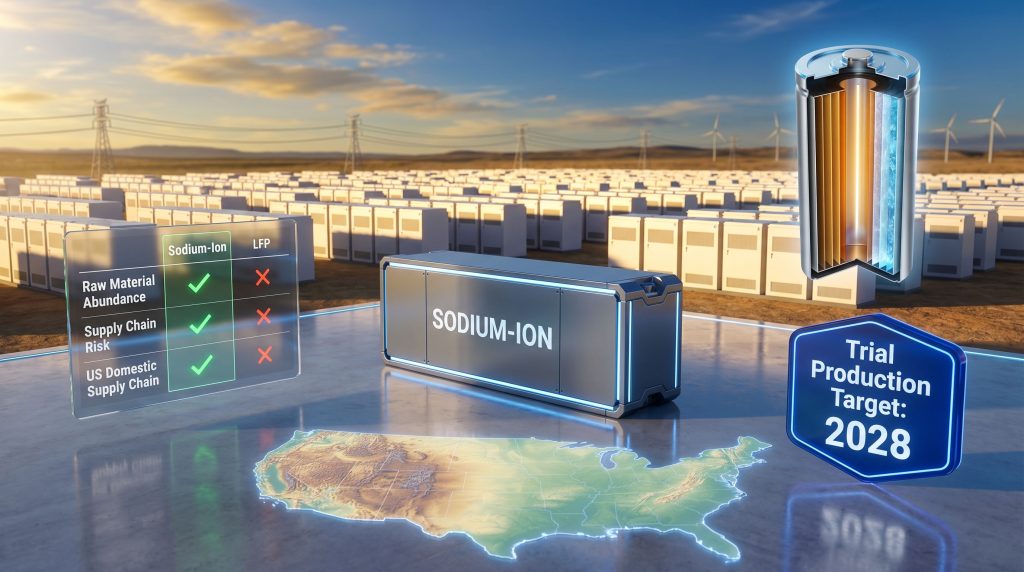
Trial production of GM's sodium-ion cells is targeted for 2028, establishing a multi-year development runway before any commercial-scale deployment would occur.
The phrase "trial production" carries specific meaning in battery manufacturing. It refers to the phase where a cell design transitions from laboratory synthesis and prototype validation into a controlled low-volume manufacturing environment. During this phase, engineers evaluate whether the chemistry that performed well in small-format test cells can be reproduced consistently at production cell sizes, whether electrode coating uniformity meets performance specifications, and whether formation protocols can be executed reliably at scale. Trial production failures at this stage are common and historically account for significant programme delays across the industry.
The 2028 target positions GM to potentially reach commercial deployment by 2029 to 2030, coinciding with a period when US grid storage demand is projected to accelerate substantially as renewable penetration increases and grid operators seek longer-duration storage solutions to manage the variability of solar and wind generation.
How Does This Partnership Fit Into GM's Broader Energy Storage Strategy?
GM's Expanding Battery Ecosystem Beyond the Automotive Sector
GM's sodium-ion commitment with Peak Energy sits within a broader multi-chemistry strategy that the company has been constructing across several parallel tracks. The automaker's established collaboration with LG Energy Solution addresses lithium-ion cell production for its Ultium electric vehicle platform, while its relationship with Redwood Materials targets a battery recycling breakthrough and domestic critical mineral recovery. The Peak Energy partnership adds a third dimension: proprietary cell development for a non-automotive application in a distinct chemistry entirely.
What makes this particularly notable is the shift from battery consumer to battery intellectual property owner that it implies. GM has historically licensed cell technology and relied on supplier partnerships for its core chemistry. Developing sodium-ion cells in-house at Michigan facilities, and retaining exclusive manufacturing rights, represents a strategic departure toward owning the underlying technology rather than purchasing it. If sodium-ion achieves commercial scale and cost targets, GM would hold a manufacturing position in what could become a major energy storage chemistry.
Is GM Trying to Become a Battery Supplier, Not Just a Battery Consumer?
This question carries significant strategic weight. The economics of grid storage are ultimately driven by cell cost per kilowatt-hour, and the entity that controls cell manufacturing holds the critical margin in the value chain. By securing exclusive manufacturing rights under the Peak Energy arrangement, GM is positioning to capture that margin rather than pass it upstream to a cell supplier.
The Michigan battery laboratory investment also signals a long-term commitment to battery research and development as a core competency. This reflects an understanding, increasingly common among major industrials with battery exposure, that chemistry differentiation is a durable competitive advantage in ways that systems integration and project development are not. According to TechCrunch, GM is additionally targeting data centre energy storage as a key commercial application, further broadening the potential revenue base for the sodium-ion programme.
What Are the Implications for the US Grid-Scale Energy Storage Market?
The Growing Demand for Cost-Competitive Stationary Storage Solutions
The US grid storage market is experiencing demand growth that existing lithium iron phosphate supply chains are struggling to address cost-effectively. LFP currently dominates installed grid storage capacity, but its supply chain presents two structural challenges: lithium price exposure and Chinese manufacturing concentration. The overwhelming majority of LFP cell manufacturing currently occurs in China, creating both cost dependence and national security considerations that have prompted policy responses aimed at encouraging domestic production.
Sodium-ion's potential contribution to this landscape is not simply a cheaper cell, though that matters. It is the prospect of a cell chemistry that can be manufactured domestically using raw materials sourced domestically, without the geopolitical exposure associated with either lithium supply from South America or cell manufacturing from China. Sodium carbonate deposits exist in significant quantities across several western US states, including Wyoming's Green River Basin, one of the world's largest natural soda ash reserves, providing a credible foundation for a genuinely domestic sodium-ion supply chain.
Supply Chain Sovereignty and Critical Mineral Reduction
Sodium-ion's critical mineral profile is substantially lighter than any lithium-ion variant. The elimination of lithium, cobalt, and in many formulations nickel from the cell chemistry removes three of the most geopolitically sensitive inputs in the current battery supply chain. Furthermore, this alignment with domestic manufacturing priorities creates a natural fit with the domestic content and sourcing requirements embedded in the Inflation Reduction Act. The broader critical minerals demand challenge facing the energy transition makes sodium-ion's lighter mineral footprint an increasingly strategic asset.
The broader point is that sodium-ion's raw material geography is fundamentally different from lithium-ion, and that difference has strategic value independent of pure cell cost comparisons. For utilities, grid operators, and government procurement programmes evaluating storage on a total risk-adjusted basis, a domestically sourceable chemistry with reduced geopolitical exposure carries a premium that does not show up in simple cost-per-kilowatt-hour comparisons.
Hypothetical Scenario: What Does Commercial Success Look Like by 2030?
Scenario Analysis: If GM's sodium-ion cells achieve successful trial production by 2028 and Peak Energy advances integrated system deployment to utility scale, the partnership could occupy a meaningful position in a US grid storage market that analysts project will require hundreds of gigawatt-hours of new capacity through the early 2030s.
For this scenario to materialise, several conditions would need to align:
- Cell performance validation during the trial production phase must confirm that laboratory results translate to manufactured cells at production scale.
- Cost targets must be achievable at commercially relevant production volumes, which typically requires substantial capital investment in dedicated manufacturing capacity beyond initial trial production lines.
- Peak Energy's system integration must demonstrate bankable performance metrics that satisfy utility procurement requirements, including cycle life guarantees, round-trip efficiency specifications, and warranty structures.
- Offtake agreements with utilities or independent power producers must be secured to underwrite the capital requirements of scale-up manufacturing investment.
- Regulatory certification under relevant UL and IEEE standards for stationary energy storage must be completed for the specific cell chemistry and system configuration.
Each condition involves meaningful execution risk, and investors should treat the 2028 trial production milestone as a proof-of-concept gate rather than a commercial launch date.
How Does Sodium-Ion Compare to Competing Grid Storage Technologies?
Sodium-Ion vs. Lithium Iron Phosphate: A Direct Comparison
LFP remains the benchmark against which any emerging grid storage chemistry must be measured. Its commercial maturity, established certification pathways, well-understood degradation behaviour, and global manufacturing base represent a formidable incumbent position. Sodium-ion's case is not that it is superior to LFP on every dimension today; it is that it offers a distinct combination of supply chain characteristics and cost structure potential that becomes increasingly attractive as the grid storage market scales.
The evolving landscape of battery raw materials further underscores why sodium-ion's lighter mineral footprint is attracting serious institutional capital.
| Performance Factor | Sodium-Ion | LFP (Lithium Iron Phosphate) |
|---|---|---|
| Commercial maturity | Early-stage (2026) | Commercially mature |
| Raw material cost sensitivity | Low (sodium abundant) | Moderate (lithium-dependent) |
| Manufacturing scale | Limited (scaling phase) | Large-scale (China-dominant) |
| Cycle life | Competitive (5,000-7,000 cycles) | Well-established |
| Grid application suitability | High (stationary focus) | High |
| US domestic supply chain | Development stage | Largely import-dependent |
| Cobalt/nickel content | Largely avoidable | Not applicable (iron-based) |
| Domestic content qualification potential | High (future) | Challenging currently |
Other Competing Technologies in the Long-Duration Storage Space
Beyond LFP, sodium-ion competes for capital and project allocations against a range of alternative storage technologies, each with distinct performance envelopes:
- Vanadium redox flow batteries offer theoretically unlimited cycle life and independent power and energy scaling, but vanadium's cost and geographic concentration create their own supply chain concerns, and the technology's lower energy density requires substantial footprint.
- Iron-air batteries, being developed by companies such as Form Energy, target very long duration storage of 100+ hours at low cost, occupying a different market niche from the 4 to 8-hour applications where sodium-ion is most competitive.
- Compressed air energy storage and gravity-based systems offer attractive long-duration economics in specific geographies but cannot be deployed arbitrarily at utility substations due to site-specific geological or structural requirements.
- Lithium manganese iron phosphate (LMFP), an evolution of the LFP chemistry, is emerging as a potential bridge technology that improves energy density while retaining iron-based stability, representing a direct competitive response to sodium-ion's cost narrative.
Sodium-ion's most defensible niche in this competitive landscape is the 4 to 8-hour duration, utility-scale, domestically manufactured segment, where its combination of supply chain characteristics, acceptable cycle life, and potential for a lower long-run cost floor differentiates it from both LFP and the longer-duration alternatives. Innovations in direct lithium extraction may also influence the competitive dynamics by improving lithium supply economics over the medium term.
The next major ASX story will hit our subscribers first
Frequently Asked Questions: GM, Peak Energy, and Sodium-Ion Batteries
What Is the GM and Peak Energy Partnership About?
General Motors, through its GM Ventures investment arm, has formed a strategic collaboration with Peak Energy to develop sodium-ion battery technology specifically for grid-scale stationary energy storage. GM is responsible for cell chemistry development and manufacturing at its Michigan facilities, retaining exclusive manufacturing rights, while Peak Energy handles the integration of those cells into complete energy storage systems for utility deployment.
Why Is GM Using Sodium-Ion for Grid Storage Rather Than Its Existing EV Battery Technology?
Sodium-ion's lower energy density makes it commercially uncompetitive for electric vehicles, where range per kilogram is a critical purchasing factor. For stationary grid storage, however, energy density is a secondary concern. What matters is cost per kilowatt-hour of delivered capacity over the system's operational life, thermal safety, cycle durability, and supply chain resilience — areas where sodium-ion offers genuine advantages over current lithium-based alternatives.
When Will GM's Sodium-Ion Batteries Be Commercially Available?
Trial production is targeted for 2028. Commercial deployment timelines will depend on the outcomes of that production phase, including yield performance, cost validation, and subsequent qualification testing for grid storage applications.
How Does This Partnership Differ from GM's Other Battery Collaborations?
GM's existing battery partnerships, including those with LG Energy Solution and Redwood Materials, are oriented toward lithium-ion EV applications and recycling. The Peak Energy collaboration is specifically targeted at stationary grid storage in a distinct chemistry, representing GM backs Peak Energy in a sodium-ion battery partnership as its most direct move into the utility energy storage market and its most explicit pursuit of proprietary cell intellectual property outside automotive applications.
What Makes Sodium-Ion Potentially Cheaper Than Lithium-Ion Over Time?
Sodium is orders of magnitude more abundant and geographically distributed than lithium, removing the price volatility and geographic concentration risk that drives lithium carbonate cost fluctuations. Several sodium-ion formulations also avoid cobalt and nickel, two of the most cost-volatile and supply-constrained inputs in lithium-ion manufacturing. While current sodium-ion production costs remain elevated due to limited manufacturing scale, the raw material cost structure suggests a structurally lower floor is achievable as the technology matures.
Key Takeaways: What the GM Backs Peak Energy in Sodium-Ion Battery Partnership Deal Signals for the Industry
The strategic and commercial implications of this collaboration extend well beyond the two companies involved:
- Automotive battery expertise is migrating into grid storage at an accelerating pace, with cell development knowledge built for EVs being redeployed toward stationary applications that operate on fundamentally different commercial logic.
- Sodium-ion is gaining institutional credibility that laboratory results alone cannot provide. GM's involvement signals that a major industrial player with substantial battery manufacturing experience views the chemistry as commercially viable on a multi-year development horizon.
- The vertical partnership model, separating cell development from systems integration, reflects a structural trend in the energy storage industry that may define how future chemistry-to-market pathways are organised.
- US domestic battery manufacturing is diversifying beyond lithium-ion, creating the foundation for a more resilient multi-chemistry storage ecosystem that reduces dependence on concentrated foreign supply chains.
- 2028 is the critical inflection point for this specific programme. Trial production success or failure at that milestone will determine whether the partnership scales into a significant market force or requires strategic reassessment.
This article is intended for informational purposes only and does not constitute financial or investment advice. Forward-looking statements regarding commercial timelines, market projections, and technology performance involve material uncertainty and should not be relied upon as guarantees of future outcomes. Readers should conduct independent research and consult qualified advisers before making investment decisions. Further coverage of global energy storage developments is available through Renewables Now.
Want to Stay Ahead of the Next Major Battery Metals Discovery on the ASX?
As sodium-ion and alternative battery chemistries attract serious institutional capital, the race to secure the raw materials powering this transition is accelerating — and Discovery Alert's proprietary Discovery IQ model delivers real-time alerts the moment significant mineral discoveries are announced on the ASX, ensuring subscribers can act on actionable opportunities before the broader market reacts. Explore historic discoveries and the substantial returns they generated, then begin your 14-day free trial at Discovery Alert to position yourself at the forefront of the next major find.