June 10, 2026
The Structural Fault Line Beneath Australia's LNG Export Machine
Every major LNG export nation carries a distinct risk profile. Qatar faces geopolitical exposure. The United States contends with hurricane seasonality and infrastructure bottlenecks. But Australia's recurring vulnerability sits inside its own legal architecture, specifically the enterprise bargaining framework that grants unionised workforces at critical energy infrastructure the legally protected right to strike. When that right is exercised at a facility supplying nearly a tenth of a billion dollars' worth of LNG annually to Asian utilities, the consequences extend far beyond a domestic labour dispute.
That is precisely the dynamic now playing out at the Ichthys LNG project near Darwin, where escalating industrial action has prompted operator Inpex Corporation to seek urgent legal intervention from Australia's Fair Work Commission (FWC). Inpex applies to halt Australia's Ichthys LNG strike is a case being closely watched across Asian energy markets, not only for its immediate cargo implications, but for what it reveals about the long-term reliability calculus of Australian LNG supply.
When big ASX news breaks, our subscribers know first
What the Ichthys Project Represents in the Global LNG Supply Chain
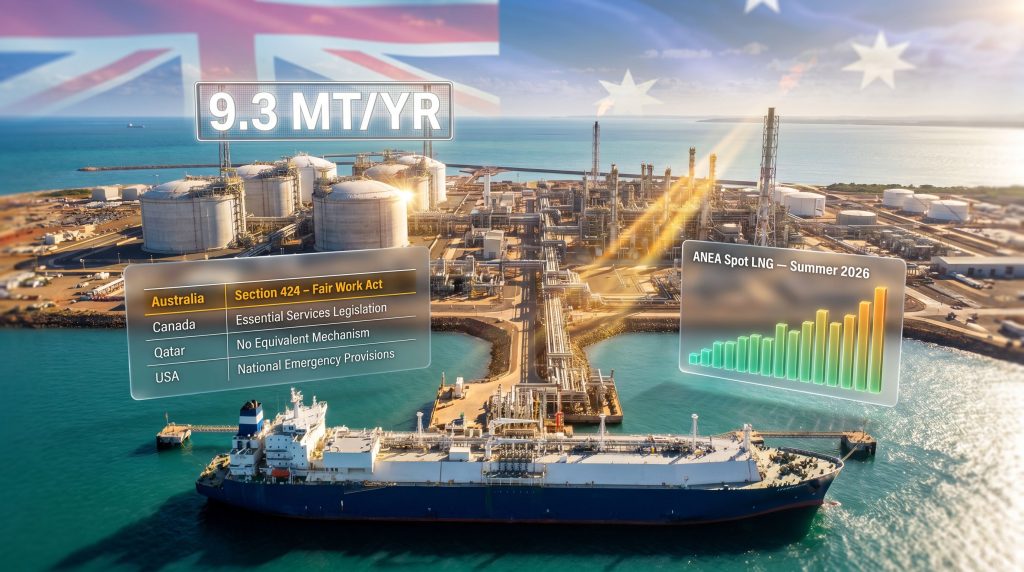
Ichthys is among the most consequential LNG facilities in the Asia-Pacific region. Operated by Tokyo-headquartered Inpex Corporation, with French major TotalEnergies holding a significant co-venture interest, the project is located in Australia's Northern Territory and operates with a nameplate production capacity of 9.3 million tonnes per year (mt/yr).
The project's significance extends across three distinct dimensions:
- Asian contracted supply: Ichthys underpins long-term offtake agreements with Japanese utilities and trading houses, making it a cornerstone of Japan's gas import portfolio.
- Spot market influence: At 9.3mt/yr, any production curtailment is material enough to move Northeast Asia (ANEA) spot LNG benchmarks, particularly during periods of constrained supply.
- Domestic energy dependency: Darwin and the Northern Territory rely on Ichthys-associated gas production for domestic power and industrial supply, with virtually no pipeline interconnection to southern Australian gas networks. This geographic isolation means there is no quick substitute if Ichthys output falls.
Darwin's position as Australia's northern LNG export hub also gives Ichthys a strategic role in Australia's broader energy export identity, one that becomes particularly visible when operations are disrupted. Furthermore, understanding Australia's energy export challenges provides essential context for assessing just how significant this disruption could prove to be.
How Protected Industrial Action Works Under Australian Law
To understand why Inpex applies to halt Australia's Ichthys LNG strike, it is necessary to understand the legal framework that made the strike possible in the first place.
Defining Protected Industrial Action
Under the Fair Work Act 2009, workers engaged in enterprise bargaining negotiations are entitled to take protected industrial action (PIA) once specific procedural requirements are satisfied. This includes conducting a protected action ballot and serving appropriate notice. PIA carries an important legal shield: workers who engage in it cannot be sued for losses caused by the action, and employers cannot stand workers down without pay solely because of the action.
The distinction between protected and unprotected industrial action is significant. Unprotected action exposes participants to damages claims and FWC orders to stop immediately. Protected action does not, which is why the threshold for terminating it through legal mechanisms is intentionally high.
Section 424 of the Fair Work Act: The Override Mechanism
Section 424 provides the FWC with the authority to suspend or terminate protected industrial action when it is satisfied that the action is threatening to cause, or is causing, significant damage to the Australian economy or an important part of it. This is a deliberately narrow threshold, designed to preserve workers' fundamental industrial rights while acknowledging that some facilities are so economically significant that prolonged disruption cannot be absorbed.
The phrase "important part of the economy" has been interpreted broadly in past FWC decisions involving the resources sector, recognising that LNG export revenues and downstream domestic energy supply can independently satisfy the threshold. Inpex's application leans heavily on both arguments simultaneously.
Section 424 is not a routine industrial tool. Its invocation signals that an operator believes the economic stakes have reached a level where continuing the dispute without intervention is untenable.
The comparison with legislative frameworks in other major exporting nations illustrates how unusual Australia's position is:
| Mechanism | Jurisdiction | Trigger Threshold | Outcome Authority |
|---|---|---|---|
| Section 424, Fair Work Act | Australia | Significant national or sectoral economic damage | Fair Work Commission |
| Essential Services Legislation | Canada | Public health or safety risk | Labour Relations Board |
| No equivalent strike-halt mechanism | Qatar | State-owned workforce, strikes prohibited | N/A |
| National Emergency Provisions | USA | Presidential declaration required | Federal courts |
| Industrial Relations Act | Malaysia | National oil company workforce, restricted action | Director General of IR |
Australia is notable among major LNG exporters for having a framework that both permits lawful strikes at critical energy infrastructure and provides a formal override mechanism. The tension between those two features defines much of the dispute's legal character.
Anatomy of the Escalation: How the Ichthys Dispute Developed
Phase One: Bargaining Breakdown and Initial Stoppages
Enterprise bargaining between Inpex and unions, primarily the Offshore Alliance, broke down over three interconnected issues: pay rates, workplace allowances, and a career progression framework for facility employees. These sticking points are not unusual in Australian offshore LNG negotiations, but failure to resolve them within the bargaining window created the conditions for lawful strike action.
A brief pause in planned strike activity was reported around 27 to 28 May, following apparent progress at the negotiating table. That progress did not hold. Strikes formally commenced on 2 June, initially structured as four-hour daily stoppages across Ichthys sites.
Phase Two: Escalation and Cargo Loading Bans
The dispute intensified through two sequential escalations:
- Daily stoppages extended from four hours to eight hours per day.
- The Offshore Alliance announced bans on loading and unloading LNG cargoes at the Ichthys terminal, effective 11 June.
- Further protected industrial action covering the period 11 to 23 June was formally notified to Inpex.
- Inpex filed an urgent application to the FWC on 10 June, seeking suspension or termination orders under section 424.
- The FWC scheduled a hearing for 12 June at 10:00am Australian Western Standard Time (02:00 GMT).
Phase Three: Cargo Impact Assessment
Vessel tracking data from Kpler showed that three LNG cargoes had been successfully loaded since strike action began. The 174,000 cubic metre LNG carrier Archy Vanguard was berthed at the terminal at the time of reporting. However, with cargo loading bans imminent, traders assessed that up to four cargoes were at risk of being lost if bans remained in force, requiring replacement supply to be sourced in an already constrained spot market.
Market Consequences: Who Bears the Immediate Impact
Asian LNG Buyers and the Spot Price Feedback Loop
Ichthys's contracted buyer base consists predominantly of Japanese utilities and trading houses operating under long-term offtake agreements. A production curtailment of meaningful duration creates cargo shortfall obligations that require either spot market purchases or, in extreme scenarios, consideration of force majeure provisions.
The timing is particularly adverse. Escalated Australian strike action is arriving simultaneously with Qatari LNG supply remaining offline following Middle East conflict disruptions. South Korea's coal-to-gas switching patterns and above-average summer temperature forecasts for Northeast Asia are amplifying demand-side pressure. Consequently, the convergence of reduced Australian supply and absent Qatari volumes creates a dual-source shock for ANEA spot benchmarks precisely as summer demand from Asian importers accelerates. These dynamics also reflect the broader trade war energy impacts reshaping global energy trade flows in 2025 and 2026.
When two of the world's major LNG supply sources face simultaneous disruption during a peak demand period, the spot market absorbs the pressure through price rather than volume. Buyers without flexible portfolio optionality face the most acute exposure.
The Northern Territory's Structural Isolation Problem
A dimension of this dispute that receives insufficient attention is the Northern Territory's domestic gas vulnerability. Unlike southeastern Australia, where multiple pipeline interconnections and supply sources provide resilience, Darwin's energy system has extremely limited alternatives if Ichthys output is curtailed. Industrial consumers, power generators, and residential users in the territory face a supply environment with virtually no short-term substitution options. This structural isolation strengthens Inpex's argument under section 424 considerably, since domestic energy security forms a distinct and independent component of the economic damage threshold.
How the FWC Evaluates a Section 424 Application
The procedural pathway from application to determination under section 424 follows a structured sequence:
- Application filing by the employer (or third party) citing specific evidence of economic damage risk.
- Urgent hearing scheduling by the FWC, typically within 24 to 72 hours.
- Evidence submission from both parties, including production data, cargo commitment schedules, domestic supply dependency analysis, and economic modelling.
- Union right of response, including counter-evidence on the proportionality of the action and the merits of the underlying bargaining dispute.
- FWC determination: the Commission may suspend PIA for a defined period, terminate it permanently, or reject the application.
If a suspension or termination order is granted, all protected industrial action at the affected facility must cease immediately for the duration specified. Workers who continue strike activity after a termination order lose the legal protection afforded by PIA status, exposing them and their unions to potential damages claims. The FWC typically also directs parties back into mediated bargaining or arbitration to address the underlying enterprise agreement dispute.
Past FWC panels have consistently grappled with the political sensitivity of terminating protected action in heavily unionised sectors. The Commission must weigh a constitutionally significant right to organise and bargain collectively against the macroeconomic consequences of disrupting nationally significant infrastructure. Neither interest is absolute, and the evidentiary quality of the economic damage case Inpex presents will be determinative.
The next major ASX story will hit our subscribers first
Australia's Recurring Labour Problem: A Systemic Supply Risk
Ichthys is not an isolated case. Australia's enterprise bargaining model creates a cyclical disruption pattern at major LNG facilities that is structurally embedded rather than accidental.
The Contract Duration Mismatch
LNG supply contracts typically run for 15 to 20 years, reflecting the enormous capital expenditure required to build and operate offshore production facilities. Enterprise agreements, by contrast, are renegotiated on three to four year cycles. This means a single LNG facility will face multiple bargaining rounds across the life of a single supply contract, each carrying strike risk. Buyers holding 20-year offtake agreements must absorb the labour relations risk of five or more enterprise agreement negotiations over the contract period.
Workforce Characteristics Amplify Leverage
The workforce at offshore LNG facilities has characteristics that inherently concentrate bargaining power on the union side:
- Highly specialised skills that cannot be quickly replaced.
- Geographic concentration on specific facilities with no cross-site substitution.
- Strong union density, particularly through the Offshore Alliance.
- Shift-based rostering that means even partial stoppages have disproportionate operational impact.
These factors make LNG facilities structurally more vulnerable to industrial action than onshore manufacturing or service sector equivalents.
Australia vs. Competing LNG Exporters: A Risk Comparison
| Exporter | Primary Labour Risk | Strike Rights | Historical Disruption Frequency |
|---|---|---|---|
| Australia | Enterprise bargaining disputes | Legally protected | High, recurring at multiple facilities |
| Qatar | State-controlled workforce | Prohibited | Negligible |
| USA (Sabine Pass, Freeport) | Contract labour disputes | Limited by federal framework | Low to moderate |
| Malaysia (MLNG) | National oil company workforce | Restricted | Low |
| Papua New Guinea | Community and landowner disputes | Indirect | Moderate |
Woodside's North West Shelf extension and Gorgon/Wheatstone facilities have both faced comparable bargaining disputes, reinforcing the pattern. For Asian buyers, this is not a novel concern, but the Ichthys dispute adds another data point to a growing body of evidence that Australian LNG supply reliability requires explicit risk pricing in long-term portfolio strategies.
Investor and Buyer Portfolio Implications
LNG buyers are increasingly incorporating Australian industrial action risk into diversification strategies. Growing interest in US LNG offtake as a structural hedge reflects, in part, a calculated response to the recurring disruption cycle at Australian facilities. US LNG facilities operate under a legal framework that makes large-scale protected strikes substantially more difficult to sustain, providing a degree of supply reliability that some Asian utilities are actively willing to pay a premium for.
However, the oil price volatility generated by simultaneous supply disruptions across multiple sources compounds the challenge for buyers attempting to build resilient, cost-effective portfolios. For Inpex specifically, the outcome of the FWC hearing carries implications beyond the immediate bargaining round. A successful section 424 application that terminates PIA may resolve the immediate supply risk but does not address the underlying enterprise agreement impasse, which will require mediated resolution. Conversely, a rejected application leaves cargo loading bans in place through at least 23 June, with measurable consequences for contracted volumes and spot market pricing.
In addition, the pressure on oil markets from concurrent geopolitical and industrial disruptions means that downstream energy price benchmarks across Asia remain unusually sensitive to any further supply-side shocks through the remainder of 2026.
FAQ: Ichthys LNG Strike and the Section 424 Application
What is the Ichthys LNG project's production capacity?
Ichthys operates with a nameplate capacity of 9.3 million tonnes per year, making it one of Australia's largest single LNG export facilities.
Why did Inpex apply to the Fair Work Commission?
Inpex sought urgent orders under section 424 of the Fair Work Act to suspend or terminate protected industrial action, citing the risk of significant damage to LNG export commitments and to domestic gas supply in the Northern Territory.
What issues remain unresolved in the enterprise bargaining negotiations?
Outstanding items include pay rates, workplace allowances, and a career progression framework for Ichthys facility employees.
How many LNG cargoes could be affected?
Traders have assessed that up to four LNG cargoes could be lost if cargo loading bans are sustained, with replacement volumes required in an already tight spot market.
When was the FWC hearing scheduled?
The Fair Work Commission hearing was scheduled for 12 June at 10:00am Australian Western Standard Time (02:00 GMT).
What happens to spot LNG prices if Ichthys output is disrupted?
Reduced Australian LNG supply, layered on top of existing Qatari supply disruptions, is expected to place upward pressure on Northeast Asia spot LNG benchmarks, particularly as summer demand from Asian importers increases.
What is the Offshore Alliance?
The Offshore Alliance is a union coalition representing workers at offshore oil and gas facilities across Australia. It has been the primary bargaining representative in the Ichthys dispute and has coordinated the protected industrial action notifications served to Inpex.
Key Takeaways for Market Participants
Inpex applies to halt Australia's Ichthys LNG strike through the FWC in a supply security event with measurable cascading effects across Asian energy markets. Several conclusions are worth internalising:
- The dual supply disruption created by Australian industrial action and Qatari LNG supply remaining offline creates compounding spot price pressure heading into Northern Hemisphere summer 2026.
- Section 424 of the Fair Work Act provides a legally defined override mechanism, but its application is politically sensitive and outcome-uncertain. The evidential burden on Inpex is material.
- The structural mismatch between long-duration LNG supply contracts and short-cycle enterprise agreement renegotiations is an endemic feature of Australia's LNG sector, not a one-off anomaly.
- Darwin's geographic energy isolation elevates the domestic economic damage argument under section 424, potentially strengthening Inpex's case beyond the export revenue dimension alone.
- Asian LNG buyers and portfolio traders are being reminded, again, that Australian supply reliability carries a labour relations risk premium that demands explicit treatment in supply diversification and contract structuring decisions.
This article contains forward-looking analysis and market commentary. Statements regarding price movements, cargo outcomes, and regulatory decisions involve uncertainty and should not be construed as investment advice. Readers should conduct independent research before making commercial or investment decisions based on the information presented.
Want to Stay Ahead of ASX Energy and Resources Discoveries Before the Market Moves?
Discovery Alert's proprietary Discovery IQ model delivers real-time alerts on significant ASX mineral discoveries, transforming complex resources data into actionable investment insights — explore historic discoveries and their returns to understand the opportunity, then start your 14-day free trial at Discovery Alert to position yourself ahead of the broader market.