July 16, 2026
The Geological Edge That Changes Everything About El Domo's Economics
Most discussions about copper project economics begin with commodity prices. A more revealing starting point is the rock itself. The mineralogy of a deposit determines not just what can be extracted, but how cheaply, how reliably, and over what timeframe. When a single ore body hosts copper, gold, zinc, silver, and lead in economically significant concentrations, the financial mathematics shift fundamentally compared to single-commodity systems. That geological reality sits at the heart of why the El Domo copper gold zinc study in Ecuador has attracted serious attention from mine financiers, technical analysts, and project developers tracking the next generation of Latin American copper supply.
When big ASX news breaks, our subscribers know first
What Makes El Domo's VMS Geology Structurally Unique
Understanding the Deposit Architecture
Volcanogenic massive sulphide deposits form through a specific set of hydrothermal processes tied to ancient submarine volcanic activity. Superheated seawater circulates through fractured oceanic crust, leaching metals from surrounding rock before venting as metal-rich fluids onto the seafloor. As these fluids cool rapidly upon contact with cold seawater, dissolved metals precipitate and accumulate in dense, high-grade lenses. The result is a compact but extraordinarily metal-rich mineralised system.
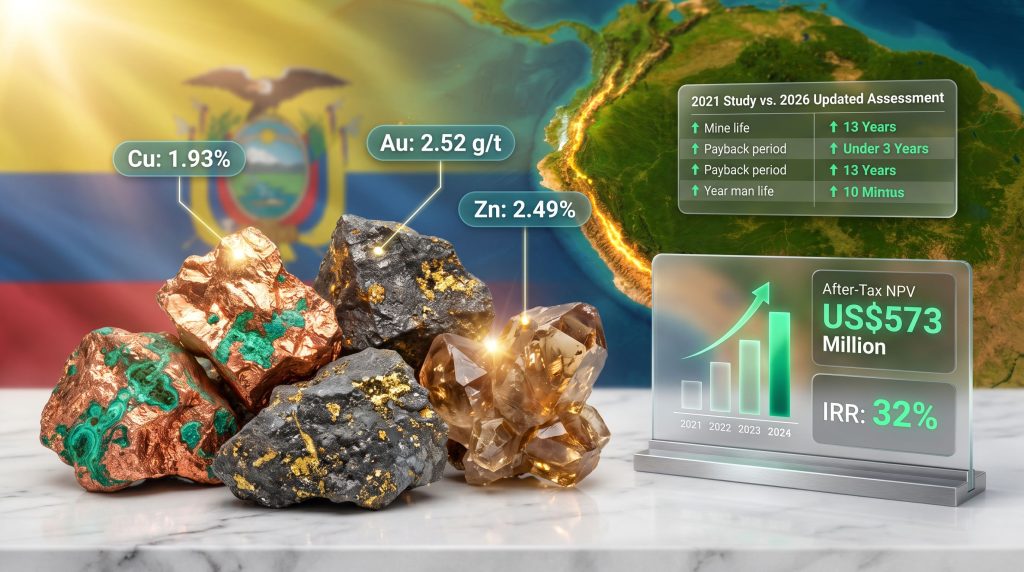
El Domo sits within Ecuador's Andean arc terrain, a geological corridor where convergent tectonic activity has preserved ancient VMS systems at mineable depths. What distinguishes El Domo from many VMS peers is the exceptional gold enrichment layered onto an already high-grade copper-zinc system. In most VMS deposits globally, gold grades hover below 1 gram per tonne. At El Domo, gold grades reach 2.52 g/t, which fundamentally changes the revenue structure of the operation.
VMS vs. Porphyry Copper: Why the Comparison Matters
The global copper industry has long been dominated by large-scale porphyry copper systems, particularly across Chile and Peru. However, porphyry deposits typically carry copper grades between 0.4% and 0.6%, requiring massive throughput volumes to generate equivalent metal output. VMS systems like El Domo operate from a different economic premise entirely: smaller tonnage, much higher grades, and meaningful multi-metal co-production.
| Feature | Porphyry Copper (Typical) | VMS System (El Domo) |
|---|---|---|
| Copper Grade | 0.4% to 0.6% | 1.93% |
| Gold Grade | Minimal to low | 2.52 g/t |
| Deposit Size | Very large (100s Mt) | Compact (11.4 Mt M&I) |
| Cost Structure | High volume, lower grade | High grade, by-product credits |
| Revenue Diversification | Limited | Strong (Cu, Au, Zn, Ag, Pb) |
This comparison is not academic. It explains why El Domo can achieve a cost structure that most large open-pit copper mines would struggle to match, even at significantly larger scales.
Reserve and Resource Profile: What the Numbers Actually Mean
The Grade Combination That Drives the Economics
The 2026 updated technical assessment, prepared by SRK Consulting, confirms a measured and indicated resource of 11.4 million tonnes and proven and probable open-pit reserves of 7.1 million tonnes. Understanding mineral deposit tiers is useful here, as the reserve grades across all five metals are as follows:
- Copper: 1.93%
- Gold: 2.52 g/t
- Zinc: 2.49%
- Silver: 46 g/t
- Lead: 0.2%
To contextualise these figures: the global average copper grade for open-pit mines in production is broadly estimated at below 0.6% copper. El Domo's copper grade alone is more than three times that average. Combined with gold grades that would be considered economic as a standalone gold deposit in many jurisdictions, the polymetallic nature of El Domo creates a revenue stack that structurally compresses net production costs far below what copper grades alone would suggest.
"Silver at 46 g/t is frequently underappreciated in project discussions. At current silver prices, this grade across 7.1 million tonnes of reserves contributes meaningfully to total revenue, functioning as a silent margin expander that rarely receives headline attention."
How the 2026 Feasibility Study Transforms the Project's Financial Case
A Dramatic Shift in Core Economic Metrics
The 2026 updated assessment represents a material re-rating of El Domo's investment profile relative to the 2021 feasibility study. The changes are not incremental adjustments; they reflect a fundamentally improved understanding of the resource, updated commodity price assumptions, and engineering optimisation.
| Economic Metric | 2021 Feasibility Study | 2026 Updated Assessment | Change |
|---|---|---|---|
| After-Tax NPV | ~US$260M (estimated) | US$573 million | +121% |
| Mine Life | 10 years | 13 years | +3 years |
| IRR | ~22% (estimated) | 32% | Significant uplift |
| Payback Period | ~4 years (estimated) | Under 3 years | Accelerated |
| Annual Ore Processed | Previous rate | 666,000 tonnes/year | Confirmed |
A 121% increase in after-tax NPV is not a routine study update. It signals that earlier modelling meaningfully underestimated the project's value, whether through conservative metal price assumptions, incomplete resource definition, or engineering parameters that have since been refined. For project stakeholders, this scale of NPV revision represents a genuine re-rating event.
Cost Structure and the By-Product Credit Advantage
The C1 cash cost of US$1.14 per pound of copper and AISC of US$1.26 per pound of copper-equivalent place El Domo in the lower quartile of global copper production costs. However, understanding how these figures are achieved is as important as the numbers themselves.
By-product credits work by assigning revenue from secondary metals (gold, zinc, silver, lead) against the total cost of producing copper, effectively reducing the reported cost per pound. At El Domo, the gold and zinc credits are substantial enough that the net copper production cost drops well below gross cash operating costs. This creates a natural hedge: if copper prices weaken but gold or zinc prices hold firm, the project's economics are partially insulated.
Furthermore, many new copper projects entering the development pipeline in 2026 carry AISCs between US$2.00 and US$2.80 per pound. El Domo's US$1.26 figure represents a structural cost advantage that is difficult to replicate without comparable polymetallic grade profiles.
Operational Design: Mine Plan, Throughput, and Production Targets
Annual Metal Output and Revenue Diversification
Based on the 666,000 tonne per year processing rate across a 13-year mine life, El Domo is expected to produce approximately:
- 10,463 tonnes of copper per year
- 21,390 tonnes of copper-equivalent per year (incorporating gold, zinc, silver, and lead contributions)
The gap between copper production and copper-equivalent production quantifies the by-product contribution. Approximately half of El Domo's economic output, measured in copper-equivalent terms, comes from metals other than copper. This level of revenue diversification is unusual for a project still primarily described as a copper mine.
Construction and First Production Timeline
| Milestone | Target Date |
|---|---|
| Advanced works / plant construction start | September 2025 |
| Full construction commencement | January 2026 |
| Pre-production build period | Approximately 18 months |
| First metal production | 2027 (targeted) |
The project's Andean location introduces genuine logistical considerations around power supply, water management, tailings facility design, and access infrastructure. Ecuador's terrain presents engineering challenges that are reflected in the capital cost structure, though these are not unusual for comparable projects in the region.
Disclaimer: Construction timelines and production targets are forward-looking estimates based on current project plans. Actual outcomes may differ materially due to regulatory, logistical, financing, or operational factors.
Ownership Structure and the Road to Construction
How El Domo Reached This Stage
Silvercorp Metals holds a 75% interest in El Domo, secured through its 2024 acquisition of Adventus Mining. Salazar Resources retains the remaining 25% interest, contributing local technical expertise and community relationships built over years of in-country presence.
The permitting history of El Domo is worth understanding in detail. A 2022 Ecuadorian court ruling confirmed full operational permitting for the project, resolving prior legal challenges that had created uncertainty around the development timeline. This judicial outcome was a prerequisite for the financing and construction planning that followed. It is important to note that this represented a legal resolution through Ecuador's established court system, not a government-directed development designation or special project status.
Ecuador's Mining Jurisdiction: Risk Profile and Fiscal Terms
Ecuador occupies a complex position within the Latin American mining landscape. Its geological endowment within the northern Andean arc is substantial, yet the country's mining regulatory framework has historically been less developed than those of Chile or Peru. This creates both opportunity and risk for project developers.
Ecuador's fiscal terms for large-scale mining, including royalty structures, corporate tax rates, and profit-sharing arrangements, have evolved materially over the past decade. The framework now broadly aligns with comparable Andean jurisdictions, though sovereign risk and political variability remain factors that project financiers incorporate into discount rate assumptions.
The next major ASX story will hit our subscribers first
Underground Expansion: The Hidden Upside in the Reserve Base
From Open-Pit to Extended Mine Life
The current 13-year mine life is based exclusively on open-pit reserves. However, additional inferred resource volumes sit outside the current proven and probable reserve categories, and ongoing infill drilling campaigns are designed to convert this material into measured and indicated status. Interpreting drilling results accurately is therefore critical to understanding how this resource conversion story may unfold.
If successful, underground development could extend El Domo's operational life to between 14 and 17 years under optimistic resource conversion scenarios. This represents meaningful additional NPV beyond the base case, though it is conditional on drilling results and incremental capital deployment.
The silver grade of 46 g/t carries particular significance for the underground expansion scenario. At depth, VMS deposits sometimes exhibit grade zonation, meaning that silver and lead concentrations can shift relative to copper and zinc. Understanding how El Domo's grade profile evolves with depth is a critical variable in modelling the underground optionality accurately.
How El Domo Benchmarks Against Global Copper-Gold Peers
Grade and Cost Comparison
| Project | Country | Cu Grade | Au Grade | AISC (US$/lb CuEq) |
|---|---|---|---|---|
| El Domo | Ecuador | 1.93% | 2.52 g/t | ~US$1.26 |
| Global open-pit Cu average | Various | ~0.4 to 0.6% | Minimal | ~US$2.00 to 2.50 |
| High-grade VMS peers | Various | 1.0 to 1.5% | 0.5 to 1.5 g/t | ~US$1.50 to 1.80 |
El Domo's grade and cost profile is exceptional not just relative to the average copper mine, but also relative to other high-grade VMS peers. The combination of 1.93% copper and 2.52 g/t gold in a single deposit is genuinely rare in the current global development pipeline.
What a 32% IRR Signals in the Current Capital Environment
Mining projects are broadly considered financially robust when they achieve IRRs above 20% under conservative commodity price assumptions. A 32% IRR suggests that El Domo generates strong returns even under scenarios where copper prices soften from current levels.
For project lenders evaluating debt capacity, and for streaming or royalty counterparties assessing upfront payment structures, this return profile provides meaningful headroom. A sub-3-year payback period on a capital-intensive mining project is, in addition, genuinely unusual. Most comparable copper developments targeting similar annual throughput carry payback periods of four to six years. The compression achieved at El Domo reflects the combination of high grades, multi-metal revenue, and a relatively lean capital cost structure for the scale of operation.
El Domo's Role in the Broader Copper Supply Narrative
The structural copper supply crunch emerging through the late 2020s and into the 2030s is well-documented in industry forecasts. Decades of underinvestment in new mine development, combined with accelerating demand from electrification, EV manufacturing, and grid infrastructure buildout, have created a gap between projected demand and confirmed supply that few new projects are positioned to address before 2030.
El Domo's 2027 first production target places it among a small cohort of projects capable of contributing meaningful new copper supply within the critical window before the deficit deepens. The copper price growth drivers underpinning this dynamic further reinforce why its polymetallic revenue structure, low cost position, and confirmed permitting status differentiate it from development-stage projects still navigating approvals processes or feasibility uncertainty.
The El Domo copper gold zinc study in Ecuador ultimately illustrates something broader about where value is being created in the mining sector: not in low-grade bulk tonnage, but in compact, high-grade, multi-metal systems where geology compresses costs, diversifies revenue, and accelerates payback in ways that conventional copper projects cannot replicate.
This article contains forward-looking statements and financial projections based on publicly available feasibility study data and industry estimates. Actual project outcomes, production figures, and economic results may differ materially from those discussed. This content does not constitute investment advice. Readers should conduct independent due diligence before making any investment decisions.
Want to Know When the Next High-Grade Discovery Hits the ASX?
Discovery Alert's proprietary Discovery IQ model scans ASX announcements in real time, instantly identifying significant mineral discoveries across copper, gold, zinc, and more than 30 other commodities — turning complex geological data into actionable investment insights for both new and experienced investors. Explore historic discoveries and the returns they generated, then start your 14-day free trial at Discovery Alert to position yourself ahead of the market.