
July 16, 2026
Peru's Copper Permitting Crisis Is Bigger Than One Election
The copper industry has spent the better part of a decade watching one of the world's most resource-rich nations slowly freeze itself out of the global supply chain. Peru sits atop extraordinary geological wealth, yet a combination of rotating governments, regulatory reversals, and entrenched community conflict has kept billions in copper investment locked in planning documents rather than production schedules. The arrival of a new administration with an explicit mandate to cut through that paralysis is being watched closely by markets, operators, and communities alike, each for entirely different reasons.
The question surrounding Keiko Fujimori copper fast-track in Peru is not whether the political will exists. It is whether the structural conditions necessary for meaningful acceleration can be built before that political will expires.
When big ASX news breaks, our subscribers know first
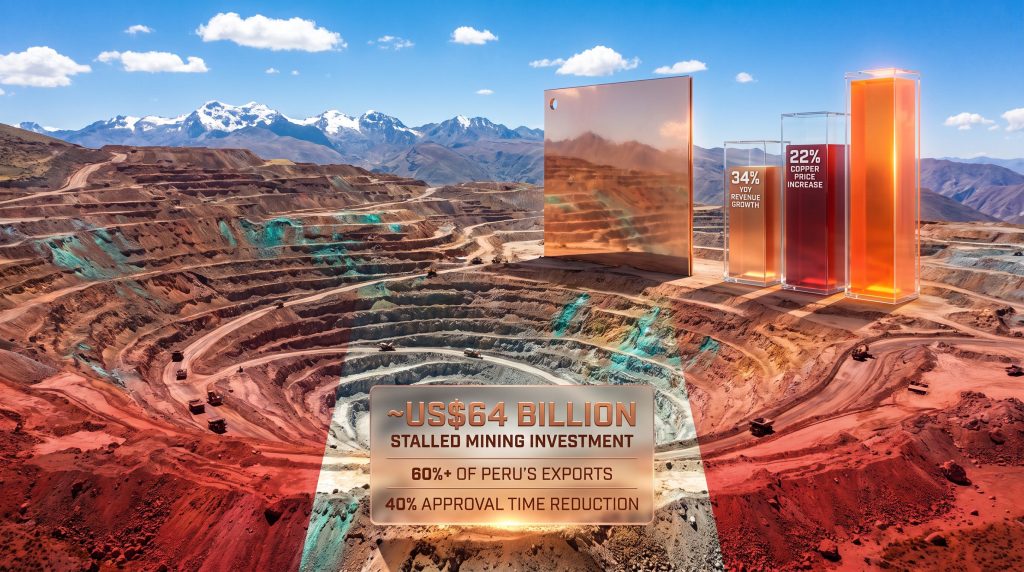
The Investment Freeze: Understanding Peru's US$64 Billion Problem
Peru's mining sector carries the weight of years of accumulated uncertainty. Successive administrations have approved, revised, suspended, and reinstated permits for major copper projects with a frequency that has made long-term capital planning extraordinarily difficult for international operators. The cumulative result is approximately US$64 billion in planned mining investment sitting in various stages of delay, a figure that represents not just lost revenue but lost development potential for some of the poorest rural regions in South America.
Copper is not merely an important export category for Peru. It is the structural foundation of the country's external trade, accounting for more than 60% of total exports. When copper projects stall, the fiscal consequences extend beyond the mining sector into infrastructure budgets, education spending, and regional development programmes. The broader economy bears the cost of regulatory dysfunction in ways that rarely appear in project-specific impact assessments.
Furthermore, Peru's ombudsman currently tracks close to 200 active social conflicts nationwide, with 64 of those directly linked to mining or environmental disputes. That number reflects not simply local resistance to individual projects, but a systemic breakdown in the relationship between extractive industries and the communities that share land and water resources with them. This is consistent with the broader copper supply crunch being felt globally, where constrained supply from politically complex jurisdictions is tightening available inventory.
| Metric | Figure |
|---|---|
| Total stalled mining investment | ~US$64 billion |
| Copper's share of Peru's total exports | 60%+ |
| Active social conflicts (national) | ~200 |
| Mining/environmental-related conflicts | 64 |
| Copper projects stalled nationwide (estimated value) | ~US$7 billion |
| Fujimori's proposed community revenue share | 40% of mining royalties |
| Target reduction in project approval times | 40% |
The Policy Architecture: How the Fast-Track System Is Designed to Work
A Single Digital Window and Strategic Classification
The centrepiece of Fujimori's economic agenda, branded as the "Peru with Order" platform, is a fast-track approval channel designed specifically for mining projects classified as strategically significant. The mechanism aims to consolidate what is currently a fragmented, multi-agency permitting process into a single digital interface, reducing inter-agency duplication and the bureaucratic delays that have historically allowed permits to stall between departments for months or years.
The proposed architecture includes several interconnected components:
- A dedicated fast-track channel for strategically classified projects, separating high-priority applications from the general permitting queue.
- A single digital permit window that coordinates submissions across environmental, land use, water rights, and construction authorities simultaneously.
- Tax incentives targeting companies that reinvest mining profits within Peru rather than repatriating capital.
- Infrastructure prioritisation through public-private partnerships, targeting road and rail corridors connecting inland mine sites to export ports.
- A community revenue redistribution model directing 40% of mining royalties to local populations via direct bank transfers, bypassing regional government intermediaries.
The stated objective is a 40% reduction in project approval timelines, which analysts have noted would represent a structural overhaul rather than a superficial administrative refresh. In addition, copper investment strategies that account for jurisdictional risk are increasingly factoring Peruvian reform timelines into their modelling.
What Makes This Attempt Different From Previous Reform Efforts
Prior administrations typically approached permitting reform reactively, responding to project-specific crises rather than redesigning the underlying approval architecture. The distinction Fujimori's team draws is between managing delays after they occur and building a system that prevents accumulation in the first place.
That said, independent observers have been measured in their expectations. Even under an optimised approval framework, new copper output from fast-tracked projects will not appear on production schedules immediately. Enabling legislation must be drafted and enacted, subordinate regulatory instruments must define exactly which projects qualify for strategic classification, and community consultation obligations do not disappear simply because a permit window becomes digital.
"Policy design and policy delivery are two separate problems. A 40% reduction in approval time means little to communities that have not yet agreed to the project being approved at all."
Canon Minero Reform: Revenue Redistribution as Conflict Prevention
How the Current System Works and Why It Has Failed Communities
Canon Minero is the statutory mechanism through which Peru allocates a share of mining tax revenues to the regions where extraction occurs. In principle, it is designed to ensure that host communities receive a financial return from the resources extracted beneath them. In practice, the system has channelled funds through regional government structures where they have frequently been absorbed into general budgets with limited visibility at the community level.
This opacity is central to the trust deficit that plagues Peru's mining sector. Communities that live adjacent to large copper operations, and in some cases bear environmental costs associated with them, have often seen little direct evidence of the revenue those operations generate. The disconnect between extraction and community benefit has been a recurring driver of conflict across the country's mining regions.
Fujimori's proposed reform addresses this directly by routing 40% of royalties to individual community members via bank accounts, eliminating regional government as an intermediary. The model draws on a logic similar to direct cash transfer programmes that have demonstrated effectiveness in other resource-dependent developing economies. According to analysis from Americas Mining Insights, the success of this approach will hinge heavily on implementation credibility at the community level.
The Electoral Geography Problem
There is a significant complication embedded in the redistribution strategy. The majority of Peru's primary copper-producing regions returned votes against Fujimori in the presidential election. This creates a structural trust deficit that exists before a single permit is processed or a single royalty payment is made.
Communities with prior conflict histories are unlikely to receive revenue redistribution promises at face value, particularly from an administration they did not support. The risk is that fast-track approvals are interpreted as top-down imposition rather than collaborative development, triggering exactly the unrest the redistribution model is meant to prevent.
Revenue promises have preceded, rather than prevented, major mining conflicts in Peru's recent history. Execution credibility will matter far more than policy design in communities where institutional trust has been eroded over years of unfulfilled commitments.
Tía María: The Project That Carries the Entire Debate
A Decade of Conflict Condensed Into One Copper Mine
No single asset illustrates the complexity of Peru's mining environment more completely than Tía María. The US$1.8 billion copper development in Arequipa, operated by Southern Peru Copper Corporation, a subsidiary of Mexico's Grupo México, has been at the centre of the country's mining conflict narrative for more than a decade.
Protests between 2011 and 2015 turned violent, resulting in fatalities and an extended project suspension. The social wounds from that period never fully healed. In March 2026, Peru's Mining Council revoked Tía María's operating permit, voiding an October 2025 authorisation on the grounds that it lacked adequate legal justification and sufficient documentation around waste management infrastructure.
Authorities framed the reversal as procedural rather than definitive, and the project has since recovered its regulatory pathway toward a projected 2027 operational start. However, the episode demonstrated with clarity how quickly permit status can change around even the most advanced copper development in the country. This volatility echoes challenges observed at other major copper system projects across South America.
The mine is designed to produce 120,000 tonnes of copper cathodes annually, making it a material contributor to national output figures. For that production to become real, environmental advocacy groups, water rights holders, and farming communities in the Tambo Valley all need to reach a level of confidence that the project will not compromise agricultural water supplies. That confidence has been slow to build and fast to erode.
The Contradiction at the Heart of the Fast-Track Agenda
Fujimori has publicly stated that drinking water and agricultural use must take precedence over mining extraction. She has also criticised what she characterised as misleading community engagement practices at certain copper projects. These positions sit in tension with the commercial logic of a policy designed to accelerate approvals by 40%.
Fast-tracking a project that the incoming president has publicly questioned on community engagement grounds is not a contradiction that administrative efficiency can resolve. It points to a deeper challenge: the fast-track system's credibility will be tested most severely at precisely the projects with the most complex social histories.
Southern Copper and Grupo México: The Financial Stakes
A US$8.5 Billion Expansion Portfolio Exposed to Peruvian Risk
Southern Copper Corporation, which trades under the ticker SCCO and is controlled by Grupo México through Americas Mining Corporation, is Peru's largest copper producer, accounting for approximately 15% of national output. The company has directed roughly US$15 billion into copper operations across Peru and Mexico over the past decade, making Peruvian regulatory stability a foundational assumption in its long-term capital plan.
The Peruvian expansion portfolio spans four projects:
- Tía María (Arequipa): 120,000 tonnes of copper cathodes annually, targeted 2027 start
- Los Chancas: Advanced-stage copper and molybdenum project in Apurímac
- Michiquillay: Large-scale copper porphyry deposit in Cajamarca
- Cuajone expansion: Incremental output growth at an existing operation
Together, the portfolio carries a combined value of US$8.5 billion and targets 520,000 additional tonnes of copper output over the coming decade. The scale of that commitment makes Peruvian political risk directly material to the company's earnings trajectory.
Record Financial Performance Against a Backdrop of Uncertainty
Southern Copper's most recent financial results reflect the commercial opportunity that the copper price environment has created, even as project-level risks persist.
| Financial Metric | Figure |
|---|---|
| Net income (most recent reporting period) | ~US$1.43 billion |
| Revenue (most recent reporting period) | ~US$5.15 billion |
| Year-on-year revenue growth | 34% |
| Copper price increase (contributing factor) | 22% |
| Total Peruvian expansion portfolio value | US$8.5 billion |
| Tía María annual production target | 120,000 tonnes copper cathodes |
A 22% rise in copper prices has provided meaningful earnings support, but commodity tailwinds do not insulate operators from community conflict or permit reversals. The gap between strong financial performance and stalled production growth in Peru reflects exactly the kind of execution risk that investors in copper-exposed equities need to weigh carefully.
The Leadership Transition at a Critical Moment
The passing of long-serving Southern Copper executive Óscar González in April 2026 removed a figure who had spent more than 25 years building relationships in Peru's mining regions. His approach was defined by a consistent effort to position mining and agriculture as mutually compatible activities, including investments in water infrastructure in the Tambo Valley designed to demonstrate that the company's presence did not threaten farming communities' livelihoods.
Sustaining that community dialogue under new leadership, during a period of political transition and accelerated permitting pressure, is an institutional challenge that financial metrics do not capture. The quality of community relations work in Arequipa over the next 12 to 24 months may ultimately determine whether Tía María's 2027 target holds.
The next major ASX story will hit our subscribers first
Río Blanco and the Geopolitical Dimension
Chinese Capital in Peru's Conflict Landscape
The Observatory of Mining Conflicts flagged Río Blanco, a copper project backed by China's Zijin Mining, as a secondary flashpoint alongside Tía María. The project introduces a dimension that goes beyond domestic regulatory dynamics, as community relations strategies and stakeholder engagement models employed by Chinese-backed operators in Latin America have frequently differed from those of North American or European counterparts.
How Fujimori's fast-track classification framework applies to projects with distinct ownership structures, community histories, and geopolitical associations will be an early signal of whether the policy operates on commercially neutral criteria or reflects broader investment preferences. Consequently, copper project partnerships between majors and juniors operating in such jurisdictions may face additional scrutiny under the new framework.
Regional Comparison: How Peru's Reform Stacks Up
| Country | Reform Approach | Outcome |
|---|---|---|
| Chile | Environmental Impact Assessment modernisation | Reduced average permitting time; persistent community opposition in some regions |
| Mexico | Sector-specific concession review mechanisms | Mixed results; significant conflict in indigenous territories |
| Brazil | Federal-state permit coordination reforms | Improved throughput for large-scale projects; ongoing Amazon-region tensions |
| Peru (proposed) | Single digital window plus fast-track classification | Projected 40% approval time reduction; community trust deficit unresolved |
The regional comparison is instructive. No Latin American jurisdiction has found a permitting reform model that simultaneously accelerates approvals and resolves community opposition. The two objectives require different tools and different timelines, and conflating them tends to generate neither outcome effectively. For instance, the Reko Diq copper project in Pakistan offers a parallel case study in how sovereign-level political commitment can revive stalled assets, though the community dynamics differ considerably from Peru's.
The Five Variables That Will Determine Whether Fast-Track Delivers
Investors and operators assessing exposure to the Keiko Fujimori copper fast-track in Peru should monitor five sequenced conditions:
- Legislative enactment speed: Enabling regulations defining strategic project classification criteria must be passed after the July 28 inauguration before any fast-track mechanism becomes operational.
- Digital window implementation: The single permit portal requires genuine inter-agency coordination protocols, not simply a shared submission interface.
- Community consultation integrity: Consultation frameworks must satisfy legal requirements and Fujimori's own stated environmental standards, a bar that is higher than simple procedural compliance.
- Infrastructure procurement timelines: PPP approvals for road and rail corridors are on the critical path for several projects and carry their own regulatory sequences.
- Operator engagement quality: Companies operating in regions with conflict histories cannot rely on permit acceleration to substitute for relationship-building work that takes years to develop.
However, as Reuters reported on Peru's mining investment outlook, even optimistic projections carry material downside risk if community opposition intensifies. Furthermore, a study cited by US News warned that aggressive permitting acceleration could spur unrest in regions that already carry deep grievances toward extractive industries. These findings reinforce the view that the Keiko Fujimori copper fast-track in Peru will ultimately be judged not by its legislative design, but by its execution across communities that have heard similar promises before.
Disclaimer: This article contains forward-looking assessments of regulatory policy, mining investment timelines, and political outcomes. These assessments involve inherent uncertainty and should not be construed as financial advice. Actual outcomes may differ materially from projections based on political, regulatory, social, or commodity market developments.
Want to Stay Ahead of the Next Major Copper Discovery?
Discovery Alert's proprietary Discovery IQ model delivers real-time alerts on significant ASX mineral discoveries, instantly translating complex geological and commodity data into actionable investment insights — so subscribers can identify opportunities well ahead of the broader market. Explore Discovery Alert's dedicated discoveries page to understand how historic mineral discoveries have generated substantial returns, and begin your 14-day free trial today to position yourself at the forefront of the next major find.