July 16, 2026
When Two Commodity Cycles Collide Inside One Portfolio
Mining investors often assume that a diversified commodity portfolio insulates large producers from single-market volatility. In reality, diversification creates a different kind of complexity: the simultaneous management of assets operating at completely different points in their respective demand and grade cycles. This tension is rarely more visible than when a company's flagship commodities diverge sharply in the same reporting period.
That is precisely the dynamic playing out across BHP's (ASX: BHP) FY26 production results. As BHP copper production falls against the prior year, iron ore has reached a milestone that redefines what operational excellence looks like in the Pilbara. Understanding why these two outcomes coexist, and what they signal for the sector's longer-term trajectory, requires looking well beyond the headline numbers.
When big ASX news breaks, our subscribers know first
Iron Ore Rewrites the Record Books at WAIO
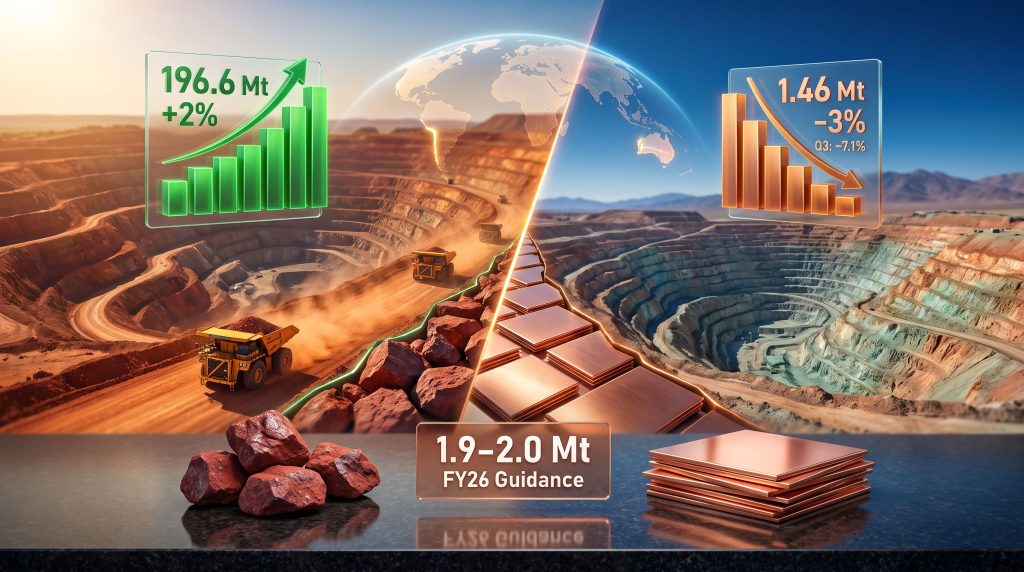
BHP's Western Australia Iron Ore division delivered 196.6 million tonnes of production in FY26 year-to-date, a 2% improvement over the equivalent prior period and the highest output level the operation has achieved. The result was not purely the product of new infrastructure coming online. It reflects something more systemic: the convergence of supply chain maturity, autonomous technology deployment, and the progressive commissioning of the South Flank mine into a cohesive operational whole.
South Flank, which replaced the ageing Yandi mine, is one of the largest iron ore projects developed in Australia in recent decades. Its ore grades are meaningfully higher than Yandi's, and the incremental tonnage it contributes to the WAIO system has allowed BHP to lift output without proportional increases in processing costs. As South Flank continues ramping toward its nameplate capacity of approximately 80 million tonnes per annum, its influence on system-wide throughput will only grow.
Beyond the mine itself, BHP's port and rail coordination across the Pilbara played a measurable role in achieving the record. Logistics bottlenecks have historically constrained production even when mines are performing well. The FY26 result suggests those constraints have been progressively addressed through:
- Expanded use of autonomous haulage fleets across multiple mine sites
- Improved stockpile management and blending discipline at port
- Tighter integration between rail scheduling and vessel loading sequences
- Continued investment in maintenance strategies that reduce unplanned downtime
The record at WAIO illustrates an important principle: in mature mining operations, the greatest production gains often come not from additional resource extraction, but from optimising the systems that move material from pit to port.
This has direct relevance for how investors should evaluate large-cap iron ore producers. Throughput efficiency, rather than resource endowment, increasingly determines who captures value at the top of the production curve.
The Pilbara Context: A Region Nearing Its Operational Ceiling
BHP's record does not exist in isolation. Rio Tinto (ASX: RIO) recently marked the cumulative shipment of 8 billion tonnes of iron ore from the Pilbara since its first export sailed to Japan more than six decades ago. Fortescue (ASX: FMG) separately achieved a historic milestone by shipping 200 million tonnes in a single financial year for the first time.
Collectively, these achievements confirm that the Pilbara iron ore province is operating at or near its practical production ceiling under current infrastructure configurations. The implications are significant:
| Producer | Recent Milestone | Key Driver |
|---|---|---|
| BHP (WAIO) | Record 196.6 Mt FY26 YTD | South Flank ramp-up, logistics optimisation |
| Rio Tinto | 8 billion cumulative tonnes shipped | 60 years of infrastructure maturity |
| Fortescue (FMG) | 200 Mt shipped in single financial year | Fleet expansion, port debottlenecking |
Future volume growth across the Pilbara will increasingly depend on incremental debottlenecking, port capacity augmentation, and autonomous technology rather than greenfield mine development. That context matters enormously for assessing revenue quality: record production volumes do not automatically translate to record revenues when iron ore price realisations remain tied to China steel demand, property sector conditions, and shifting trade policy dynamics.
BHP Copper Production Falls: Unpacking the 3% Decline
While iron ore was breaking records, BHP copper production falls across the division as it navigated a more difficult operating environment. Full-year-to-date copper output came in at 1.46 million tonnes, representing a 3% decline compared to the prior corresponding period. The steepest contraction occurred in the third quarter, where production fell 7.1% to 476,800 tonnes, the sharpest single-quarter drop in the FY26 reporting cycle.
The primary cause was ore grade deterioration at BHP's Chilean operations, specifically Escondida and Spence. Understanding why grade decline matters so deeply to copper economics requires a short geological explanation. Furthermore, the copper supply crunch playing out globally makes these operational nuances all the more consequential for long-term pricing.
The Geology Behind the Numbers: Why Ore Grade Is Everything in Copper Mining
Open-pit copper mines like Escondida extract ore in what geologists call a grade shell, where the highest-concentration copper mineralisation is typically found in the upper portions of the orebody, transitioning to lower-grade and more mineralogically complex material at depth. As surface and near-surface zones are mined out, operators must progressively access material with lower copper content per tonne of rock processed.
This is not a malfunction. It is a mathematically predictable feature of the mine life curve, baked into every open-pit copper project's feasibility study. The critical variable is how well an operator manages the grade transition period, which typically requires one or more of the following responses:
- Increasing concentrator throughput to process more tonnes of lower-grade material
- Selective mining to target remaining higher-grade domains within the pit
- Leaching supplementary oxide material to maintain payable copper output
- Advancing the mine plan into the next higher-grade ore zone as quickly as scheduling allows
At Escondida, BHP pursued the throughput strategy aggressively, achieving record concentrator throughput and record material mined during the period. This is a critical technical detail that the headline copper production figure alone does not reveal. The concentrator was processing more tonnes than ever before, but declining feed grade meant the copper-in-concentrate output still fell short of prior-year comparatives.
Compounding this, Escondida encountered complex ore mineralogy during Q3. Mixed oxide-sulphide ore transitions are notoriously difficult to process efficiently, as the optimal flotation chemistry for sulphide ores can produce poor recoveries when oxide mineralogy is present in significant proportions. This reduces the percentage of copper that is successfully captured during processing, amplifying the impact of grade decline on final output. Indeed, cut-off grade economics play a central role in determining which ore is even sent to the concentrator in the first place.
| Operational Variable | Impact on Copper Output | BHP FY26 Status |
|---|---|---|
| Ore Feed Grade | Direct positive correlation | Declined at Escondida and Spence |
| Concentrator Throughput | Partial compensating factor | Record levels achieved at Escondida |
| Ore Complexity (oxide-sulphide) | Inverse impact on recovery rates | Elevated during Q3 |
| Mine Plan Sequencing | Determines grade profile trajectory | H2 recovery anticipated |
Full-Year Guidance Held: What BHP Needs from the Second Half
Despite the year-to-date shortfall, BHP retained its full-year copper production guidance of 1.9 to 2.0 million tonnes and indicated the company expects to land in the upper half of that range. For that outcome to materialise, the second half needs to deliver meaningfully stronger output than H1.
The conditions required for that recovery to occur are technically plausible:
- Mine plan sequencing at Escondida is expected to access higher-grade ore zones in H2 as pit development advances
- Concentrator performance is already at record throughput levels, meaning volume capacity is not the constraint
- Spence's grade profile, while under pressure, benefits from supplementary heap leach operations that can sustain copper cathode output independently of concentrator feed quality
The retention of upper-half guidance is not simply a public relations exercise. It reflects BHP's internal mine planning confidence that H2 ore zones will deliver the grade improvement needed to lift recovered copper volumes back toward the required run-rate.
Investors should, however, note that guidance maintained under grade pressure carries execution risk. If mine plan sequencing encounters unexpected geological variability, or if concentrator recovery rates remain suppressed, the upper-half target becomes harder to defend. This is a key variable to monitor in BHP's Q4 production release.
Copper's Earnings Supremacy: The Hierarchy Has Already Shifted
Perhaps the most structurally significant detail buried within BHP's FY26 results is this: copper contributed more to BHP's first-half earnings than iron ore, marking a reversal of the historical earnings hierarchy that has defined the company for decades. According to BHP's operational review, this shift underscores just how rapidly the earnings mix is evolving.
This shift reflects two converging forces. First, copper prices have sustained elevated levels globally, driven by structural demand growth across electric vehicle production, grid-scale energy storage, renewable power generation, and the rapid expansion of data centre infrastructure. Second, iron ore price realisations have softened relative to their post-pandemic peaks, compressing margins even as volumes reach records.
The energy transition demand thesis for copper is well understood at a macro level, but the supply-side constraint is less commonly appreciated. Global copper mine supply growth has consistently underperformed demand projections for the past decade, constrained by:
- Declining ore grades at major established operations worldwide, not just at BHP
- Permitting timelines for new copper projects averaging 16 to 20 years from discovery to first production in many jurisdictions
- Water scarcity challenges in the Atacama Desert region of Chile, which hosts the world's largest copper operations
- Social licence conflicts and community opposition to new mine development in copper-rich regions of South America and Central Africa
These structural supply constraints mean that even a temporary production dip at Escondida contributes to a tighter global copper balance, which in turn supports the price environment that is now making copper BHP's most profitable commodity on an earnings-contribution basis.
Comparing Transition Metal Strategies Across ASX Mining Majors
BHP is not the only ASX major repositioning around critical minerals. The strategic race toward copper, lithium, and transition metals is reshaping capital allocation across the sector's largest players. The BHP strategic pivot away from coal and toward transition metals represents one of the most deliberate portfolio transformations in the company's recent history.
| Company | Primary Commodity | Transition Metal Strategy | Key Asset or Move |
|---|---|---|---|
| BHP (ASX: BHP) | Iron Ore | High copper weighting, growing | OZ Minerals acquisition, Escondida expansion |
| Rio Tinto (ASX: RIO) | Iron Ore | Lithium and copper growth | Rincon lithium project, Oyu Tolgoi copper |
| South32 (ASX: S32) | Diversified base metals | Copper growth via Hermosa | Hermosa project in Arizona, USA |
BHP's acquisition of OZ Minerals in 2023 was the most consequential copper-focused transaction in its recent history, adding the Prominent Hill and Carrapateena copper-gold operations in South Australia to its portfolio and deepening its exposure to the Australian copper growth story. Meanwhile, the Rio Tinto copper expansion strategy provides a useful benchmark for how ASX mining majors are approaching the same structural demand opportunity from different starting positions. These assets provide geographic and operational diversification away from the Chilean grade pressure that is currently weighing on near-term output.
The next major ASX story will hit our subscribers first
What the Divergence Signals for Investors and the Sector
The simultaneous occurrence of record iron ore production and declining copper output at BHP is not a contradiction requiring resolution. It is a vivid illustration of what commodity cycle management looks like inside a globally diversified mining major.
Iron ore is a volume game at this point in its cycle. The Pilbara systems are mature, throughput-optimised, and approaching physical capacity limits. Earnings quality from iron ore will consequently be determined more by cost control and price realisation than volume growth.
Copper, by contrast, is in an earlier and more dynamic phase of its strategic cycle for BHP. Grade pressure at Escondida is a near-term operational challenge, but the structural demand trajectory underpinning copper investment is measured in decades. BHP's record concentrator throughput at Escondida, even during a period of grade headwinds, demonstrates the operational infrastructure is capable of delivering strongly when higher-grade ore zones are accessed. Industry observers have noted this distinction in detail, with recent production analysis highlighting how BHP's throughput achievements represent a genuine operational milestone regardless of grade conditions.
The divergence between BHP's copper decline and iron ore record is not a story about one business outperforming another. It is a portrait of how large mining operators navigate the reality that different commodities, different geologies, and different demand cycles rarely align neatly within the same financial year.
For investors, the medium-term question is not which commodity is performing better in FY26. It is which commodity will define BHP's earnings profile as the decade progresses. Based on current capital allocation priorities, the acquisition history, and the structural demand fundamentals underpinning the global energy transition, copper is positioning itself as the answer.
This article contains forward-looking statements and analysis based on publicly available production data and market observations. It does not constitute financial advice. Investors should conduct independent research and consider their own financial circumstances before making investment decisions.
Want to Track the Next Major Copper or Iron Ore Discovery Before the Market Moves?
Discovery Alert's proprietary Discovery IQ model scans ASX announcements in real time, instantly identifying significant mineral discoveries across copper, iron ore, and more than 30 other commodities — turning complex data into actionable investment insights for traders and long-term investors alike. Explore historic examples of major discovery returns and begin your 14-day free trial at Discovery Alert to position yourself ahead of the broader market.