July 16, 2026
The Quiet Signal Behind a Major Equipment Win in Latin America's Copper Belt
When a Tier-1 original equipment manufacturer secures a large drilling equipment contract at a major copper mine, the transaction rarely makes front-page financial news. Yet for those who track capital flows and production timelines in the global mining sector, these procurement decisions function as some of the most reliable leading indicators available. Equipment orders of this scale are placed well ahead of production ramp-ups, meaning they reveal operator intent before quarterly output figures ever confirm it.
The recent Epiroc order for a Peru copper mine, announced in July 2026, is precisely this kind of signal. Encompassing drill rigs, drilling tools, and associated services, the order points toward active expansion activity at one of South America's most important copper-producing nations. Understanding what it means requires stepping back from the transaction itself and examining the broader forces shaping copper supply investment in 2025 and 2026.
When big ASX news breaks, our subscribers know first
Peru's Structural Importance to the Global Copper Supply Chain
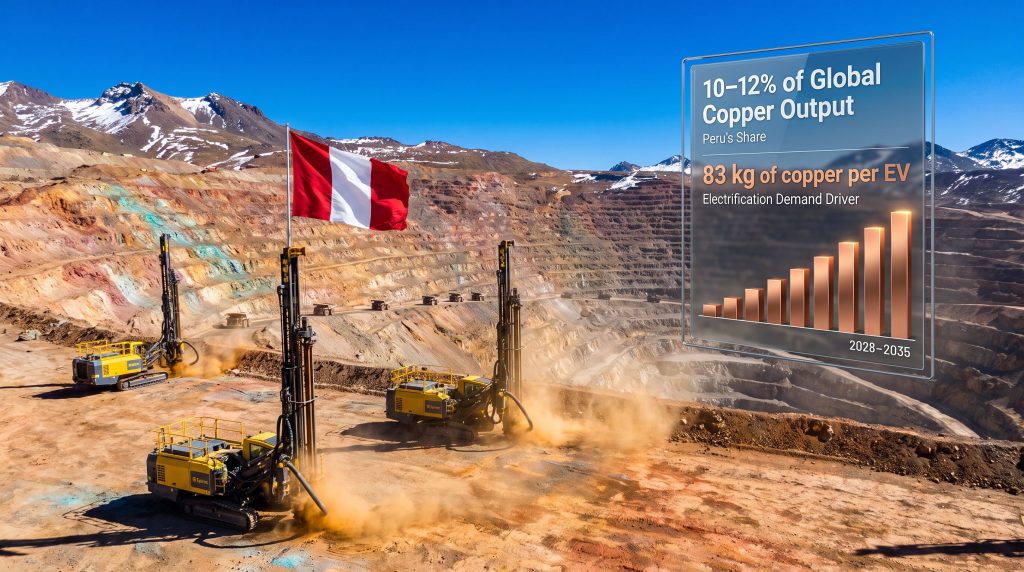
Peru consistently ranks as the world's second-largest copper producer, responsible for roughly 10 to 12 percent of global copper output each year. The country's major operating mines, including Las Bambas, Quellaveco, Antapaccay, Toromocho, and Cerro Verde, collectively generate billions of dollars in annual export revenue and represent some of the most capital-intensive mining operations on the planet.
What makes Peru particularly significant from an equipment investment perspective is the technical complexity of its deposits. Many of the country's largest copper ore bodies sit at elevations between 3,500 and 5,000 metres above sea level, deep within the Andes mountain range. Operations at these altitudes require:
- Modified engine configurations to compensate for reduced air density and combustion efficiency
- Enhanced hydraulic systems capable of performing reliably in extreme cold and variable humidity
- Dust suppression systems engineered for dry, high-altitude environments
- Specialised rock tools designed for the abrasive, hard-rock porphyry copper geology that characterises Peru's most productive ore bodies
These technical requirements do not simply raise the cost of operations. They effectively narrow the field of viable equipment suppliers to those OEMs with proven deployment experience in comparable geological and environmental conditions. That selective dynamic is a critical, often underappreciated factor in understanding why large equipment contracts in Peru tend to cluster around a small number of established manufacturers.
Porphyry copper deposits, which account for the majority of Peru's copper production, are characterised by large, low-grade ore bodies requiring high-volume drilling programs and significant mechanised fleet investments. A single large-scale porphyry operation may run dozens of drill rigs simultaneously across production, grade control, and development drilling phases.
What the Epiroc Peru Copper Mine Order Actually Encompasses
Epiroc AB, the Swedish OEM spun off from Atlas Copco in 2018, announced the Epiroc order for a Peru copper mine without disclosing the name of the mine operator. This approach is standard practice in the industry. Large mining equipment contracts frequently precede formal capital expenditure announcements by the mine operator, and confidentiality provisions are common in procurement agreements tied to expansion phases that have not yet been publicly disclosed by the operating company.
The order covers three interconnected categories:
- Drill rigs designed for surface and underground copper mining applications, most likely including surface blast-hole or production drill platforms suited to large open-pit or combined operations
- Drilling tools and consumables, encompassing down-the-hole (DTH) hammers, drill bits, and rock tools engineered for high-abrasion copper ore environments
- Associated services, which typically include long-term service agreements (LTSAs), parts supply arrangements, and technical support contracts that extend well beyond the initial equipment delivery
The bundling of services into the order is particularly meaningful. It signals a multi-year commercial relationship rather than a one-off hardware transaction, and it reflects the dominant procurement model now used across Tier-1 copper operations globally.
The Long-Term Service Agreement Model: A Structural Shift in Mining Procurement
One of the most consequential but least-discussed changes in mining equipment procurement over the past decade is the widespread adoption of long-term service agreements as the standard commercial structure for major OEM contracts. Understanding this shift provides important context for interpreting the Epiroc Peru order.
Under traditional procurement models, mine operators purchased equipment outright and managed maintenance internally or through third-party contractors. Under the LTSA model, the OEM retains responsibility for maintenance, parts supply, and equipment performance guarantees over a contracted period, typically ranging from three to ten years.
| Procurement Model | Operator Benefit | OEM Benefit |
|---|---|---|
| Outright purchase | Full ownership, flexibility | Single revenue event |
| LTSA-bundled contract | Predictable cost, guaranteed uptime | Recurring high-margin revenue |
| Fleet management agreement | Reduced capital outlay | Long-term client retention |
| Digital service integration | Real-time performance data | Upsell pathway to automation |
For OEMs like Epiroc, the LTSA component of large orders generates revenue streams that can exceed the initial equipment sale value over the contract term. Furthermore, it creates a structural barrier to competitor entry, since switching OEMs mid-contract involves significant operational disruption and retraining costs. This is why securing a large expansion-phase order in Peru is strategically valuable well beyond the immediate order intake figures.
Epiroc's Competitive Position in Latin America's Drill Rig Market
Epiroc operates across more than 150 countries and has built a particularly strong presence across Latin America's major copper, gold, and lithium producing regions. The company's primary competition in the large-scale mining drill rig market comes from Sandvik Mining and Rock Solutions, Komatsu Mining, and Caterpillar, each of which maintains significant footholds in the Peruvian market.
Sandvik has historically held a strong position across underground hard-rock operations in the Andes, while Caterpillar's dominance in large surface mining equipment (particularly haul trucks and motor graders) gives it cross-selling opportunities in drill rig procurement. Epiroc's competitive differentiation in this context likely centres on several factors:
- Its SmartROC and Pit Viper surface drill rig platforms, which are widely deployed at large open-pit copper operations globally and have a documented track record in high-altitude environments
- Its Lima-based regional operations hub, which provides logistical support for parts delivery and technical service in challenging Andean terrain
- Its 6th Sense automation and connectivity suite, which allows mine operators to monitor drill rig performance in real time and integrate drilling data into mine planning systems
- A commercial model that bundles hardware, consumables, and services into a single contract, simplifying procurement processes for large operators managing complex multi-vendor supply chains
A lesser-known competitive dynamic in the Peruvian market is the role of altitude certification in OEM selection. Equipment manufacturers must demonstrate that their drill rig platforms maintain specified performance parameters at elevation, including rotational torque output, feed force, and air compressor efficiency. Rigs that underperform at altitude create costly downtime scenarios that ripple across interconnected mine planning schedules.
How Equipment Orders Function as Production Timeline Indicators
From an industry intelligence perspective, large equipment orders placed in support of mine expansion are among the most reliable forward-looking signals available outside of formal operator guidance. The reasoning is straightforward: lead times for large drill rigs typically range from six to eighteen months from order placement to site delivery, depending on configuration complexity and manufacturing queue depth.
This means an equipment order announced in mid-2026 points toward a planned production ramp-up or development drilling campaign commencing somewhere between late 2026 and mid-2028. By extension, a confirmed drilling program investment of this scale signals that:
- The mine operator has, with high probability, completed or substantially progressed the permitting processes required for expansion activity
- Social licence conditions, including community relations and land access agreements, are sufficiently resolved to commit major capital
- Project financing or internal capital allocation for the expansion has been secured at the corporate level
- The operator holds sufficient confidence in long-term copper price assumptions to justify the investment
This cluster of prerequisites means that a confirmed large equipment order carries significant informational weight for anyone tracking Peruvian copper supply timelines.
The next major ASX story will hit our subscribers first
The Electrification Demand Cycle and Its Implications for Peruvian Production Expansion
The underlying rationale for mine expansion investment in Peru is inseparable from the structural transformation of global energy systems. Indeed, the energy transition demand for copper continues to intensify, with each electric vehicle requiring approximately 83 kilograms of copper, compared to roughly 23 kilograms in a conventional internal combustion engine vehicle.
Offshore wind turbines require around 8 tonnes of copper per megawatt of installed capacity, and grid-scale battery storage systems, solar infrastructure, and transmission network upgrades add further layers of demand. Global copper demand is widely projected to approach or exceed double its current levels by the mid-2030s, driven by the convergence of EV adoption, renewable energy deployment, and grid modernisation investment across Asia, Europe, and North America.
The critical supply-side challenge is that bringing new copper mines into production takes 10 to 20 years from initial discovery through to full production, while expanding existing operations typically requires three to seven years from feasibility to ramp-up. Consequently, a major porphyry copper mine that expands production capacity in 2027 or 2028 will be positioning its output to serve the steepest portion of the demand curve, where the global copper supply gap is most acutely forecast.
Equipment OEMs are, in this context, indirect but highly exposed beneficiaries of the electrification megatrend. Every tonne of incremental copper production requires drilling infrastructure, and every expansion phase at a major mine represents a substantial equipment procurement cycle.
Why the Copper Supply Crunch Makes Peru Critical
The copper supply crunch facing global markets in the coming decade makes expansion activity at established, permitted operations in Peru particularly important. However, the country's regulatory complexity means that not all planned expansions reach the equipment procurement stage.
Peru's mining approval framework is among the most multi-layered in Latin America. Expansion projects must navigate:
- Environmental Impact Assessments (EIAs) administered through the Ministry of Energy and Mines (MINEM), which can take between two and five years to complete for major modifications
- Oversight from the Environmental Assessment and Oversight Agency (OEFA), which monitors ongoing compliance at operating mines
- Regional government consultations, which introduce additional timeline variability for projects affecting communities under regional jurisdiction
- Prior consultation processes under ILO Convention 169, required when expansion activity affects indigenous communities, adding procedural layers that can extend project timelines by one to three years beyond standard EIA processes
The last point is rarely discussed in mainstream mining coverage but represents one of the most significant sources of project delay risk in Peru. Operations that have successfully navigated prior consultation and obtained community consent are genuinely de-risked in ways that regulatory approval alone cannot replicate.
A mine operator placing a large expansion-phase equipment order has, by implication, cleared enough of this regulatory and social licence complexity to commit material capital. That signal should not be underestimated by those monitoring copper price growth drivers or supply chain developments.
Frequently Asked Questions: Epiroc Order for Peru Copper Mine
What type of equipment is included in the Epiroc Peru copper mine order?
The order covers drill rigs, drilling tools including DTH hammers and drill bits, and associated services. The combination indicates a comprehensive fleet supply arrangement supporting expansion-phase drilling across production and development workings.
Why has Epiroc not disclosed which mine the order is for?
Client confidentiality provisions are standard in large OEM procurement contracts, particularly when the mine operator has not yet made a corresponding public disclosure of its expansion capital expenditure plans. This practice is consistent across the mining equipment industry.
How large is the order in financial terms?
Epiroc classifies orders exceeding approximately SEK 100 million (roughly USD 9 to 10 million) as large orders in its financial reporting. However, when multi-year service components are included, the total contract value across the full engagement period may be substantially higher than the initial hardware value.
What does the order tell us about copper supply timelines?
Equipment lead times of six to eighteen months mean this order is a credible indicator of increased copper production activity at the relevant mine sometime between late 2026 and mid-2028, during a period when supply constraints are most acute relative to accelerating demand.
How does altitude affect drill rig selection for Peruvian mines?
High-altitude operations require equipment certified to maintain specified performance outputs at reduced atmospheric pressure. Rigs that cannot sustain rotational torque, feed force, and compressor efficiency at elevation create costly downtime events, making altitude certification a genuine selection criterion, not merely a technical formality.
Disclaimer: This article contains forward-looking statements and industry projections based on publicly available data and general market analysis. It does not constitute financial or investment advice. Readers should conduct independent research before making investment decisions. Demand forecasts and production timeline estimates are inherently subject to uncertainty.
Want to Catch the Next Major Copper Discovery Before the Market Does?
Discovery Alert's proprietary Discovery IQ model delivers real-time alerts on significant ASX mineral discoveries — instantly translating complex geological data into actionable insights for both traders and long-term investors. Explore historic discoveries and their exceptional market returns, then begin your 14-day free trial to position yourself ahead of the next major copper find.