August 20, 2026
The Hidden Infrastructure Gap Driving Long-Term Cobalt Supply Deals
Most discussions about the battery metals transition focus on mining output, electric vehicle adoption curves, or cathode chemistry debates. Far less attention is paid to the processing bottleneck sitting between raw ore extraction and battery-ready chemical production. Cobalt refining, specifically the conversion of cobalt hydroxide feedstock into battery-grade cobalt sulfate, represents one of the most concentrated and geographically lopsided steps in the entire lithium-ion supply chain. Understanding why structured, multi-year commercial agreements between miners and refiners have become essential commercial tools requires examining this bottleneck first.
The Electra Glencore cobalt purchase agreement extension, announced in August 2026 and running through December 31, 2031, is a direct response to this infrastructure gap. It signals something larger than a single bilateral contract renewal: it reflects a structural shift in how the North American battery supply chain is being deliberately reconstructed from the processing layer upward. Furthermore, it arrives at a time when the critical minerals demand surge is reshaping commercial strategies across the entire sector.
When big ASX news breaks, our subscribers know first
Why Cobalt Hydroxide Feedstock Security Is the Foundational Challenge for Refiners
A cobalt sulfate refinery cannot operate without a guaranteed, consistent supply of cobalt hydroxide, the intermediate product produced at mining operations before further chemical processing occurs. Unlike commodity traders who can absorb spot market volatility through portfolio diversification, a single-site refinery faces an existential problem if feedstock supply becomes irregular or cost-unpredictable.
The economics of refinery development compound this challenge. Capital expenditure for a purpose-built cobalt sulfate refinery runs into the hundreds of millions of dollars. Lenders and institutional investors underwriting that capital require evidence that feedstock supply is contractually secured before committing funds. In practical terms, this means that a long-term feedstock agreement with a credible global supplier is not merely commercially advantageous for a refiner. It is frequently a prerequisite for the project financing that makes construction possible at all.
Long-term structured agreements between upstream feedstock suppliers and downstream refiners function as de facto credit instruments. By reducing revenue and input uncertainty to quantifiable levels, they lower the risk premium demanded by lenders and can unlock project financing for capital-intensive refinery infrastructure that would otherwise be unbankable on merchant terms alone.
This dynamic explains why Electra Battery Materials (TSXV: ELBM) prioritised locking in its Glencore (LON: GLEN) relationship as the earliest and most foundational commercial step in developing its Ontario facility. Consequently, understanding the broader battery metals investment landscape helps contextualise why this type of agreement has become so strategically critical.
Decoding the Electra Glencore Cobalt Purchase Agreement Extension
The original Electra Glencore cobalt supply partnership was established in 2021, at a point when Electra's refinery at Temiskaming Shores, Ontario, was still in its development phase. That initial arrangement secured 100% of the feedstock Electra needed to commission and ramp up production through 2027, providing input certainty during the refinery's most technically vulnerable period.
The 2026 extension fundamentally changes the nature of the relationship. Rather than serving a commissioning and ramp-up function, the extended agreement is designed to support full commercial-scale production continuity well beyond the refinery's startup phase.
| Agreement Feature | Original 2021 Deal | 2026 Extension |
|---|---|---|
| Duration | Through 2027 | Through December 31, 2031 |
| Primary Purpose | Commissioning feedstock security | Long-term commercial production supply |
| Market Context | Pre-development phase | Active engineering and commissioning phase |
| Strategic Scope | Ramp-up support | Full production-scale supply continuity |
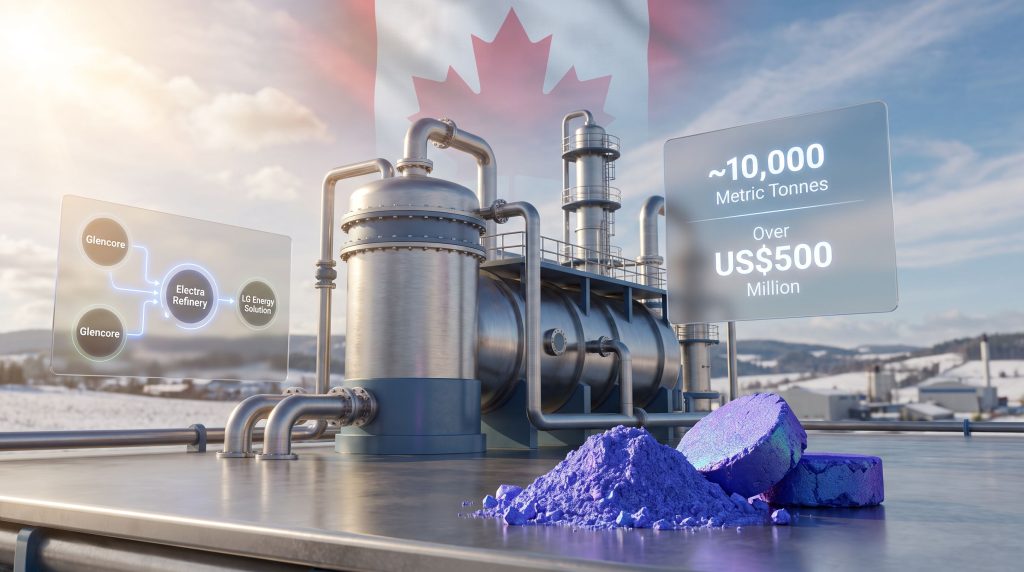
Under the extended terms, Electra will receive approximately 10,000 metric tonnes of contained cobalt over five years. At prevailing market prices at the time of announcement, that volume represents a contract value exceeding US$500 million, or approximately C$689 million. The agreement also preserves delivery scheduling flexibility, which is critical for aligning feedstock arrivals with actual refinery throughput capacity as commissioning activities progress.
Select commissioning activities at the Temiskaming Shores facility are expected to begin by the end of 2026, following the substantial completion of engineering work. Full commercial production is targeted for the fourth quarter of 2027. The feedstock coverage provided by the Glencore agreement effectively backstops the entire commissioning and initial commercial production period within a single contractual structure.
Electra's Dual-Track Commercial Architecture
One of the more strategically sophisticated aspects of Electra's commercial positioning is that the Glencore agreement does not stand alone. The company has simultaneously secured its output side through a cobalt sulfate offtake agreement with LG Energy Solution, one of the world's largest lithium-ion battery manufacturers.
| Partner | Agreement Type | Volume Commitment | Term |
|---|---|---|---|
| Glencore | Cobalt hydroxide feedstock purchase | ~10,000 t contained cobalt / 5 years | Through 2031 |
| LG Energy Solution | Cobalt sulfate offtake | 60% of production | Through 2029 (option to 2032) |
This dual-track structure, anchoring both the input supply and the output offtake through long-term contracts with globally credible counterparties, is exceptionally rare among junior or emerging refiners. Most companies at Electra's development stage carry either feedstock risk or offtake risk, or frequently both. Having contractual certainty on both ends of the production equation creates a vertically integrated commercial structure that substantially de-risks the entire refinery business case.
For investors and project finance lenders, this architecture matters. The LG Energy Solution offtake covers an estimated 60% of projected production, meaning that a majority of the refinery's output has a committed buyer before the first tonne of cobalt sulfate is produced commercially. Combined with Glencore's feedstock commitment, the financial model for the Ontario refinery rests on two independently verifiable contractual pillars rather than merchant market assumptions.
Glencore's Role and What It Signals About North American Cobalt Refining
Glencore is not a marginal participant in the global cobalt market. The company is consistently ranked among the world's largest producers of cobalt, with mining and processing operations anchored in the Democratic Republic of Congo (DRC), which accounts for roughly 70% of global cobalt mine production according to US Geological Survey data. In fact, reviewing global cobalt production figures underscores just how dominant the DRC remains within overall supply dynamics. Glencore's willingness to commit feedstock supply to a North American refiner through 2031 carries genuine market signal weight.
For a global mining major to enter a five-year extension rather than simply allowing an existing agreement to lapse or diverting material to higher-bidding spot buyers suggests confidence in Electra's execution trajectory. It also reflects a commercially rational calculation: as pressure builds across North America and allied economies to establish domestic critical mineral processing capacity, having a refinery partnership in Ontario positions Glencore's cobalt output for markets that increasingly demand supply chain provenance documentation.
The Processing Deficit North America Faces
The scale of North America's cobalt refining gap is often underappreciated. While the continent hosts exploration and some mining activity for cobalt-bearing ores, the vast majority of cobalt chemical processing, specifically the conversion of hydroxide to sulfate suitable for battery cathode precursor manufacturing, occurs in China. Estimates from industry analysts have placed China's share of global cobalt refining capacity at well above 70%, creating a structural dependency that battery manufacturers and governments alike have been working to address.
Electra's Ontario refinery, when operational, would represent one of the first purpose-built battery-grade cobalt sulfate facilities in North America. The significance of that distinction extends beyond Electra as a company. It represents proof that the processing segment of the critical mineral supply chain can be rebuilt domestically, potentially catalysing additional investment in the broader battery materials processing ecosystem across Canada and the United States.
Cobalt Market Dynamics Heading Into the Late 2020s
Battery Chemistry Evolution and Cobalt Demand
A common concern raised about cobalt investment is the trajectory of battery chemistry development. High-nickel cathode formulations such as NMC 811 and NCA use less cobalt per kilowatt-hour of storage than earlier NMC 111 chemistries, and lithium iron phosphate (LFP) batteries eliminate cobalt entirely. These trends have led some observers to forecast declining cobalt demand as EV adoption scales.
The more nuanced picture is considerably different. While cobalt intensity per battery cell has declined in some segments, overall cobalt demand has continued to rise in absolute volume terms as the total number of cells manufactured grows. High-performance applications, including aviation, defence, premium EV platforms, and energy storage systems requiring high energy density in constrained form factors, continue to favour cobalt-containing chemistries. The US$500 million implied contract value over five years in the Electra Glencore cobalt purchase agreement extension reflects market pricing assumptions that do not anticipate cobalt becoming commercially irrelevant within that timeframe.
The DRC Concentration Problem
Beyond battery chemistry debates, the structural supply risk in cobalt markets stems from geographic concentration at the mine level. The DRC cobalt supply risks are well documented, with the country's dominance of global cobalt production creating exposure to political instability, artisanal mining regulation challenges, and infrastructure constraints that periodically disrupt supply. Cobalt prices have historically exhibited sharp cyclical swings, partly driven by the difficulty of quickly adjusting DRC output.
Moreover, the cobalt export ban impacts on downstream processors have intensified the urgency around securing stable, long-term supply arrangements. Agreements like the Electra Glencore cobalt purchase agreement extension attempt to redistribute processing risk by placing refining capacity in a geopolitically stable jurisdiction, even if the raw feedstock originates from concentrated sources. The value proposition for downstream battery manufacturers is that cobalt sulfate produced in Ontario under transparent supply chain conditions carries a provenance premium that Chinese-refined material increasingly cannot match in regulated Western markets.
The next major ASX story will hit our subscribers first
Frequently Asked Questions: Electra Glencore Cobalt Purchase Agreement Extension
What is the Electra Glencore cobalt purchase agreement extension?
It is a renewed and extended supply contract between Electra Battery Materials and Glencore, first established in 2021, under which Glencore supplies cobalt hydroxide feedstock to Electra's Ontario refinery. The 2026 extension runs through December 31, 2031.
How much cobalt is committed under the extended agreement?
Approximately 10,000 metric tonnes of contained cobalt over five years.
What is the estimated value of the contract?
The agreement represents a value exceeding US$500 million (approximately C$689 million) at current market prices. This figure is price-dependent and will fluctuate with cobalt market conditions.
When does Electra expect to begin production?
Select commissioning activities are targeted to begin at the end of 2026, with full commercial production planned for Q4 2027.
Does Electra have other major supply agreements?
Yes. In addition to the Glencore feedstock agreement, Electra holds a cobalt sulfate offtake agreement with LG Energy Solution covering approximately 60% of production output.
Five Structural Takeaways for Critical Mineral Investors
The Electra Glencore cobalt purchase agreement extension carries implications that extend well beyond the two companies involved. For investors and industry observers tracking the North American critical mineral landscape, the deal illustrates five structural realities worth internalising:
-
Feedstock security precedes financing – in capital-intensive refinery development, long-term input supply contracts are typically a prerequisite for institutional debt or equity commitment, not a luxury to be arranged post-construction.
-
Dual commercial anchoring is rare and valuable – simultaneously securing feedstock supply (Glencore) and offtake (LG Energy Solution) on long-term terms creates a risk profile that most junior refiners cannot replicate.
-
A major miner's multi-year commitment functions as external project validation – Glencore's willingness to extend through 2031 provides a credibility signal that independent engineering studies alone cannot generate.
-
North American cobalt refining is transitioning from concept to operational reality – with a Q4 2027 production target now backed by contractual supply certainty, the Ontario facility is no longer a speculative project.
-
Processing geography is becoming a competitive advantage – as Western battery manufacturers and automotive OEMs face increasing pressure to demonstrate supply chain provenance, cobalt refined in Canada carries a market positioning benefit that grows over time.
This article is intended for informational purposes only and does not constitute financial advice. All figures relating to contract values, volumes, and production timelines are sourced from publicly available company announcements and industry reports. Commodity price projections and implied contract valuations are subject to market fluctuation. Readers should conduct their own due diligence before making investment decisions.
Want to Stay Ahead of the Next Major Mineral Discovery on the ASX?
Discovery Alert's proprietary Discovery IQ model delivers real-time alerts on significant ASX mineral discoveries — instantly transforming complex mineral data into actionable investment insights for both short-term traders and long-term investors. Explore historic examples of exceptional mineral discovery returns and begin your 14-day free trial today to position yourself ahead of the broader market.