June 8, 2026
Electric Powertrains Reshape Underground Mining Operations
Mining operations worldwide face mounting pressure to reduce environmental impact while maintaining productivity. Traditional diesel-powered equipment generates significant emissions, heat, and noise in confined underground spaces, creating operational challenges and worker health concerns. Advanced electric powertrain technologies now offer viable alternatives for heavy-duty mining applications, with battery-electric mining vehicles emerging as practical solutions for underground vehicle fleets.
Modern battery-electric mining vehicles deliver immediate torque advantages over diesel counterparts, enabling superior performance on steep gradients and heavy-load scenarios. Electric motors provide consistent power delivery regardless of altitude or ambient temperature variations, while eliminating diesel particulate matter exposure in confined mining environments. Thermal management benefits include reduced heat generation, allowing mining companies to optimise ventilation systems and improve underground working conditions.
Energy recovery systems integrated into electric mining vehicles capture kinetic energy during descents and braking operations. This regenerative capability extends operational range while reducing overall energy consumption. Advanced power management algorithms optimise performance versus efficiency ratios, while thermal control systems maintain optimal battery operating temperatures across extreme mining conditions.
When big ASX news breaks, our subscribers know first
Mining Industry Embraces Fleet Electrification Programs
Canadian mining company Eldorado Gold recently expanded its battery-electric vehicle deployment at the Lamaque underground complex in Québec, increasing from two to twelve Sandvik electric units. This sixfold expansion demonstrates growing confidence in battery-electric technology for production mining operations. The order encompasses ten battery-electric vehicles and ten dedicated charging systems, representing significant infrastructure investment in electric mining technology.
Sandvik's commitment to battery-electric mining equipment includes a $61 million investment in a new Sudbury, Ontario facility, positioning the company for expanded electric vehicle production and support services. This strategic investment reflects industry momentum toward electrification across mining operations globally.
Underground mining applications present ideal conditions for battery-electric mining vehicles deployment due to controlled environments and predictable operational patterns. Furthermore, the transition to electric vehicles transforming mining operations typically begins with support vehicles and specialised equipment before transitioning to primary hauling operations. This phased approach allows operators to develop expertise while minimising operational disruption.
Surface mining operations focus primarily on emissions reduction targets and corporate sustainability commitments. Large-scale haul truck electrification requires substantial charging infrastructure investment but offers significant environmental benefits and operational cost savings over extended deployment periods.
Technical Specifications Define Equipment Performance
Battery capacity requirements vary significantly across mining vehicle categories, with underground loaders typically utilising battery packs ranging from 200-400 kWh for 8-12 hour operational cycles. Support vehicles require smaller battery systems of 100-250 kWh while achieving 10-16 hour operating ranges through optimised energy management.
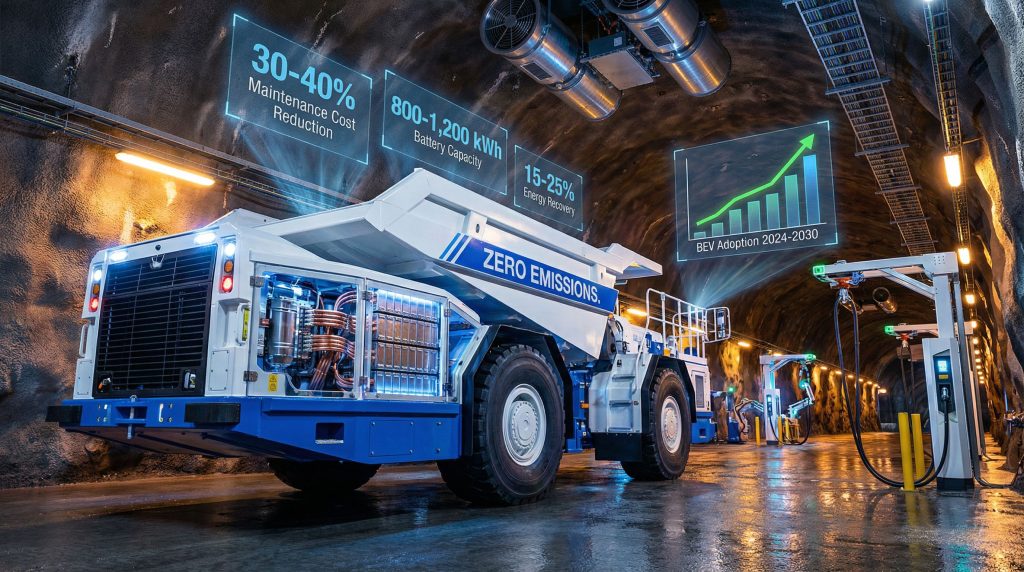
Large haul trucks represent the most demanding application, requiring 800-1,200 kWh battery systems for 4-8 hour operational periods. Charging infrastructure must accommodate these high-capacity systems with 4-8 hour charging cycles, necessitating robust electrical grid connections and sophisticated power management systems.
Drilling equipment applications utilise intermediate battery capacities of 150-350 kWh, achieving 6-10 hour operational ranges with 2-5 hour charging requirements. These specifications reflect the intermittent duty cycles typical of drilling operations compared to continuous hauling applications.
Advanced Energy Management Systems
Advanced power management systems enable dynamic allocation between performance and efficiency modes. Operators can prioritise maximum power output for demanding applications or extend operational range through efficiency optimisation. Smart charging algorithms prevent grid overload while ensuring equipment availability during critical production periods.
Regenerative braking systems integrated into modern battery-electric mining vehicles recover energy during deceleration and descent operations. Consequently, these systems contribute meaningfully to extended operational range and reduced energy consumption, while the development of battery recycling breakthrough technologies supports sustainable battery lifecycle management.
Charging Infrastructure Transforms Mine Planning
Electrical grid capacity planning requires careful assessment of peak demand scenarios when multiple vehicles charge simultaneously. Mining operations must evaluate existing grid connections and potential upgrade requirements to support fleet electrification programmes. Typical installations require additional capacity ranging from several megawatts to accommodate full fleet charging requirements.
Underground charging infrastructure design incorporates automated connection systems to minimise operator exposure and improve efficiency. Pantograph charging systems enable opportunity charging during brief operational pauses, maximising vehicle availability while reducing charging infrastructure requirements.
Surface charging installations accommodate rapid-charging requirements for haul truck operations, with charging stations designed for harsh mining environments. Mobile charging units provide flexibility for remote work areas where permanent infrastructure installation proves impractical.
Infrastructure Investment Considerations
Infrastructure investment considerations encompass charging station installation, electrical grid upgrades, and backup power systems ensuring operational continuity. While initial capital expenditures are substantial, operational savings through reduced fuel costs and maintenance requirements typically justify investment over multi-year deployment periods.
Integration with renewable energy sources offers additional benefits through reduced grid dependency and enhanced sustainability credentials. Solar and wind power systems can supplement charging requirements while reducing operational costs and environmental impact.
Operational Challenges Require Strategic Solutions
Extreme temperature conditions present significant challenges for battery-electric mining vehicles deployment. Mining operations span environments from arctic conditions below -40°C to tropical underground temperatures exceeding 60°C. Battery thermal management systems must maintain optimal operating temperatures across these extremes while preserving performance and longevity.
Humidity and dust exposure require robust environmental protection for electrical systems. Mining environments expose equipment to moisture, corrosive substances, and abrasive particles that can compromise electrical components. Manufacturers incorporate appropriate ingress protection ratings and sealed system designs to ensure reliable operation.
Vibration resistance represents another critical design consideration for mining applications. Heavy equipment operates across rough terrain and experiences significant mechanical stress during normal operations. Battery systems and electrical components require robust mounting and protection systems to maintain performance and prevent premature failure.
Workforce Transition and Safety Protocols
Workforce transition programmes address training requirements for electric vehicle operation and maintenance. Operators require certification on high-voltage safety procedures, while maintenance personnel need specialised training on electric powertrains and battery systems. Emergency response teams must develop new protocols for battery-related incidents.
Fire suppression system modifications accommodate lithium-ion battery installations, which require different suppression agents and procedures compared to diesel fire hazards. For instance, mining operations must update emergency response procedures and install appropriate suppression systems for electric vehicle charging and storage areas.
Equipment Manufacturers Lead Technology Development
Sandvik has emerged as a leading supplier of battery-electric mining equipment, with comprehensive underground vehicle portfolios and significant manufacturing investments. The company's recent introduction of the world's first battery-powered cable bolter demonstrates continued innovation in electric mining equipment development.
Major Equipment Suppliers:
- Sandvik: Comprehensive underground BEV portfolio with proven deployment experience
- Caterpillar: 793 XE prototype development for large haul truck applications
- Komatsu: Electric drive systems and hybrid technology integration
- Epiroc: Battery-powered drilling and loading equipment specialisation
Specialised Electric Vehicle Manufacturers:
- Artisan Vehicle Systems: Underground utility vehicle focus
- MacLean Engineering: Electric underground truck development
- XCMG: Large-capacity electric haul truck programmes
- Rokion: Purpose-built electric mining vehicle design
Retrofit and conversion specialists provide alternatives for existing fleet electrification. Independent conversion companies offer custom battery pack integration services and hybrid system retrofits for transitional operations. These services enable mining companies to electrify existing equipment while evaluating battery-electric technology before purchasing new equipment.
However, the integration of AI in mining technology with electric vehicle systems creates opportunities for enhanced performance optimisation and predictive maintenance capabilities.
The next major ASX story will hit our subscribers first
Performance Comparison Reveals Electric Advantages
Electric motor characteristics provide immediate torque delivery advantages over diesel engines, which require gradual power buildup during acceleration. This instant torque capability improves cycle times on steep gradients and enhances overall productivity in challenging terrain applications.
Performance Metrics Analysis:
| Performance Factor | Battery-Electric | Diesel | Advantage |
|---|---|---|---|
| Torque Delivery | Instant maximum | Gradual buildup | Electric |
| Maintenance Frequency | Reduced complexity | Standard intervals | Electric |
| Point-of-Use Emissions | Zero emissions | CO₂/NOx production | Electric |
| Refueling Time | Extended charging | Quick refueling | Diesel |
| Altitude Performance | Consistent output | Reduced power | Electric |
Energy cost comparisons vary significantly by geographic location and utility rate structures. Electricity costs typically range from $0.08-0.15/kWh depending on regional rates and renewable energy availability. Diesel fuel costs fluctuate based on global commodity prices and transportation logistics to remote mining locations.
Maintenance and Productivity Benefits
Maintenance cost advantages stem from electric powertrain simplicity compared to diesel engines. Electric motors contain fewer moving parts, eliminate oil changes, and reduce scheduled maintenance requirements. However, battery replacement costs must be factored into long-term total cost of ownership calculations.
Productivity improvements result from enhanced operator comfort through reduced noise and vibration exposure. Electric vehicles operate significantly quieter than diesel equivalents, improving communication and reducing operator fatigue during extended shifts.
Environmental and Regulatory Drivers Accelerate Adoption
Corporate sustainability commitments drive mining company electrification programmes as organisations seek to reduce Scope 1 emissions from mobile equipment. Battery-electric vehicle deployment can achieve 60-80% emissions reductions compared to diesel equivalents, contributing significantly to corporate environmental targets.
Increasingly stringent air quality regulations in various jurisdictions favour electric vehicle adoption. Mining operations must comply with emissions limits and worker exposure standards that become more restrictive over time. Electric vehicles eliminate point-of-use emissions while improving underground air quality for worker health protection.
Health and safety improvements provide additional justification for electric vehicle adoption. Elimination of diesel particulate matter exposure reduces long-term health risks for underground workers. Reduced noise pollution improves communication and safety protocols while lower heat generation enhances working conditions in confined spaces.
Carbon Pricing and Social License Impact
Carbon pricing mechanisms in various jurisdictions make electric alternatives more economically attractive by imposing costs on carbon emissions. Mining companies subject to carbon pricing benefit from direct cost savings through emissions reduction, improving the financial case for electric vehicle adoption.
Social licence to operate considerations increasingly emphasise environmental stewardship and community impact reduction. Mining companies operating near populated areas or environmentally sensitive locations benefit from demonstrable emissions reduction efforts through fleet electrification programmes.
Investment Analysis Guides Strategic Decisions
Capital expenditure requirements for battery-electric mining vehicles typically exceed diesel equivalents by 20-40%, depending on vehicle category and manufacturer. This premium reflects advanced battery technology costs and lower production volumes compared to established diesel equipment manufacturing.
Charging infrastructure represents significant additional investment, with installation costs varying based on site requirements and electrical grid capacity. Underground charging installations require explosion-proof equipment and specialised ventilation systems, increasing infrastructure complexity and costs.
Grid upgrade requirements depend on existing electrical capacity and fleet size projections. Mining operations may require substantial electrical infrastructure improvements to support simultaneous charging of multiple vehicles during shift changes and maintenance periods.
Return on Investment Considerations
Return on investment calculations must incorporate operational cost savings through reduced fuel consumption, lower maintenance requirements, and decreased ventilation system operation. These savings typically accumulate over 3-5 year periods, with longer-term benefits from extended equipment lifecycles and improved reliability.
Risk assessment considerations include battery technology advancement rates that may affect asset values over equipment lifecycles. Rapid improvements in battery energy density and cost reduction could impact residual values of early-generation electric mining vehicles.
Future Technology Evolution Shapes Industry Direction
Next-generation battery technologies promise substantial performance improvements through solid-state battery development. These advanced systems could deliver 50% higher energy density while improving safety characteristics and extending operational lifecycles beyond 10,000 charge cycles.
Fast-charging capabilities under development target 30-60 minute charging periods for large mining vehicles, addressing operational availability concerns. Advanced thermal management and charging algorithms enable rapid energy transfer without compromising battery longevity or safety.
Moreover, the advancement of direct lithium extraction technologies supports the raw material supply chain for battery production, while new battery-grade lithium refinery facilities enhance global lithium processing capacity.
Autonomous Integration and Industry Projections
Autonomous integration opportunities leverage electric powertrain advantages for advanced automation systems. Electric vehicles provide precise control capabilities that enhance autonomous navigation while simplified powertrains reduce programming complexity for autonomous operation.
Industry projections suggest 25-35% battery-electric vehicle adoption across mining operations by 2030, driven by technology cost reductions and regulatory requirements. Technology advancement and manufacturing scale increases are expected to reduce costs by 15-25% over the next five years.
The expansion from underground to surface hauling applications represents the next major development phase. Large-scale surface mining operations present greater challenges but also larger potential benefits through fleet electrification programmes targeting primary hauling operations.
Ready to Capitalise on Mining Technology Innovations?
Discovery Alert's proprietary Discovery IQ model delivers real-time alerts on significant mineral discoveries across the ASX, including companies advancing electric mining technologies and battery material exploration. Explore Discovery Alert's historic discoveries to understand how major mineral breakthroughs have generated substantial market returns, then begin your 30-day free trial today to position yourself ahead of emerging opportunities in the evolving mining sector.