
June 22, 2026
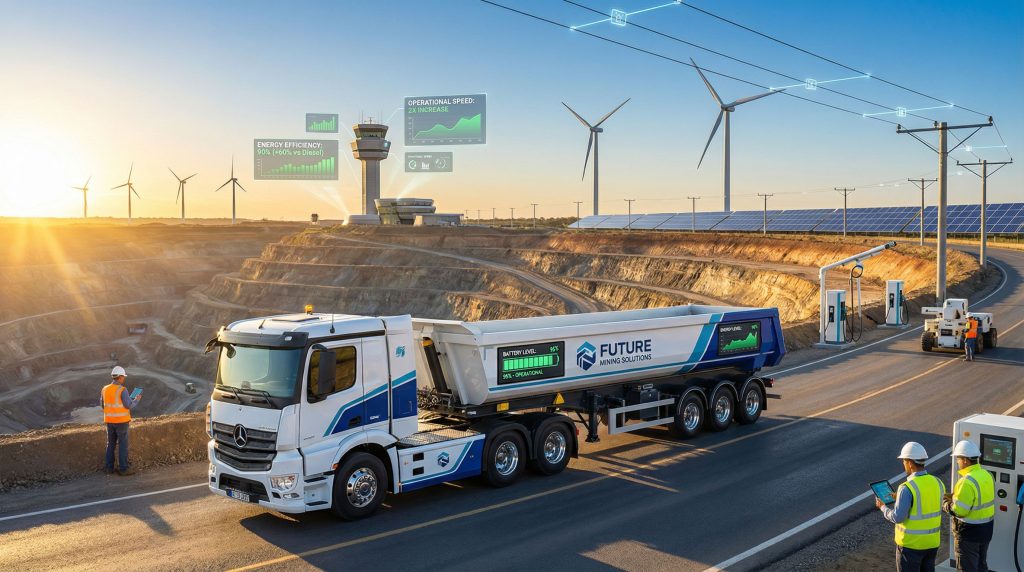
The transformation of mining operations extends far beyond simply replacing diesel engines with electric motors. Complete mining electrification represents a comprehensive reimagining of how energy flows through extraction, processing, and transportation systems across both surface and underground environments.
At its core, the electrification of the mining industry demands integration across multiple technological layers. Battery-electric vehicle fleets must coordinate with grid-independent renewable microgrids, while automated charging infrastructure manages predictive load balancing based on production forecasts. Digital twin technology optimises energy distribution patterns, creating what industry experts describe as a fundamentally different operational paradigm.
Defining the All-Electric Mine Ecosystem
The modern electrified mining operation functions as an interconnected energy ecosystem rather than a collection of independent electric machines. Battery-electric vehicles operate within networks that include surface haul trucks achieving 90% energy efficiency compared to diesel's 30% efficiency, underground loaders powered by trolley-assist systems, and autonomous drill rigs coordinated through centralised energy management platforms.
This ecosystem approach recognises that electric mining operations create volatile demand peaks during charging cycles, particularly when integrated with renewable energy sources. Furthermore, successful implementation requires treating power as a strategic operational resource managed through sophisticated digital monitoring systems rather than a background utility.
Underground applications present unique advantages for electrification. The absence of diesel exhaust eliminates ventilation energy requirements while enabling autonomous operation in previously hazardous environments. Electric systems remove fire and explosion risks associated with combustion engines, expanding operational safety boundaries.
The Technology Stack Behind Electric Mining Operations
| Technology Category | Primary Applications | Efficiency Gains |
|---|---|---|
| Battery-Electric Vehicles | Haul trucks, loaders, drill rigs | 90% energy efficiency vs 30% diesel |
| Trolley-Assist Systems | Underground haulage routes | Up to 90% emission reduction |
| Fast-Charging Infrastructure | Fleet turnaround optimisation | 2x operational speed increase |
| Energy Storage Systems | Load balancing, grid stability | 40-60% peak demand reduction |
The charging infrastructure component requires particular sophistication. Stationary charging systems use manual or automated connections during idle periods, while fast offboard systems support continuous-use equipment with minimal downtime. Slower onboard systems optimise intermittent-use equipment such as drill rigs.
Additionally, all systems built on open standards ensure multi-vendor compatibility across evolving fleet compositions. Data-driven mining operations are increasingly incorporating these standardised approaches for maximum operational flexibility.
Battery Energy Storage Systems (BESS) work in coordination with renewable generation and real-time production forecasting to smooth load peaks and reduce supply disruption risks. These systems enable demand curve flattening while providing backup power during weather-related renewable generation variations.
When big ASX news breaks, our subscribers know first
The Economic and Strategic Drivers Accelerating Mining Electrification
Mining companies face unprecedented pressure to accelerate electrification timelines, with 30% of mining leaders currently reporting they are falling behind 2030 decarbonisation targets. However, the strongest implementation drivers extend beyond environmental compliance to fundamental operational economics.
42% of companies are planning haulage decarbonisation investment by 2026, while 68% plan to electrify 25% of their fleets by 2030. These aggressive timelines reflect recognition that electrification addresses multiple operational challenges simultaneously.
The Economic Imperative Beyond Environmental Compliance
Electric haul trucks operate at twice the speed of diesel equivalents, creating immediate throughput advantages that compound over operational lifecycles. Maintenance cost reductions result from fewer moving parts in electric powertrains, while reduced downtime improves asset utilisation ratios.
Consequently, diesel price volatility exposure elimination provides strategic cost predictability through fixed electricity contracts. Digital monitoring platforms deliver unprecedented visibility into energy consumption patterns, enabling optimisation impossible with diesel operations.
Underground operations benefit particularly from air quality improvements. For instance, reduced noise and vibration decrease worker fatigue levels, while cleaner environments improve respiratory health outcomes. These factors contribute to enhanced productivity metrics beyond direct equipment performance gains.
Workforce Transformation and Talent Attraction
68% of survey respondents identified technology adoption as a driver of diversity and means of attracting younger workers to an industry historically challenged by aging workforce demographics. Cleaner, quieter, and more digitally sophisticated operations fundamentally change the employment proposition for prospective employees.
Modern electric mining environments attract technology-oriented talent who prefer digital systems over traditional mechanical equipment. This demographic shift brings fresh perspectives on operational optimisation while addressing critical skills gaps in automation and data analysis.
The combination of electrification and automation creates what experts describe as not simply a greener version of mining operations, but a fundamentally different operating model requiring new competencies and approaches. The mining industry evolution continues to accelerate these transformative changes.
How Declining Ore Grades Intensify Electrification Urgency
Structural changes in global mining face operators with exponentially increasing energy demands. As ore grades decline worldwide, significantly more energy is required to extract and process equivalent metal volumes, transforming energy efficiency from an environmental preference to an economic necessity.
The Declining Ore Grade Crisis
The structural shift toward lower-grade deposits creates exponential energy requirements for equivalent metal production. This fundamental change makes energy optimisation not merely environmentally responsible, but economically essential for maintaining operational viability.
New mining projects increasingly locate in remote areas with limited access to established grid infrastructure. This geographic constraint makes renewable energy integration not just desirable but operationally essential for project economics.
Since 2021, ABB has completed 26 electrification studies across nine countries, providing site-specific blueprints that address the dual pressures of higher energy demand and limited grid access. These studies consistently identify that addressing energy intensity requires fundamental reconsideration of how mines are powered.
Remote Location Energy Security
Off-grid renewable generation systems with battery backup create what specialists term grid-independent renewable energy microgrids. These systems provide energy independence while reducing logistics complexity associated with diesel fuel transportation to remote locations.
- Autonomous renewable generation eliminates diesel supply chain dependencies
- Battery backup systems provide resilience against weather-related generation variations
- Scalable power infrastructure adapts to changing mine layouts over operational lifecycles
- Microgrid resilience protects operations from broader grid instability
The approach treats power availability as directly shaping productivity, safety, and uptime rather than a background utility. Real-time production forecasting enables demand curve management that smooths renewable energy intermittency while optimising equipment utilisation patterns.
Implementation Pathways: From Pilot Projects to Full Electrification
Successful mining electrification follows proven implementation sequences that minimise operational disruption while building organisational confidence in electric technologies. The approach emphasises incremental changes generating meaningful performance gains rather than comprehensive overnight transitions.
Surface Mining Electrification Strategies
Implementation Sequence:
- Fleet Assessment and Energy Mapping – Comprehensive analysis of baseline diesel consumption patterns and equipment duty cycles across operational areas
- Charging Infrastructure Design – Strategic placement optimisation minimising operational disruption while maximising equipment utilisation
- Pilot Equipment Deployment – Initial implementation focusing on auxiliary equipment before transitioning to primary haulage systems
- Grid Integration Planning – Renewable generation and storage capacity sizing based on operational load profiles and growth projections
- Workforce Training Programmes – Technical skills development for electric system maintenance, troubleshooting, and optimisation
This phased approach acknowledges that electrification represents not simply technology replacement but operational transformation requiring gradual organisational adaptation.
Underground Operations Transformation
Underground mining environments offer unique advantages for electrification implementation. Trolley-assist systems provide up to 90% reduction in haulage emissions while offering unlimited energy availability during transport cycles.
The world's first fully battery-electric trolley truck system, installed on Boliden's underground test track and subsequently extended to a 5km operational segment, demonstrates regenerative braking energy recovery on decline sections. This technology recovers energy otherwise lost as heat while providing modular infrastructure adaptable to evolving mine layouts.
Battery-electric secondary equipment integration complements trolley-assist primary haulage, creating comprehensive underground electrification. Ventilation system optimisation through emission elimination reduces energy requirements while improving working conditions.
Technology Selection and ROI Optimisation
Electrification ROI optimisation requires careful technology selection based on equipment duty cycles, operational patterns, and site-specific constraints. The strongest business cases combine sustainability benefits with operational performance improvements.
Battery-Electric Haul Trucks: The Productivity Multiplier
| Performance Metric | Electric Trucks | Diesel Trucks | Advantage |
|---|---|---|---|
| Operational Speed | 2x faster | Baseline | 100% improvement |
| Maintenance Intervals | 3x longer | Baseline | 200% reduction in downtime |
| Energy Efficiency | 90% | 30% | 300% efficiency gain |
| Noise Levels | 50% reduction | Baseline | Worker comfort improvement |
Electric haul trucks demonstrate the convergence of sustainability and commercial logic. Operating twice as fast as diesel counterparts significantly boosts throughput while fewer moving parts reduce maintenance costs and operational downtime.
Autonomous charging capabilities eliminate human intervention requirements, streamlining operations while removing personnel from potentially hazardous refuelling activities. Moreover, these advancements reflect the broader battery raw materials update driving technological improvements.
Trolley-Assist Systems: The Underground Game-Changer
Trolley-assist technology feeds power via overhead lines as vehicles travel, with regenerative braking energy recovery on decline sections. This infrastructure approach offers advantages over battery-only systems through unlimited energy availability during transport cycles.
- Overhead power delivery eliminates range anxiety for continuous-use applications
- Regenerative braking systems recover energy otherwise lost as heat
- Modular infrastructure design enables relocation as mine layouts evolve
- Real-time power allocation optimises energy distribution based on operational schedules
Modern trolley systems utilise modular pre-cast foundations and lightweight suspension, making them adaptable to dynamic mining environments. Automated energy management systems analyse operational schedules in real-time to allocate power where needed most efficiently.
Infrastructure Design for Electrified Mining Operations
Robust infrastructure planning forms the foundation of successful mining electrification. Unlike simple energy source substitution, electric mining operations require sophisticated power management treating electricity as a strategic operational resource.
Smart Grid Design for Mining Operations
Battery storage systems combined with real-time production forecasting enable operators to flatten demand curves and reduce supply disruption risks. This approach protects operations from renewable energy intermittency while optimising equipment utilisation patterns.
- Predictive load management uses production forecasting algorithms for demand optimisation
- Battery energy storage systems provide peak shaving and grid stability
- Renewable energy integration incorporates weather prediction modelling
- Redundant power pathways ensure operational continuity during maintenance
Digital monitoring platforms provide unprecedented visibility into energy consumption patterns, enabling optimisation impossible with diesel operations. Automated systems anticipate and prevent failures before they occur, reducing unplanned downtime.
Charging Strategy Optimisation
Mining electrification requires three distinct charging approaches: fast offboard systems for continuous-use equipment, slower onboard charging for intermittent operations, and opportunity charging during natural operational breaks. The optimal combination depends on equipment duty cycles and site layout constraints.
All charging solutions built on open standards ensure compatibility across multi-vendor fleets while providing adaptability to specific site requirements. This interoperability prevents operational lock-in to single equipment manufacturers while enabling gradual fleet transitions.
Recent innovations in battery recycling breakthrough technologies further enhance the sustainability credentials of these charging systems.
The next major ASX story will hit our subscribers first
Workforce Development and Safety Enhancement
Electric mining operations create fundamentally different working environments that attract new talent demographics while enhancing safety profiles across operational areas.
Transforming Underground Working Conditions
The elimination of diesel exhaust substantially improves respiratory health outcomes for underground workers. Reduced noise and vibration levels decrease fatigue while enhanced visibility through reduced dust and emissions improves working conditions.
Temperature control improvements in confined spaces result from eliminating combustion engine heat generation. When combined with autonomous operation capabilities, personnel can be removed from the most hazardous environments altogether.
Electric systems remove fire and explosion risks associated with combustion engines, expanding operational safety boundaries while reducing insurance premiums through improved risk profiles.
Skills Development and Talent Attraction
Electric mining operations attract younger, technology-oriented workers who prefer digital, clean environments over traditional diesel-heavy sites. This demographic shift helps address the industry's aging workforce challenge while bringing fresh perspectives on operational optimisation.
53% of leaders expect operational transformation over five years, requiring comprehensive workforce development programmes. Training programmes must address electric system maintenance, digital monitoring platform operation, and automated equipment supervision.
The talent attraction benefit extends beyond environmental preferences to technological sophistication. Modern electric mining environments appeal to candidates with backgrounds in automation, data analysis, and digital systems optimisation.
Overcoming Implementation Challenges
Despite clear operational advantages, mining electrification faces implementation barriers requiring strategic approaches to capital investment, technical integration, and organisational change management.
Capital Investment and Cash Flow Management
Upfront capital requirements for comprehensive electrification can strain operational budgets, particularly for companies managing existing debt obligations or expansion programmes.
- Phased retrofit programmes spread costs over multiple budget cycles while building operational confidence
- Equipment leasing models reduce initial capital requirements while transferring technology risk
- Government incentive programmes and carbon credit monetisation improve project economics
- Operational savings quantification provides investment justification through total cost of ownership analysis
Diesel trucks can be retrofitted with onboard components including batteries and inverters rather than replaced outright, reducing capital requirements and operational disruption during transitions.
Technical Integration and Compatibility Issues
Legacy system integration presents challenges when incorporating modern electric equipment into existing operational frameworks. Open-standard charging infrastructure ensures multi-vendor compatibility while preventing technology lock-in.
Maintenance protocol adaptation requires training programmes for electric vehicle servicing while establishing parts inventory and technical support capabilities. Digital control platform integration enables coordinated operation between electric and remaining diesel equipment during transition periods.
Future Technology Developments and Industry Transformation
The electrification of the mining industry continues evolving through emerging technologies that promise enhanced performance, reduced costs, and expanded operational capabilities.
Emerging Technologies on the Horizon
Solid-state batteries offer potential for extended operational range and improved safety profiles compared to current lithium-ion technology. Wireless charging systems could eliminate physical connection requirements, reducing infrastructure complexity and maintenance needs.
AI-powered energy management systems promise real-time power distribution optimisation based on equipment location, operational priorities, and renewable generation availability. Hydrogen fuel cells may address ultra-long-range surface applications where battery weight becomes limiting.
Industry Transformation Timeline and Milestones
| Timeframe | Expected Developments | Market Penetration |
|---|---|---|
| 2026-2028 | Underground BEV standardisation | 25% of new equipment |
| 2029-2031 | Surface truck electrification scaling | 50% of replacement cycles |
| 2032-2035 | Autonomous electric fleet integration | 75% of mining operations |
| 2036-2040 | Complete diesel phase-out in developed markets | 90%+ electric operations |
The transformation timeline reflects recognition that complete electrification requires infrastructure development, workforce training, and technology maturation beyond current capabilities.
Mining currently accounts for approximately 7% of global greenhouse gas emissions, making electrification a critical component of climate change mitigation strategies. The combination of environmental necessity and operational advantages creates compelling implementation drivers.
Industry events such as the global resources innovation expo continue to showcase these technological advances and their practical applications.
Measuring Success: KPIs and Performance Metrics for Electric Mining
Effective measurement systems track both operational performance improvements and environmental impact reductions across comprehensive metrics frameworks.
Operational Efficiency Indicators
- Energy cost per tonne of material moved provides direct productivity measurement
- Equipment uptime and availability rates demonstrate reliability improvements
- Maintenance cost reduction percentages quantify operational savings
- Worker productivity and safety incident rates measure workplace improvements
Energy efficiency gains of 300% compared to diesel operations create substantial cost advantages while 2x operational speed increases boost throughput across production cycles.
Environmental and Financial Impact Assessment
Carbon emission reduction achievements provide quantifiable environmental benefits for ESG reporting requirements. Total cost of ownership comparisons demonstrate long-term economic advantages despite higher initial capital requirements.
Return on investment timelines typically range from three to seven years depending on operational scales, energy costs, and equipment utilisation rates. Regulatory compliance cost savings through reduced emissions monitoring and environmental impact mitigation contribute to overall project economics.
The convergence of environmental necessity, operational advantages, and economic benefits positions the electrification of the mining industry as an inevitable transformation rather than an optional enhancement to existing operations. Furthermore, Australian mining equipment electrification continues to accelerate as companies recognise these compelling business advantages.
However, successful implementation requires comprehensive planning and strategic electrification solutions for mining operations that address site-specific challenges and operational requirements.
This analysis is based on industry research and technological assessments current as of 2026. Investment decisions should consider site-specific factors, regulatory requirements, and comprehensive feasibility studies. Future technology developments and market conditions may affect implementation timelines and economic projections.
Looking to Invest in the Mining Electrification Revolution?
Discovery Alert's proprietary Discovery IQ model delivers instant notifications on significant ASX mineral discoveries, including companies pioneering mining electrification and clean energy technologies that could benefit from this industry transformation. With the electrification of mining operations creating new investment opportunities across battery metals, renewable energy infrastructure, and innovative mining technologies, subscribers gain immediate access to actionable trading opportunities ahead of the broader market. Begin your 14-day free trial today and position yourself at the forefront of mining's electric future.