
August 20, 2026
When Surface Meets Subsoil: The Structural Fault Line Running Through Mexican Mining
Long before a single blockade makes headlines, the conditions for community-driven operational disruptions in Mexican mining are written into the legal architecture of the country itself. Mexico operates under a bifurcated resource ownership model that creates an inherent structural tension: subsoil mineral wealth belongs to the state, which licenses extraction rights to private operators, while surface rights remain in the hands of the communities who live and work above those deposits. When those two layers of ownership collide in practice, the results can be sudden and costly.
This is precisely the dynamic now playing out at the Terronera silver-gold mine in Jalisco, where Endeavour suspends Terronera mine operations after an Ejido blockade that began on 12 August 2026 halted full production. Understanding why this happened, and what it reveals about systemic risk in Mexican silver mining, requires looking well beyond the immediate dispute.
When big ASX news breaks, our subscribers know first
The Ejido System: Collective Land Rights as Operational Risk
The Ejido is one of the defining institutions of Mexican agrarian law, originating from post-revolutionary land reforms enshrined in the 1917 Constitution and later codified through the Ley Agraria of 1992. An Ejido functions as a form of collective land tenure in which a community holds rights over a defined territory. Individual members, known as ejidatarios, are granted usufruct rights over parcels within that territory, but the land itself cannot be freely sold without satisfying complex legal processes.
For mining operators, this matters enormously. A federally granted mineral concession gives a company the legal right to extract subsoil resources, but it does not automatically confer the right to access the surface above those resources. That surface access must be separately negotiated with the Ejido community. This distinction between subsoil rights and surface rights is not merely administrative; it is a practical chokepoint that gives Ejido communities significant leverage over any operation that requires physical land access.
Is There a Legal Framework Protecting Community Consent?
What makes this particularly complex is the absence of a mandatory Free, Prior and Informed Consent (FPIC) framework in Mexico's current mining law. While Mexico is a signatory to ILO Convention 169, which establishes consultation rights for indigenous and tribal communities, its domestic application has been inconsistent. The result is a governance gap in which companies frequently enter into informal agreements with Ejido communities during project development, without the formal legal structure that would make those commitments enforceable and transparent over the long term. Furthermore, the broader question of mining rights and communities in resource-rich regions continues to generate regulatory debate across multiple jurisdictions.
Terronera's Dispute in Detail: A Multi-Layered Grievance
The blockade at Terronera is not a spontaneous protest triggered by a single incident. It reflects a convergence of unresolved obligations across several distinct grievance categories. The demands raised by Ejido community members span infrastructure maintenance, health service access, communications support, water access and control, and financial contributions to the community.
| Grievance Category | Specific Demand | Classification |
|---|---|---|
| Infrastructure | Road maintenance and upkeep | Social licence obligation |
| Health and Welfare | Access to medical services | Corporate social responsibility |
| Communications | Connectivity infrastructure support | Community development commitment |
| Resource Access | Control over and access to water supply | Environmental and rights-based claim |
| Economic | Increased financial assistance | Revenue-sharing / benefit agreement |
Of these, the water access demand carries the greatest legal weight. Water rights in Mexico are governed under the Ley de Aguas Nacionales as a separate regulatory stream from mineral concessions. Ejido communities near mining operations frequently hold prior-use water entitlements that can conflict directly with the processing requirements of a flotation plant.
At Terronera, which operates a central flotation facility processing up to 2,000 tonnes of ore per day, water consumption is not incidental but operationally essential. The inclusion of water access as a core demand elevates this dispute from a community relations matter into a potential multi-jurisdictional regulatory confrontation.
Key Timeline of the Terronera Dispute
- 2010: Endeavour Silver acquires the Terronera project in Jalisco, Mexico
- October 2025: The mine achieves commercial production status, transitioning from development to active operations
- 12 August 2026: Ejido community members initiate a blockade, suspending full mine operations
- Post-blockade: A reduced workforce remains on-site to maintain safety protocols and essential infrastructure
- Ongoing: Active negotiations between company representatives and Ejido leadership continue, with legal proceedings identified as a contingency option
Operational Profile and Portfolio Significance
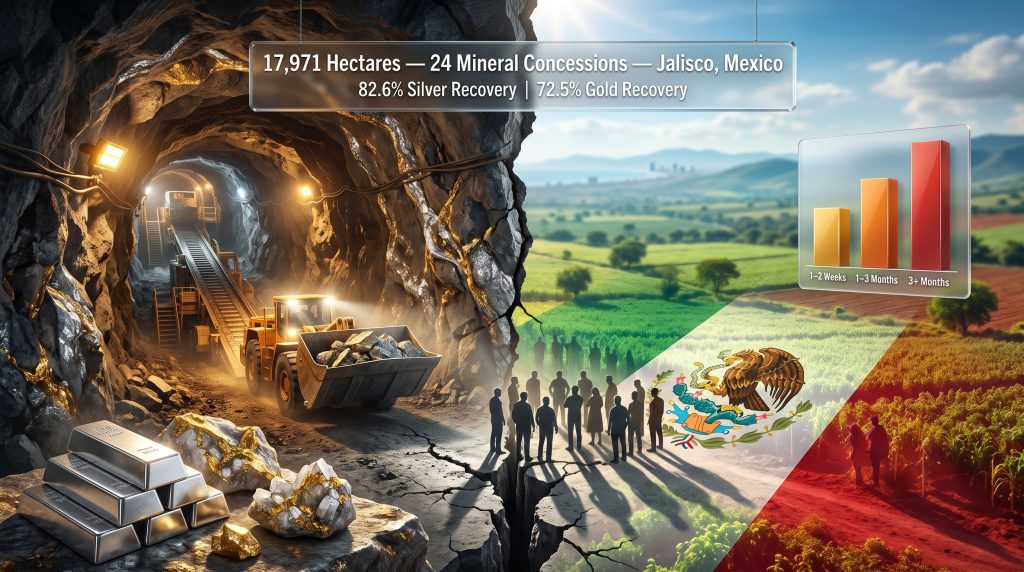
The Terronera mine sits within the San Sebastián del Oeste Municipality of Jalisco, positioned approximately 160 kilometres west of Guadalajara and 50 kilometres north-east of Puerto Vallarta in mountainous terrain. The operation covers 24 mineral concessions across 17,971 hectares and uses mechanised underground ramp access to reach low-sulphidation epithermal vein systems carrying silver and gold mineralisation.
Low-sulphidation epithermal deposits are geologically significant for precious metals mining. These systems form at relatively shallow crustal depths from hydrothermal fluids at low temperatures, typically producing high-grade veins with strong silver-to-gold ratios. They are characterised by quartz-adularia-calcite gangue assemblages and can exhibit bonanza-grade intervals, though their geometry is often structurally complex. This geological profile helps explain both Terronera's appeal as a flagship asset and the precision required in its underground development.
In 2025, the mine reported metal recovery rates of 82.6% for silver and 72.5% for gold through its flotation circuit. With a projected ten-year operational life, Terronera represents the centrepiece of Endeavour Silver's production profile. Indeed, silver's dual role as both a monetary metal and an industrial input makes these recovery metrics particularly meaningful for long-term revenue planning.
For a flotation plant processing 2,000 tonnes per day with an 82.6% silver recovery rate, each week of suspended operations translates directly into a material volume of unrecovered metal. For a mid-tier silver producer, the compounding effect of a multi-week or multi-month suspension on annual guidance figures can be substantial.
Endeavour Silver manages three mines across Mexico and Peru, alongside exploration programmes in Mexico, Chile, and the United States. The designation of Terronera as the company's primary underground silver-gold operation means any prolonged suspension carries disproportionate weight at the group level, particularly given that the mine has only been in commercial production since October 2025 and is still within its critical ramp-up phase. Additionally, the company's Endeavour Silver expansion into Peru underlines how portfolio diversification is becoming an increasingly important strategic consideration.
Suspension Risk Scenarios
| Scenario | Operational Impact | Financial Exposure | Reputational Risk |
|---|---|---|---|
| Resolved within 1-2 weeks | Minimal throughput loss | Low | Low |
| Suspension of 1-3 months | Material output reduction | Moderate to High | Moderate |
| Protracted dispute beyond 3 months | Potential guidance revision | High | High: social licence questioned |
A Systemic Pattern, Not an Isolated Event
It would be misleading to frame the Terronera blockade as exceptional. Mexico has experienced a rising frequency of Ejido-related mining disruptions over the past decade, driven by growing community awareness of land rights, greater access to legal advocacy networks, and increasing expectations around benefit-sharing as mines transition from construction to production. Consequently, Mexico mine strikes and government intervention have become a more familiar feature of the country's resource sector landscape.
The transition from development to commercial operations is itself a high-risk period that the industry frequently underestimates. During the construction phase, communities tend to experience indirect benefits such as local employment and infrastructure improvements, while the environmental and social footprint of the operation remains relatively contained. Once commercial production begins, the picture changes considerably.
Water consumption rises sharply with processing plant activation. Traffic volumes increase significantly. Noise, dust, and hydrological impacts become tangible and sustained. Communities that accepted informal commitments during permitting and construction often find that those commitments feel inadequate when measured against the lived reality of a fully operational mine.
Comparing Community Dispute Frameworks Across Latin America
| Jurisdiction | Legal Framework | Resolution Mechanism | Typical Duration |
|---|---|---|---|
| Mexico | Mining Law and Agrarian Law, no mandatory FPIC | Negotiated benefit agreements | Weeks to months |
| Peru | Prior Consultation Law (2011) | Government-mediated consultation | Months |
| Chile | Partial ILO 169 application | Company-led community engagement | Variable |
| Colombia | Constitutional Court precedents | Judicial review and negotiation | Months to years |
Mexico's framework sits at the least formalised end of this spectrum. Without mandatory FPIC requirements and without standardised benefit-sharing agreements, the outcome of Ejido disputes depends heavily on the quality of informal relationships built during earlier project phases. When those relationships fray, as they appear to have done at Terronera, companies are left managing a reactive crisis rather than a structured process.
Endeavour Silver's Legal and Negotiation Options
The company has confirmed it is engaged in dialogue with Ejido leadership, a posture consistent with industry best practice. Negotiated resolution typically involves converting previously informal commitments into formalised agreements covering infrastructure contributions, health service access, and financial transfers tied to production performance.
Endeavour Silver has also indicated readiness to pursue legal proceedings if dialogue does not produce a resolution within an acceptable timeframe. Under Mexican federal law, physically obstructing a licensed mining operation may constitute unlawful interference with economic activity, potentially opening avenues for injunctive relief through federal courts.
However, legal action against Ejido communities in Mexico carries well-documented risks. Court orders can be obtained but may prove deeply difficult to enforce in remote mountainous terrain without the sustained cooperation of the community itself. Historical precedent across multiple Mexican states suggests that legal victories frequently harden community opposition rather than resolving it, producing outcomes where the technical legal position improves while the practical operational situation deteriorates.
Maintaining a reduced on-site workforce during a suspension serves a dual strategic purpose: it preserves physical infrastructure integrity and signals continued operational intent to both the community and investors, while limiting the legal exposure that could arise from a complete site abandonment under Mexican environmental and mining regulations.
Furthermore, broader market pressures add urgency to a swift resolution. The current dynamics around gold and silver supply constraints mean that any prolonged production disruption at a flagship asset can have outsized implications for investor sentiment and commodity positioning.
The next major ASX story will hit our subscribers first
Diagnosing Social Licence Failure: A Replicable Pattern
The sequence of events at Terronera follows a pattern that recurs across Latin American mining jurisdictions with notable consistency:
- Pre-production phase: Informal community agreements reached during permitting and construction, often without legal formalisation
- Transition to production: Operational footprint expands; water use, traffic, and environmental impacts become tangible at community level
- Expectation gap emerges: Community members perceive that pre-production commitments have not been scaled proportionally to the mine's actual operational impact
- Trigger event: A specific unresolved grievance catalyses organised community action
- Operational disruption: Physical blockade forces reactive engagement from the operator
Structural Measures to Reduce Ejido Dispute Risk
- Formalise all community agreements in legally binding benefit-sharing contracts before construction commences, not after
- Establish independent grievance mechanisms accessible to Ejido members at every project phase
- Embed water access protocols in community agreements that clearly delineate mine water usage from community entitlements
- Create joint monitoring committees with direct Ejido representation to oversee environmental and social performance metrics
- Schedule community benefit reviews at production milestones rather than fixed annual intervals, aligning payments with actual operational performance
In addition, industry bodies such as the International Council on Mining and Metals have published guidance on indigenous peoples and mining that provides a practical framework operators can adapt to Ejido engagement contexts.
Frequently Asked Questions
What is an Ejido blockade and why does it affect a mining operation?
An Ejido blockade occurs when members of a communally governed land tenure group restrict physical access to a mining site in response to unresolved grievances. Although Mexico's subsoil mineral resources belong to the state and are licensed to private operators, surface access rights remain with Ejido communities. This gives communities practical leverage to halt operations even where a valid mineral concession exists.
How long has the Terronera mine been producing?
The Terronera mine achieved commercial production status in October 2025, meaning the blockade occurred within its first year of full commercial operations, during what is typically the most critical ramp-up period for demonstrating throughput reliability.
What are the key production metrics at Terronera?
The mine processes up to 2,000 tonnes of ore per day through a central flotation plant targeting low-sulphidation epithermal silver-gold veins. Reported 2025 metal recovery rates were 82.6% for silver and 72.5% for gold, with a projected ten-year operational mine life across 17,971 hectares and 24 mineral concessions.
Is the blockade legal under Mexican law?
Endeavour Silver has characterised the blockade as illegal. Obstructing a federally licensed mining operation may constitute unlawful interference with economic activity under Mexican law. The company has prioritised negotiation as its primary resolution strategy while preserving the option to pursue legal action if discussions fail.
Disclaimer: This article contains forward-looking analysis and scenario modelling based on publicly available information. It does not constitute financial advice. Investors should conduct independent research before making any investment decisions related to companies or projects discussed herein.
Want to Stay Ahead of the Next Major Mineral Discovery on the ASX?
Discovery Alert's proprietary Discovery IQ model delivers real-time alerts on significant ASX mineral discoveries — cutting through complex data across 30+ commodities to surface actionable opportunities the moment they're announced. Start your 14-day free trial today and see why investors tracking historic discoveries have been able to position themselves well ahead of the broader market.