June 6, 2026
Why Vertical Integration Is the Only Way to Win the Rare Earth Race
The global rare earth industry has a structural problem that is widely misunderstood outside specialist circles. Most commentary focuses on mining and separation as the critical bottlenecks, yet the most strategically sensitive link in the chain sits further downstream: the conversion of separated oxides into metals and alloys. Without that capability, a producer is simply supplying feedstock to whoever controls the next step, and for the past two decades, that controller has been China. The Energy Fuels ASM acquisition is a direct attempt to resolve this problem, not at the margins, but structurally.
China currently accounts for roughly 85–90% of global rare earth separation capacity and an even higher proportion of metals and alloy conversion. Western producers who have invested heavily in mining and processing have found themselves selling separated neodymium-praseodymium oxide into a market where the only buyers of scale are Chinese downstream processors. The rare earth geopolitical importance of this dynamic cannot be overstated; it is the operational reality that Western defence, automotive, and energy equipment manufacturers navigate every day.
When big ASX news breaks, our subscribers know first
The Supply Chain Gap That Made This Deal Inevitable
From Oxide to Alloy: Understanding the Missing Middle
Rare earth supply chains are best understood as a sequential series of value-adding transformations. Each stage requires distinct chemistry, engineering expertise, and capital infrastructure:
- Mining and concentrate production – Extraction of ore and production of mineral concentrate (e.g., monazite)
- Primary processing – Cracking of concentrate to remove thorium and produce a mixed rare earth carbonate
- Separation – Solvent extraction circuits that isolate individual rare earth oxides such as NdPr oxide, terbium oxide, and dysprosium oxide
- Metals conversion – Reduction of separated oxides into metallic form through electrochemical or metallothermic processes
- Alloy production – Combining metals with iron and boron to produce NdFeB alloy ingots or flakes
- Magnet manufacturing – Sintering or bonding alloy into finished permanent magnets
Western producers have largely mastered steps one through three. The critical gap has always been steps four and five, precisely because building metals conversion capability requires not just capital but years of accumulated process knowledge. This expertise cannot be replicated quickly from first principles, which is why acquisition of an operating metals plant represents a fundamentally different strategic move than building one.
What the Energy Fuels ASM Acquisition Actually Delivers
The ASM Asset Portfolio in Detail
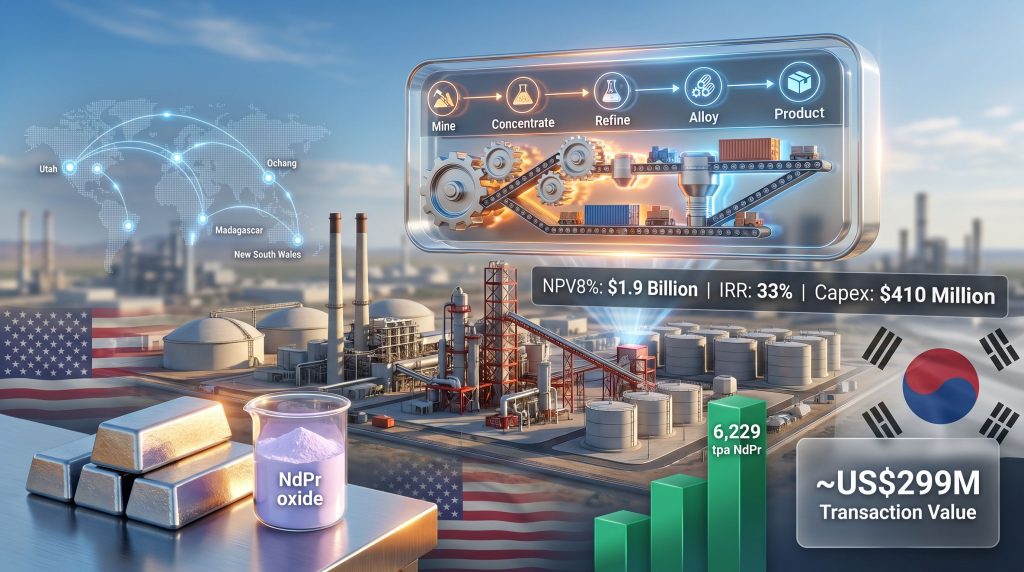
The Energy Fuels ASM acquisition, announced in January 2026, combines Energy Fuels' processing infrastructure with ASM's operating and development assets across three geographies:
| ASM Asset | Location | Current Status | Strategic Function |
|---|---|---|---|
| Korean Metals Plant (KMP) | Ochang, South Korea | Operating | NdFeB alloy production (~1.3 ktpa, expandable to ~3.6 ktpa) |
| American Metals Plant (AMP) | United States | Planned | Initial alloy capacity ~2 ktpa |
| Dubbo Project | New South Wales, Australia | Construction-ready | 42-year modelled mine life; rare earth development asset |
The Korean Metals Plant deserves the most analytical attention. It is not a pilot facility or a demonstration plant; it is an operating commercial-scale asset already producing NdFeB alloy, the direct precursor material that magnet manufacturers use to build the permanent magnets in electric vehicle motors, wind turbine generators, and precision defence systems. Acquiring an operating plant with real production history is categorically different from acquiring a development-stage asset, and it is why the implied transaction valuation of approximately US$299 million is arguably defensible despite appearing elevated at first glance.
The KMP's expansion pathway to approximately 3.6 ktpa of NdFeB alloy is also significant. At that scale, combined with the planned American Metals Plant at an initial ~2 ktpa capacity, Energy Fuels would control more alloy production capacity than any other non-Chinese integrated producer outside of Japan.
Deal Structure and Approval Pathway
The transaction is structured as a scheme of arrangement under Australian law, with the following terms:
- Exchange ratio: 0.053 Energy Fuels shares or CDIs per ASM share
- Optional special dividend: up to A$0.13 per ASM share
- Implied value per ASM share: approximately A$1.60
- Required approvals: ASM shareholder vote, Federal Court of Australia sanction, Foreign Investment Review Board (FIRB) clearance, and relevant listing approvals
- Anticipated closing: as early as July 2026, following a scheme meeting originally targeted for late May to early June 2026
Energy Fuels' Financial Position Heading Into the Transaction
Q1 2026 Performance: Uranium Doing the Heavy Lifting
Before assessing the strategic logic of the Energy Fuels ASM acquisition, it is worth understanding the financial platform from which Energy Fuels is operating. The company reported a net loss of $10.8 million for the first quarter of 2026, equivalent to $0.04 per share, a meaningful improvement from the $26.3 million net loss recorded in the same period of 2025.
The improvement was driven by uranium revenue of $35.7 million, generated from the sale of 510,000 pounds of uranium oxide at a weighted average realised price of $70.04 per pound. Furthermore, operating cash flow swung from negative $18.8 million in Q1 2025 to positive $8.3 million in Q1 2026.
| Metric | Q1 2026 | Q1 2025 |
|---|---|---|
| Uranium Revenue | $35.7 million | Not disclosed |
| Pounds Sold | 510,000 lbs | Not disclosed |
| Realised Price per Pound | $70.04 | Not disclosed |
| Net Loss | $10.8 million | $26.3 million |
| Operating Cash Flow | +$8.3 million | -$18.8 million |
Liquidity context: At quarter-end, Energy Fuels held $108.4 million in cash and cash equivalents alongside $802.2 million in marketable securities, for total liquidity of $956.6 million. This balance sheet provides the financial foundation to absorb a US$299 million acquisition without compromising operational or development spending.
The Uranium Operations Underpinning This Strategy
The White Mesa Mill in Blanding, Utah, produced 790,000 pounds of finished uranium oxide in Q1 2026, reaching the 1 million pound cumulative milestone in April 2026. Three mines feed the mill: Pinyon Plain in Arizona, La Sal, and Pandora.
The Pinyon Plain mine is particularly noteworthy. During Q1 2026, it produced ore averaging 1.12% uranium oxide, with higher-grade zones expected as mining progresses deeper into the orebody. This grade profile is exceptional by industry standards; most conventional uranium mines operate at grades well below 0.5%. The ore grade trajectory at Pinyon Plain suggests improving unit economics as the mine matures.
Cost performance has also improved materially. The weighted average cost of finished uranium oxide inventory fell by approximately 16% from end-2025 levels to roughly $36.00 per pound, while all-in costs to mine, transport, and process Pinyon Plain ore are positioned at $23.00 to $30.00 per pound, implying healthy margins at current spot and contract prices.
Full-year 2026 guidance targets:
- Production: 1.5 million to 2.5 million pounds of processed uranium oxide
- Sales: 1.5 million to 2 million pounds
- Contract coverage: 6 long-term agreements with US nuclear utilities extending through 2032
The Rare Earth Processing Platform at White Mesa
A Monopoly Position Worth Understanding
One of the least widely appreciated facts about Energy Fuels' existing rare earth capability is the singular nature of its processing infrastructure. The White Mesa Mill is the only facility in the United States with commercial-scale capacity to convert monazite concentrate into separated rare earth oxides. There is no other US-based processing node capable of performing this function at scale.
This matters because monazite carries significant concentrations of heavy rare earths including dysprosium and terbium alongside the more abundant light rare earths like neodymium and praseodymium. Heavy rare earths are strategically important because they are added to NdFeB magnets to improve high-temperature performance, a property critical in EV motor applications. During Q1 2026, the company demonstrated pilot-scale production of terbium oxide at 99.9% purity, meeting specifications required by permanent magnet manufacturers.
The existing Phase 1 rare earth circuit can process up to 10,000 metric tonnes of monazite per annum and produce up to 1,000 metric tonnes of NdPr oxide per annum.
Phase 2 Expansion: The Bankable Feasibility Study Numbers
The completed Bankable Feasibility Study for the Phase 2 rare earth expansion at White Mesa returned economics that are difficult to find elsewhere in the non-Chinese rare earth development pipeline:
| Metric | Value |
|---|---|
| Capital Expenditure | $410 million |
| NPV at 8% Discount Rate | $1.9 billion |
| Internal Rate of Return | 33% |
| Average Annual EBITDA (first 15 years) | $311 million |
| NdPr Production Capacity | 6,229 tpa |
| Commissioning Target | 2028–2029 |
A 33% IRR against a $410 million capex commitment is a commercially compelling outcome for a greenfield processing expansion. The critical context here is that White Mesa's existing permitted infrastructure, operational workforce, and reagent supply chains materially reduce the execution risk relative to a fully new-build facility.
At full Phase 2 capacity, rare earth revenues would likely exceed uranium revenues as a proportion of total company income, fundamentally recharacterising Energy Fuels from a uranium producer with a rare earth growth option to a critical minerals company with uranium as a cash flow subsidy.
The Feedstock Pipeline: Four Projects, One Processing Hub
Securing the Monazite Supply Chain
A processing expansion of the scale Energy Fuels is targeting requires a commensurate feedstock supply. The company has contracted approximately 40,900 tonnes per annum of monazite concentrate across four projects:
| Project | Location | NdPr Contribution | Status |
|---|---|---|---|
| Donald Project (49% JV with Astron) | Victoria, Australia | Included in combined 5,381 tpa NdPr | Targeting deliveries to White Mesa by late 2027 |
| Vara Mada Project | Madagascar | FS NPV $1.8B at 10%; 38-year mine life | Awaiting FID and Madagascar fiscal agreement |
| Bahia Project | Brazil | 3,000–5,000 tpa monazite potential | Active drilling; resource estimate targeted late 2026 |
| Chemours Offtake | United States | ~800 tpa monazite | Existing agreement in place |
The combined feedstock pipeline contains an estimated 5,381 tpa of NdPr, 260 tpa of dysprosium, and 64 tpa of terbium. In addition, the Energy Fuels-Chemours partnership reinforces the domestic monazite supply element of this strategy. The heavy rare earth content embedded in the monazite feedstock is a dimension of this supply story that receives insufficient attention, particularly given the scarcity and value of dysprosium and terbium relative to neodymium and praseodymium.
One nuance worth highlighting in relation to the Donald Project is the joint venture structure. Energy Fuels is earning a 49% interest in the project but is entitled to 100% of the monazite produced. This is an unusual and commercially favourable arrangement, effectively securing full feedstock offtake rights while sharing project development costs with Astron Corporation.
The Vara Mada Project in Madagascar carries the most development uncertainty. While its feasibility study returns an NPV of $1.8 billion at a 10% discount rate over a 38-year mine life, progression to a final investment decision requires finalisation of a fiscal agreement with the Malagasy government, a process that carries inherent sovereign risk and timeline uncertainty.
The next major ASX story will hit our subscribers first
Competing With China: The Integration Imperative
Why Partial Supply Chains Are Structurally Disadvantaged
Industry analysis consistently highlights that rare earth producers operating at single points in the processing chain face structural margin compression. Buyers at each stage use competitive leverage to extract value, and without control over downstream steps, upstream producers are price takers rather than price setters. This dynamic is central to understanding America's rare earth supply chain vulnerability and why integrated strategies are gaining traction.
Chinese integrated producers capture margin at every stage from mining through to alloy and often into magnet manufacturing. A Western producer selling separated oxide into this market is, in effect, subsidising the downstream economics of its primary competitive rival. Furthermore, the critical minerals demand surge driven by electric vehicles and clean energy infrastructure is only intensifying the strategic imperative for Western nations to develop fully integrated supply chains.
Former Energy Fuels CEO Mark Chalmers articulated that fully replicating an integrated Chinese supply chain requires acquiring capabilities rather than building them organically, because the skills involved in hydrometallurgy, metals conversion, and alloy production accumulate over years of operational practice and cannot be compressed into a short development timeline. (Source: Crux Investor interview with Mark Chalmers, Energy Fuels Inc.)
Structural Comparison: Post-Acquisition Capability Gap Analysis
| Capability | Chinese Integrated Producers | Energy Fuels Post-ASM Close |
|---|---|---|
| Mining and Feedstock | Extensive domestic reserves | Four contracted global projects |
| Separation and Processing | Dominant global capacity | White Mesa Mill (sole US facility) |
| Metals Conversion | Large-scale domestic capacity | KMP (operating) plus AMP (planned) |
| Alloy Production | Global market leadership | KMP NdFeB alloy, expandable to 3.6 ktpa |
| Geographic Diversification | Concentrated in China | US, South Korea, Australia, global feedstock |
| Magnet Manufacturing | Strong domestic capability | Outside current scope |
The capability gap that remains post-acquisition is magnet manufacturing. Energy Fuels' stated strategy stops at alloy production, which means finished magnets will still need to be sourced from magnet producers, the majority of whom are currently in China or Japan. Whether that represents a deliberate scope limitation or a future acquisition target is a question investors should monitor as integration progresses.
Medical Isotopes: The Third Revenue Stream Taking Shape
Radium-226 and Radium-228 for Targeted Alpha Therapy
One dimension of the White Mesa Mill's strategic value that extends well beyond uranium and rare earths is its emerging capability in medical isotope production. The mill is targeting commercial-scale production of radium-226 and radium-228 for use in targeted alpha therapy, a cancer treatment modality that delivers highly localised radiation doses to tumour cells while minimising damage to surrounding healthy tissue.
Targeted alpha therapy is one of the fastest-growing segments of nuclear medicine. The global market for actinium-225, a radium decay product used in alpha therapy, is projected to grow substantially through the 2030s as clinical programmes advance and regulatory approvals expand. Commercial production of both isotopes is targeted for as early as 2028, subject to successful pilot-scale production and required regulatory approvals.
The commercial logic here is that monazite concentrate naturally contains radium alongside rare earth elements and thorium. A processing facility already handling monazite for rare earth recovery can, with appropriate engineering additions, recover radium as a co-product rather than treating it as a waste stream. This co-product recovery model has the potential to add meaningful revenue at relatively low incremental capital cost.
Approval Risks and Scenario Analysis Before July 2026
What Stands Between Now and Closing
The Energy Fuels ASM acquisition must clear four distinct approval hurdles before implementation:
- ASM shareholder approval via scheme of arrangement vote
- Federal Court of Australia sanction
- Foreign Investment Review Board (FIRB) clearance under Australian foreign investment rules
- Relevant exchange listing approvals for Energy Fuels securities and CDIs
| Scenario | Key Driver | Strategic Impact |
|---|---|---|
| On-time close (July 2026) | All approvals proceed as expected | Integration planning begins; KMP operations absorbed immediately |
| Delayed close (Q3–Q4 2026) | Extended FIRB review or court scheduling | Phase 2 planning continues independently; minor delay to integration |
| Deal fails | FIRB rejection or shareholder vote failure | Energy Fuels retains $956.6M liquidity; must pursue alternative downstream pathway |
FIRB review of transactions involving Australian mineral assets and foreign acquirers has become progressively more rigorous in recent years, reflecting Australia's broader sensitivity around critical mineral ownership. However, the transaction does not involve acquisition of producing Australian mines; the Dubbo Project remains pre-construction, which may reduce the regulatory complexity relative to acquisitions of operating Australian mining assets.
Key Milestones to Track Through 2027 and Beyond
A Forward-Looking Timeline for Investors
Investors monitoring this deal and the broader rare earth strategy should track the following catalysts:
| Milestone | Target Date |
|---|---|
| ASM scheme implementation | July 2026 (anticipated) |
| Bahia Project resource estimate | Late 2026 |
| Donald Project first monazite deliveries to White Mesa | Late 2027 |
| White Mesa Phase 2 first-stage commissioning | 2028 |
| Radium isotope commercial production target | 2028 |
| White Mesa Phase 2 second-stage commissioning | 2029 |
Three structural shifts are worth monitoring at the sector level as this strategy matures:
- Vertical integration as competitive differentiation – The market is increasingly rewarding rare earth companies that control multiple processing steps rather than single-stage producers exposed to margin compression
- Multi-jurisdictional supply chain architecture – Combining US processing, South Korean alloy manufacturing, and globally diversified feedstock projects represents an emerging template for non-Chinese critical mineral supply networks
- Dual-commodity platforms as capital-allocation tools – Uranium operating cash flows are enabling rare earth capital deployment, demonstrating how commodity diversification can fund strategic transformation without requiring continuous equity dilution
Disclaimer: This article contains forward-looking statements, financial projections, and feasibility study estimates that involve material uncertainty. Actual outcomes may differ materially from those projected. Nothing in this article constitutes financial advice. Investors should conduct their own due diligence and consult a qualified financial adviser before making investment decisions.
For readers seeking additional institutional-grade analysis on Energy Fuels and the broader critical minerals sector, Crux Investor publishes in-depth coverage of this acquisition and its implications for rare earth production.
Want to Identify the Next Major Critical Minerals Discovery Before the Broader Market Does?
Discovery Alert's proprietary Discovery IQ model delivers real-time alerts on significant ASX mineral discoveries — including critical minerals and rare earths — instantly translating complex data into actionable investment insights for both short-term traders and long-term investors. Explore Discovery Alert's discoveries page to understand how major mineral discoveries have historically generated substantial returns, and begin your 14-day free trial today to position yourself ahead of the market.