
August 8, 2026
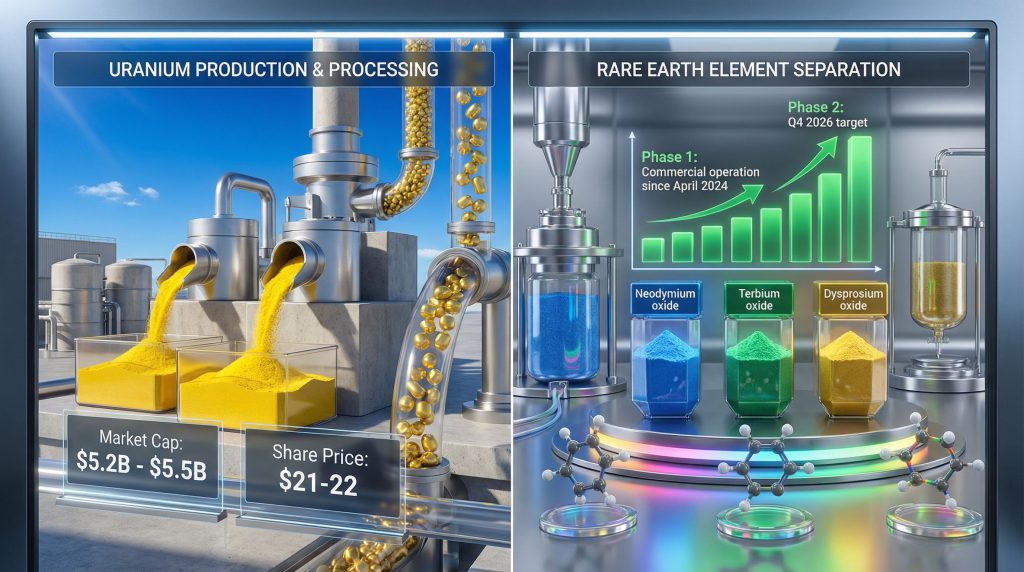
Strategic Positioning Within Dual-Market Complexity
Mining companies traditionally operate within single commodity frameworks where valuation metrics align with established industry benchmarks. Energy Fuels valuation reflects a departure from this convention, positioning the company at the convergence of uranium production and downstream rare earth element separation. This strategic pivot creates analytical challenges that transcend conventional enterprise value per pound methodologies, particularly amid rising critical minerals demand across global markets.
The White Mesa facility represents a unique asset within North American critical minerals infrastructure. As the sole operating conventional uranium mill in the United States, the facility provides established processing capacity while simultaneously adapting infrastructure for rare earth oxide production. This dual-capability framework introduces valuation complexity that single-asset peer comparisons cannot adequately capture, especially considering ongoing uranium market volatility.
When big ASX news breaks, our subscribers know first
Operational Scale and Processing Efficiency
Recent performance data demonstrates the facility's operational capacity. Processing volumes reached 350,000 pounds of uranium in December 2024, representing significant throughput compared to industry peers targeting quarterly production levels substantially below this monthly achievement. According to Energy Fuels management, this processing capacity positions the company competitively within the domestic uranium production landscape.
The integration of rare earth processing capabilities alongside uranium operations creates infrastructure leverage that extends beyond traditional mining valuations. Mixed rare earth carbonate production commenced in April 2024, establishing commercial feasibility for Phase 1 operations while Phase 2 individual oxide separation remains targeted for Q4 2026 commercial deployment.
Furthermore, the company's strategic positioning benefits from broader trends in US uranium production and the increasing focus on domestic supply chain security.
Financial Architecture Supporting Multi-Commodity Strategy
Energy Fuels valuation currently reflects market capitalisation ranging between $5.2 billion and $5.5 billion, trading at premium levels relative to pure-play uranium developers. This valuation incorporates both established uranium processing capabilities and rare earth optionality embedded in the White Mesa facility's expanded processing infrastructure.
| Performance Metric | Current Status | Strategic Significance |
|---|---|---|
| Market Capitalisation | $5.2B – $5.5B | Premium to single-asset uranium peers |
| Revenue Growth | +79.8% (recent quarter) | $17.71M quarterly performance |
| Analyst Consensus | Moderate Buy | Average price target: $23.08 |
| Beta Coefficient | 1.45 | Elevated volatility vs. broader market |
Capital Structure Optimisation
The company's financing strategy demonstrates competitive positioning within the uranium sector. Energy Fuels secured $700 million through convertible debt financing at a 0.75% coupon rate, significantly below the 4-5.5% range typical for comparable uranium sector convertibles. This cost advantage provides strategic flexibility for advancing both uranium and rare earth development programmes without immediate funding constraints.
Management's approach to capital allocation emphasises the competitive nature of this financing structure. The low-cost convertible provides development capital whilst preserving balance sheet flexibility, contrasting with higher-cost financing structures across the uranium development sector.
Rare Earth Processing Economics and Infrastructure Scarcity
Rare earth optionality within Energy Fuels' business model introduces economic dynamics fundamentally different from uranium production frameworks. Whilst uranium represents a relatively standardised commodity with established pricing mechanisms, rare earth processing yields multiple discrete products commanding differentiated market premiums.
Heavy Rare Earth Premium Structure
The economic potential of rare earth separation centres on heavy rare earth elements, particularly dysprosium and terbium, which historically command 10-50x premiums relative to light rare earth elements such as cerium and lanthanum. This pricing differential creates margin optimisation opportunities dependent on separation efficiency and feedstock composition.
Phase 1 operations currently produce mixed rare earth carbonate, capturing baseline processing margins whilst demonstrating technical feasibility. Phase 2 separation into individual oxides represents the primary value creation catalyst, targeting premium capture through specification-grade oxide production.
The transition from mixed carbonate to individual oxide separation introduces additional complexity but unlocks differentiated pricing structures unavailable in bulk processing. Additionally, these developments align with broader energy transition and security initiatives globally.
Feedstock Security and Geographic Diversification
Energy Fuels' integrated approach combines external feedstock sourcing with domestic processing capacity. Key feedstock projects targeting 40,000+ tonnes annual monazite capacity include:
• Donald Project (Australia): 49% joint venture earn-in opportunity with potential production timeline extending to end-2027
• Toliara Project (Madagascar): World-class rare earth deposit with estimated $1.8 billion NPV potential and commercial timeline targeting approximately 2028
• Bahia Project (Brazil): Exploration phase development with existing Chemours offtake arrangements supporting future production scenarios
This geographic diversification strategy addresses feedstock security concerns whilst providing optionality across multiple rare earth deposit types and processing characteristics. Energy Fuels' recent acquisition of Australian Strategic Materials further strengthens this positioning, creating a new mine-to-metal-alloy rare earth champion.
Operational Milestones Driving Valuation Catalysts
The progression from Phase 1 mixed carbonate production to Phase 2 individual oxide separation represents the critical valuation inflection point for Energy Fuels valuation frameworks. Current operations demonstrate technical feasibility and processing capability, whilst commercial-scale oxide separation introduces margin expansion potential.
Technical Complexity and Scale-Up Considerations
Rare earth separation requires precise chemical control across multiple processing stages. Whilst pilot-scale operations provide technical validation, commercial-scale deployment introduces operational variables affecting throughput consistency, product quality, and cost structure predictability. The complexity of heavy rare earth separation further amplifies these technical requirements.
Processing costs between $23-30 per pound for uranium operations at the company's projects provide margin visibility when uranium prices exceed $75 per pound. Multiplied across projected production volumes of 1.5-2 million pounds, uranium operations generate substantial cash flow potential during favourable pricing cycles.
Policy Environment and Strategic Resource Classification
U.S. government classification of rare earths as critical minerals creates policy support through procurement preference programmes and strategic stockpile initiatives. This classification provides regulatory acceleration opportunities and potential revenue visibility through government contracts, although policy support requires translation into binding commercial agreements to support sustained valuation premiums.
Risk Assessment and Execution Variables
Execution Risk Framework
Several risk factors constrain near-term valuation expansion despite strategic positioning advantages. Technical challenges in rare earth separation include chemical process optimisation, feedstock quality consistency, and scale-up execution from pilot to commercial operations. These operational variables introduce uncertainty regarding timeline achievement and cost structure realisation.
However, the company's positioning within the broader mining industry evolution provides strategic advantages that may offset some execution risks.
Market Dynamics and Competitive Positioning
External market forces affecting rare earth optionality include pricing volatility across individual oxide markets, competition from established Asian processing operations, and feedstock availability affecting processing facility utilisation rates. Energy Fuels' domestic processing location provides supply chain advantages but requires competitive cost structures and technical performance to sustain market positioning.
Recent insider trading activity reflects mixed market sentiment, with 463,119 shares sold representing approximately $6.94 million over 90 days. Institutional ownership at 48% demonstrates professional investment interest whilst suggesting ongoing evaluation of execution progress relative to strategic positioning.
The next major ASX story will hit our subscribers first
Investment Framework and Scenario Analysis
Bull Case Scenario Development
Successful Phase 2 commissioning achieving design throughput specifications would materially reduce execution risk whilst improving cash flow visibility. Heavy rare earth separation demonstrating premium capture capabilities combined with binding offtake agreements would support transition from optionality-based to earnings-supported valuation frameworks.
Additional feedstock project approvals accelerating supply security, policy support translating into contractual revenue streams, and infrastructure expansion creating competitive advantages represent key upside catalysts supporting valuation re-rating potential. Goldman Sachs recently initiated coverage on Energy Fuels with a buy rating, reflecting institutional confidence in the company's strategic direction.
Constraint Factors and Downside Considerations
Technical challenges delaying commercial-scale separation, cost overruns pressuring development economics, and feedstock availability limitations constraining processing utilisation represent primary execution risks. Market dynamics including rare earth price compression reducing margin assumptions and increased competition from alternative supply sources further limit upside potential.
Policy uncertainty affecting strategic premiums and regulatory delays impacting facility expansion timelines introduce additional variables affecting valuation sustainability.
Strategic Value Proposition Assessment
Energy Fuels valuation incorporates unique positioning within critical minerals supply chains combining established uranium operations with emerging rare earth processing capabilities. The company's infrastructure scarcity at White Mesa supports strategic positioning whilst introducing valuation complexity that extends beyond traditional mining sector frameworks.
Investment Considerations and Portfolio Positioning
The investment thesis balances uranium cash flow optionality against rare earth processing execution risk. Uranium operations provide financial stability through permitted capacity and competitive cost structures, whilst rare earth processing introduces high-margin potential with corresponding technical and market execution requirements.
Infrastructure scarcity supporting strategic positioning in critical minerals supply chains aligns with policy objectives whilst requiring operational delivery to sustain valuation premiums. The hybrid exposure profile differentiates Energy Fuels from single-asset uranium producers and upstream rare earth developers.
Valuation Framework Evolution
Market pricing currently reflects uranium fundamentals providing financial anchoring whilst assigning option value to rare earth optionality. The transition toward earnings-supported valuation frameworks depends on Phase 2 separation success, cost control achievement, and binding commercial agreements converting strategic positioning into measurable cash flow generation.
Energy Fuels represents strategic positioning within critical minerals processing rather than traditional mining development, requiring investors to evaluate infrastructure scarcity, processing capability, and execution potential alongside conventional commodity exposure metrics. The company's success ultimately depends on translating unique positioning and technical capabilities into sustainable competitive advantages within evolving critical minerals markets.
Ready to Position Yourself in the Next Critical Minerals Discovery?
Discovery Alert's proprietary Discovery IQ model identifies significant ASX mineral discoveries instantly, including emerging opportunities in critical minerals like rare earths and uranium that are reshaping the global resource landscape. Gain immediate market insights and explore historic discovery returns that demonstrate why positioning ahead of major announcements can deliver substantial portfolio advantages—start your 14-day free trial today.