
June 12, 2026
When Exploration Capital Meets Execution Capacity: Understanding the Drilling Services Supercycle
Commodity cycles are well understood by mining investors. What receives far less attention is the infrastructure layer that sits beneath exploration activity itself: the contract drilling sector. Before a single gram of copper or lithium can be classified as a resource, drill bits must penetrate rock across thousands of metres of core. The companies capable of doing that work at scale, across multiple continents, with the technical precision required by major mining clients, represent a distinct and often underappreciated corner of the mining services universe.
The current environment is generating the kind of conditions that periodically transform mid-tier drilling contractors into genuinely scaled global operators. Exploration budgets have expanded significantly across copper, gold, and battery minerals as mining companies race to define resources capable of meeting energy transition demand. Against this backdrop, Major Drilling's remarkable growth in fiscal year 2026 deserves examination not simply as a corporate earnings story, but as a window into structural forces reshaping the entire contract drilling industry.
When big ASX news breaks, our subscribers know first
The Contract Drilling Sector in 2025-2026: Setting the Competitive Stage
Why Specialized Drilling Services Are Outperforming Broader Mining Services
The mining services sector is not monolithic. Equipment manufacturers, processing technology vendors, logistics providers, and contract drillers each respond to different parts of the mining investment cycle. Contract drilling, particularly the specialised segment, is most sensitive to exploration and resource definition expenditure, which tends to accelerate when commodity prices rise and mining companies seek to expand their reserve bases.
What distinguishes the current period is the breadth of commodity demand driving exploration activity simultaneously. Historically, drilling demand has been led by a single commodity supercycle, typically gold or copper. The current environment, as reflected in the broader mining commodity outlook, features parallel demand from:
- Copper exploration driven by electrification infrastructure requirements
- Gold resource definition programmes supported by elevated spot prices
- Lithium and nickel brownfield and greenfield programmes linked to battery supply chain development
- Polymetallic projects combining multiple target minerals in single exploration programmes
This diversification of demand sources provides contract drillers with more durable revenue visibility than previous cycles, where single-commodity corrections could rapidly reduce drilling activity across entire client portfolios.
Market Forces Reshaping Demand for Exploration Drilling Globally
A lesser-known structural dynamic in the contract drilling sector involves the relationship between resource depletion and discovery complexity. As easily accessible, near-surface ore deposits become increasingly rare, exploration programmes are being pushed into more challenging geological environments: greater depths, more remote locations, and more complex rock formations. This shift directly benefits technically sophisticated drillers over commodity service providers.
Furthermore, the work itself demands higher-specification equipment, more experienced crews, and more advanced operational planning. The mineral exploration importance of this transition cannot be overstated for investors seeking to understand where value is being created in the sector.
The industry is experiencing a simultaneous compression on two fronts: a shrinking pipeline of easy-to-drill prospects and a growing demand for the minerals those difficult prospects contain. The drillers best positioned to capitalise are those with both the technical capability and the fleet scale to deploy across multiple challenging geographies at once.
The implication for investors evaluating the contract drilling sector is significant. Revenue growth driven by technical complexity is more defensible than growth driven purely by volume, because premium-priced specialised services are less susceptible to rapid margin compression during demand pullbacks.
How Does Major Drilling Compare to Global Contract Drilling Peers?
Positioning Within the Global Drilling Services Landscape
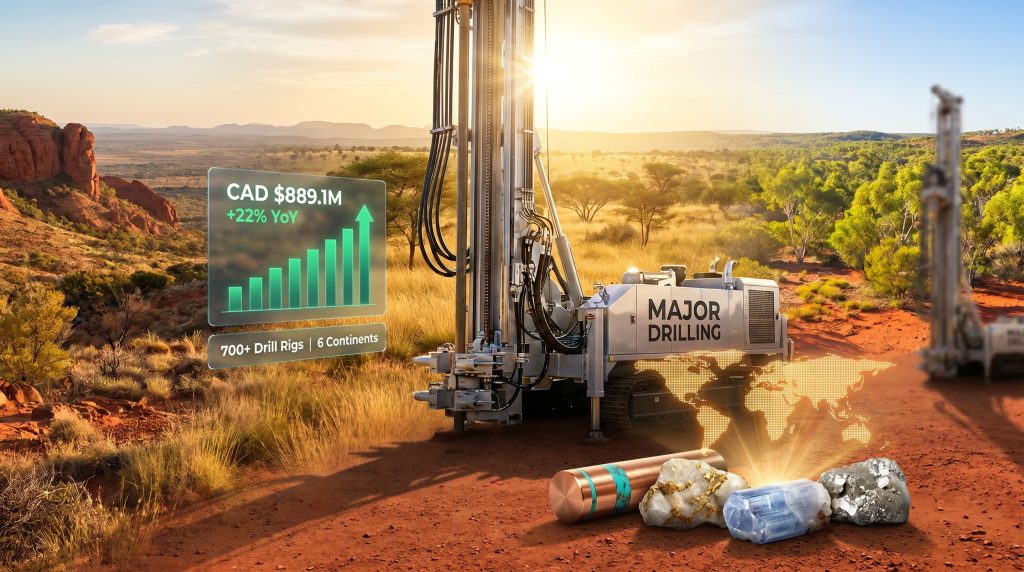
Major Drilling's fiscal 2026 results position the company among the largest contract drilling operations globally by revenue. The CAD $889.1 million (approximately USD $635.6 million) full-year result represents a 22% year-over-year increase and the highest revenue figure in the company's operational history, underscoring Major Drilling's remarkable growth trajectory.
| Metric | Major Drilling FY2026 | Context |
|---|---|---|
| Annual Revenue | CAD $889.1M | Record high in company history |
| Revenue Growth (YoY) | +22% | Full fiscal year result |
| Q4 Revenue | ~CAD $244M | +29% year-over-year |
| Total Fleet Size | 700+ drill rigs | Post-Explomin acquisition |
| Geographic Footprint | 6 continents | North America, South America, Asia-Pacific, Africa, Europe |
What Defines Specialized Drilling and Why It Commands Premium Margins
The term "specialised drilling" carries specific technical meaning within the contract drilling industry. It refers to drilling programs that require capabilities beyond standard open-hole or reverse circulation methods, typically involving one or more of the following:
- Diamond core drilling at significant depth, often exceeding 1,000 metres per hole
- Directional drilling in complex structural geological settings
- Drilling in extreme environments including high altitude, permafrost, or remote tropical terrain
- Geotechnical drilling for detailed rock mechanics assessment
- Deep-water or underground drilling requiring specialised rig configurations
The reason specialised drilling commands premium margins is straightforward from an economics perspective. The addressable pool of contractors capable of executing technically complex programmes is smaller, the capital investment required is higher, and the operational expertise needed to minimise core loss at depth is built over years of field experience. Clients cannot easily substitute a specialised driller with a lower-cost competitor without risking data quality that affects resource classification and ultimately project financing.
Competitive Differentiation: Fleet Scale, Geographic Reach, and Service Complexity
Operating a fleet exceeding 700 drill rigs across six continents creates a category of operational capability that smaller competitors cannot replicate. Beyond the headline fleet size, the practical competitive advantage lies in logistics infrastructure: spare parts networks, crew training programmes, mobilisation capacity, and relationships with national and multinational mining clients who require guaranteed rig availability across multiple jurisdictions simultaneously.
The Explomin Acquisition: A Structural Growth Catalyst
Why South America Became a Strategic Priority for Major Drilling
South America contains some of the world's most significant copper and gold belts, including the Andean porphyry copper system stretching through Chile, Peru, and Colombia. This geological reality makes the region a perpetual target for exploration capital, and drilling demand there tends to be structurally elevated rather than cyclically dependent.
The Explomin acquisition delivered measurable expansion into this environment:
- More than 100 additional drill rigs were added to Major Drilling's operational fleet
- South and Central American operations generated CAD $187.5 million in revenue during fiscal 2026
- Regional revenue growth came in at 11.6% year-over-year
- The transaction broadened Major Drilling's service capabilities beyond conventional core drilling into additional technical categories
How the Explomin Deal Reshaped Major Drilling's Revenue Architecture
Acquisitions in contract drilling are structurally different from acquisitions in most other industries. When a driller acquires another contractor, it is not simply buying revenue: it is acquiring trained crews, mobilised equipment, established client relationships, and operational knowledge of specific geological environments. These assets are difficult to replicate organically because crew training takes years and equipment mobilisation involves complex logistical and permitting work.
Acquisition-driven expansion in contract drilling creates compounding operational leverage when integrated into an existing logistics and client network. The Explomin transaction represents a textbook example of geographic consolidation in a fragmented global market, where scale advantages compound through shared procurement, cross-selling of services, and enhanced bidding capacity on larger multi-rig programmes.
Fleet Expansion Economics: What 100+ Additional Rigs Mean for Utilization and Margin
From a financial modelling perspective, adding more than 100 rigs to an established fleet creates two distinct value pathways. The first is straightforward revenue addition from active rig deployment. The second, less immediately visible, is the improvement in overall fleet utilisation economics. A larger fleet enables the company to rotate idle rigs more efficiently across geographies as demand fluctuates, reducing the revenue-drag of downtime.
Breaking Down the Record CAD $889 Million Revenue Result
Revenue Growth Drivers: Organic vs. Acquisition-Led Expansion
Understanding the composition of Major Drilling's revenue growth is critical for evaluating the sustainability of the trajectory. The 22% full-year revenue increase reflects a combination of organic demand growth for drilling services and the revenue contribution from the Explomin acquisition in South America. Consequently, distinguishing between these two sources matters considerably for forward projections.
Q4 Performance as a Leading Indicator of Operational Momentum
The fourth quarter result carries particular significance for forward-looking analysis. A quarterly revenue figure of approximately CAD $244 million representing a 29% year-over-year increase suggests the growth rate was accelerating rather than moderating as the fiscal year concluded. This is the reverse of what a demand-driven peak would look like, where quarterly run rates plateau or decline as capacity constraints become binding.
Geographic Revenue Contribution: Which Regions Are Driving the Numbers?
| Region | Revenue (FY2026) | Growth Signal |
|---|---|---|
| South and Central America | CAD $187.5M | +11.6% YoY |
| North America | Core legacy market | Stable, high-utilisation base |
| Australia and Asia-Pacific | Expanding presence | Critical minerals demand driver |
| Africa and Europe | Diversified exposure | Selective project activity |
The regional picture reveals an important characteristic of Major Drilling's model: no single geography accounts for a dominant share of revenue that would create dangerous concentration risk. South and Central America at CAD $187.5 million represents roughly 21% of total revenue, a meaningful but not outsized contribution.
What Is the Long-Term Strategic Logic Behind Major Drilling's Expansion Model?
Acquisition-Led Growth as a Repeatable Playbook
The Explomin transaction illustrates a growth model that has become increasingly rational in a fragmented global drilling market. Contract drilling remains highly fragmented below the top tier, with hundreds of regional operators running smaller fleets across individual countries or geological provinces. For a scaled operator with established logistics infrastructure, acquiring these regional players delivers faster geographic expansion than building organically, particularly in regions where local operating knowledge and regulatory relationships are critical success factors.
How Geographic Diversification Reduces Revenue Cyclicality
Operating across six continents is not simply a marketing statement: it is a genuine risk management mechanism. Consider that commodity cycles do not affect all mineral types simultaneously or with the same intensity across all geographies. When copper exploration budgets in North America contract due to a price correction, exploration activity in West Africa or Southeast Asia may remain elevated for entirely different geological or project-timing reasons.
Key diversification benefits include:
- Exposure to multiple commodity cycles simultaneously reduces single-commodity revenue concentration
- Regional regulatory differences mean that permitting timelines vary, smoothing revenue recognition across fiscal periods
- Currency diversification across CAD, USD, AUD, and local currencies creates natural hedging at the portfolio level
- Different fiscal year timings among client mining companies spread demand across calendar periods
The Role of Fleet Scale in Winning Large-Scale, Multi-Year Contracts
Large mining companies running multi-year exploration programmes across multiple jurisdictions require something most smaller drillers cannot credibly offer: guaranteed rig availability at multiple locations simultaneously, combined with consistent data quality standards and unified safety management systems. A fleet exceeding 700 rigs provides the inventory depth to make these commitments without the operational risk of over-promising and under-delivering.
The next major ASX story will hit our subscribers first
Critical Minerals Exploration: The Macro Tailwind Powering Drilling Demand
How the Energy Transition Is Structurally Expanding the Exploration Drilling Addressable Market
The connection between the critical minerals energy transition and contract drilling demand is direct but often misunderstood. The transition is not simply increasing demand for specific minerals: it is compressing the timeline within which those minerals must be discovered, classified, permitted, and brought into production. This compression places extraordinary pressure on the resource definition stage of the mining value chain, which is precisely the work that contract drillers perform.
Copper, Gold, Lithium, and Nickel: Which Commodities Are Driving Drill Meter Demand?
- Copper remains the highest-volume exploration target by drilling expenditure. Estimates from the International Energy Agency indicate that meeting energy transition infrastructure requirements would necessitate a substantial increase in global copper production capacity by 2035, driving aggressive resource definition programmes across multiple continents.
- Gold exploration has benefited from sustained high spot prices, which justify the economics of drilling lower-grade deposits that would have been uneconomic at earlier price levels, effectively expanding the total addressable market for drill metres.
- Lithium exploration surged through the early 2020s as battery demand projections escalated, creating significant greenfield drilling activity in Australia, South America, and Africa.
- Nickel remains critical for battery cathode chemistry, though demand projections have been subject to revision as battery technology evolves.
Why Exploration Budgets Are Likely to Remain Elevated Through the Late 2020s
A structural feature of mining exploration that is not widely appreciated outside the industry is the lag effect between exploration expenditure and production outcomes. The time between initial resource discovery and first production for a new mine averages between 10 and 17 years when permitting, feasibility, financing, and construction are included. This means that the minerals required to meet energy transition targets by the mid-2030s must, in many cases, already be in active exploration or early-stage development today. The urgency embedded in transition timelines therefore structurally supports elevated exploration budgets regardless of short-term commodity price movements.
How Should Investors Interpret Major Drilling's FY2026 Performance?
Revenue Records vs. Margin Quality: What the Numbers Don't Immediately Reveal
Record revenue is an attention-grabbing headline, however experienced investors in the mining services sector know that revenue growth without margin expansion can signal cost pressures that erode the quality of earnings. For Major Drilling, the key analytical question following the fiscal 2026 result is whether the revenue growth was accompanied by improving or deteriorating operating leverage, particularly given the integration costs associated with the Explomin acquisition.
Key Financial Metrics to Watch in Future Reporting Periods
Investors evaluating the sustainability of Major Drilling's remarkable growth trajectory should monitor several forward-looking indicators:
- Fleet utilisation rates as the primary indicator of pricing power and demand durability
- EBITDA margin trajectory during and after the Explomin integration period, which will reveal whether synergies are materialising as expected
- Revenue per rig as a measure of service mix quality and whether the company is successfully upgrading toward higher-margin specialised work
- Geographic revenue mix to assess whether high-growth regions are maintaining momentum
- Contract duration profile to evaluate what proportion of future revenue has already been secured through multi-year agreements
Risk Factors That Could Interrupt the Growth Trajectory
No investment or sector analysis is complete without honest consideration of downside scenarios. The following risks warrant monitoring:
| Risk Factor | Potential Impact | Mitigant |
|---|---|---|
| Commodity price correction | Reduced junior exploration budgets, lower drill demand | Geographic and commodity diversification |
| Acquisition integration risk | Cost overruns, cultural friction, client attrition | Experienced M&A execution track record |
| Currency exposure | Revenue volatility across CAD, USD, AUD, and local currencies | Natural multi-currency hedging at portfolio level |
| Labour cost inflation | Margin compression in high-demand markets | Long-term contracts with cost escalation clauses |
| Equipment supply constraints | Delayed fleet deployment | Scale procurement advantages |
This section contains forward-looking analysis and risk identification. It does not constitute financial advice. Investors should conduct their own due diligence and consult qualified financial advisers before making investment decisions.
Operational Excellence as a Competitive Moat: What Makes Major Drilling's Model Durable?
The Role of Technical Specialization in Sustaining Client Relationships
In contract drilling, client relationships are not primarily transactional. When a mining company commissions a multi-year resource definition drilling programme, the contractor's personnel develop intimate knowledge of the project geology, the client's data quality requirements, and the specific challenges of the operating environment. This embedded knowledge creates genuine switching costs that protect established contractor relationships.
Replacing a drilling contractor mid-programme risks data inconsistency, sample handling disruptions, and loss of geological context that can affect resource estimation quality and therefore project economics. Furthermore, properly interpreting drill results requires continuity of personnel and geological understanding that is difficult to transfer between contractors.
Long-Cycle vs. Short-Cycle Drilling Contracts: How Major Drilling Balances Its Portfolio
The contract drilling industry distinguishes between short-cycle work (individual programmes, spot pricing, flexible mobilisation) and long-cycle work (multi-year programmes, negotiated rates, dedicated fleet allocation). Companies with strong reputations for technical delivery can access long-cycle contract opportunities that provide revenue visibility but require the fleet scale and financial stability to commit dedicated resources for extended periods.
Balancing these contract types is a critical operational discipline: too much long-cycle work reduces flexibility to capture spot market premium pricing during demand peaks, while too much short-cycle work creates revenue volatility.
Safety, ESG Performance, and Their Influence on Contract Wins With Major Mining Companies
A dimension of competitive positioning that receives limited attention in financial analysis is the role of safety and ESG performance in contract award decisions by major mining companies. Major Drilling's ESG practices reflect a broader industry trend where large mining companies operating under ESG reporting obligations apply contractor safety standards as a qualifying criterion rather than simply a compliance matter. A contractor with a demonstrably superior safety record can access a broader pool of major mining clients than competitors with equivalent technical capabilities but weaker safety performance.
Frequently Asked Questions: Major Drilling's Growth and Business Model
What is Major Drilling and where is it headquartered?
Major Drilling is a Canadian contract drilling services company headquartered in Moncton, New Brunswick. It provides specialised drilling services to mining and exploration companies across six continents, with a fleet of more than 700 drill rigs following the completion of the Explomin acquisition.
What drove Major Drilling's record revenue in fiscal 2026?
The company's record CAD $889.1 million revenue, representing a 22% year-over-year increase, resulted from a combination of strong organic demand for specialised drilling services, the revenue contribution from the Explomin acquisition in South America, and a favourable global exploration spending environment linked to critical minerals demand and elevated precious metals prices.
How large is Major Drilling's drill rig fleet?
Following the Explomin acquisition, which added more than 100 rigs to the company's operational capacity, Major Drilling operates a fleet exceeding 700 drill rigs deployed across its global network.
What is the Explomin acquisition and why does it matter?
Explomin was a South American contract drilling company whose acquisition materially expanded Major Drilling's presence across South and Central America, contributed to CAD $187.5 million in regional revenue during fiscal 2026, and broadened the company's technical service capabilities beyond conventional core drilling.
What commodity markets are most important to Major Drilling's revenue?
Major Drilling's revenue is closely linked to exploration spending across copper, gold, and battery minerals including lithium and nickel. These commodities are experiencing elevated exploration investment driven by energy transition infrastructure requirements and strong precious metals market conditions.
Key Takeaways: What Major Drilling's FY2026 Results Signal for the Drilling Services Sector
Three Structural Themes That Will Define Contract Drilling Through 2030
-
Scale consolidation is accelerating as the gap between major multi-continental drillers and fragmented regional operators widens. Companies capable of bidding on national or multi-jurisdictional exploration programmes will capture a disproportionate share of major mining client contracts.
-
Technical specialisation commands durable pricing power as exploration programmes are pushed into more challenging geological environments. The premium attached to specialised drilling capability is structural rather than cyclical, because it reflects genuine scarcity of qualified contractors.
-
Acquisition-driven geographic expansion delivers faster revenue growth and market access than organic fleet building alone. The Explomin model demonstrates how targeted transactions in fragmented regional markets can compress years of organic growth into a single transformative step.
What This Means for Mining Companies Evaluating Drilling Contractors
Major Drilling's fiscal 2026 performance is not simply a strong earnings result. It is a signal that the global exploration drilling market has entered a structurally elevated demand phase, and that companies with the fleet scale, geographic reach, and technical specialisation to serve that demand are positioned to generate sustained revenue growth through the remainder of the decade.
For mining companies evaluating drilling contractors, the implication is practical: the supply of genuinely capable specialised drillers is constrained relative to the demand being created by simultaneous exploration programmes across copper, gold, and battery minerals. Securing long-term drilling partnerships with scaled, technically credible contractors has consequently become a strategic procurement priority rather than a routine operational decision.
Disclaimer: This article is intended for informational purposes only and does not constitute financial, investment, or professional advice. All financial data and company information referenced are drawn from publicly available sources. Past performance of any company is not indicative of future results. Readers should seek independent professional advice before making any investment decisions. Forecasts and projections discussed in this article involve inherent uncertainty and should not be relied upon as predictions of future outcomes.
Want to Know Which ASX Explorers Are Drilling the Next Major Discovery?
Discovery Alert's proprietary Discovery IQ model scans ASX announcements in real time, instantly identifying significant mineral discoveries across copper, gold, lithium, and beyond — turning complex exploration data into actionable investment insights before the broader market catches on. Explore historic examples of major discovery returns to understand the scale of opportunity, then begin your 14-day free trial at Discovery Alert to position yourself ahead of the next transformative find.